

ZENITH continues the evolution of the G.F.J. Calibre 135 with the second chapter of its Double Signed Program, this time in collaboration with J.N. Shapiro, one of the most interesting names in American independent watchmaking. Limited to just 25 pieces, this edition brings together the chronometric heritage of the Le Locle manufacture with the art of guilloché and the decorative techniques of the American watchmaking tradition.

Following the program’s debut with Naoya Hida & Co., ZENITH now turns its attention from Japan to California, creating an interpretation of the G.F.J. that goes beyond the dial to encompass the movement itself. A significant development, particularly at a time when collaborations between established manufactures and independent watchmakers are playing an increasingly important role in the world of haute horlogerie.
FROM THE CALIBRE 135 TO THE DOUBLE SIGNED PROGRAM: THE HISTORY OF THE G.F.J.
The story of the G.F.J. has its roots in the legendary Calibre 135, developed by engineer Ephrem Jobin in the late 1940s and subsequently established as one of the leading movements in observatory chronometry competitions. In its 135-O configuration, the calibre won 235 awards, including five consecutive first prizes at the Neuchâtel Observatory between 1950 and 1954, an achievement that remains a landmark in the history of chronometry.
Its modern revival began in 2022 with a project developed in collaboration with Phillips and Kari Voutilainen, involving the restoration of ten historic movements. In 2025, to mark the manufacture’s 160th anniversary, ZENITH took a further step by introducing the G.F.J., a collection named after its founder, Georges Favre-Jacot, and powered by a re-engineered version of the Calibre 135.
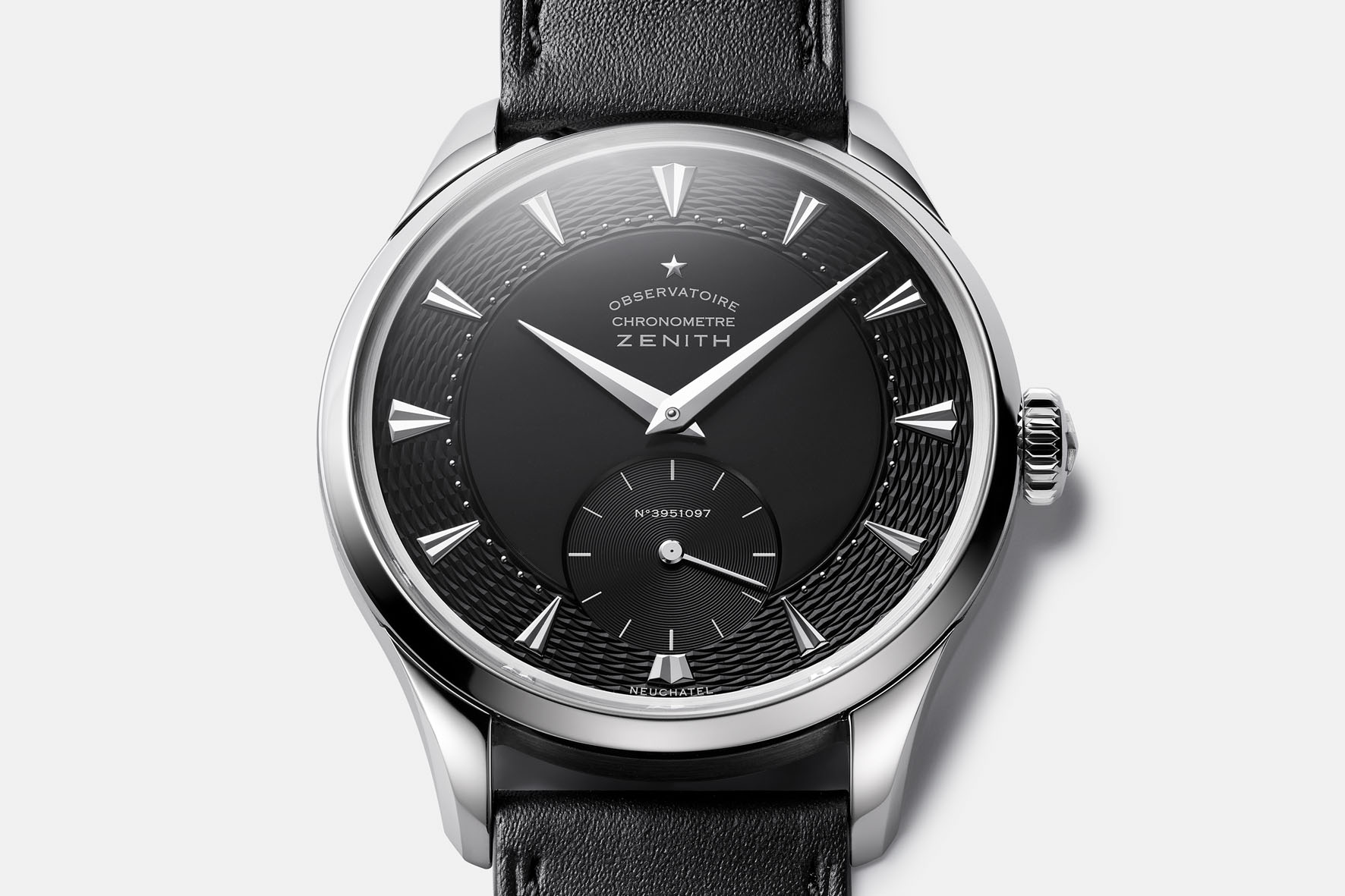
The first edition, limited to 160 pieces in 950 platinum, featured a dial with a central lapis lazuli disc, an outer ring decorated with a blue brick-pattern guilloché motif and a mother-of-pearl small seconds subdial. We explored this return in detail in our previous article on the ZENITH G.F.J. Platinum Calibre 135.
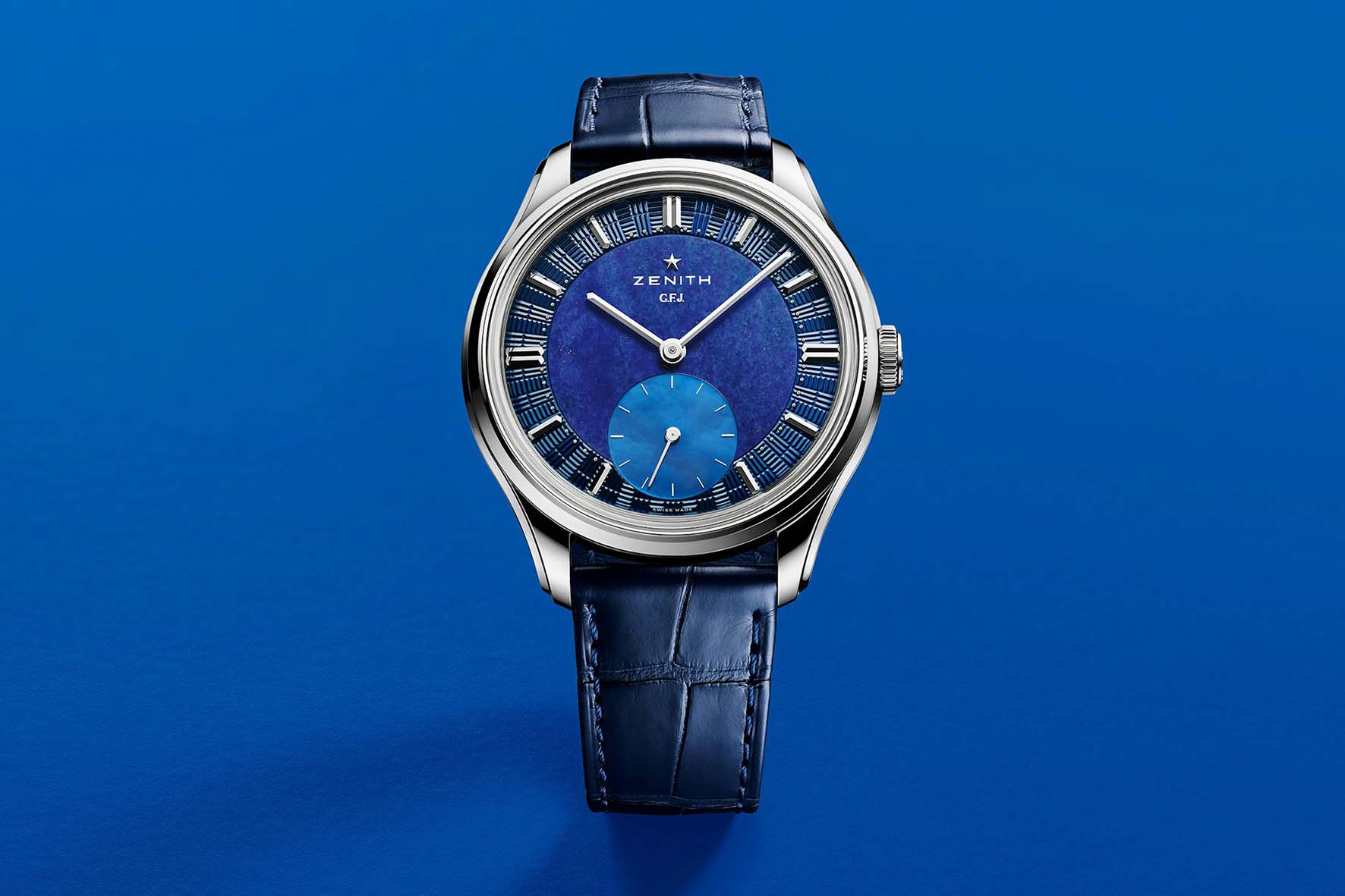
At Watches and Wonders 2026, the collection expanded with two new versions: one in 18-carat yellow gold, limited to 161 pieces, featuring a dial with a central bloodstone disc and a mother-of-pearl small seconds subdial; the other in tantalum, produced in just 20 pieces, with a central black onyx disc, grey mother-of-pearl small seconds and baguette-cut diamond hour markers.
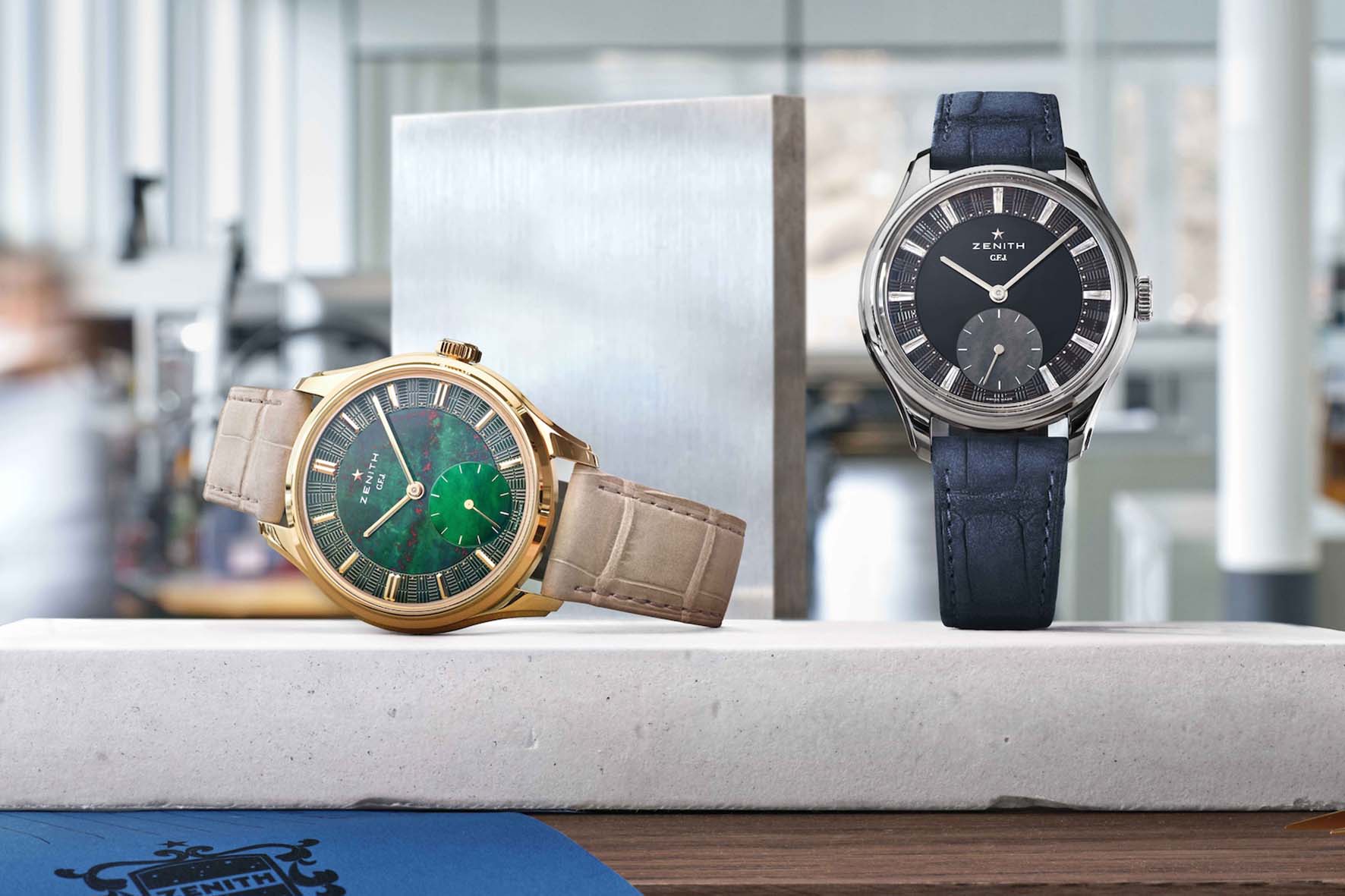
These variations were followed by the Double Signed Program, an initiative that revisits the tradition of double-signed watches, historically associated with relationships between manufactures and retailers, reinterpreting it through the creative contribution of independent watchmakers.
The first chapter, unveiled in June 2026, was the ZENITH G.F.J. Calibre 135 Double Signed with Naoya Hida & Co., an edition of just ten platinum pieces distinguished by a hand-engraved solid silver dial and details in blue Japanese Urushi lacquer.

For its second collaboration, ZENITH turns to American watchmaking, inviting Joshua Shapiro to contribute to a creation that, unlike its predecessor, extends the aesthetic reinterpretation to the finishing of the calibre itself.
ZENITH AND J.N. SHAPIRO: TWO WATCHMAKING TRADITIONS MEET
Founded in 2018 by Joshua Shapiro, J.N. Shapiro Watches is an independent Californian watchmaking company born from its founder’s passion for traditional horology. A former American history teacher and school principal, Shapiro began his journey by studying and mastering traditional engine-turning techniques, initially working from a workshop set up in his garage.

The brand made its debut with the Infinity Series, featuring dials distinguished by particularly elaborate engine-turned decorations. In the following years, the atelier progressively expanded its capabilities, developing its proprietary Caliber 26 and creating the Resurgence, a watch manufactured in-house in California that represents one of the most significant achievements in the company’s development.
Shapiro’s ambition extends beyond the creation of handcrafted timepieces: to contribute to the revival of American watch manufacturing, recovering knowledge and techniques associated with an industry that, throughout the nineteenth and twentieth centuries, had achieved remarkable levels of production and innovation.


This background makes the partnership with ZENITH particularly interesting. The Swiss manufacture contributes one of the most important calibres in its history, while the Californian atelier introduces decorative techniques rooted in its own craftsmanship.
In an industry where collaborations are becoming increasingly common, what distinguishes this initiative is the tangible contribution made by both parties. J.N. Shapiro does not simply add its signature to the dial, but introduces recognisable stylistic and decorative elements, giving the G.F.J. a different character without altering its original identity.
THE NEW ZENITH G.F.J. CALIBRE 135 DOUBLE SIGNED WITH J.N. SHAPIRO
The new ZENITH G.F.J. Calibre 135 Double Signed with J.N. Shapiro retains the collection’s classical proportions, with an 18-carat rose gold case measuring 39.15 mm in diameter, a thickness of 10.5 mm and a lug-to-lug measurement of 45.75 mm. Its defining aesthetic feature is the silver dial, entirely crafted at J.N. Shapiro’s Californian atelier, where three distinct guilloché motifs are meticulously executed by hand using rose-engine and straight-line engraving machines.
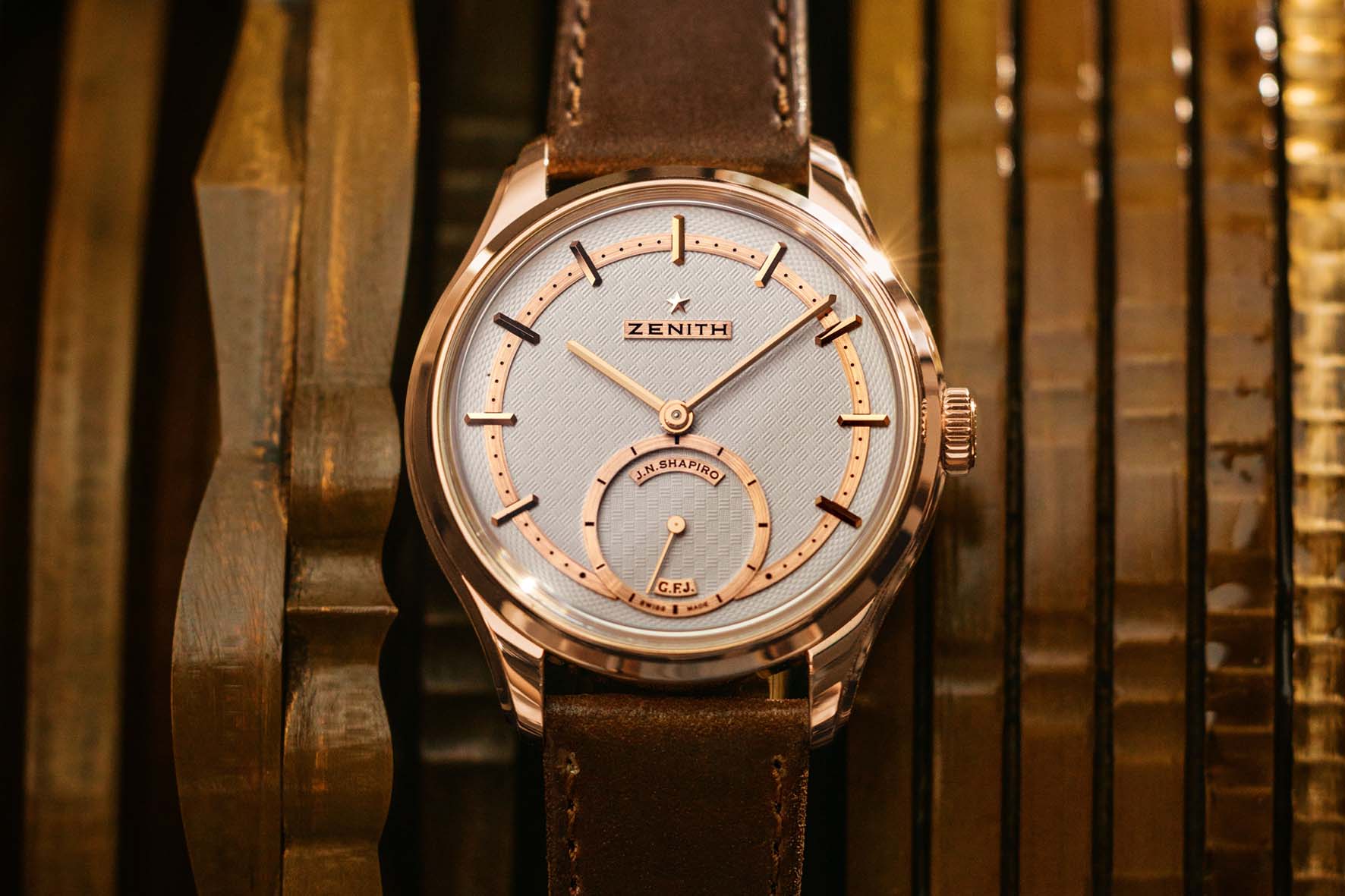
The outer section is decorated with a barleycorn pattern, while the centre features an intricate basketweave motif. At 6 o’clock, the small seconds subdial introduces the Infinity Weave, one of Joshua Shapiro’s most distinctive decorative motifs. Characterised by a complex geometric weave, this pattern has been part of the brand’s identity since its earliest creations and also appears on the dials of the Resurgence, establishing a direct connection with the American watchmaker’s signature style.
The three decorative motifs are framed by applied rings and elements in 18-carat rose gold, also used for the hour markers, the plates bearing the ZENITH and J.N. Shapiro signatures, and the hour, minute and small seconds hands. The G.F.J. initials complete the composition, maintaining a visual connection with the original model.

The interplay of engraved patterns adds depth to the surface, while the contrast between the different textures and rose gold details highlights the complexity of the techniques involved. The result preserves the classical balance of the G.F.J., enriching it with a decorative language immediately recognisable as Shapiro’s work.
THE CALIBRE 135 AND DAMASKEENING: AN AMERICAN SIGNATURE ON THE MOVEMENT
One of the most interesting aspects of this second collaboration becomes apparent through the sapphire crystal caseback. While the previous interpretation with Naoya Hida & Co. focused primarily on the dial and hands, J.N. Shapiro brings its distinctive aesthetic to the Calibre 135 itself.

The movement’s bridges feature a decorative technique known as damaskeening, historically widespread in American watchmaking, particularly in pocket-watch movements. Combining elements of Côtes de Genève and guilloché, this technique creates distinctive decorative patterns on the movement bridges. J.N. Shapiro also employs damaskeening on the movements of its Resurgence watches, and for this edition the technique is applied to the rhodium-plated bridges of the Calibre 135. The reference to American watchmaking tradition thus becomes an integral part of the timepiece, extending to one of the most significant elements of ZENITH’s technical heritage.


Mechanically, the hand-wound Calibre 135 retains the architecture that established its success in chronometry competitions, re-engineered using contemporary solutions and materials. The movement features a large variable-inertia balance wheel with a Breguet overcoil, together with the distinctive double arrow-shaped regulator developed by Charles Fleck, designed to allow particularly precise adjustment. The balance staff is also protected by spring-mounted jewel settings, a solution that directly recalls the characteristics of the historic calibre.


The movement beats at 18,000 vibrations per hour (2.5 Hz) and offers a 72-hour power reserve. A stop-second mechanism also allows the watch to be synchronised precisely. The calibre is regulated to a stated tolerance of ±2 seconds per day and is officially COSC-certified, reaffirming the central role of chronometric precision in a project conceived to bring this chapter of ZENITH’s history into contemporary watchmaking.
ZENITH G.F.J. DOUBLE SIGNED J.N. SHAPIRO: PRICE AND AVAILABILITY
The new ZENITH G.F.J. Calibre 135 Double Signed with J.N. Shapiro is produced in a limited edition of 25 pieces, priced at CHF 68,900.

The watch comes with three straps: brown Cordovan leather, beige nubuck alligator leather and black calf leather, accompanied by an 18-carat rose gold pin buckle engraved with the G.F.J. initials. An 18-carat rose gold bracelet is also available upon request, while the case offers water resistance to 5 ATM.
A COLLABORATION THAT GOES BEYOND TWO SIGNATURES
With this second edition, the Double Signed Program begins to reveal its potential more clearly. Following Naoya Hida’s restrained approach, Joshua Shapiro introduces a different sensibility, defined by the complexity of guilloché work and the revival of traditional American watchmaking decoration.
The decision to involve an independent watchmaker who has built his business around recovering these skills makes the result all the more compelling. The G.F.J. retains the characteristics that identify it as a ZENITH, while incorporating details that belong to another watchmaker’s history and design language.


This is the most convincing direction for the Double Signed Program: recognising the work of independent watchmakers through a genuine creative contribution, allowing each collaboration to bring something new to an already established collection.
The new G.F.J. demonstrates how the meeting between a major manufacture and an independent atelier can go beyond simply placing two signatures on a dial, resulting in a watch in which the history of Swiss chronometry and the American tradition of craftsmanship find a shared expression.
By Jacopo Giudici