

With the Futur Antérieur, Louis Erard and Vianney Halter unveil an entirely new creation: two automatic movements, a purpose-built case and a closer connection than ever to the legendary Antiqua.
For Louis Erard, collaborations are no longer simply one part of the collection; they have become essential to the brand’s identity. By working with some of the most original figures in independent watchmaking, the Swiss brand has developed a distinctive design language in recent years. The new Louis Erard x Vianney Halter Futur Antérieur takes this strategy a step further: rather than reinterpreting an existing model, it is a watch conceived specifically for the project, with a newly developed case and two automatic movements positioned side by side.
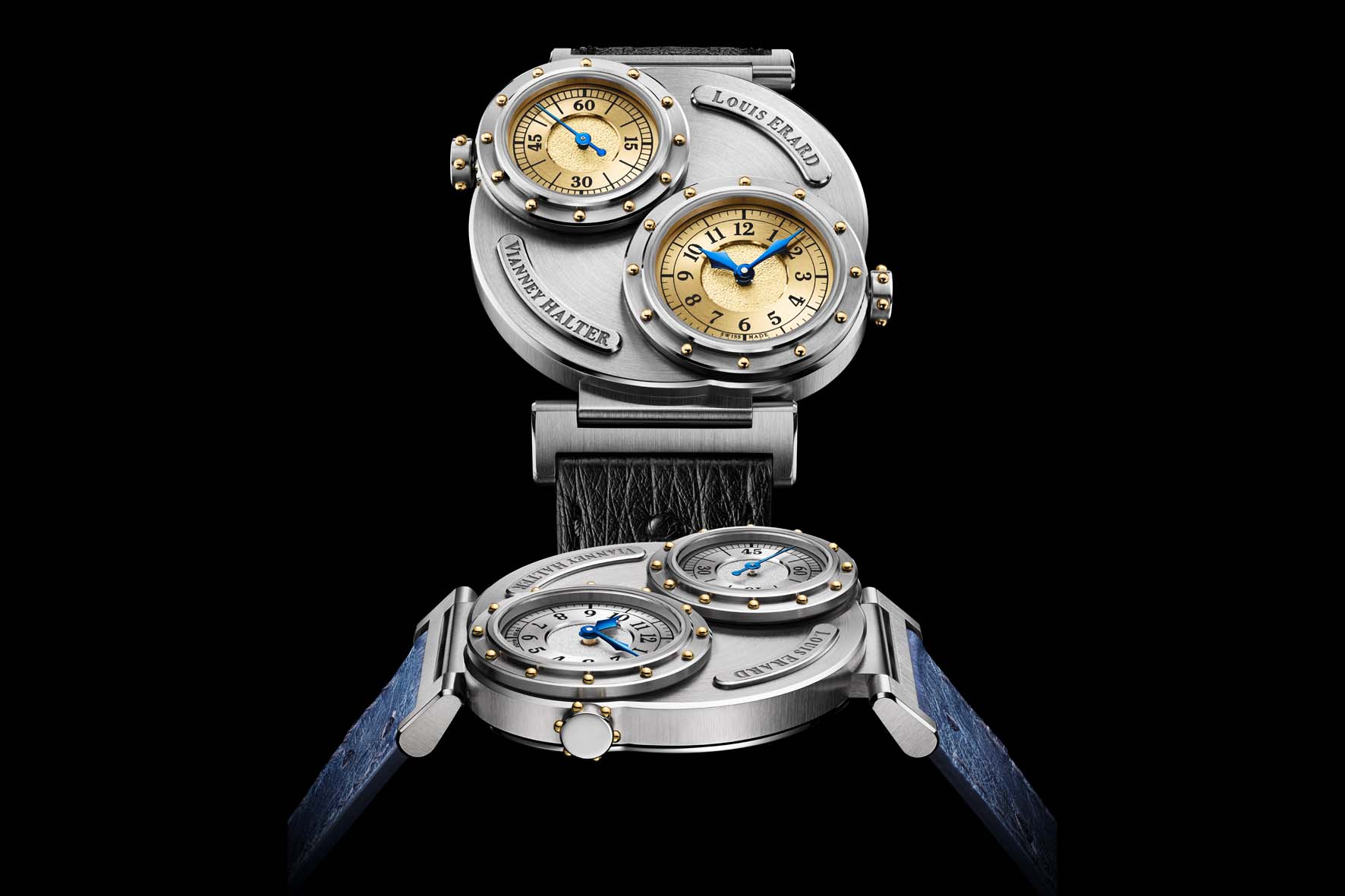
It marks the latest chapter in a relationship that began in 2020 and, above all, a more direct reference than ever to Vianney Halter‘s Antiqua. Not to reproduce its complications, but to translate some of its architectural codes into a watch with a very different construction, purpose and positioning.
LOUIS ERARD’S APPROACH TO COLLABORATIONS
Under the leadership of Manuel Emch, Louis Erard has turned collaborations into a sustained creative endeavour, working with figures including Alain Silberstein, Konstantin Chaykin and Halter himself. The idea is to bring a wider audience closer to creative visions usually associated with far more exclusive independent watches, rather than treating the creator’s involvement as little more than a name on the dial. This strategy has given the brand a distinctive position: watches that are relatively accessible within the world of designer collaborations, yet have a clearly defined visual identity.
Until now, Louis Erard‘s partnership with Vianney Halter had revolved around the Régulateur. The Futur Antérieur changes the starting point: its shapes, display layout and case construction were all developed for this specific project. That distinction makes it particularly relevant to the brand’s evolution, beyond the appeal of two names already familiar to watch enthusiasts.
VIANNEY HALTER AND THE ANTIQUA
Born in France in 1963, Vianney Halter trained at the Paris watchmaking school and spent the early part of his career restoring historical instruments and timepieces. In 1994, he established his own watch development business in Switzerland; four years later, he introduced the Antiqua, the perpetual calendar that would become one of the defining creations of his career. With its four separate displays and riveted bezels, the 1998 model looks like an object from a future imagined in the Victorian era: a combination of historical precision instruments, science fiction and traditional mechanical watchmaking.
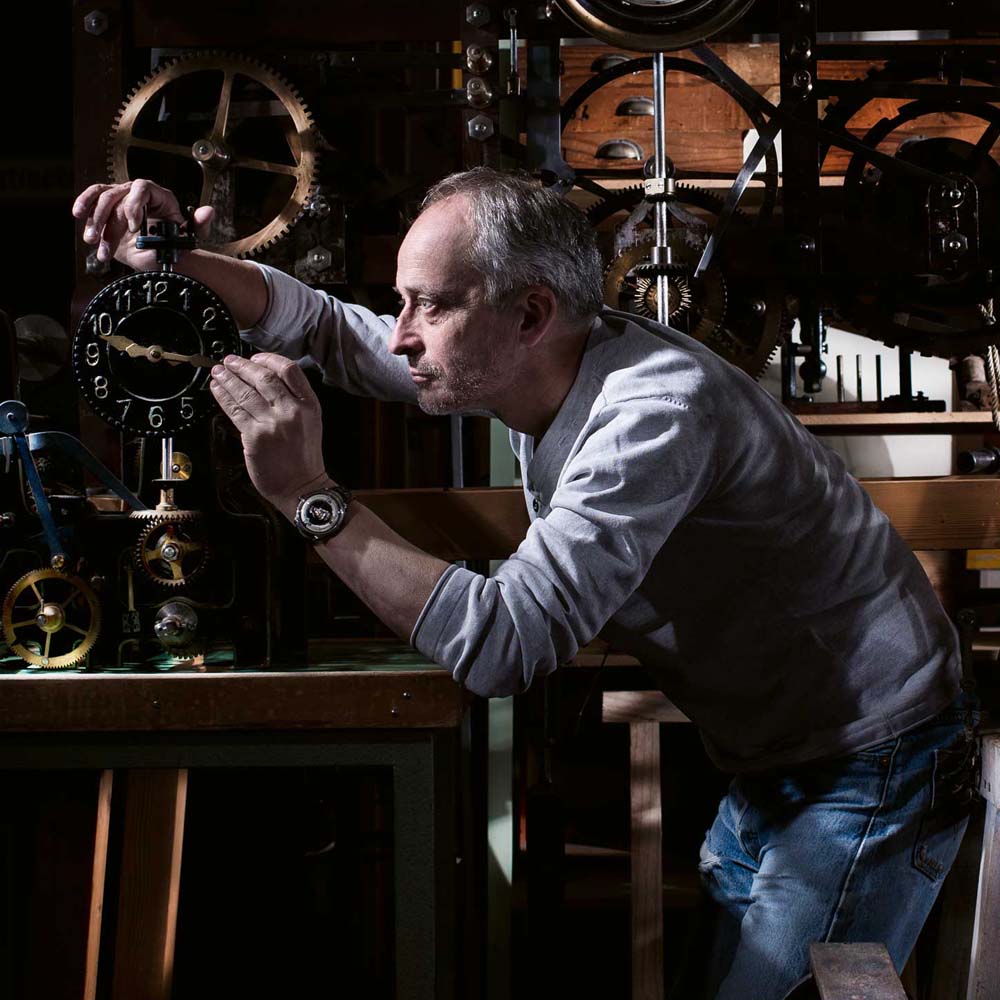
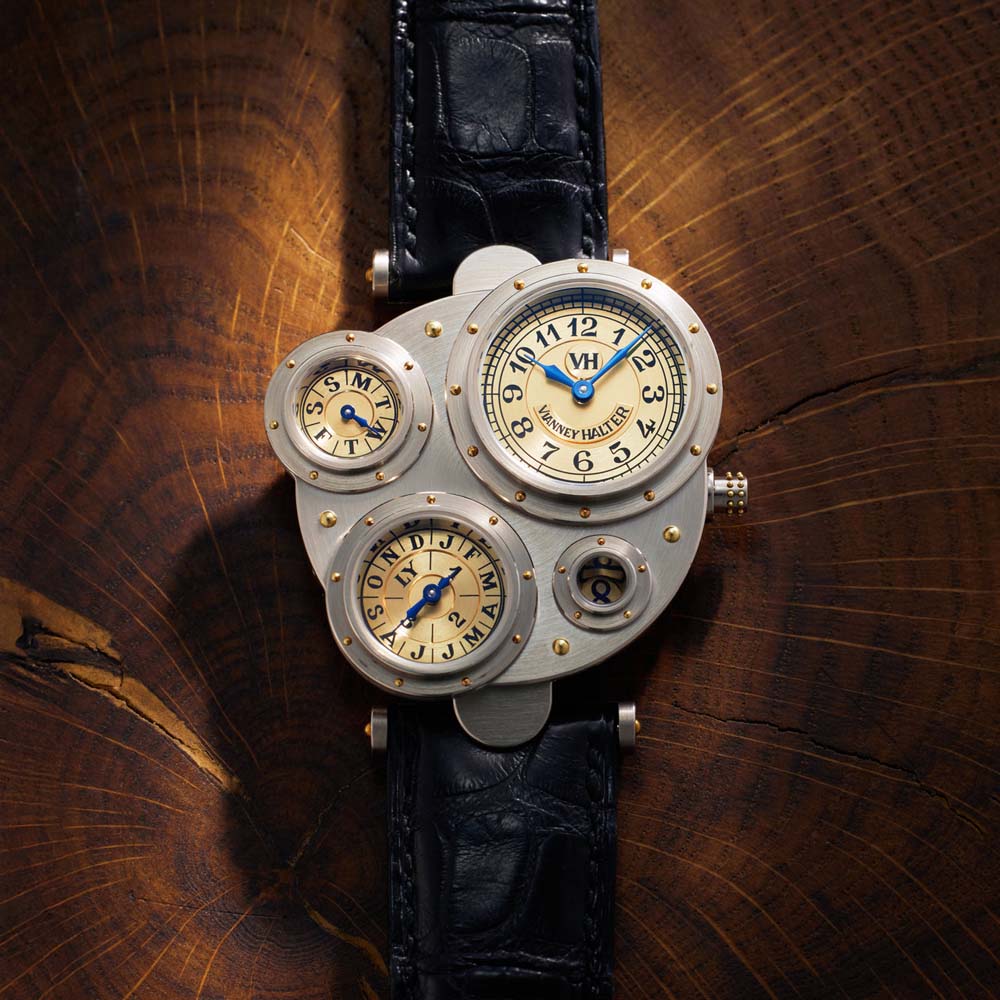
This retro-futuristic vision is about much more than appearance. For Halter, a watch’s architecture is part of the narrative, with its displays becoming elements in a composition that is instantly recognisable. Later creations, including the Deep Space Tourbillon and Deep Space Resonance, demonstrated his ability to combine mechanical experimentation with imagination. Understanding this evolution helps put the Futur Antérieur into perspective: not as a new version of the Antiqua, but as a dialogue with its creative universe.
FROM THE FIRST COLLABORATIONS TO AN ENTIRELY NEW CASE
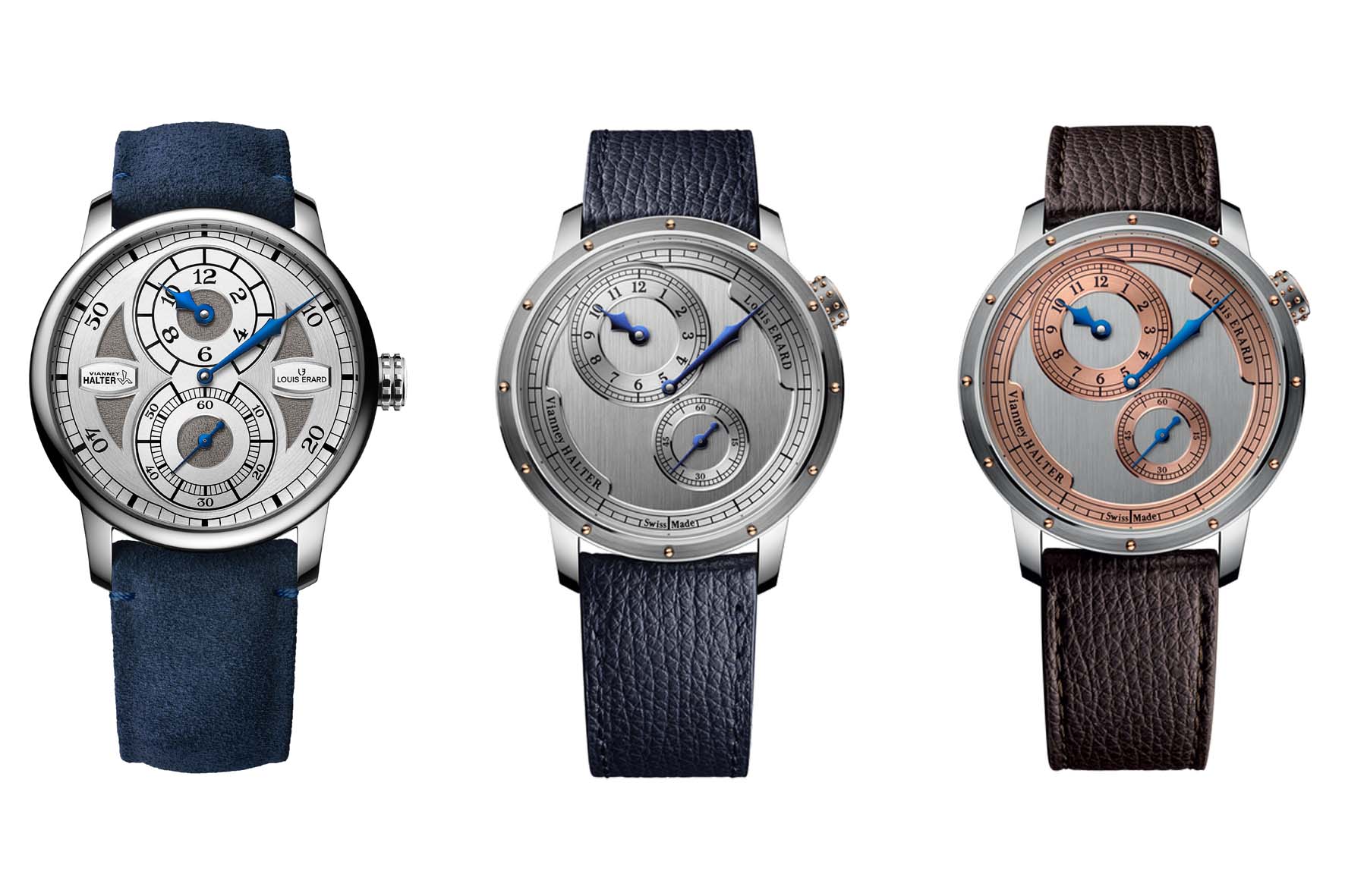
The collaboration between Louis Erard and Halter began in 2020 with a Régulateur that introduced the French watchmaker’s distinctive design codes into the brand’s collection, from the hands to the typography of the dial. With the subsequent Le Régulateur Louis Erard x Vianney Halter II, the references became more explicit: the riveted bezel and treatment of the surfaces brought the watch even closer to the Antiqua‘s visual vocabulary. In both cases, however, the starting point remained a Louis Erard Régulateur reinterpreted through Halter’s distinctive design language.
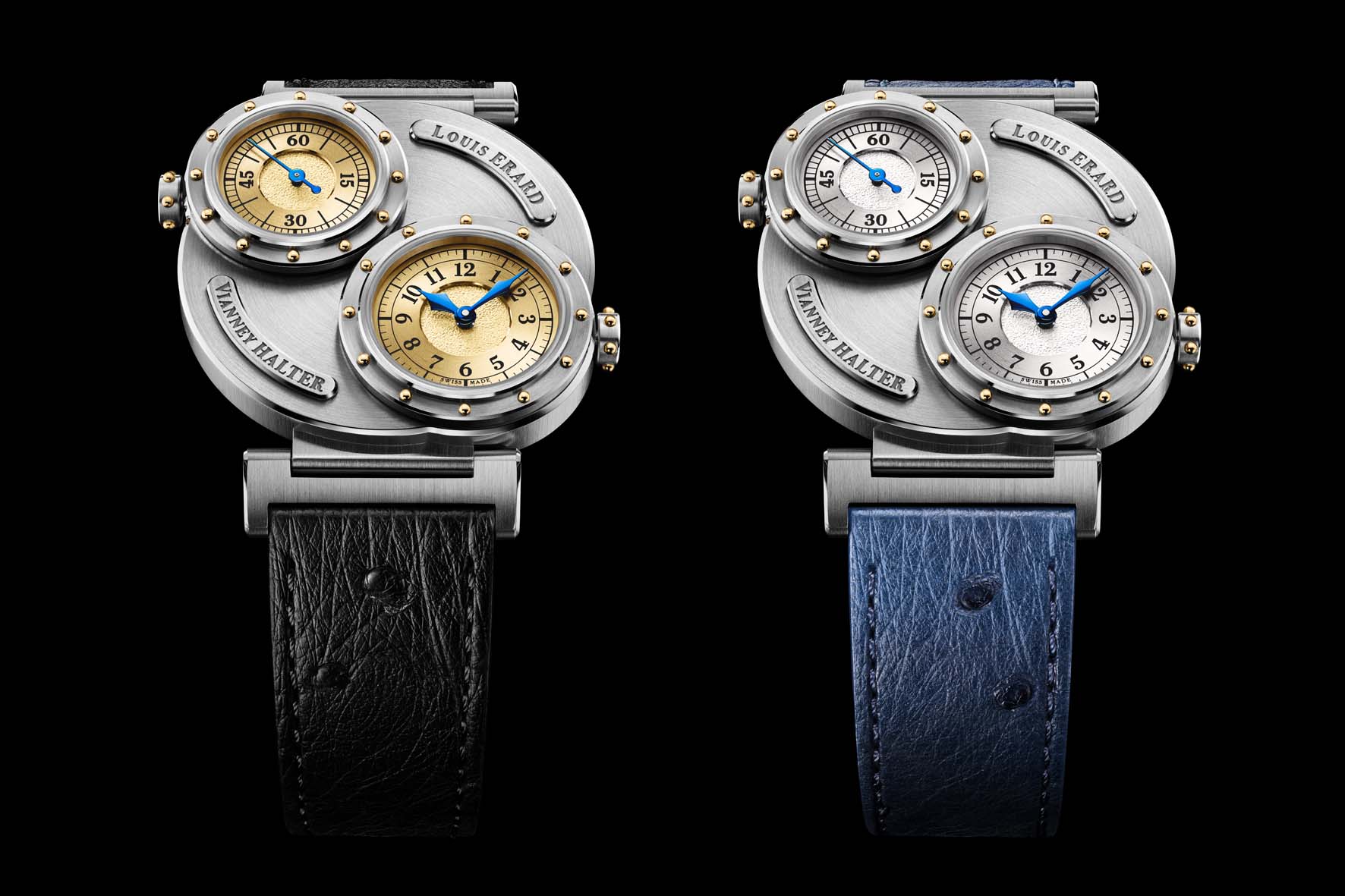
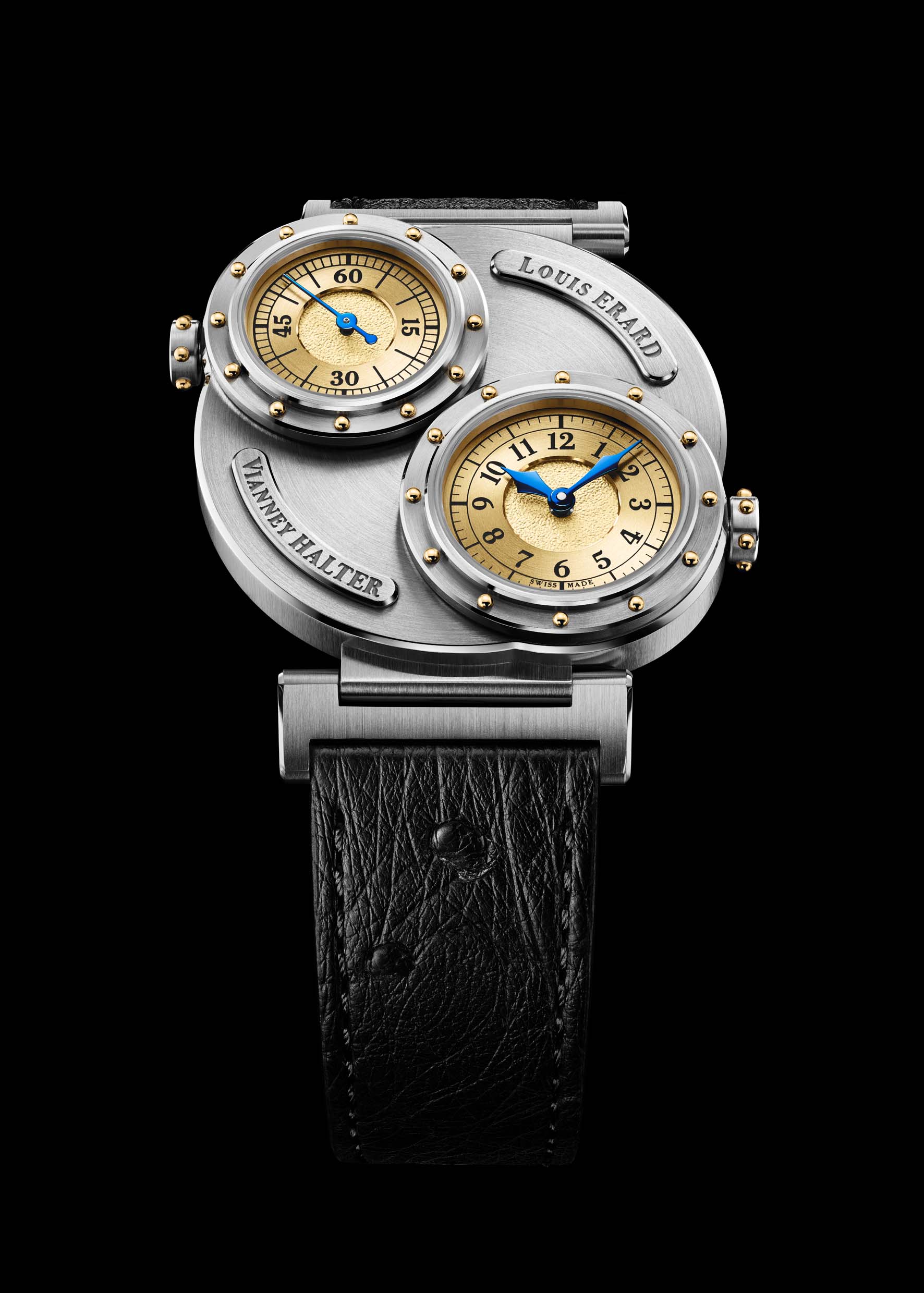
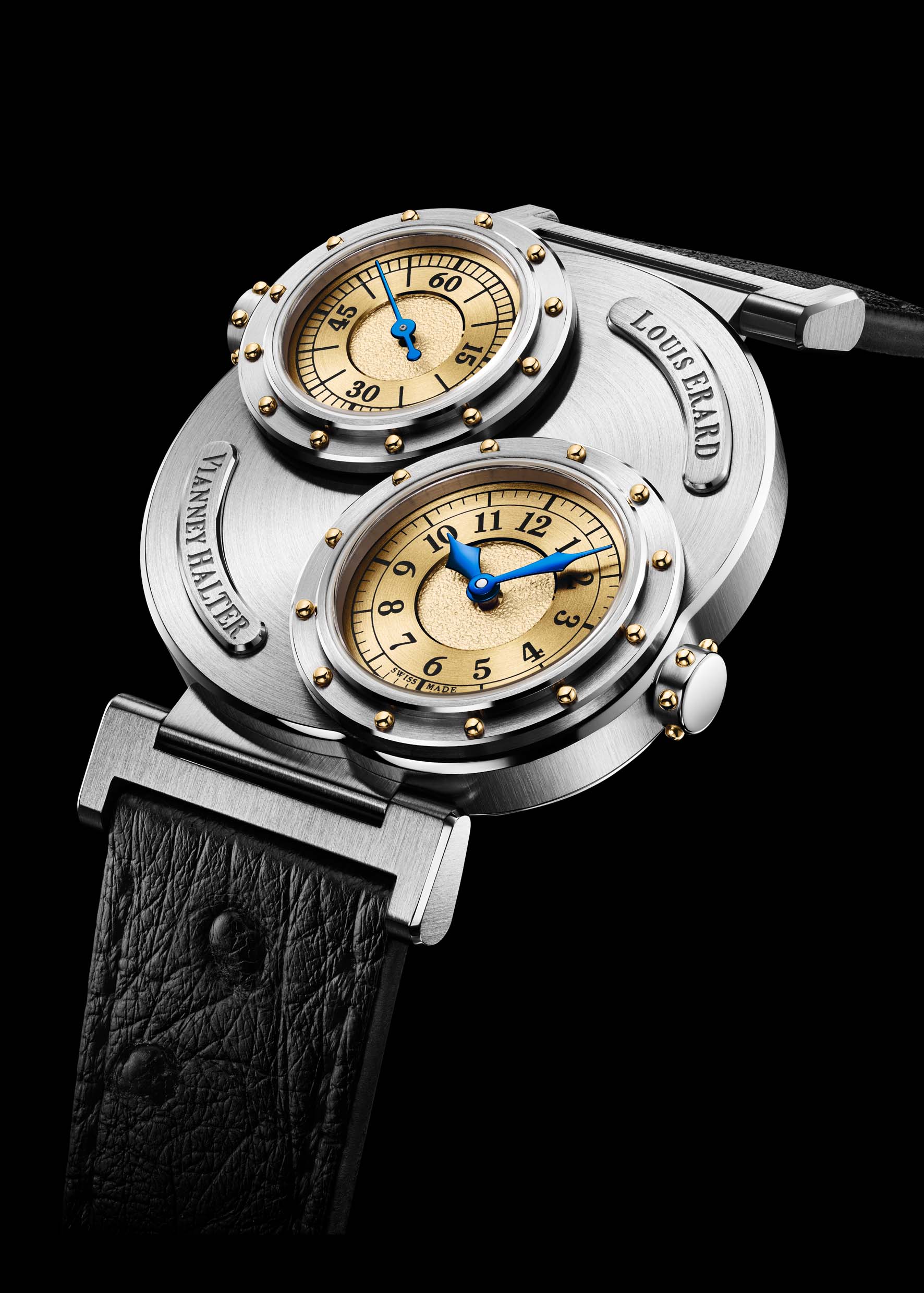
The Futur Antérieur moves beyond that formula. Its case features two raised circular openings, framed by rivets, each housing a separate dial: one displaying the hours and minutes, the other the seconds. Blued-steel hands and crowns designed according to Halter’s signature codes complete a highly recognisable composition. Even the name, taken from the French future perfect tense, evokes the idea of a future imagined long ago, a theme that has long run through the watchmaker’s work.
TWO SELLITA SW100 MOVEMENTS, TWO SEPARATE DISPLAYS
The most striking technical feature is the use of two automatic Sellita SW100 calibres, arranged side by side. One drives the hours and minutes, while the other controls the seconds hand on its own dial. Each movement has a dedicated crown, an unusual choice for a watch that essentially displays the three fundamental indications of time, but one that makes sense in a construction where each porthole has a distinct function.
Both calibres beat at 28,800 vibrations per hour (4 Hz), have 25 jewels each and offer a minimum power reserve of 38 hours. Their oscillating weights are decorated with Côtes de Genève and engraved with the Louis Erard logo, although the watch has a solid caseback. Louis Erard has not detailed any mechanical synchronisation system between the two calibres. What is confirmed is the unusual decision to devote two separate movements to the three basic time indications, making the construction itself one of the watch’s defining characteristics.
A 67-COMPONENT CASE JUST 8.85 MM THICK
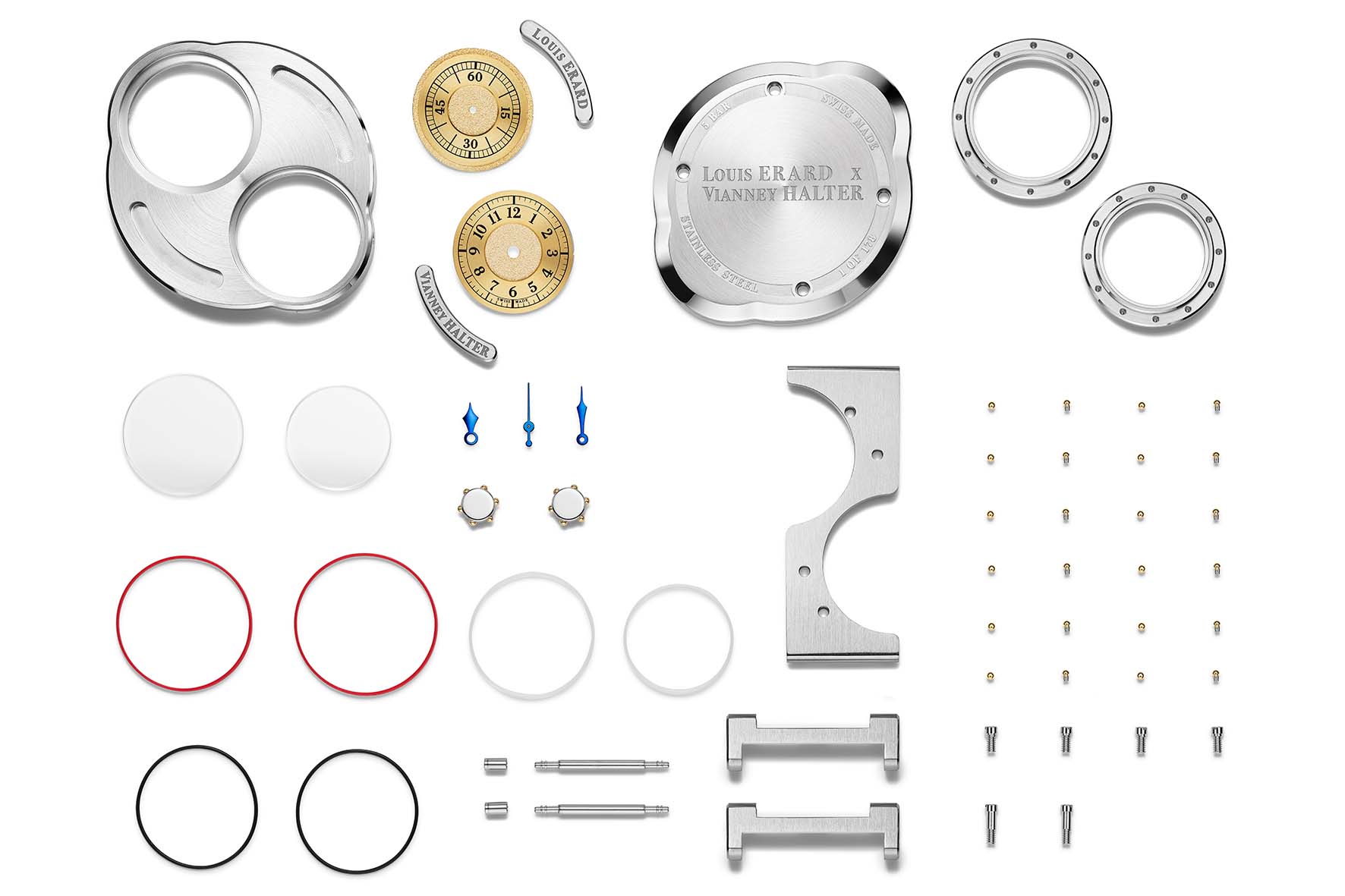
Developed specifically for the Futur Antérieur, the new stainless-steel case measures 38 × 44 mm and is just 8.85 mm thick. It comprises 67 components and combines circular brushing across its front with vertically brushed sides and polished chamfers. Each of the two bezels features 12 yellow-gilt 1N rivets, while another six rivets adorn each crown. The result is a carefully detailed case, yet a relatively slim profile given the two movements and raised display openings.
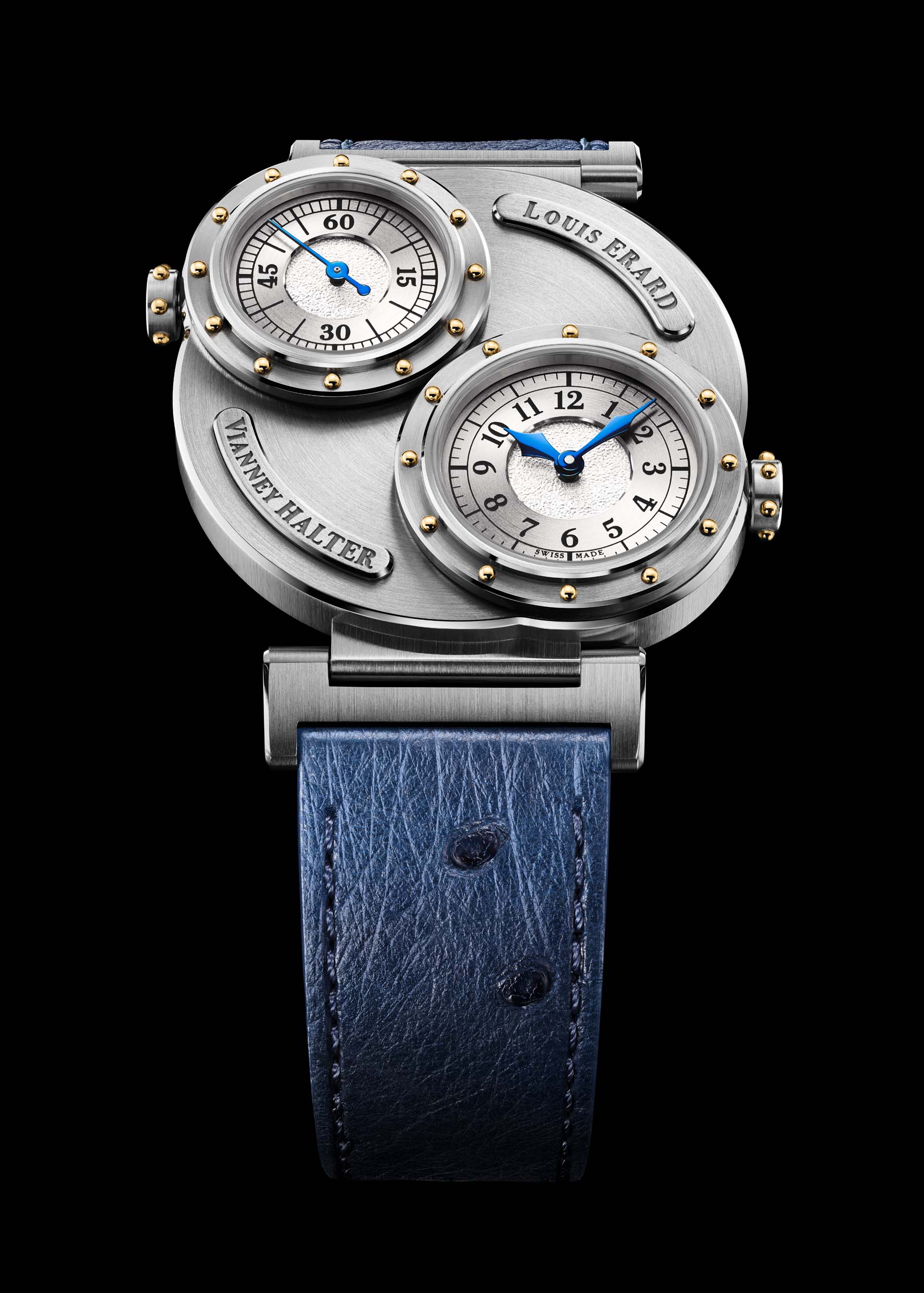
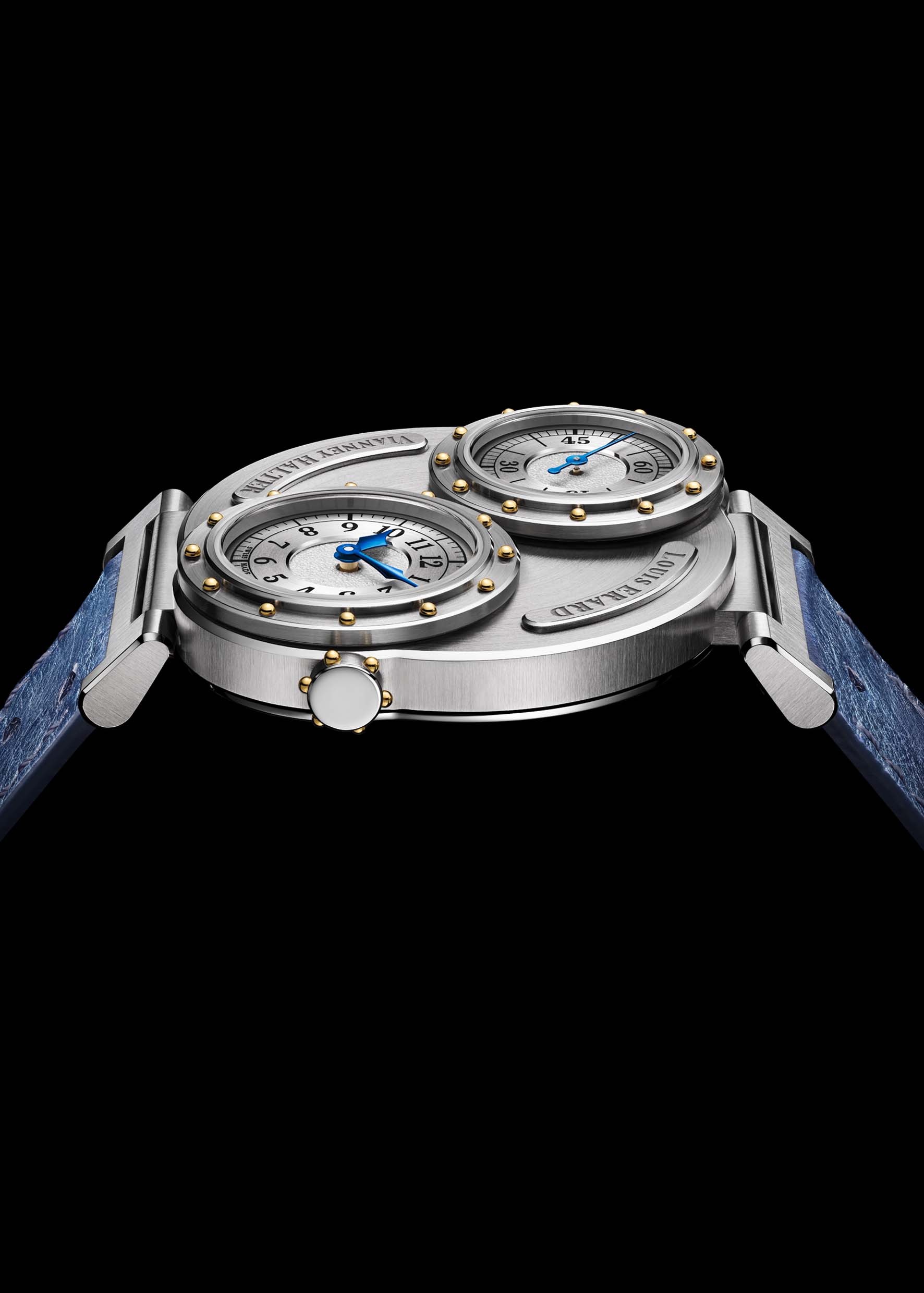
Inside the portholes, the dials combine grained surfaces, circular-brushed rings and polished edges. Two sapphire crystals with anti-reflective treatment on both sides protect the displays, while the solid caseback bears an engraving identifying the limited edition. Water resistance is rated at 5 bar (50 metres). These details illustrate the nature of the collaboration: the Antiqua inspiration is immediately apparent, but the proportions and construction belong to a distinctly different project.
GOLD AND SILVER: PRICES AND AVAILABILITY
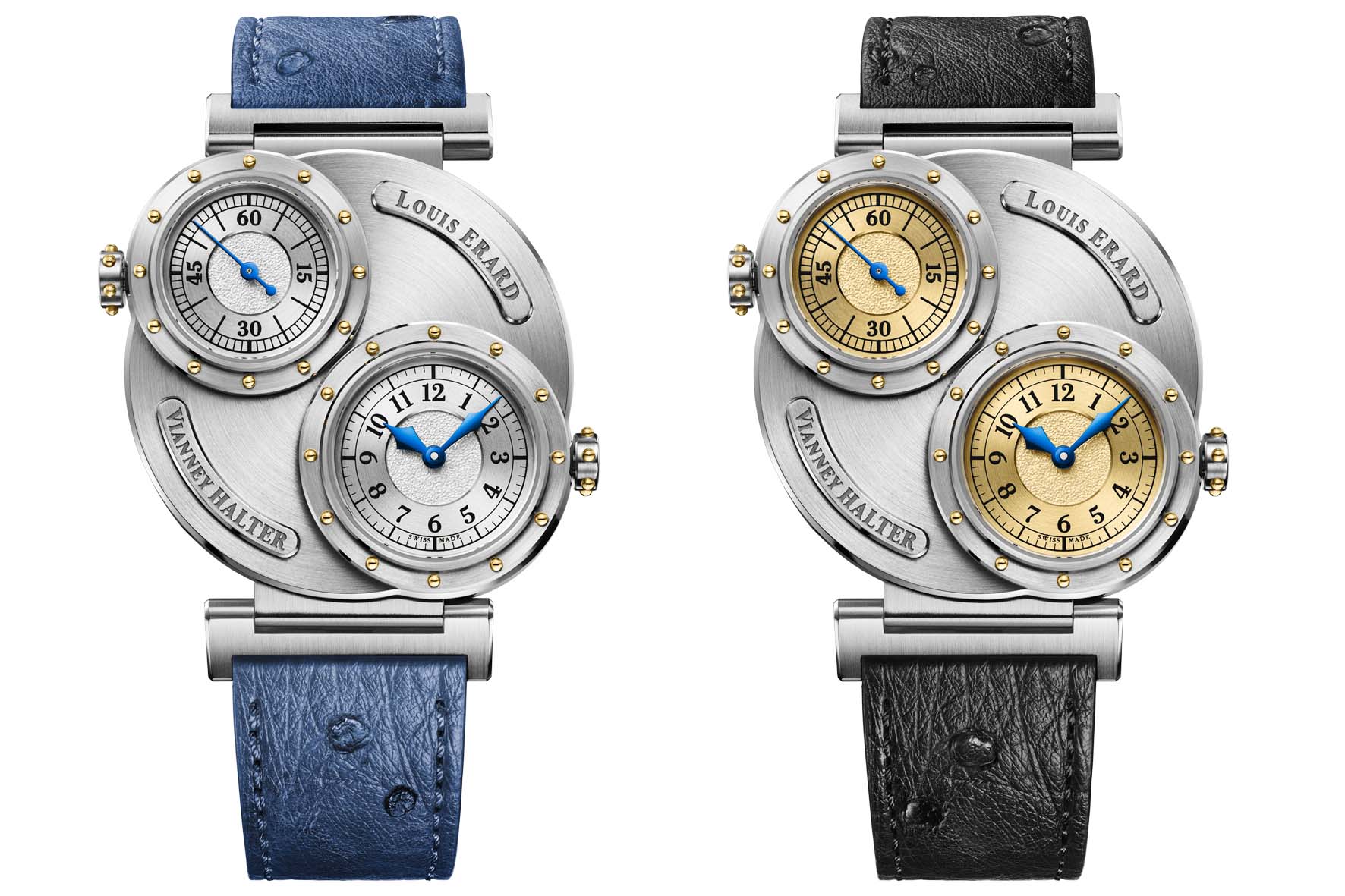
The new model makes its debut in two versions, each limited to 178 pieces. The Gold pairs gold-toned dials with a black ostrich-leather strap, while the Silver features rhodium-plated dials and a blue ostrich-leather strap. Both retain the gold-toned rivets and blued-steel hands, elements that make their shared design language clear despite the markedly different character of each version.
Louis Erard has set the price at CHF 4,950, excluding taxes, for each version. The brand has also announced 78 sets containing both editions, priced at CHF 9,900, again excluding taxes.
MORE THAN A NAME ON THE DIAL
The strength of the Louis Erard x Vianney Halter Futur Antérieur lies in the transition from an aesthetic collaboration to a project that shapes the watch’s entire architecture. The first two Régulateur generations had already made Halter’s influence unmistakable; this new creation introduces a dedicated case and a display layout built around two separate movements. The reference to the Antiqua remains central, without attempting to replicate the mechanical complexity of its perpetual calendar.
For Louis Erard, the result marks another step in the evolution of its collaborative strategy. For followers of independent watchmaking, it offers a different route into Halter’s design language: not simply through hands, rivets and finishes, but through a construction born from the collaboration itself. That, rather than simply bringing two names together, is what makes the Futur Antérieur worth a closer look.
By Jacopo Giudici