

There are watches designed to make reading the time as immediate as possible. And then there are others that deliberately take a different path, transforming an everyday gesture into something that demands attention. The new De Bethune DB25 Digitale, with jumping hours, minutes displayed on a rotating disc and a spherical moon-phase indication, undoubtedly belongs to the latter category.
To tell its story, the Manufacture borrows a line from Moon River, the celebrated song by Henry Mancini and Johnny Mercer: “There is such a lot of world to see.” A reference that perfectly anticipates the spirit of a watch in which the hours, minutes and moon phases are not simply displayed, but arranged across different levels and entrusted to three distinct forms of indication.
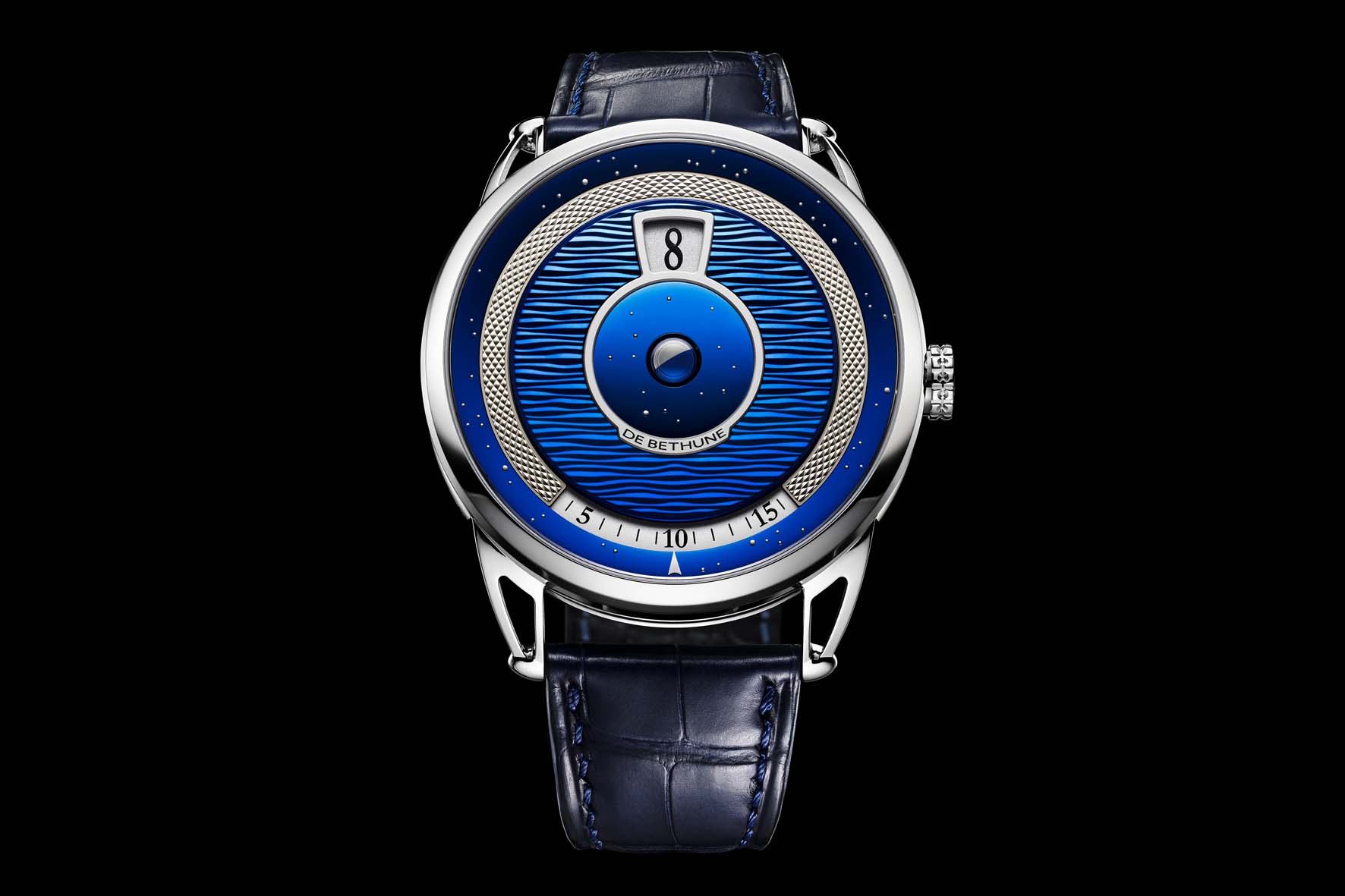
With the DB25 Digitale, De Bethune returns to a concept that has accompanied the Manufacture since its early years. The new model follows in the footsteps of the DBD, one of the brand’s emblematic creations, and represents a new evolution of a language that has taken different forms over time. The principle of digital time display is now reinterpreted within the architecture of the DB25 collection and through De Bethune’s contemporary aesthetic language.
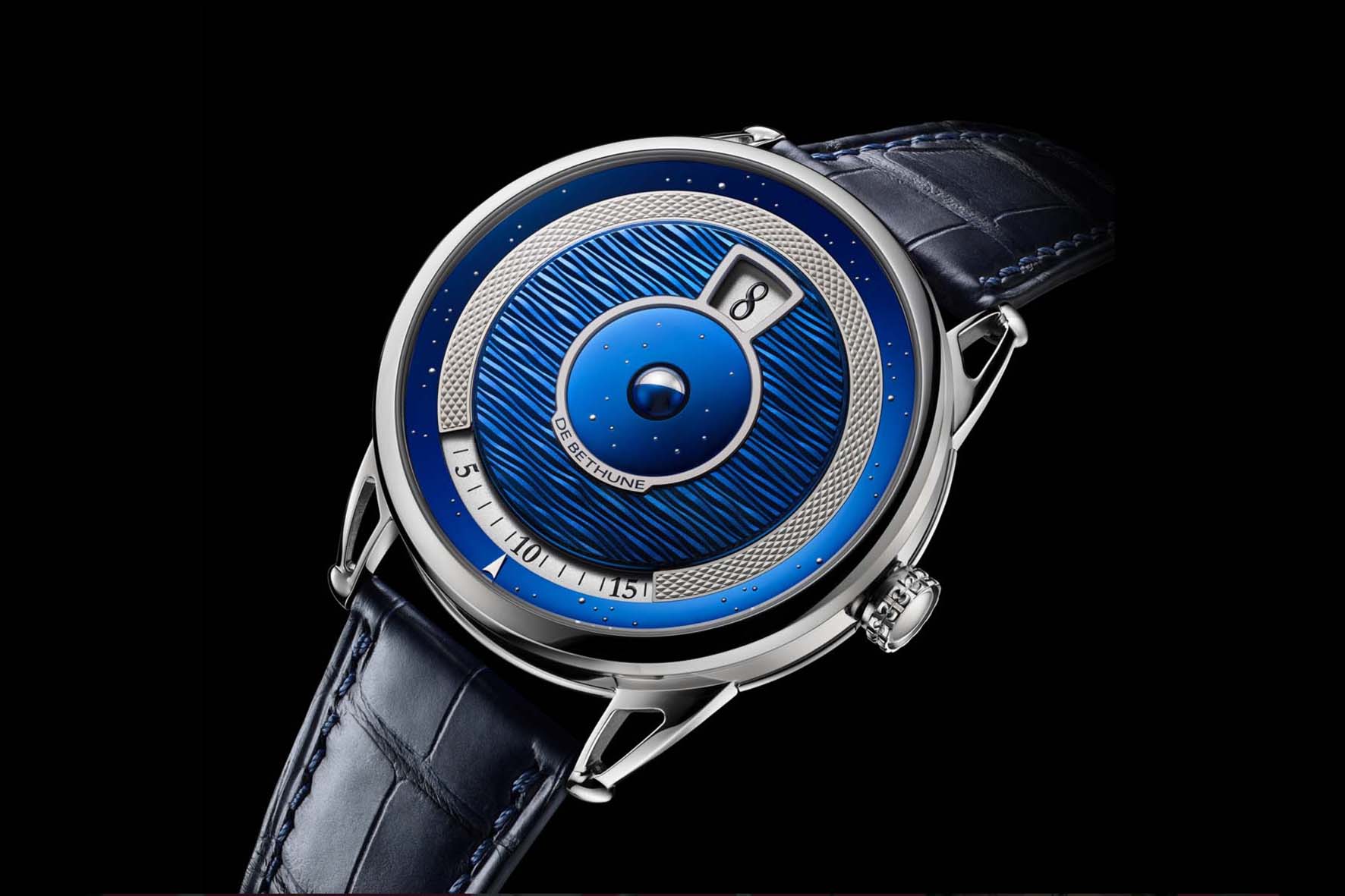
Traditional hands and hour markers therefore disappear: the jumping hours are displayed digitally through an aperture at 12 o’clock, the minutes are indicated in analogue form by a rotating disc in the lower section of the dial, while De Bethune’s unmistakable spherical moon occupies the centre. Three different ways of representing time coexist within a single architecture.
THE DIAL OF THE DE BETHUNE DB25 DIGITALE: A NIGHT-TIME LANDSCAPE COMPOSED OF 82 ELEMENTS
Even before considering its mechanics, however, the DB25 Digitale immediately draws attention to its dial. De Bethune imagines it as a night-time scene, where the different finishes and shades of blue evoke moonlight reflecting across the surface of a river.
No fewer than 82 elements make up this architecture, arranged through concentric surfaces, different materials and contrasting finishes. The protagonist is blued titanium, on which De Bethune applies its random guilloché, a technique introduced in 2023 that creates an irregular, undulating pattern whose appearance changes dramatically according to the way light strikes its surface.
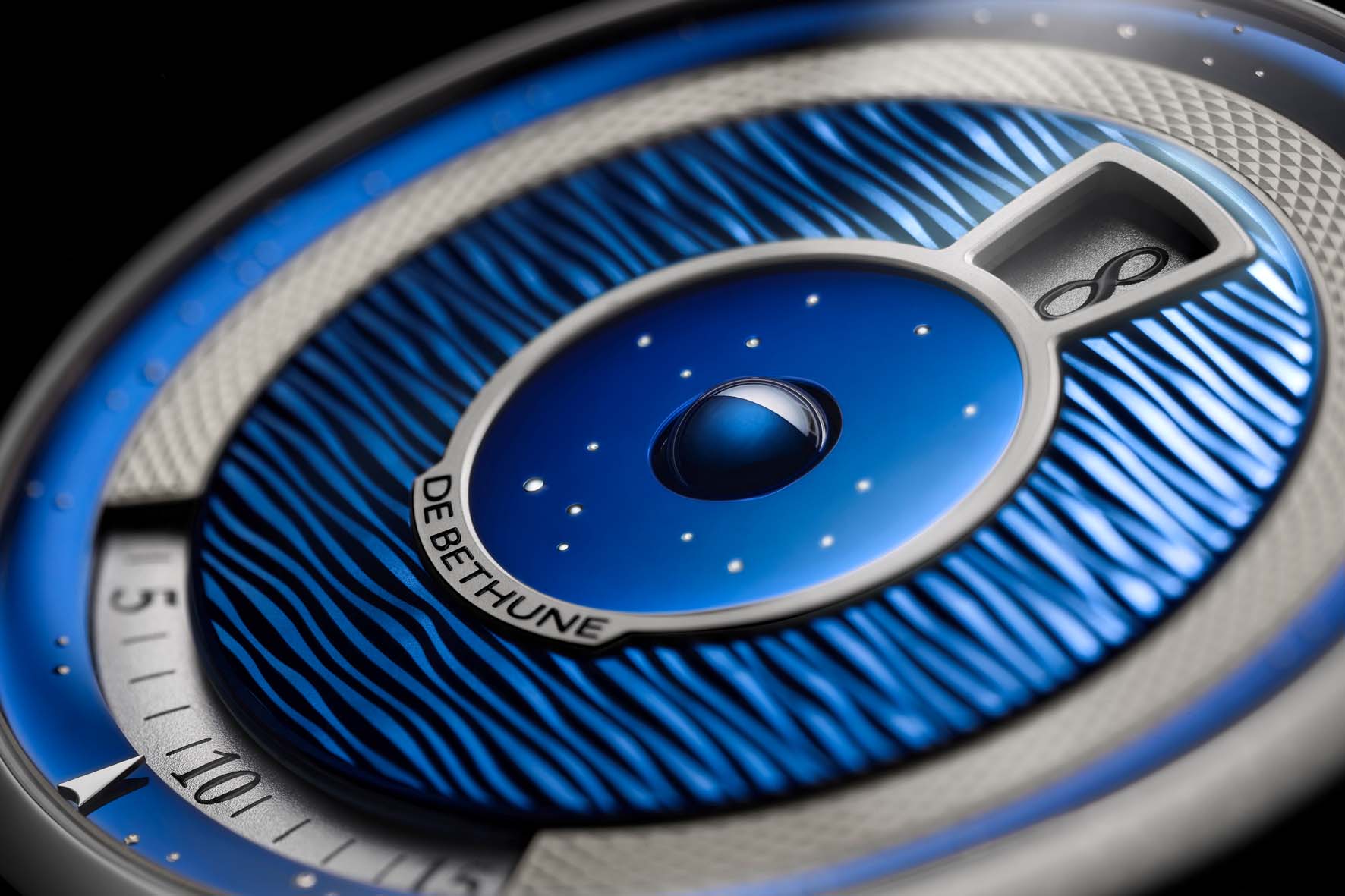
This contemporary language is contrasted with an element rooted in traditional watch decoration. The silvered minute sector is hand-finished with a barleycorn guilloché motif, while the fixed chapter ring and the surround of the spherical moon are crafted from polished and blued Grade 5 titanium, set with grey-gold stars.
It is precisely the contrast between these different techniques that defines much of the watch’s personality: polished surfaces, traditional guilloché and heat-treated titanium react differently to light, lending depth to a dial that seems to change continuously.
JUMPING HOURS, MINUTES ON A DISC AND A SPHERICAL MOON
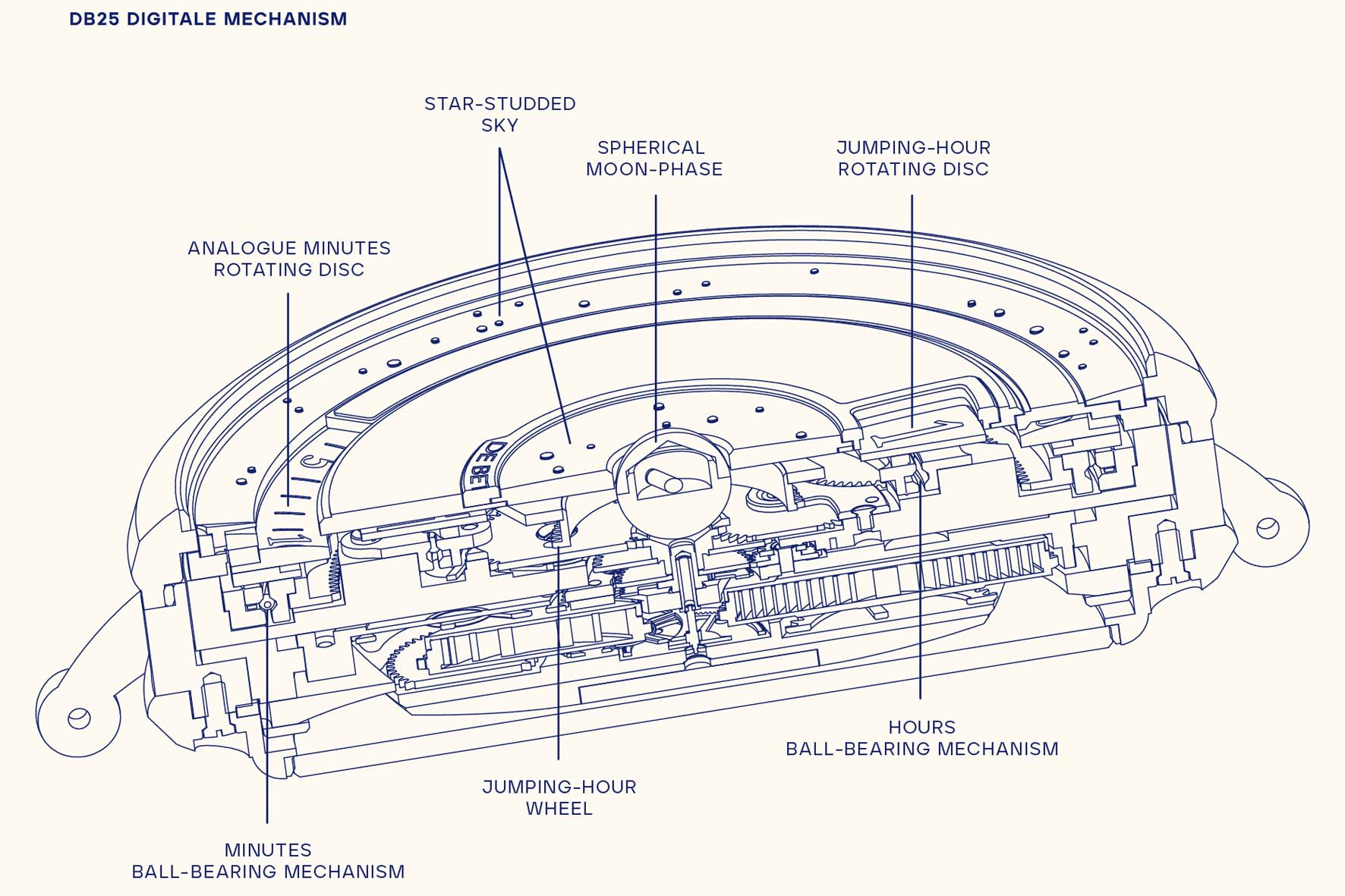
The architecture of the dial is built above all around its unusual display system. At 12 o’clock is the jumping-hour aperture, while the minutes are read in the lower section through an analogue indication displayed on a rotating disc. At the centre, becoming the visual focal point of the entire composition, sits the spherical moon.
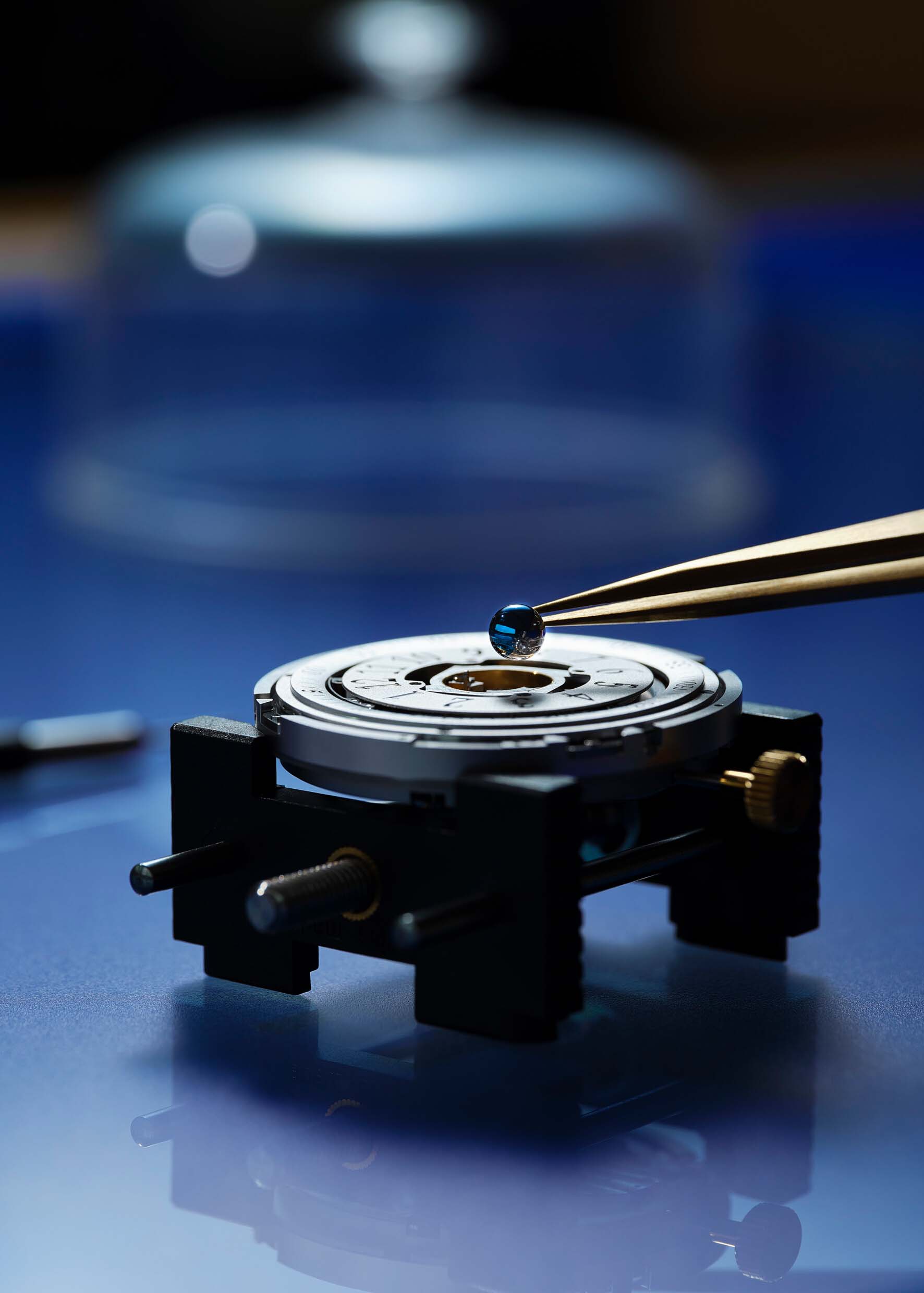
The spherical moon is composed of two polished hemispheres, one in palladium and the other in flame-blued steel, and is inclined at 60°. As it rotates, it reproduces the different phases of the Moon with an accuracy such that it accumulates a deviation of just one lunar day every 1,112 years. Patented by De Bethune in 2004, the system has over the years become one of the Manufacture’s most recognisable technical and aesthetic signatures.
Behind the apparent serenity of the dial lies an equally sophisticated construction. A system based on micro ball bearingsdrives both the jumping-hour mechanism and the rotating minute disc, allowing the mechanical complexity to remain almost entirely concealed beneath the dial’s composition.
The result is a way of reading time that abandons the conventional arrangement of hands and markers in favour of three different languages: digital for the hours, analogue for the minutes and three-dimensional for the moon phases.
THE DB2144V3 CALIBRE
Powering the De Bethune DB25 Digitale is the DB2144V3, a manually wound in-house mechanical movement now in its third generation. Measuring 30 mm in diameter, it comprises 416 components and 32 jewels, operates at a frequency of 28,800 vibrations per hour (4 Hz) and delivers an impressive five-day power reserve, provided by the self-regulating twin barrel developed by De Bethune in 2004.
The movement incorporates numerous innovations developed by the Manufacture over the years. The balance wheel is made from titanium with grey-gold inserts, a solution patented in 2004 and subsequently optimised in relation to temperature variations and aerodynamic efficiency. It is joined by the De Bethune balance spring with flat terminal curve, a silicon escape wheel and the distinctive blued triple pare-chute shock-absorbing system.
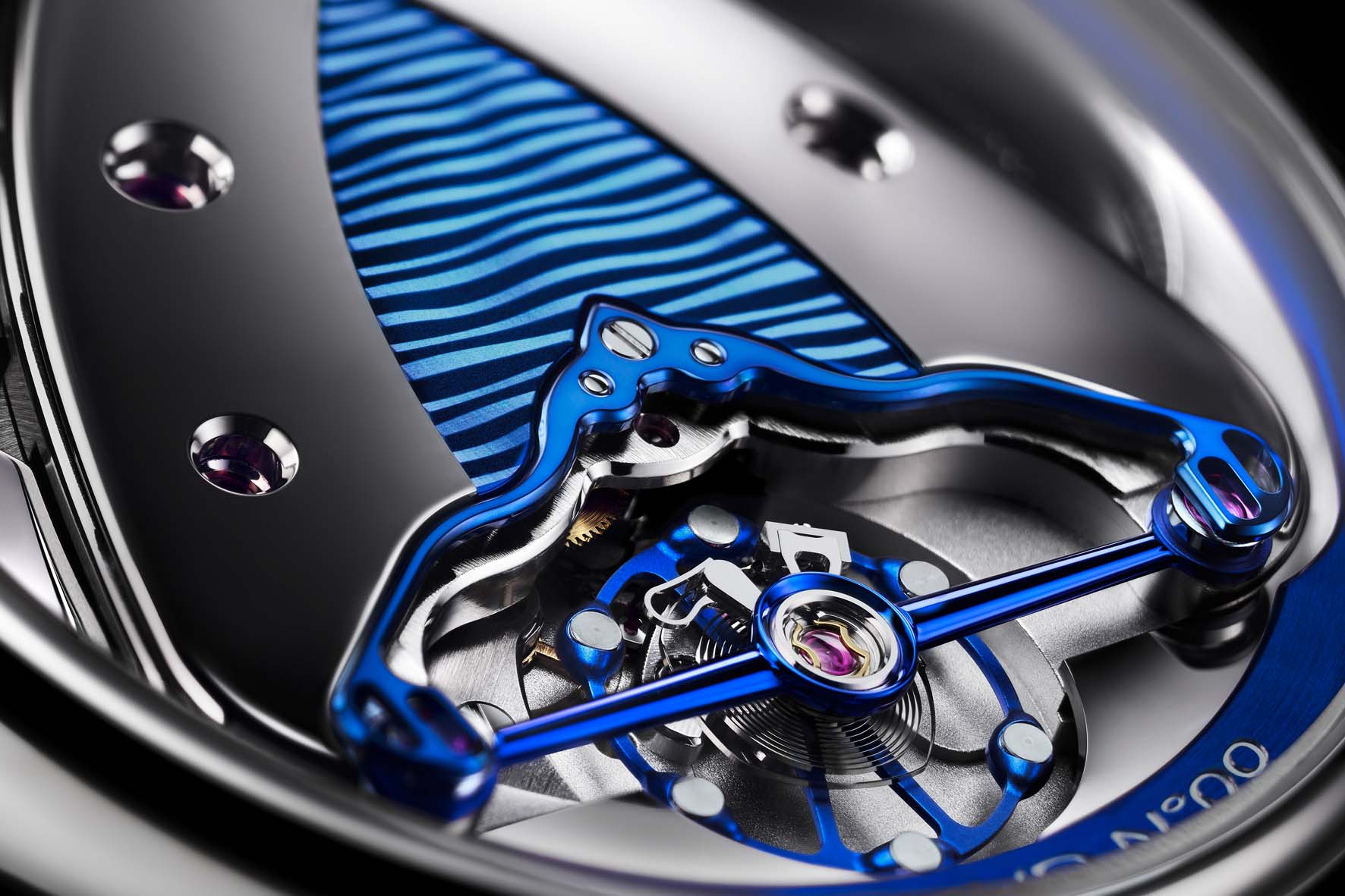
Many of the solutions employed by the DB2144V3 therefore trace their origins back to the early 2000s. Rather than radically reinventing its mechanical architecture, with this third generation De Bethune continues to develop and refine a calibre that already incorporated some of the technical solutions that would go on to become hallmarks of the Manufacture. More than two decades later, its construction retains a level of technical sophistication that remains thoroughly contemporary.
FROM THE DIAL TO THE MOVEMENT
The continuity between aesthetics and mechanics becomes evident when the watch is turned over. The sapphire crystal case-back reveals a concave titanium mainplate, while the titanium barrel bridge is finished with hand-executed bevelling and polishing. For the first time, the random guilloché motif used on the dial also appears on the central blued-titanium insert of the deltoid bridge, creating an immediate visual connection between the front and back of the watch.
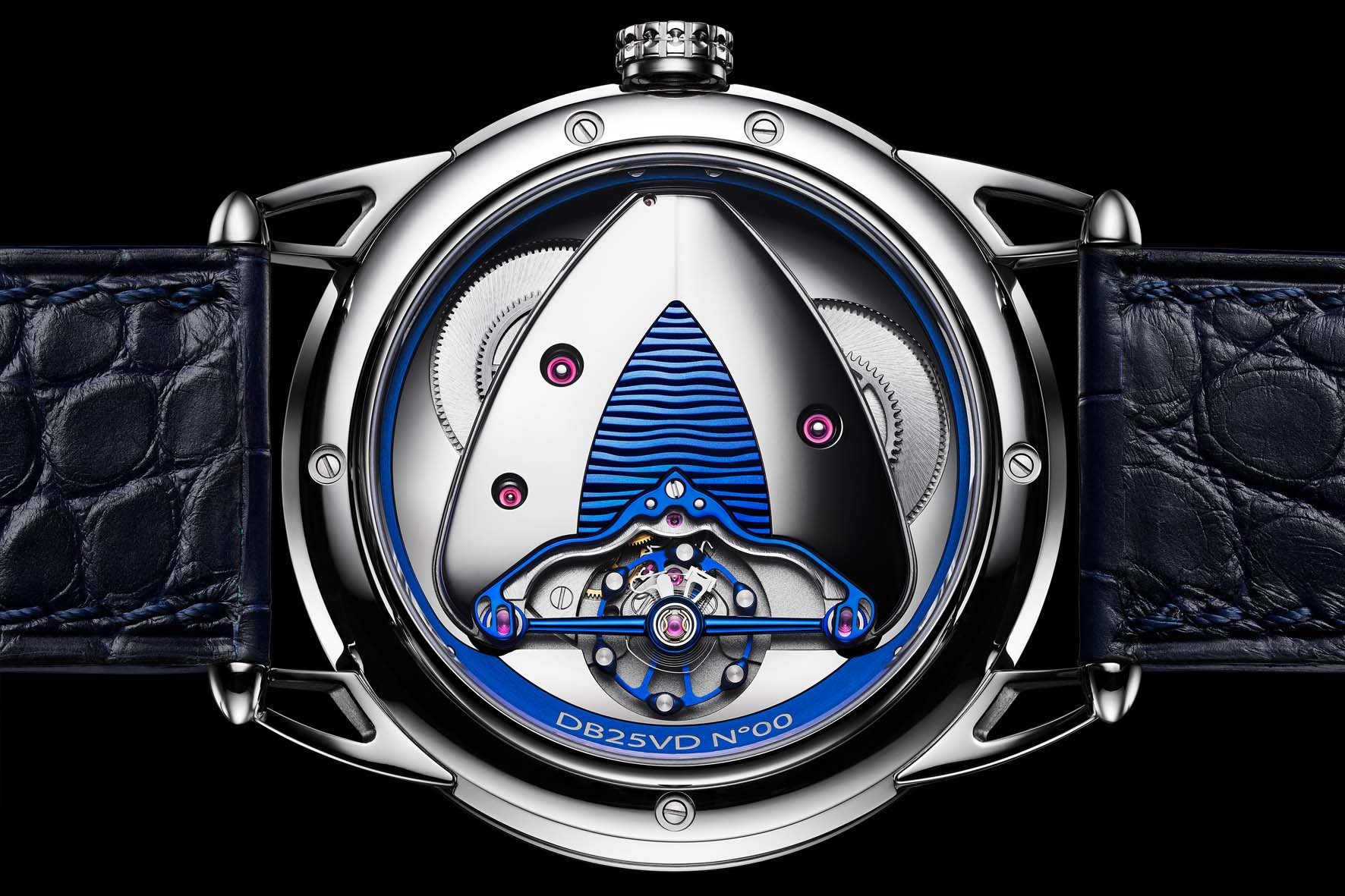
It is an important detail because it perfectly illustrates De Bethune’s approach to decoration: not as something independent from the mechanics, but as an integral part of the watch’s architecture.
42 MM MIRROR-POLISHED GRADE 5 TITANIUM CASE
All this complexity is housed within the distinctive architecture of the DB25 collection, here crafted from mirror-polished Grade 5 titanium. The case measures 42 mm in diameter and 11.9 mm thick, with a particularly discreet bezel that leaves most of the visual space to the dial. The integrated, openworked and rounded lugs feature De Bethune’s characteristic bullet aesthetic and follow the sloping geometry of the case towards the wrist.

Both the front crystal and case-back crystal are made from sapphire with double anti-reflective coating, while water resistance is rated to 3 ATM. The watch is completed by an extra-supple dark blue alligator strap, alligator-lined and hand-stitched, paired with a polished Grade 5 titanium pin buckle. The De Bethune DB25 Digitale Ref. DB25VD is not a limited edition and is priced at CHF 106,000, excluding taxes.
ANOTHER WAY OF READING TIME
The DB25 Digitale neatly encapsulates one of the most fascinating aspects of Denis Flageollet and De Bethune’s work: the ability to employ extremely sophisticated technical solutions without necessarily turning complexity into ostentation.
And perhaps this is precisely where the watch finds its identity. The jumping hours, minutes on a rotating disc and spherical moon are not three independent elements, but parts of a single composition in which mechanics, materials and decoration all contribute to the same result.
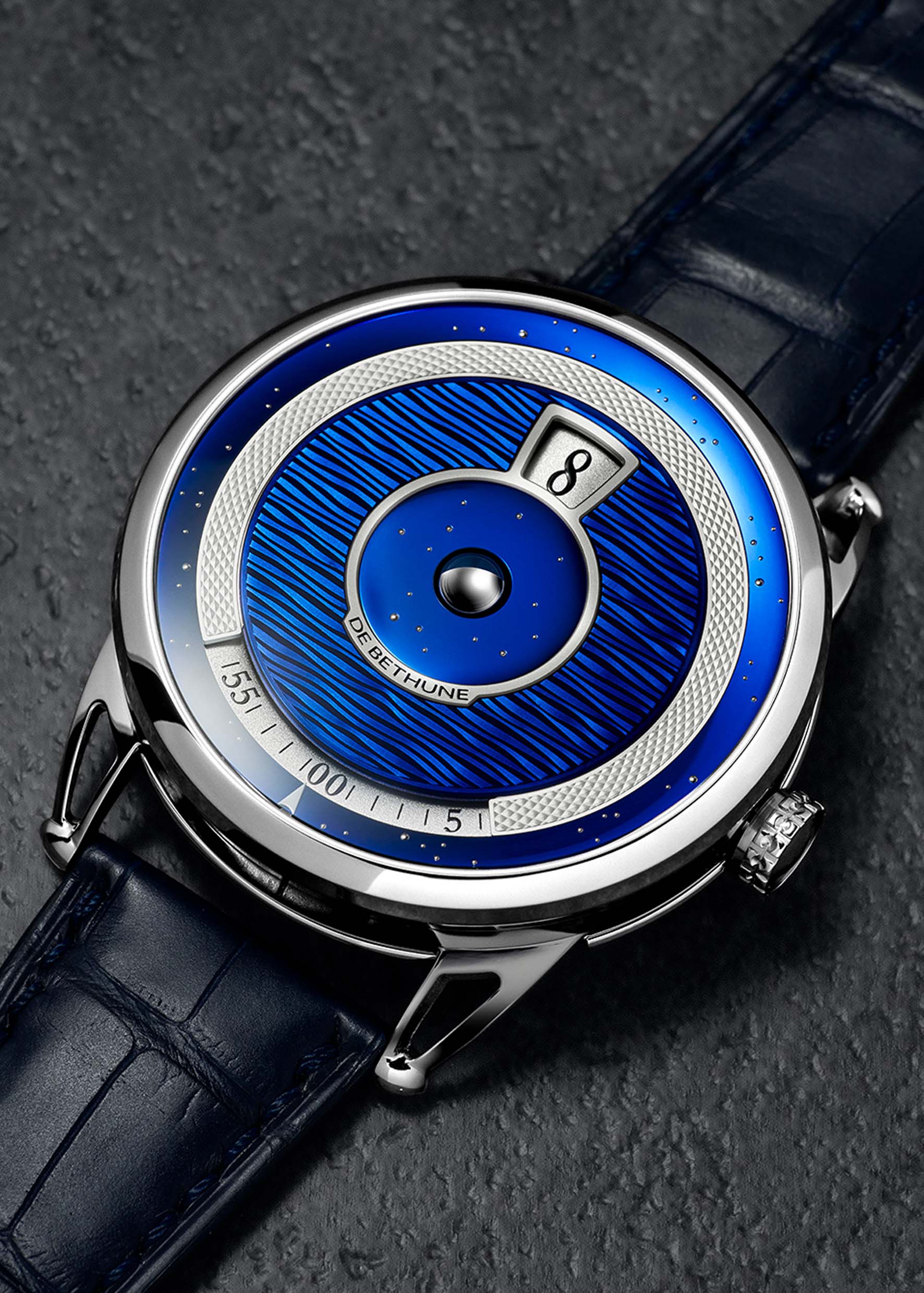
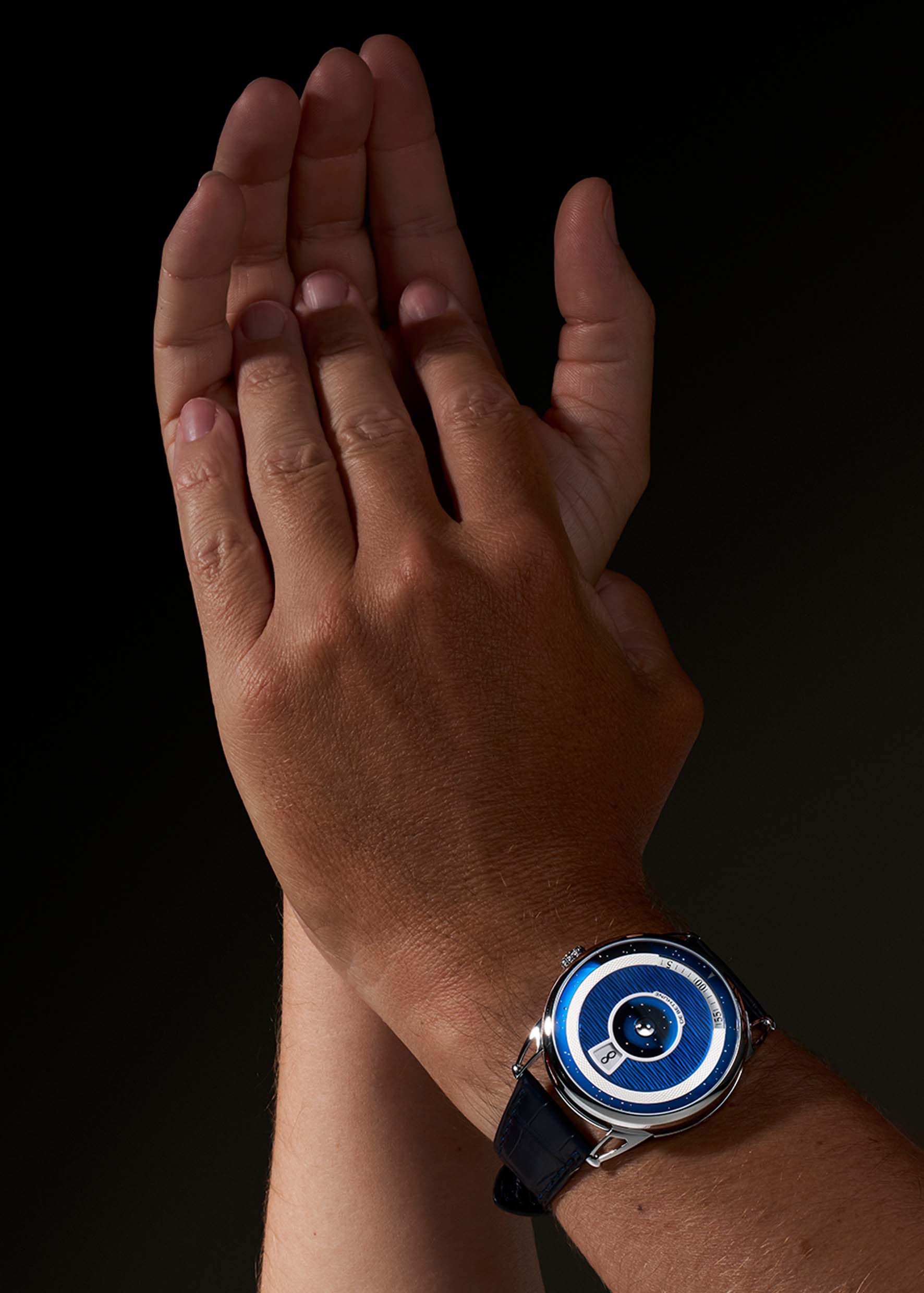
At the heart of the watch, the 416 components of the DB2144V3 are at work; on the dial side, blued titanium, guilloché and tiny grey-gold stars transform those functions into a landscape. Time continues to be measured with great precision, but the way it is displayed invites us to slow down.
This is perhaps the most compelling meaning behind the expression chosen by De Bethune to accompany the new DB25 Digitale: “Time Contemplated.” Not simply time to be read, but time to be observed.
By Jacopo Giudici