
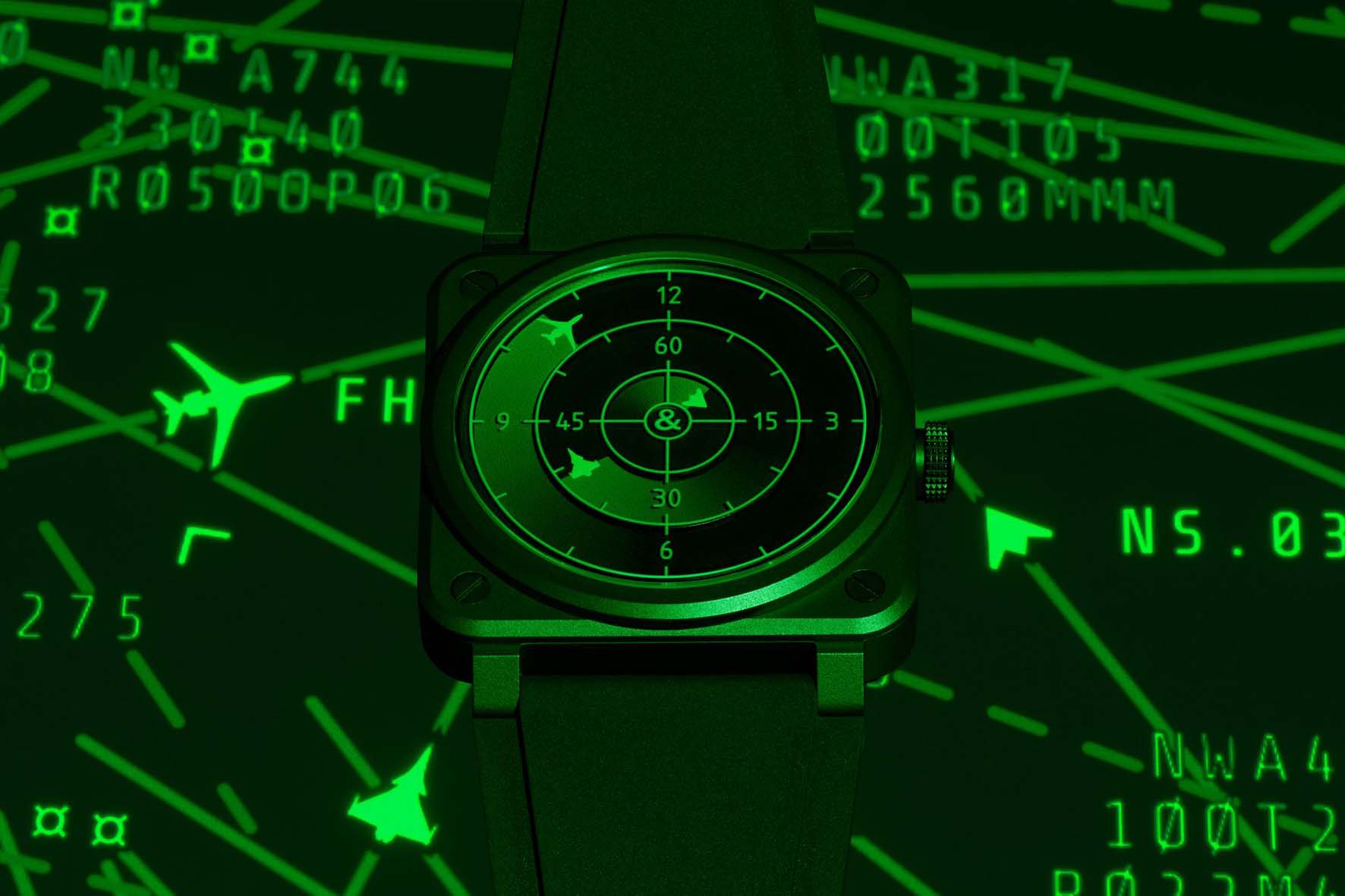

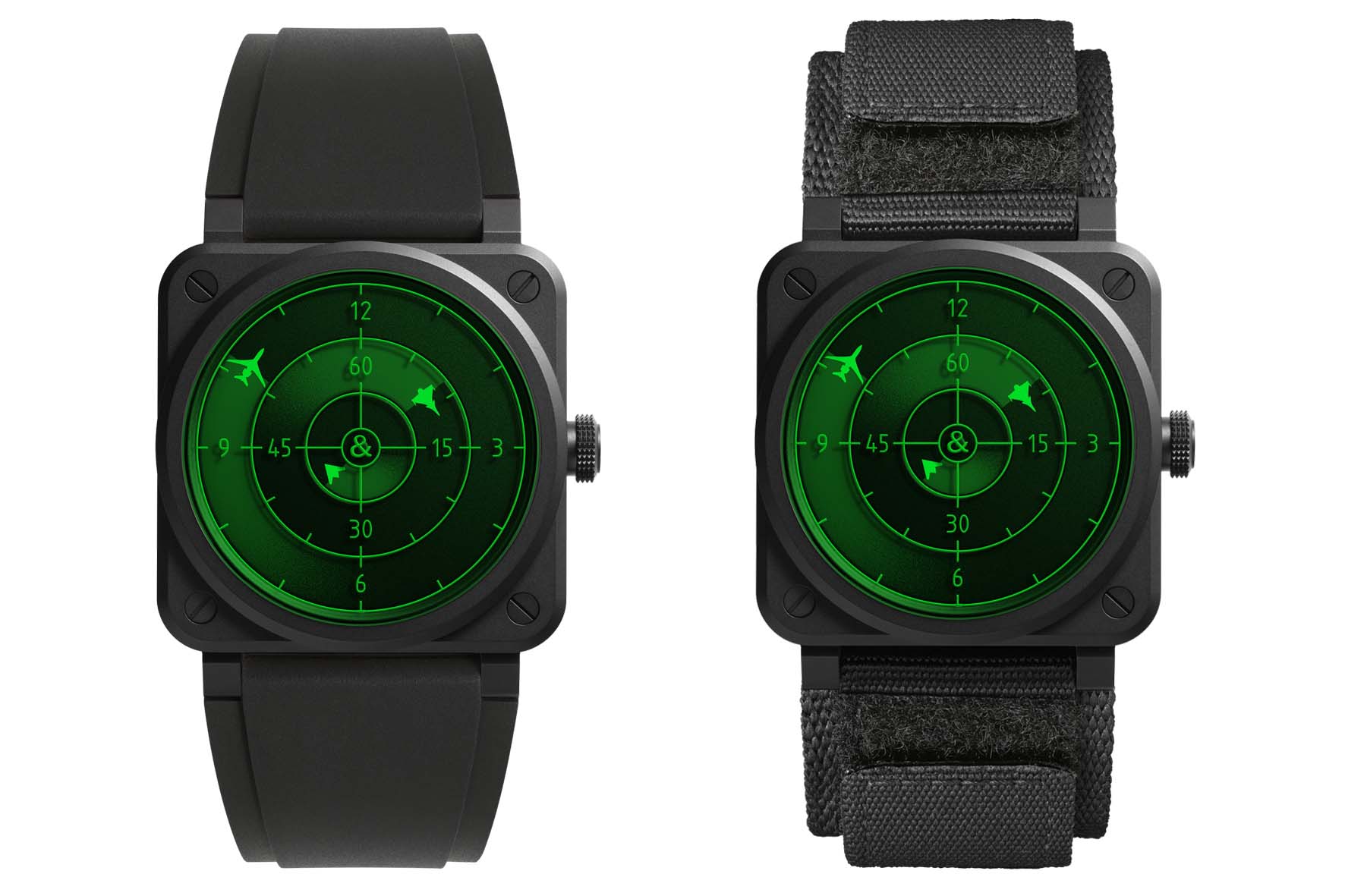
No traditional hands, but three aircraft moving on three rotating discs to indicate the hours, minutes and seconds. With the new Bell & Ross BR-03 Green Radar Ceramic, the brand revisits one of its most original concepts, turning a watch dial into a radar screen inspired by air traffic control instruments.
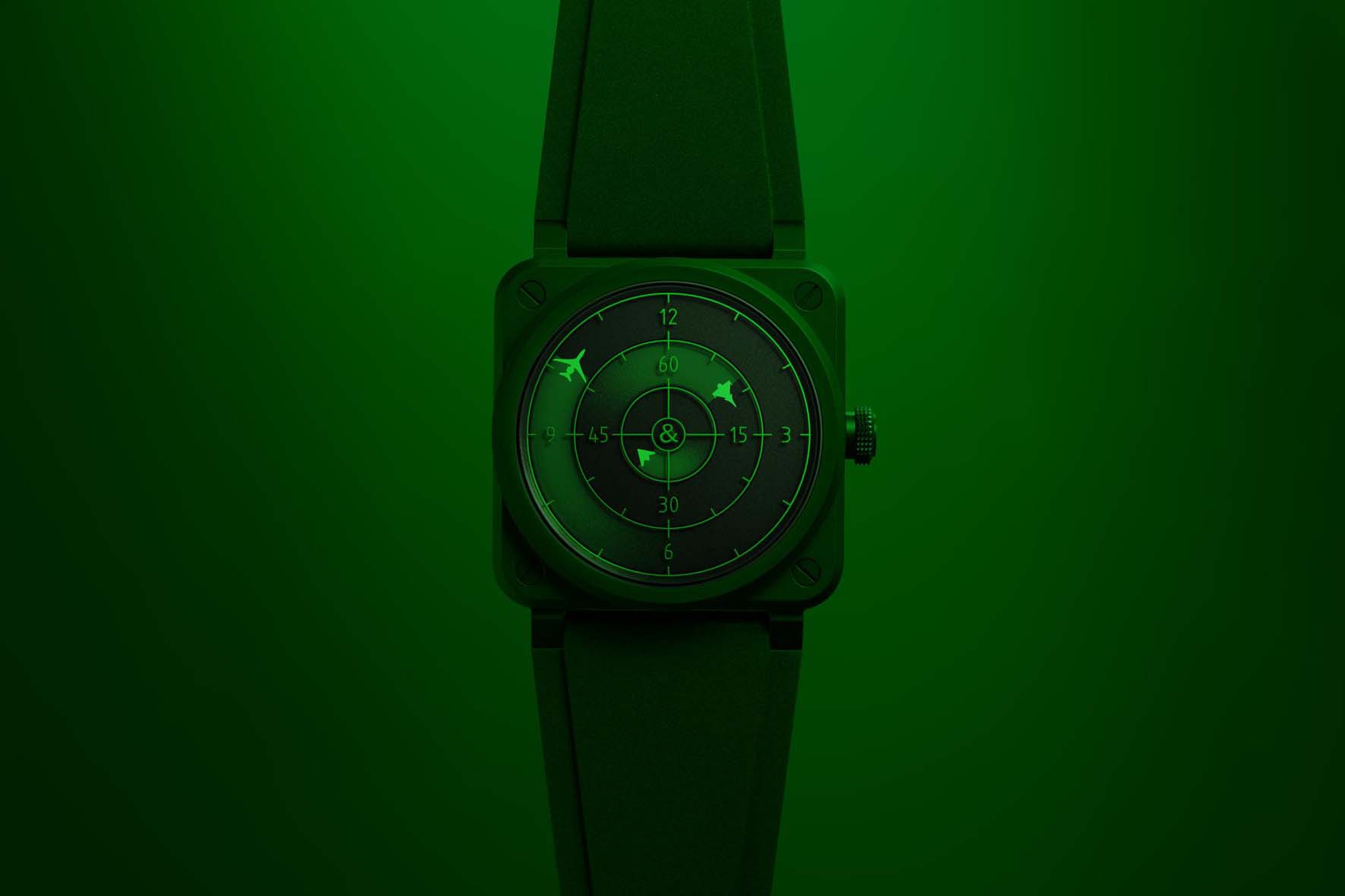
This latest interpretation is distinguished by its green dial, 41 mm black ceramic case and a display that, for the first time in the collection, combines aircraft silhouettes with their luminous trails. It marks a further evolution of a concept introduced in 2010, now offered in a limited edition of 999 pieces.
BR-03 GREEN RADAR CERAMIC: THREE AIRCRAFT IN PLACE OF HANDS
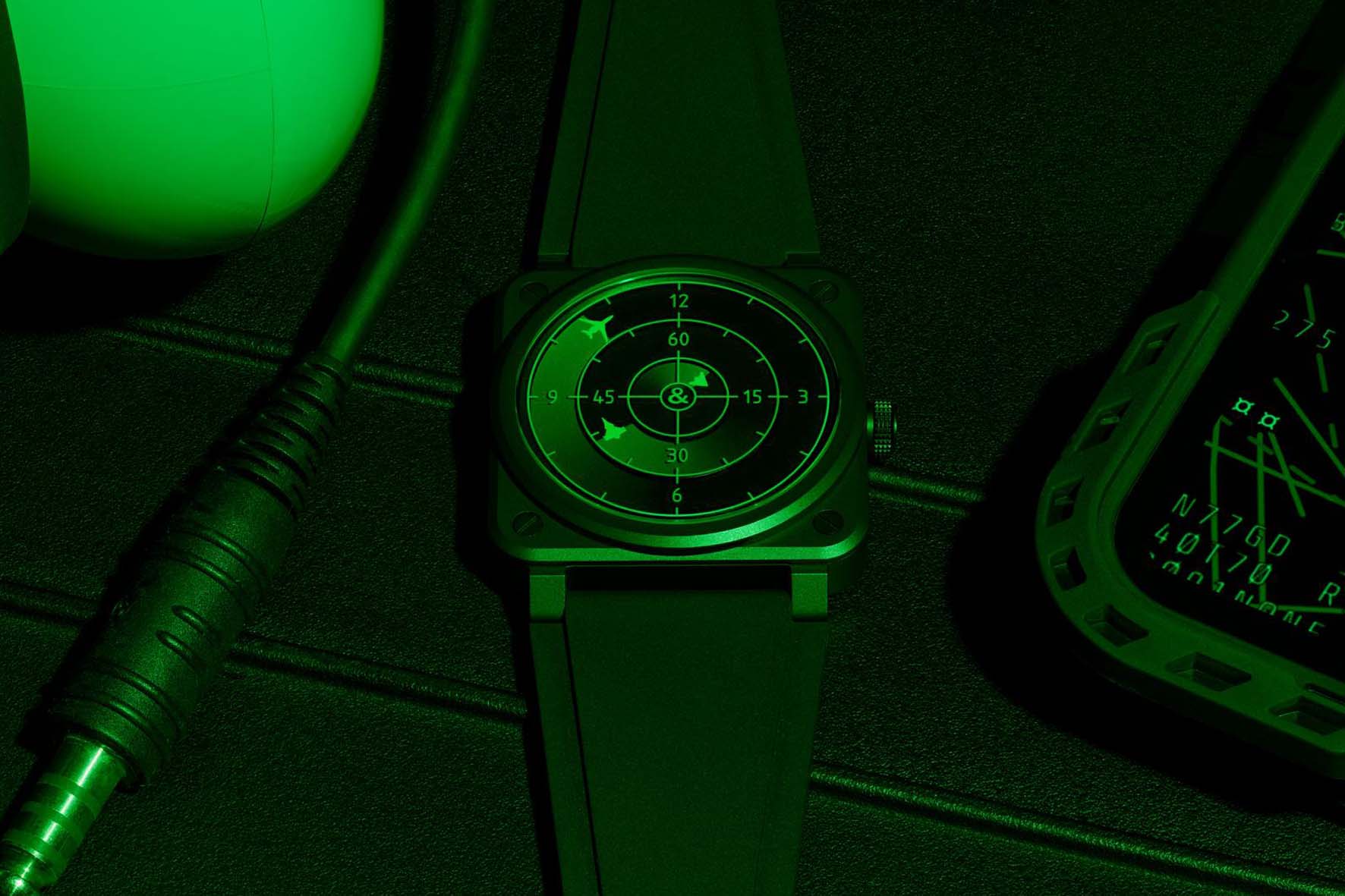
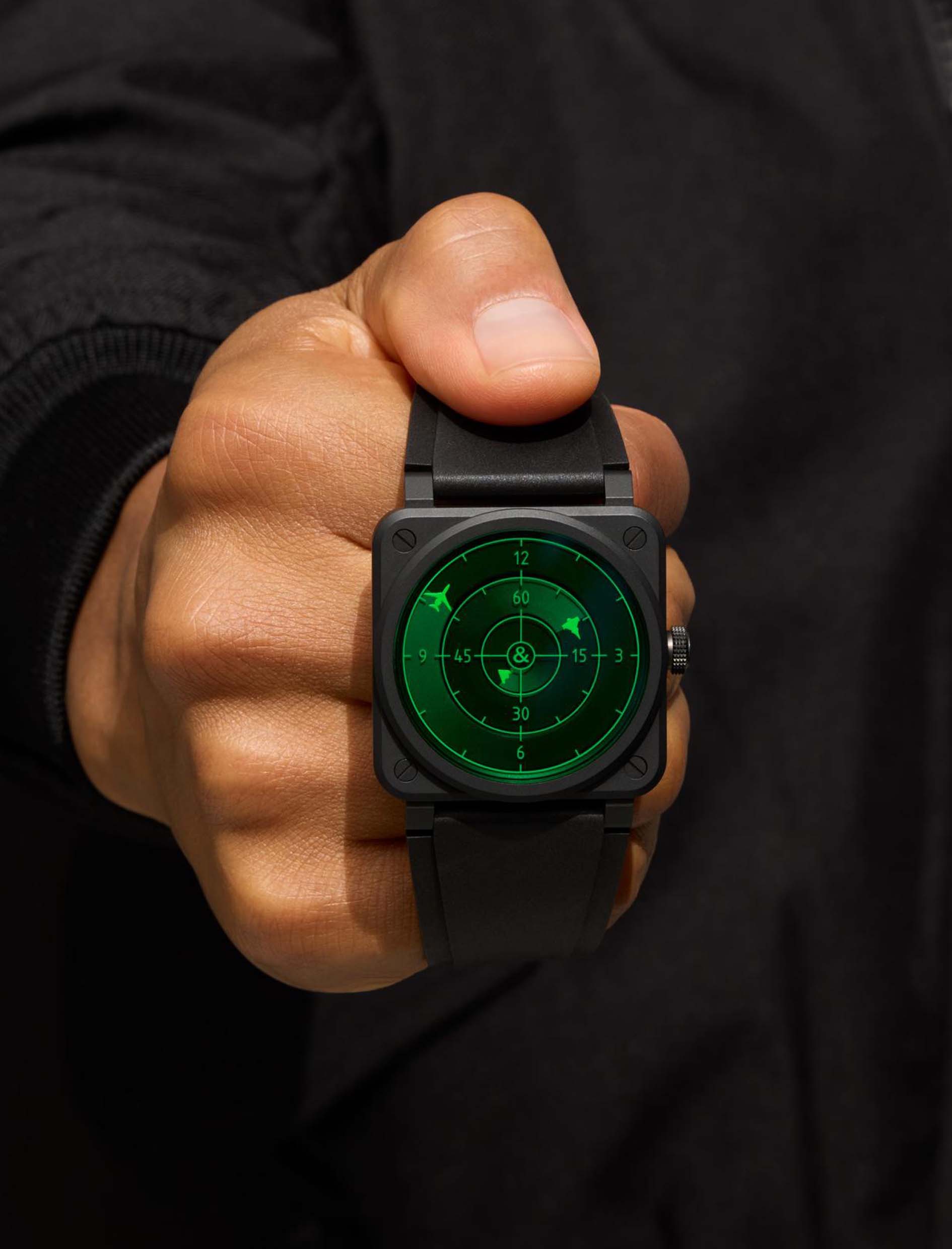
The defining feature of the new Bell & Ross BR-03 Green Radar Ceramic is undoubtedly its dial, where three stylised aircraft replace conventional hands. Each indicates a different unit of time, recreating the movement of aircraft across a radar screen.
The choice of aircraft is deliberate. Bell & Ross pays tribute to Dassault Aviation, bringing together three designs representing different fields of French aviation. The Falcon, a business jet, indicates the hours; the Rafale, a multirole fighter jet, shows the minutes; and the nEUROn, an experimental stealth unmanned combat aircraft, marks the seconds.
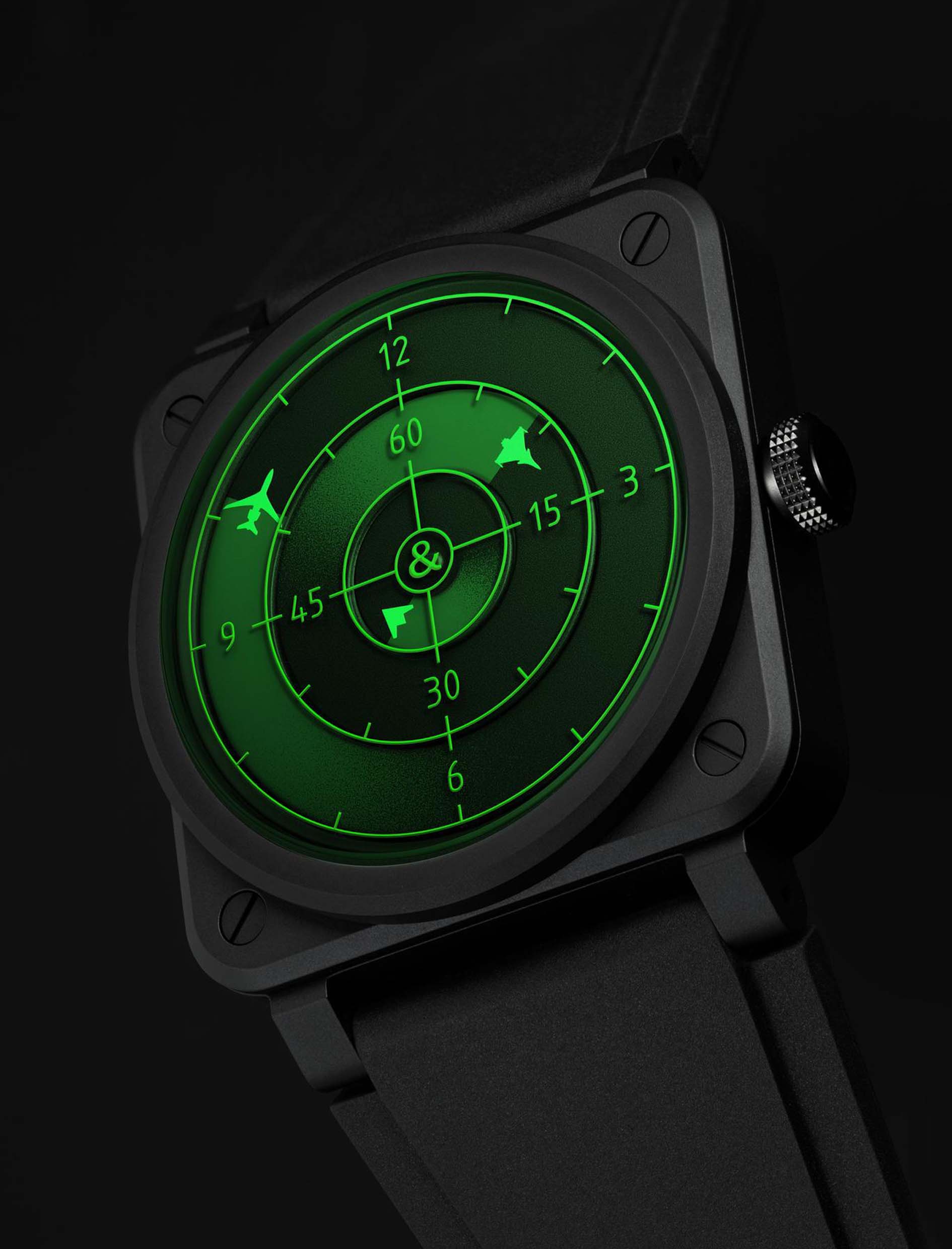
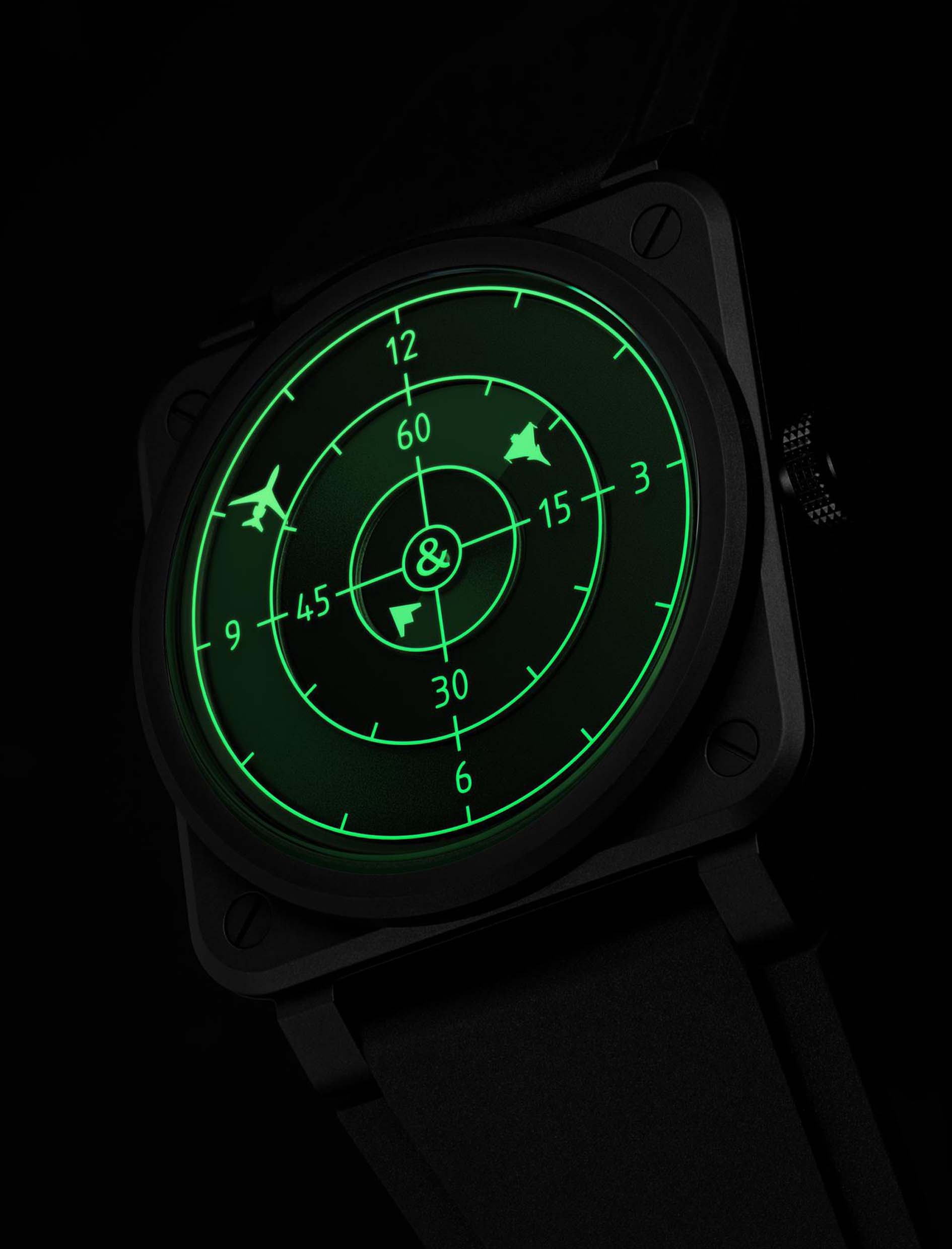
Each aircraft is accompanied by a luminous green trail, recalling the signals displayed on air surveillance screens. The effect helps recreate the appearance of an aviation instrument, giving the dial a striking visual character.
The result is a dynamic display in which every element has a purpose. These are not merely decorative details, but part of a system that draws on the visual language of aviation to offer an entirely different way of reading the time.
HOW THE BELL & ROSS GREEN RADAR DIAL WORKS
Behind this unusual display is a system of three overlapping, independently rotating discs, each moving at a different speed. The outer disc, carrying the Falcon, completes one revolution every twelve hours. The middle disc, associated with the Rafale, turns once every sixty minutes, while the central nEUROn disc completes one revolution every minute to indicate the seconds.
The time is read by observing the position of each aircraft against the fixed scales. These, together with the hour markers and distinctive central crosshair, are printed on the underside of the green-tinted sapphire crystal, coloured throughout and treated with an anti-reflective coating. The rotating discs sit beneath this fixed display, creating a sense of depth that reinforces the resemblance to a real radar screen.
From a technical standpoint, the principal challenge lies in producing and assembling the discs. Each must be light enough not to compromise the movement’s power reserve, yet sufficiently rigid to prevent deformation or contact with the other components. Bell & Ross therefore uses micrometric adjustments during assembly to maintain precise parallel alignment between the different layers.
The aircraft silhouettes also feature dark green Super-LumiNova markings that glow green, adding to the luminous effect associated with aviation instruments.
FROM THE 2010 BR-01 RADAR TO THE 2026 GREEN RADAR
The history of the Bell & Ross Radar collection began in 2010 with the BR-01 Radar, a watch that offered an original interpretation of aviation instruments. Rather than simply borrowing their shapes and colours, the brand brought radar-screen graphics onto the dial, replacing hands with concentric discs.
The BR-01 Red Radar followed in 2011, distinguished by its red crystal. In 2014 came the BR-03 Red Radar, which brought the concept to a 42 mm case. Another significant development arrived in 2021 with the BR 03-92 Red Radar Ceramic, introducing a ceramic case and two aircraft silhouettes on the dial.
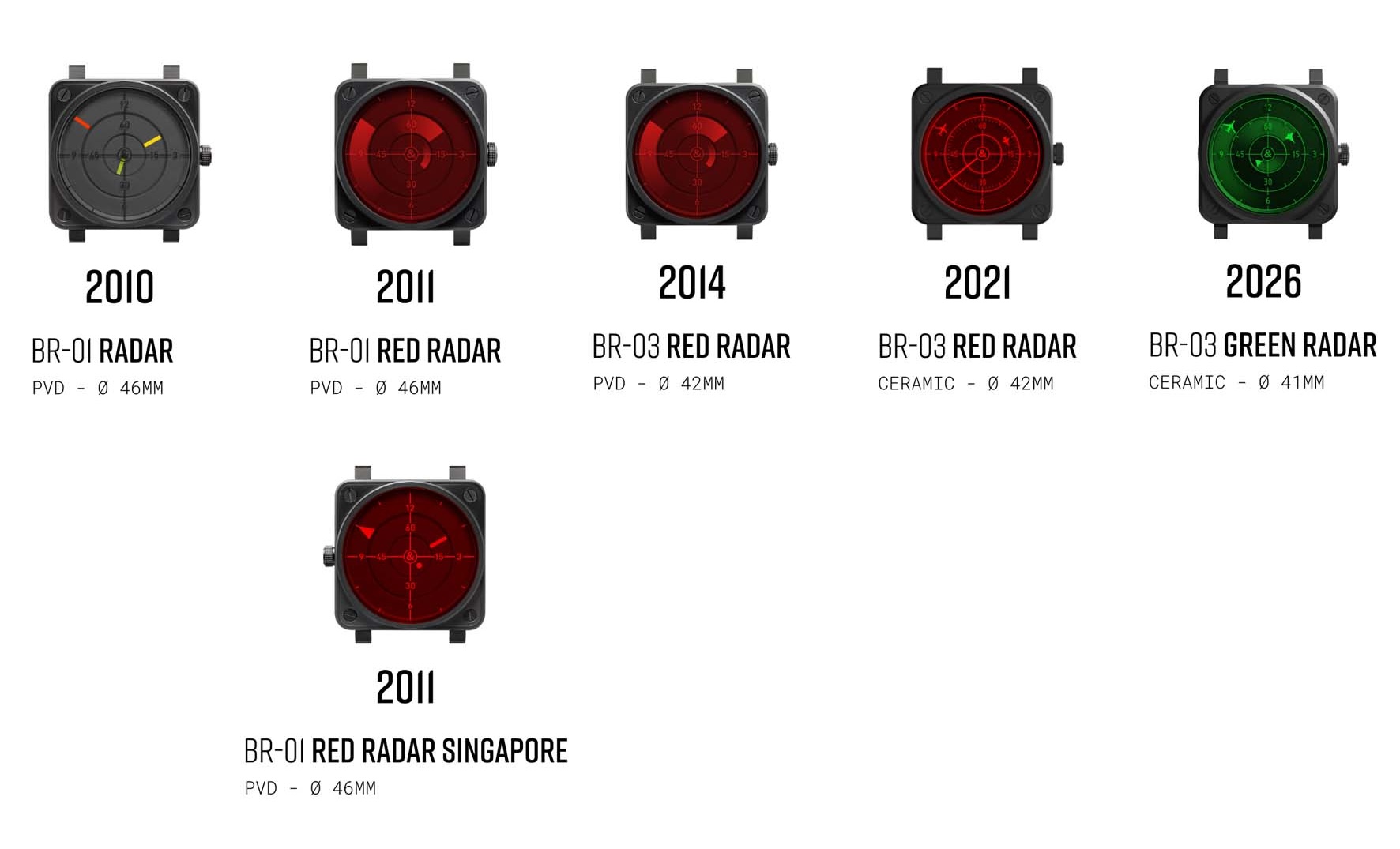
The 2026 edition builds on this heritage with a configuration that, for the first time, brings the aircraft and their luminous trails together. The colour changes too, with green replacing the red of earlier versions, while the case size is reduced to 41 mm.
The model continues the story of the Flight Instruments family, through which Bell & Ross has long reinterpreted the graphics of aviation navigation instruments. It is an approach consistent with the brand’s identity: since the launch of the BR-01 in 2005, the connection between cockpit instruments and watchmaking has been one of its defining characteristics.
41 MM BLACK CERAMIC CASE AND BR-CAL.327 MOVEMENT
The new Green Radar retains the architecture that has made the BR-03 collection instantly recognisable, with its distinctive round dial set within a square case, while adopting more compact proportions than previous Radar generations.
The case measures 41 mm across and 10.60 mm thick and is made of microblasted black ceramic, with a matte surface and high scratch resistance. This finish brings out the green of the dial, creating a strong contrast without overwhelming the design.
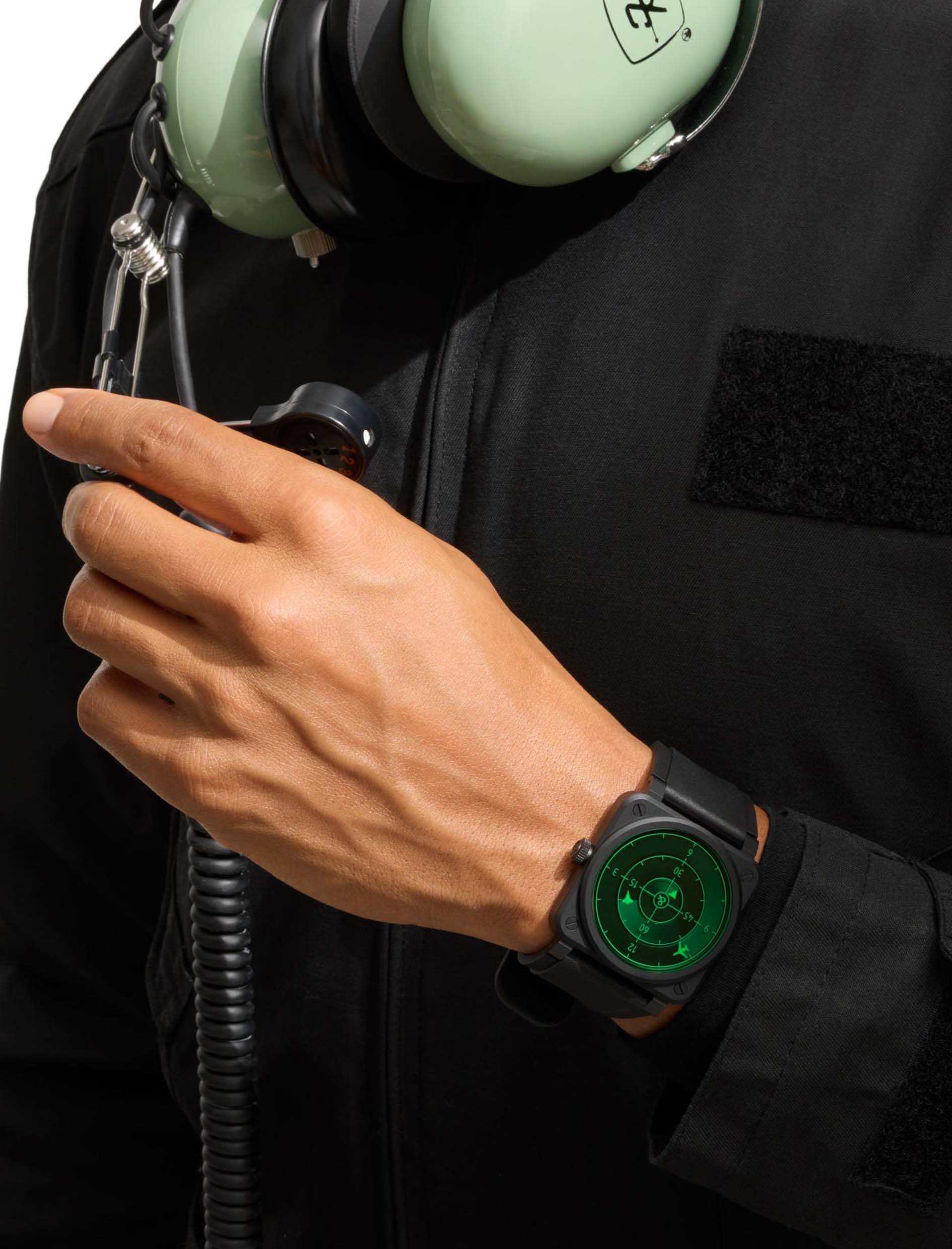
Powering the watch is the BR-CAL.327 automatic calibre, offering a 54-hour power reserve. Water resistance is rated at 100 metres, while the caseback echoes the aviation theme with engravings of the silhouettes and names of the three aircraft featured on the dial.
The watch comes on a black rubber strap, with an additional strap in ultra-resistant black synthetic fabric and a black PVD-coated steel pin buckle.
BELL & ROSS BR-03 GREEN RADAR CERAMIC: PRICE AND AVAILABILITY
The new Bell & Ross BR-03 Green Radar Ceramic, reference BR03A-GRDR-CE/SRB, is produced in a limited edition of 999 pieces, with a retail price of €4,900.
For us, the Radar is undoubtedly one of Bell & Ross’s most interesting and iconic concepts. Not simply because of its distinctive appearance, but above all because it embodies the brand’s philosophy: taking inspiration from aviation instruments to create watches with a clear identity, capable of standing apart without sacrificing their function.
The new Green Radar Ceramic is an excellent example. More than fifteen years after the first version, the concept continues to show just how original Bell & Ross’s design language can be when the brand remains true to its roots. A watch that, in our view, captures the identity of Bell & Ross better than many others.
By Jacopo Giudici