

One of the most important features for a professional watch is perfect legibility in all lighting conditions. This can be achieved through the use of high-contrast dials or, quite simply, by applying luminescent material to the hour markers, hands or the entire dial. IWC Schaffhausen has gone a step further and created a fully luminescent watch, from the dial to the case, from the strap to the hour markers.

In this article, we will discuss this very watch, the Big Pilot’s Watch Perpetual Calendar Ceralume, which has just been unveiled at Watches and Wonders Geneva. We will explore the unique features of this pilot’s watch, of which IWC has produced 250 pieces, utilising the Ceralume luminescent ceramic technology patented by the Schaffhausen-based brand. We will explain what this ceramic consists of, how it was developed, how it works and what advantages it brings to the watch. Finally, we will highlight the importance of the perpetual calendar in IWC’s collections.
A NEW MATERIAL: CERALUME
Let’s start by saying that the Big Pilot’s Watch Perpetual Calendar Ceralume is a Big Pilot that will appeal to fans of the original versions of this line, as it features a 46.5 mm × 15.9 mm case. Indeed, it is worth noting that the most recent collections have introduced a more compact size – 43 mm – in the time-only versions, to meet the demands of a market favouring smaller diameters, whilst still keeping the historic oversized versions in the range. In this case, the 46.5 mm size is necessary because we are dealing with a watch featuring a perpetual calendar.
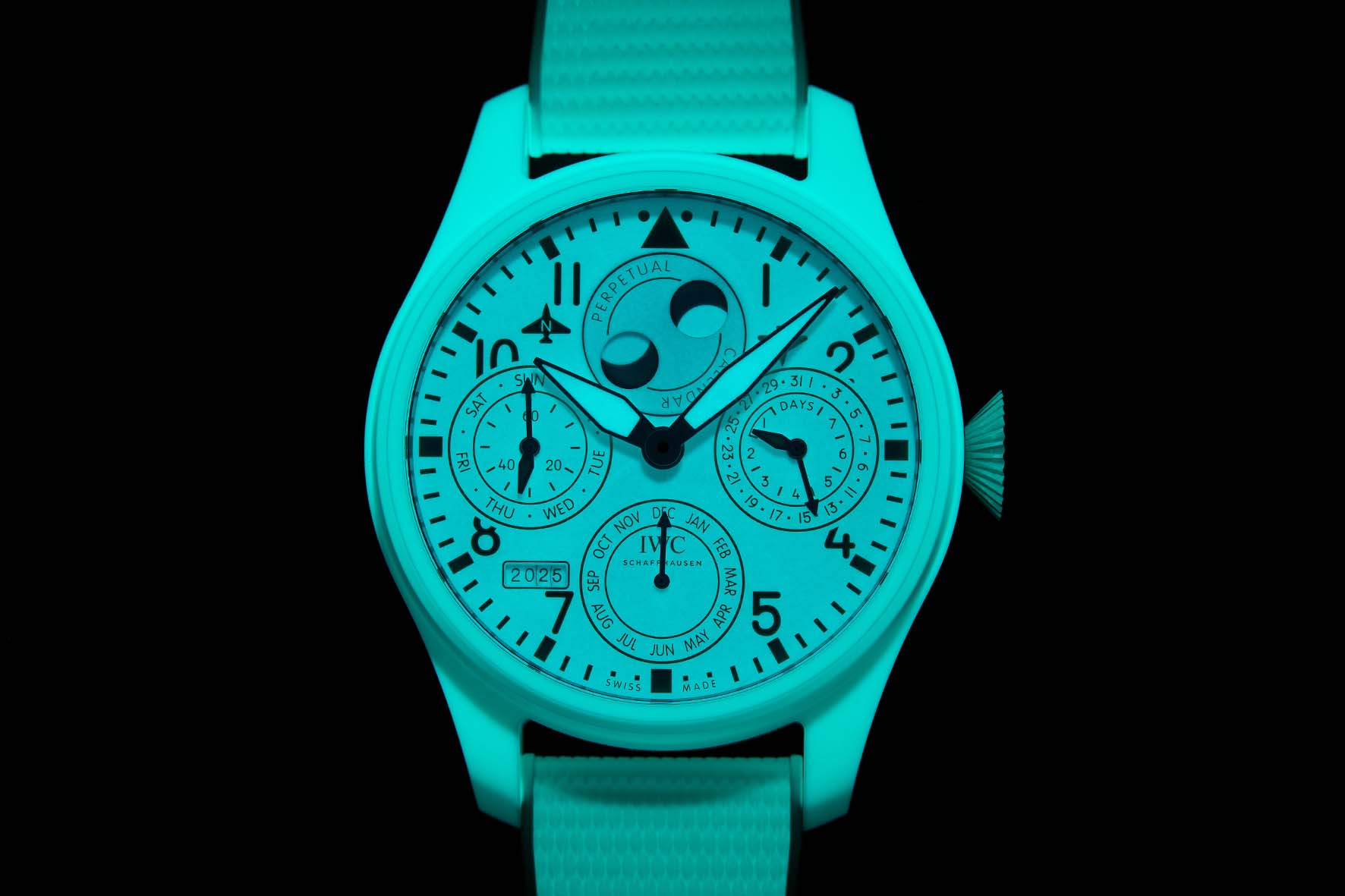
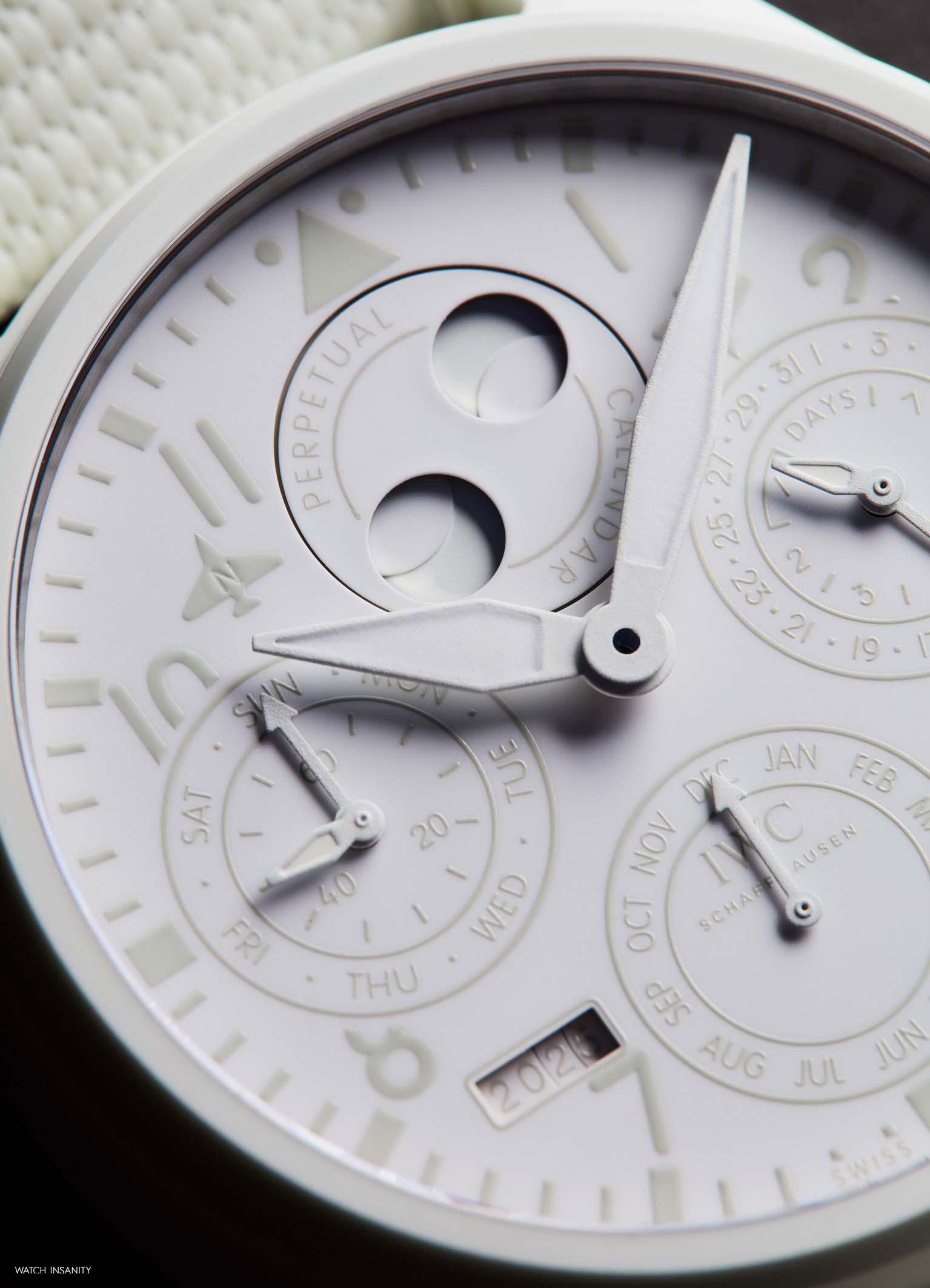
What sets it apart, however, is the unique technology of the material used to create the case, which IWC has named Ceralume and which, as the name suggests, is a compound combining ceramic and luminescence. The use of ceramic is no accident. It symbolises the profound expertise in materials that IWC has acquired over the last forty years, since 1986, when it pioneered the use of this type of hard, scratch-resistant ceramic.

Acting in a similar way to a solar cell that stores light, this ceramic compound absorbs light energy from sunlight or artificial light and re-emits it as visible light, in a cycle that can be repeated indefinitely.
HOW CERALUME IS CREATED
Ceralume is the result of many years of ceramic development carried out by the XPL engineering division at IWC Schaffhausen, with the support of experts from RC Tritec. The latter is a cutting-edge Swiss technology company renowned for its Super-LumiNova luminescent pigments.
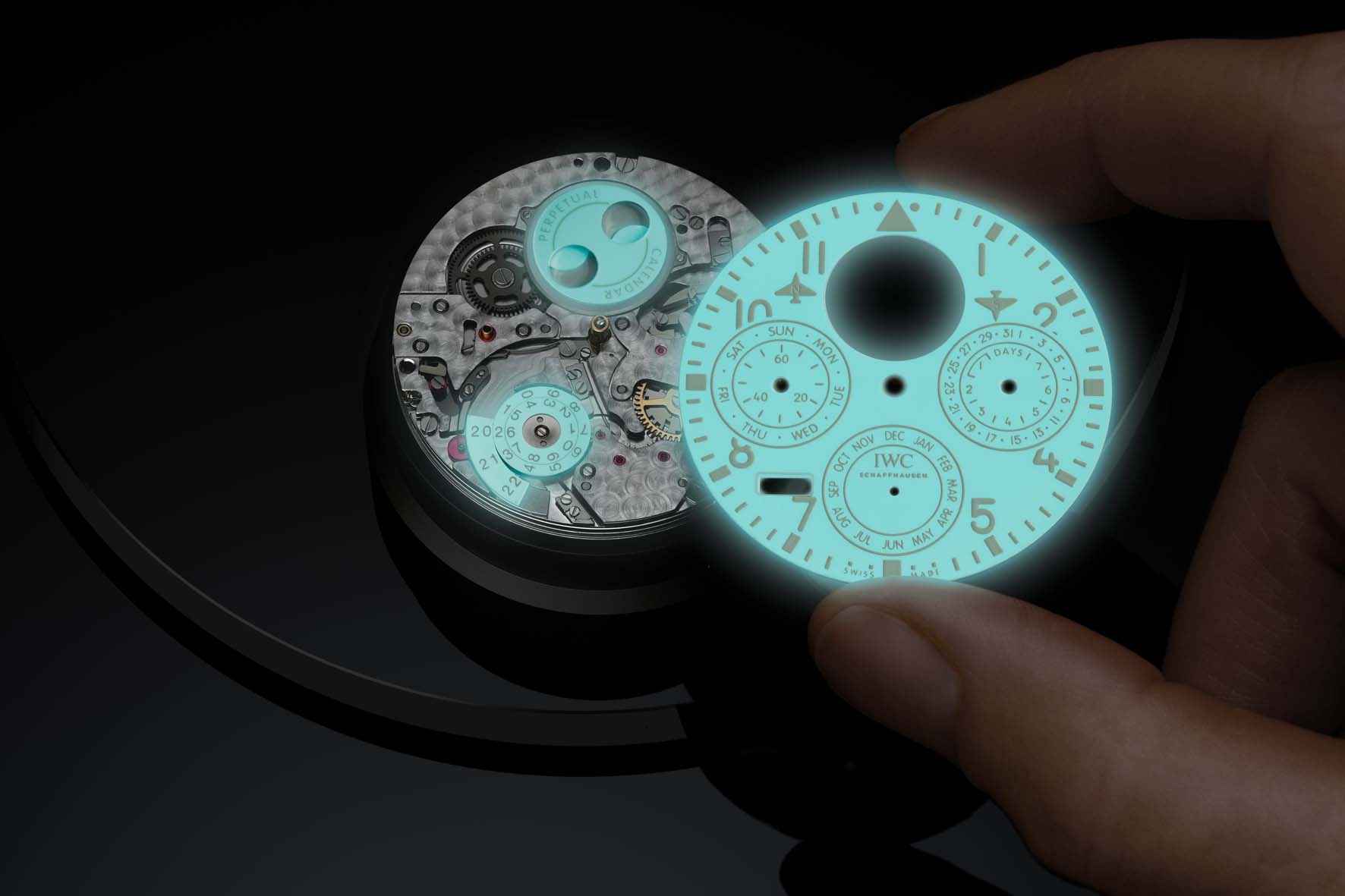
The process of creating Ceralume is unique. Whilst conventional white ceramic is produced by mixing zirconium oxide with other metal oxides, luminous ceramic is created from a mixture of ceramic powders and Super-LumiNova pigments. In this process, achieving a homogeneous mixture is essential; as these raw materials have different particle sizes, this is no simple task.

IWC’s engineers have therefore designed a ball-milling process specifically for this material. The ceramic powders and Super-LumiNova pigments are placed in a rotating cylindrical drum – similar to a washing machine drum – partially filled with small balls. As the drum rotates, the balls rise and fall, so that both the impact and the friction break down the mixture into a finer, more homogeneous powder.
THE LUMINOSITY OF THE BIG PILOT’S WATCH PERPETUAL CALENDAR CERALUME
The result, as mentioned above, is a case that essentially functions like a solar cell, designed to emit luminescence. But the effect in the dark is not produced by the case alone; it comes from the entire watch. The whole Big Pilot’s Watch Perpetual Calendar Ceralume glows in the night, from the case to the dial and right down to the strap.

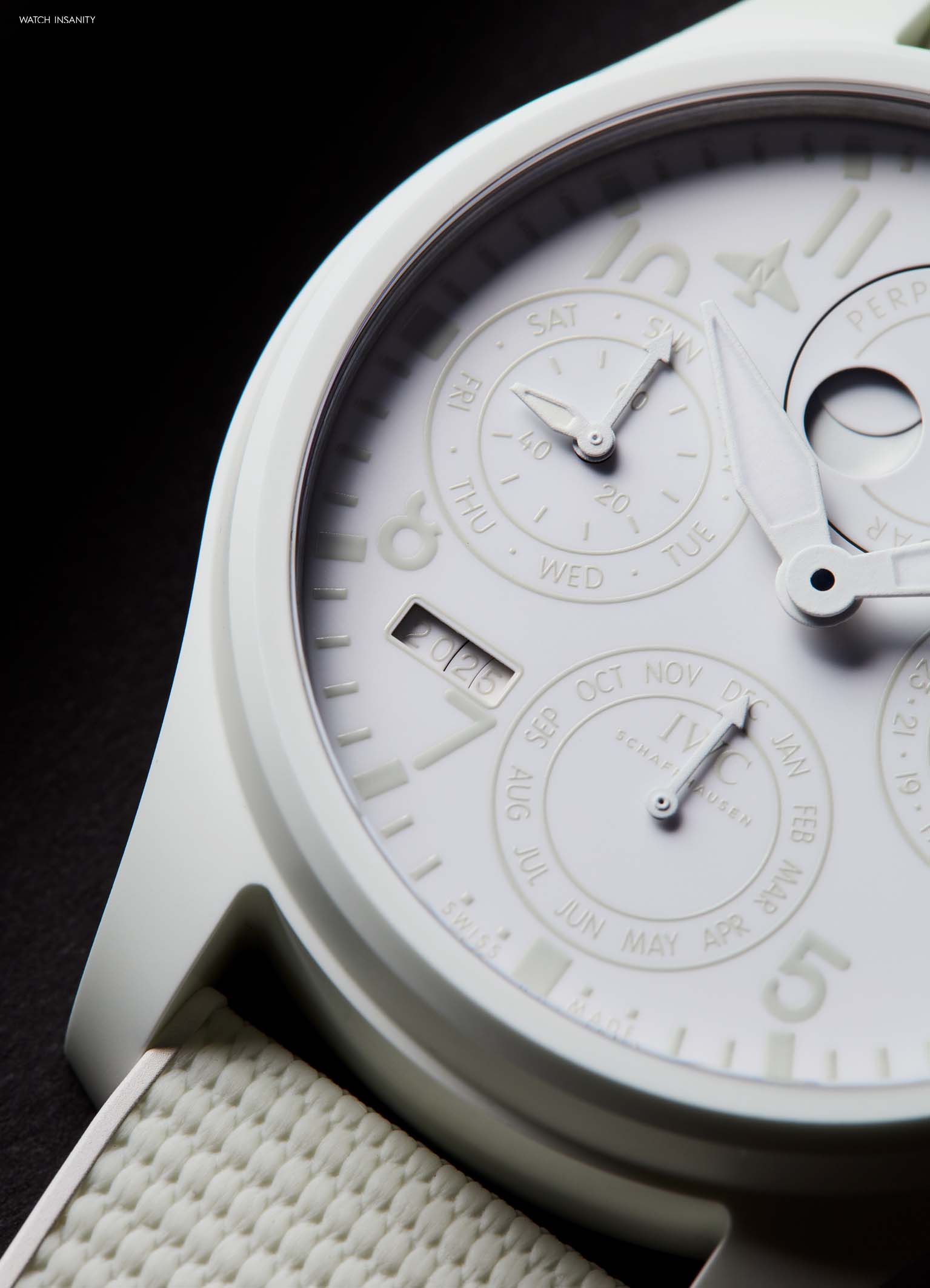
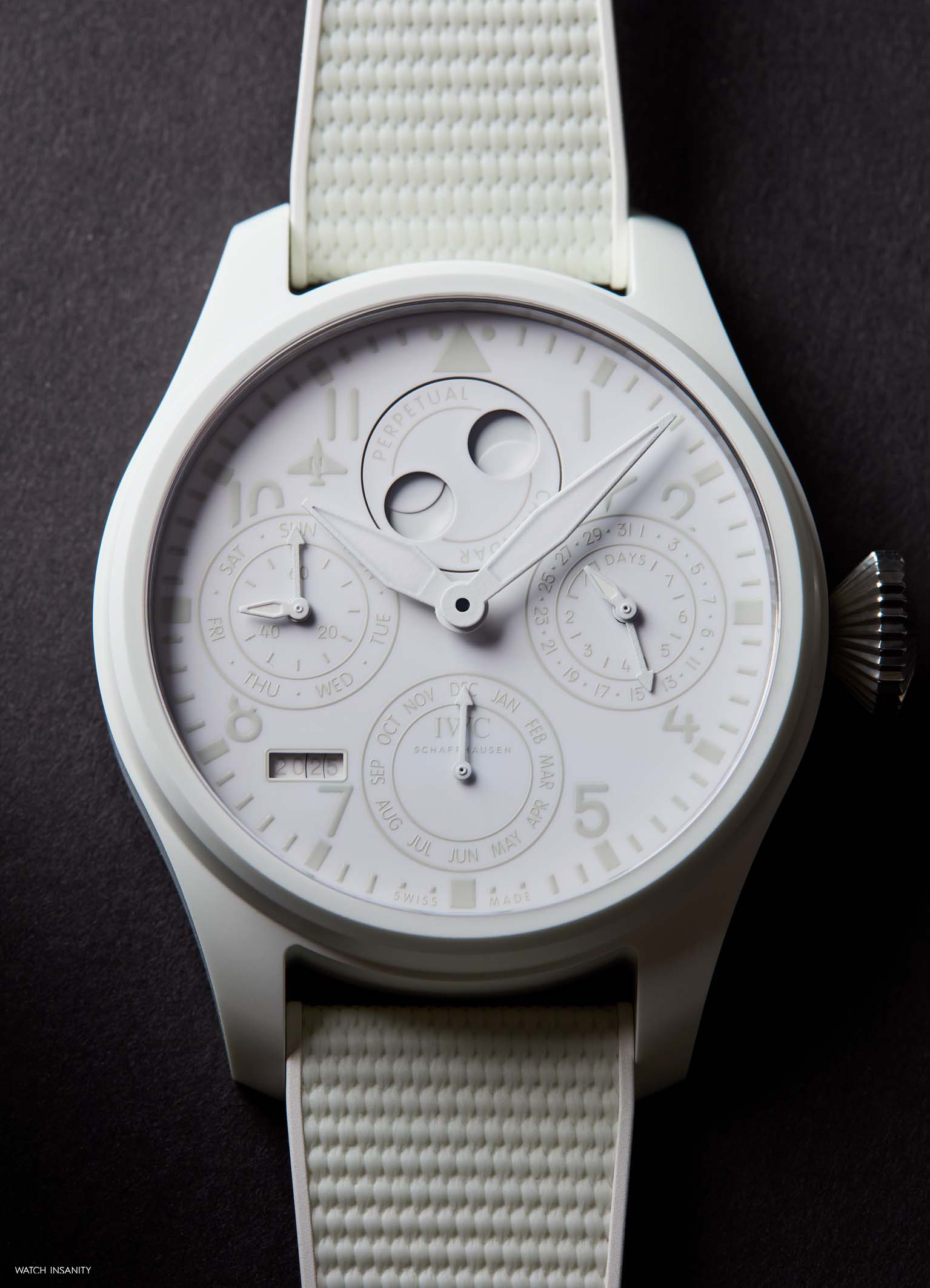
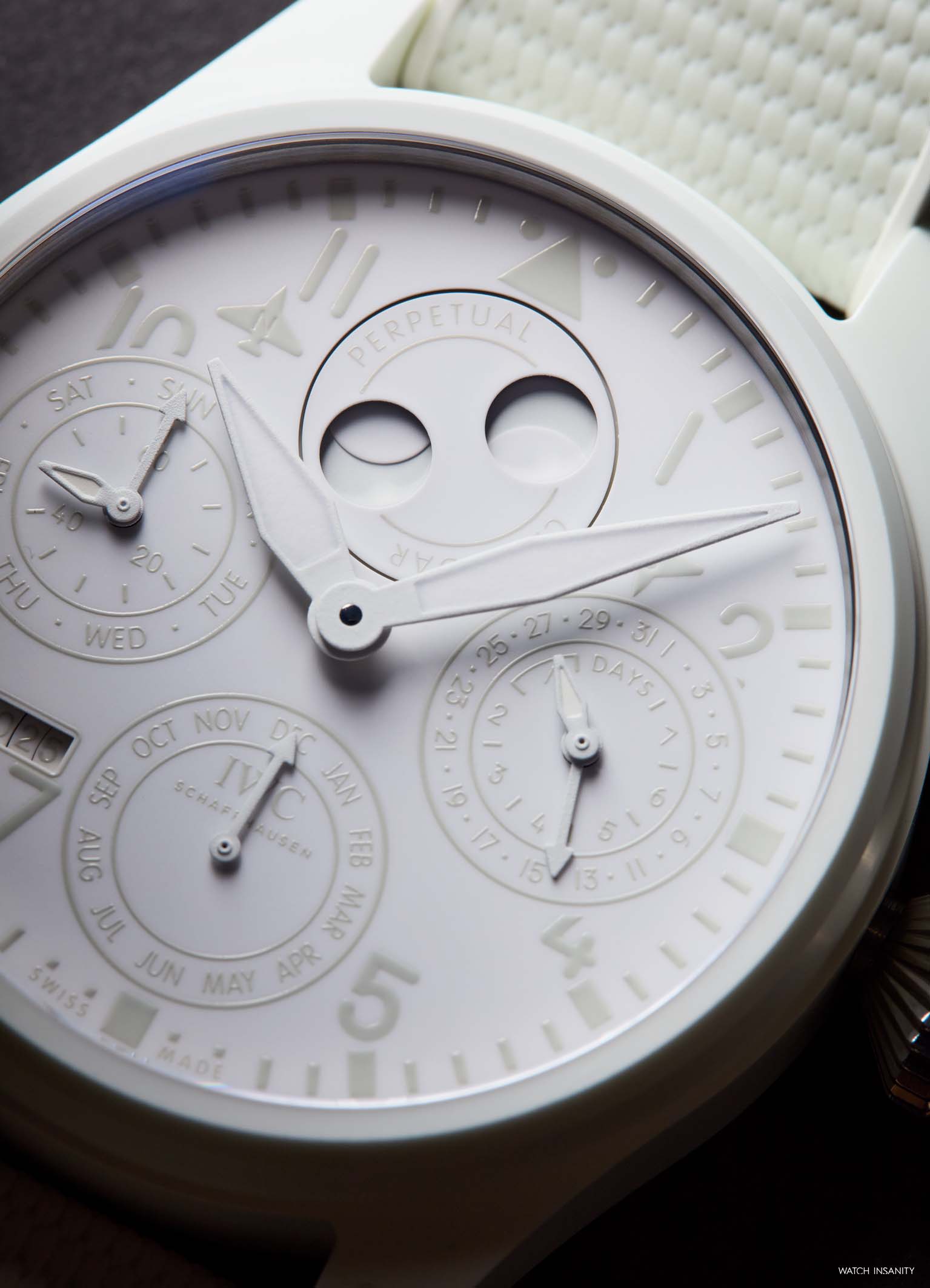
Whilst in daylight it captivates with a mix of shades of white and grey and a play of polished and matte surfaces, in the dark, the watch becomes something entirely different. The case, dial and strap emit an intense, bluish glow, whilst the hour markers and hands appear as darker shadows against the backdrop of a fully luminous dial.
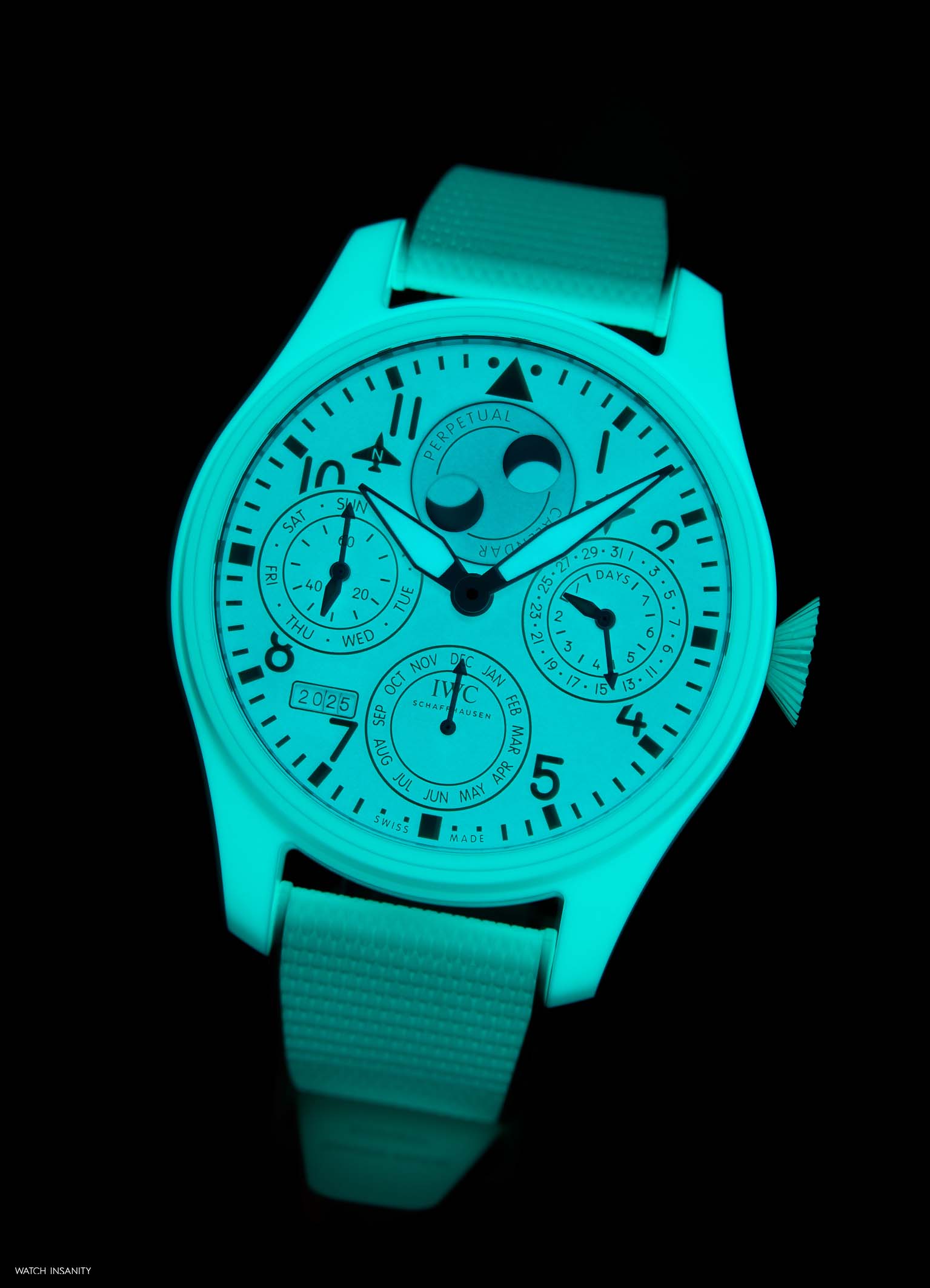
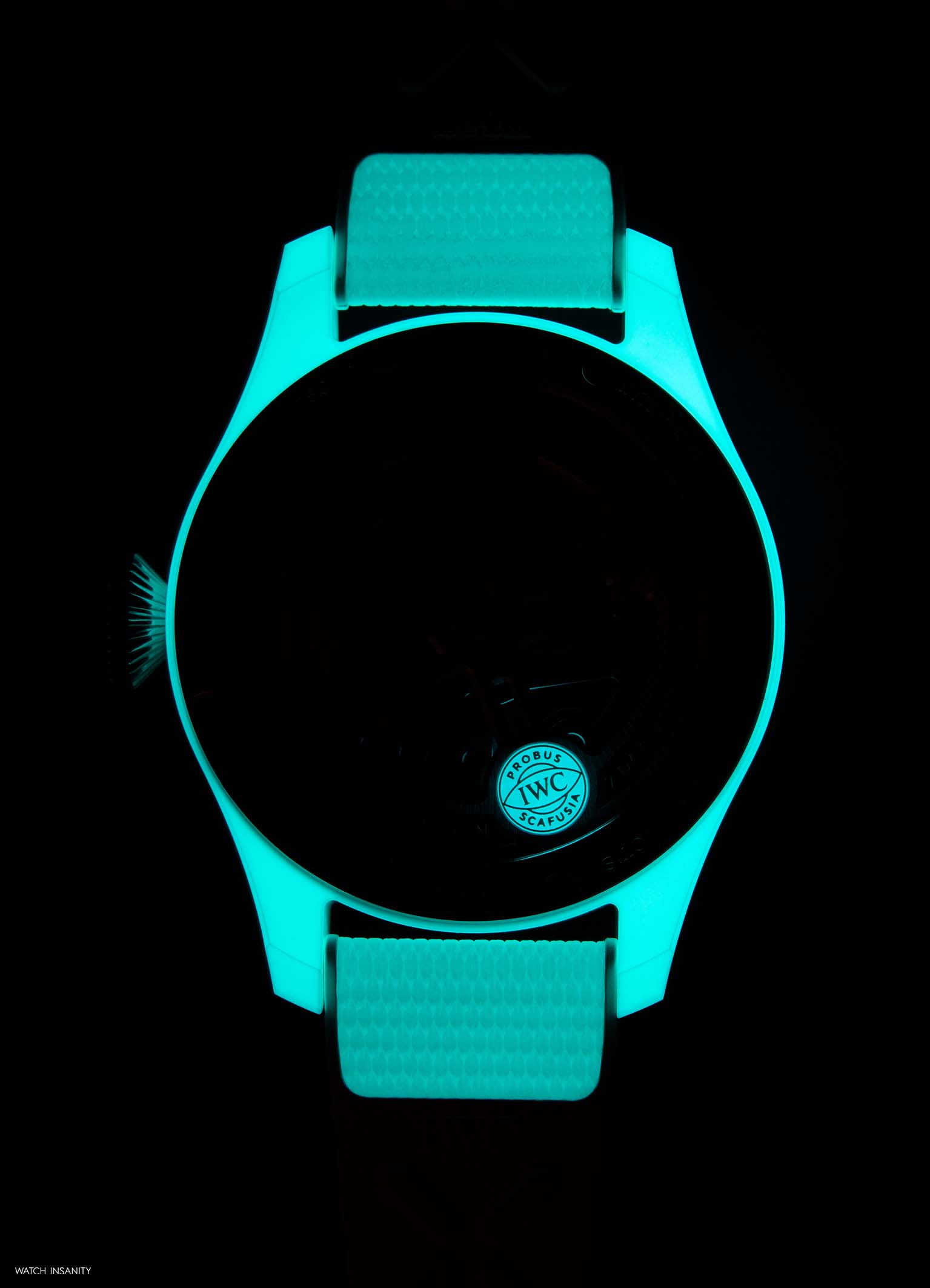
This effect is achieved not only thanks to the case material, but also because IWC’s engineers have enhanced the white dial and white rubber strap with Super-LumiNova pigments. The hour markers and numerals are printed on the dial in a different shade of white, whilst the grey hands are coated with luminescent material. When worn on the wrist in the dark, the effect is such that the watch seems almost more legible in the absence of light than in daylight.
IWC SCHAFFHAUSEN AND KURT KLAUS’ PERPETUAL CALENDAR
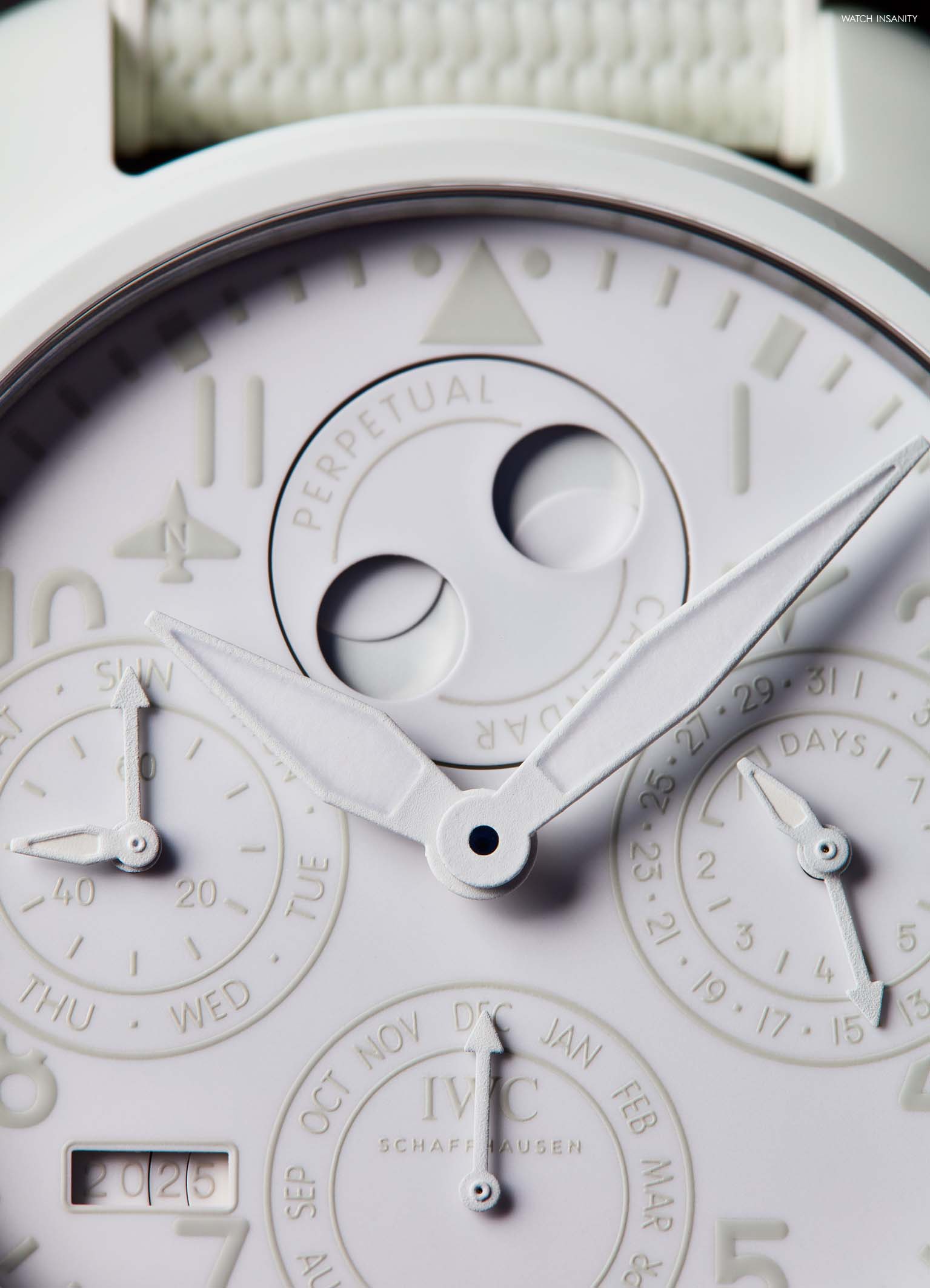
Speaking of the dial, that of the Big Pilot’s Watch Perpetual Calendar Ceralume follows the tradition of IWC’s perpetual calendars designed for this collection. At 12 o’clock is IWC’s Double Moon indicator, which shows the Moon as it appears from the northern and southern hemispheres; at 3 o’clock, the power reserve indicator and the date; at 6 o’clock, the month display; at 9 o’clock, the day of the week and the small seconds. The perpetual calendar is completed by the four-digit year display at 7 o’clock.

When discussing IWC and the perpetual calendar, one cannot fail to mention Kurt Klaus. During his time as chief watchmaker at the manufactory, he translated the Gregorian calendar, with all its irregularities, into a mechanical system designed to function flawlessly until the year 2499 without any external intervention. His design was first unveiled in 1985 in the Da Vinci Chronograph Perpetual Calendar and is still regarded today as a milestone in watchmaking. Ingeniously simple and comprising just 81 components, it propelled the Schaffhausen-based manufacturer to the pinnacle of fine watchmaking.
In the mid-1970s, Kurt Klaus created his first calendar mechanism for a pocket watch. At the time, calendars were typically integrated into a movement; he aimed to design a separate module that could be integrated into various base movements and operate as simply as possible. The idea was to use the date mechanism of the base movement as a power source. Thanks to this, a single switching impulse, activated during the night, sets in motion an entire chain of gears, advancing the displays for the date, day and moon phase. After a month, the month indicator also advances, followed by the decade and century indications over longer cycles.
HOW KURT KLAUS’ PERPETUAL CALENDAR WORKS
Every night, the base movement activates the date advance lever; a click advances the 31-tooth date wheel by one day. At the same time, another lever advances the day-of-the-week wheel and the moon phase indicator. A single tooth on the date wheel is longer than the others: at the end of each month, it automatically advances the month cam – the heart of the mechanical calendar system – by one position.

A series of ridges and recesses runs along its edge, encoding the varying lengths of the months. The mechanism operates in a similar way to the punch cards used in the early days of computing. To ensure that leap years are also accounted for, the cam represents a complete four-year cycle. A single recess, corresponding to 29 February, is deeper than all the others. In shorter months, an additional notch on the date-advance lever rests on an eccentric connected to the date wheel. At the end of months with fewer than 31 days, it drops off the eccentric and rests on a protrusion. This mechanism is indirectly controlled by the month cam. In months with fewer than 31 days, an arm connected to the date-advance lever drops into a recess. The deeper the recess, the greater the radius over which the lever moves. A longer radius causes the additional pawl to retract slightly further and drop off the eccentric at the end of the month.
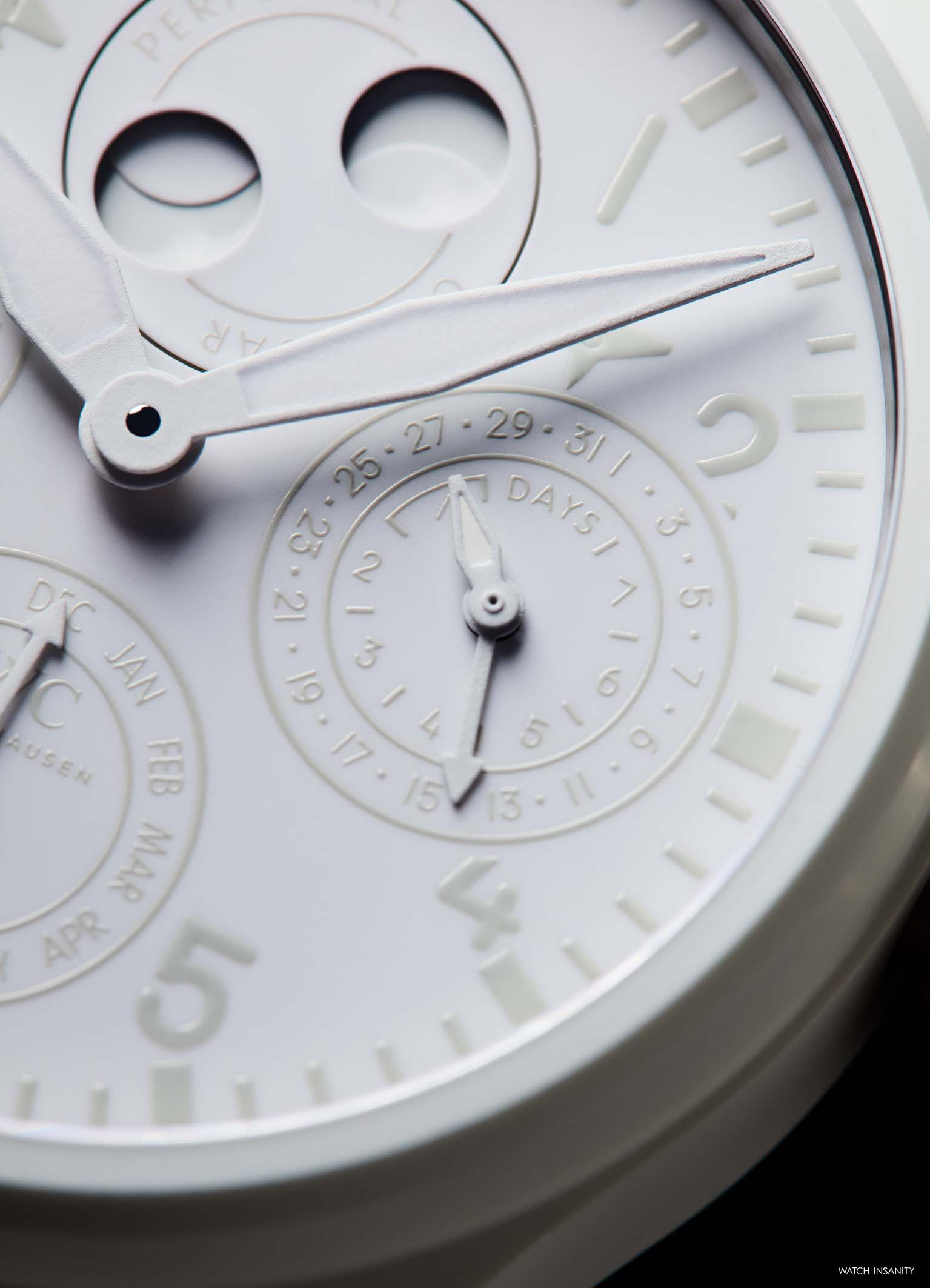
Starting from the month wheel, Klaus incorporated a transmission chain leading to a year wheel, a decade wheel and a century slider, the latter moving just 1.2 millimetres every 100 years.
IWC BIG PILOT’S WATCH PERPETUAL CALENDAR CERALUME: CALIBRE 52616
The calendar module of the watch is powered by the IWC-manufactured calibre 52616, based on the calibre 52010from the 52000 family, introduced in 2015. This is IWC’s new generation of automatic movements with a 7-day power reserve. Compared to previous models, the Pellaton winding system has been reinforced with ceramic components, improving durability. Energy is stored in two barrels, and the calibre operates at 28,800 vibrations per hour.
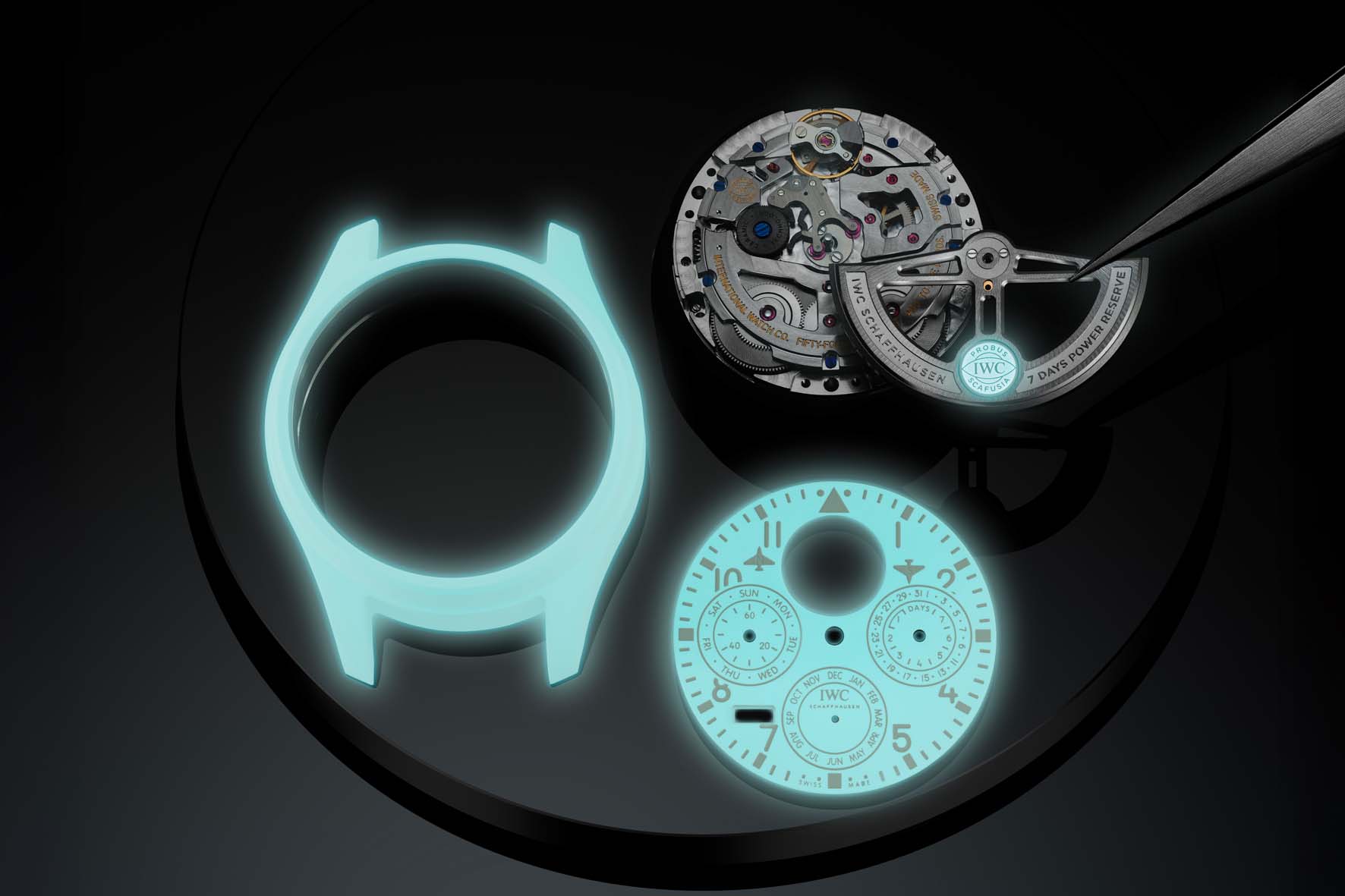

The luminescent details extend to the case back, where the medallion bearing the inscription “Probus Scafusia”, integrated into the gold rotor, is made of Super-LumiNova and glows in the dark like the rest of the timepiece. Decorated with perlage and fitted with blued screws, the calibre 52616 is visible through the sapphire crystal case back.
PRICE AND CONCLUSIONS
As mentioned at the start, the Big Pilot’s Watch Perpetual Calendar Ceralume has been produced by IWC Schaffhausen in a limited run of just 250 pieces. As befits a limited-edition watch characterised by extensive research into advanced materials, its price is substantial: €78,400.

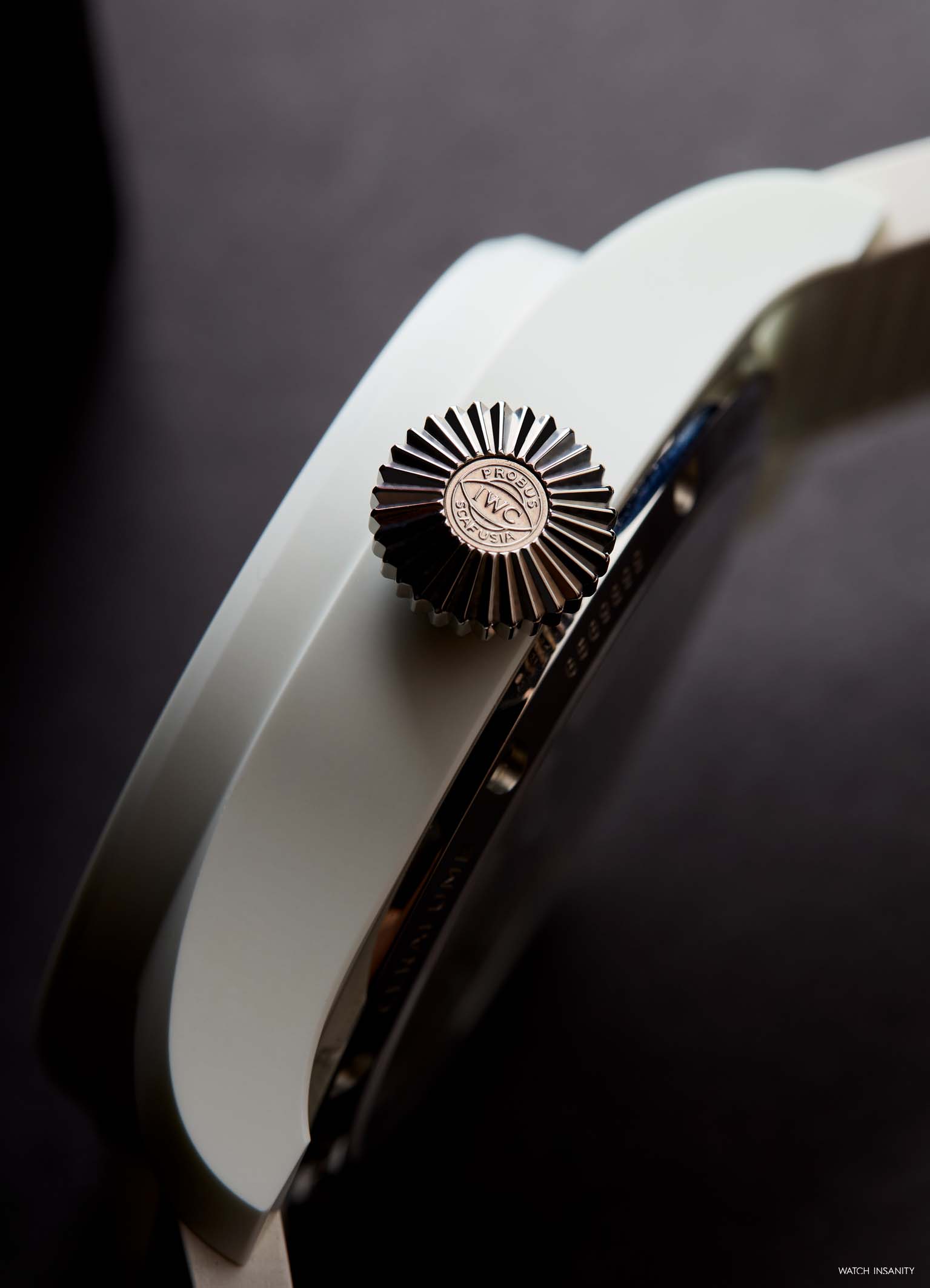
That said, the impression we gained from wearing it at both Watches and Wonders Geneva and in Milan, during an exclusive preview in March, was striking. The 46.5 mm case is certainly noticeable on the wrist, although the relatively lightweight material ensures overall comfort. What is truly impressive, however, is the luminescence provided by Ceralume. It stands out for its intensity, duration and distinctive blue-tinged colour – unusual, visually striking and highly effective in terms of readability. So much so that, paradoxically, the indications of the perpetual calendar and the time appear even easier to read in the dark than in daylight.


Ultimately, the Big Pilot’s Watch Perpetual Calendar Ceralume remains both a professional timepiece and, in a sense, an experimental watch. With this model, IWC introduces a new material that will likely find its way into future collections. Seen in this light, the watch becomes even more compelling and, although aimed at a niche of enthusiasts, we believe it will hold a prominent place among the most prestigious creations of the Schaffhausen-based manufacturer.
By Davide Passoni