

After bringing renewed attention to classically inspired watchmaking with the Millésime, Raymond Weil takes a different direction with A.R.T., an entirely new collection that introduces an integrated-bracelet watch for the first time in the Maison’s history. The launch comprises five 38 mm automatic references alongside nine 30 mm quartz models, arriving in the year the Geneva-based brand celebrates its 50th anniversary. It opens a new chapter in contemporary sport-chic watchmaking without abandoning the balanced proportions and accessibility that have distinguished the Maison’s most recent creations.
FROM THE MILLÉSIME TO THE NEW RAYMOND WEIL A.R.T.
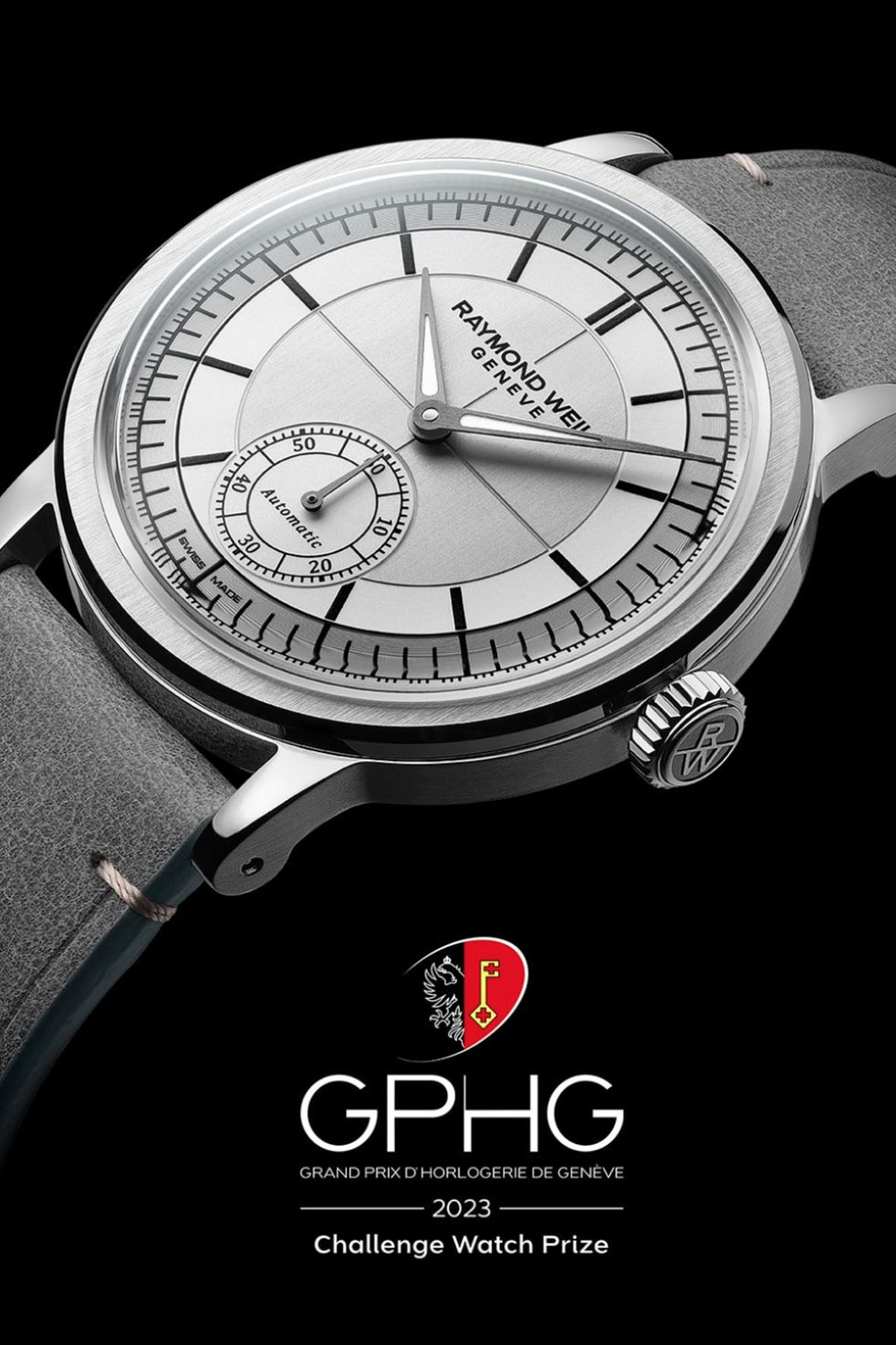
To fully understand the direction Raymond Weil has taken with A.R.T., it is worth beginning with a watch that, at least on the surface, appears to belong to an entirely different world. In 2023, the Raymond Weil Millésime Automatic Small Seconds won the Challenge Watch Prize at the Grand Prix d’Horlogerie de Genève, bringing a collection built around restrained proportions, a sector dial and clear references to mid-20th-century watchmaking into the spotlight, yet interpreting them with a clarity of design that makes them thoroughly contemporary.

Three years later, Raymond Weil builds on that journey by placing something very different alongside the Millésime, moving into one of the categories that has most strongly shaped contemporary watchmaking. The integrated bracelet appears for the first time in the brand’s history and becomes the starting point for the entire construction, directly influencing the design of the case, bezel and first links. The collection’s name also retains a connection to Raymond Weil’s longstanding relationship with art, music and culture, but it would be reductive to view A.R.T. solely through that reference. In its 50th-anniversary year, the Maison introduces a family that significantly updates its catalogue, bringing the philosophy of accessible Swiss Made watchmaking championed since its foundation in 1976 into a decidedly more contemporary design language.
RAYMOND WEIL A.R.T. 38 MM: CASE AND INTEGRATED BRACELET
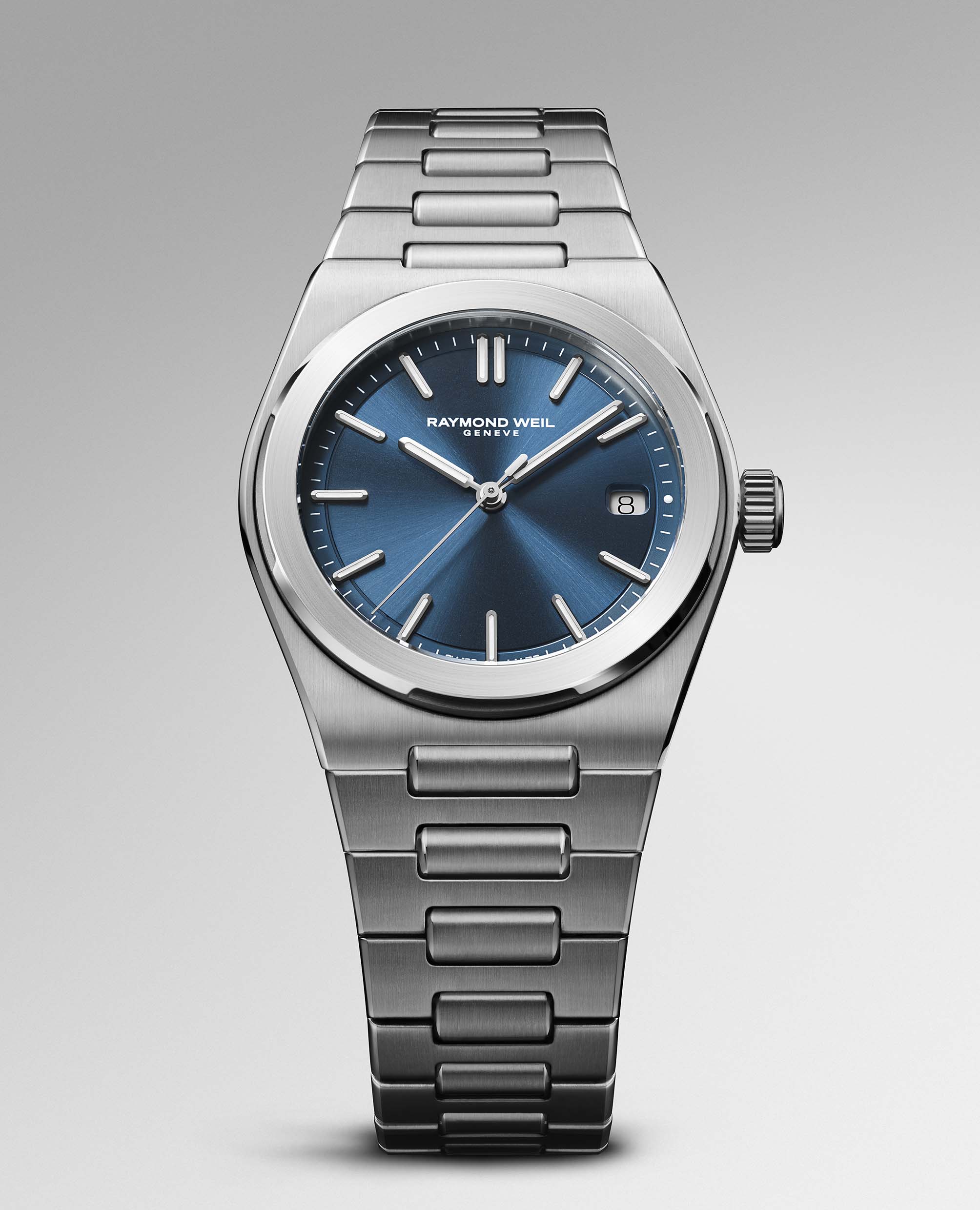
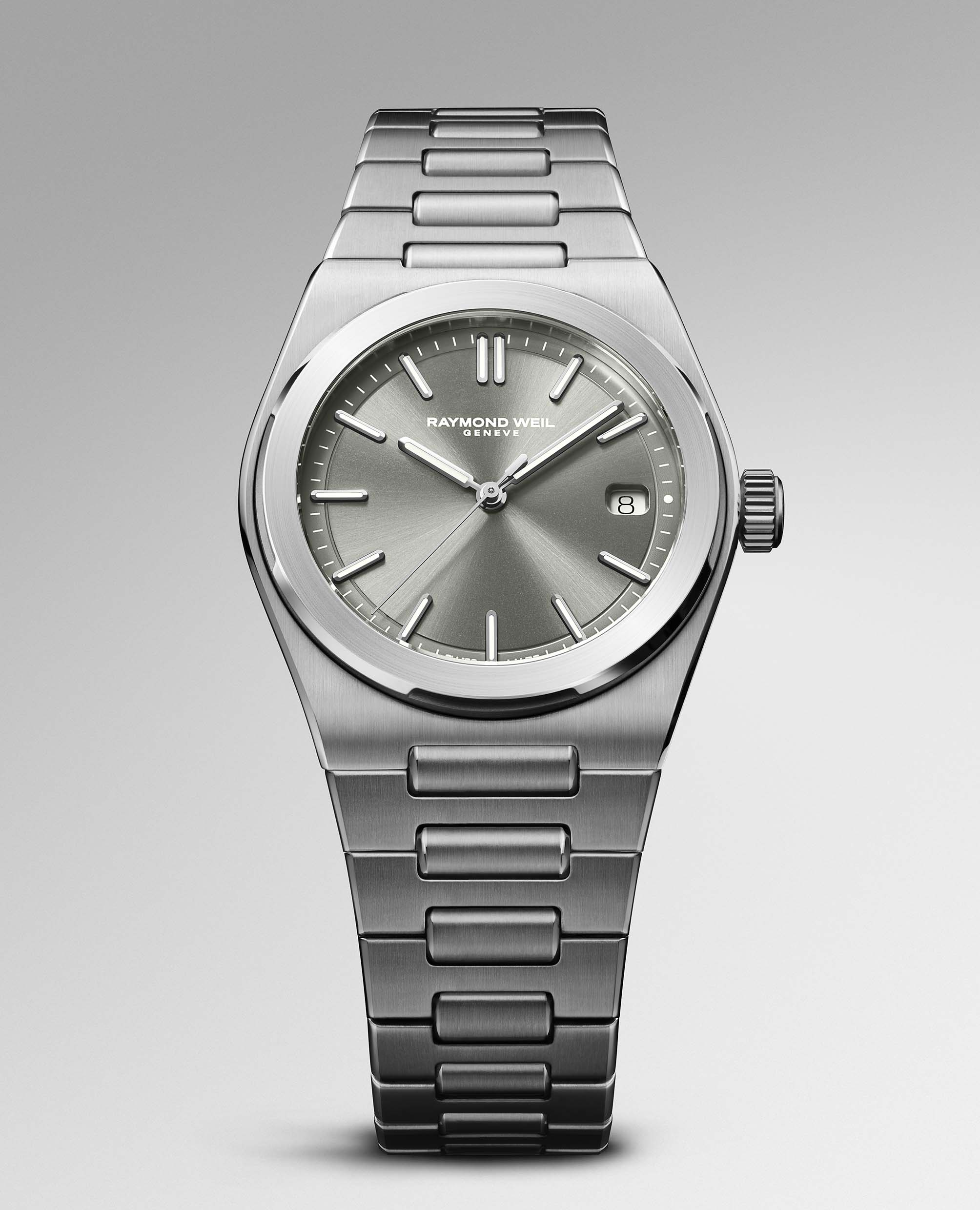
Viewed from the front, the 38 mm Raymond Weil A.R.T. retains the reassuring regularity of a round case. A slight change of perspective, however, reveals a more complex design: the sculpted bezel meets a more structured case middle, which flows directly into the bracelet, creating the visual continuity that is one of the collection’s defining features.
For the occasion, Raymond Weil has developed an H-link construction with chamfered intermediate elements, satin-brushed surfaces and polished bevels that follow the outline of the case and continue along the bracelet. Polishing accentuates the edges and changes in volume, while satin brushing covers the larger surfaces, allowing the watch’s architecture to emerge as the wrist moves and the light shifts.
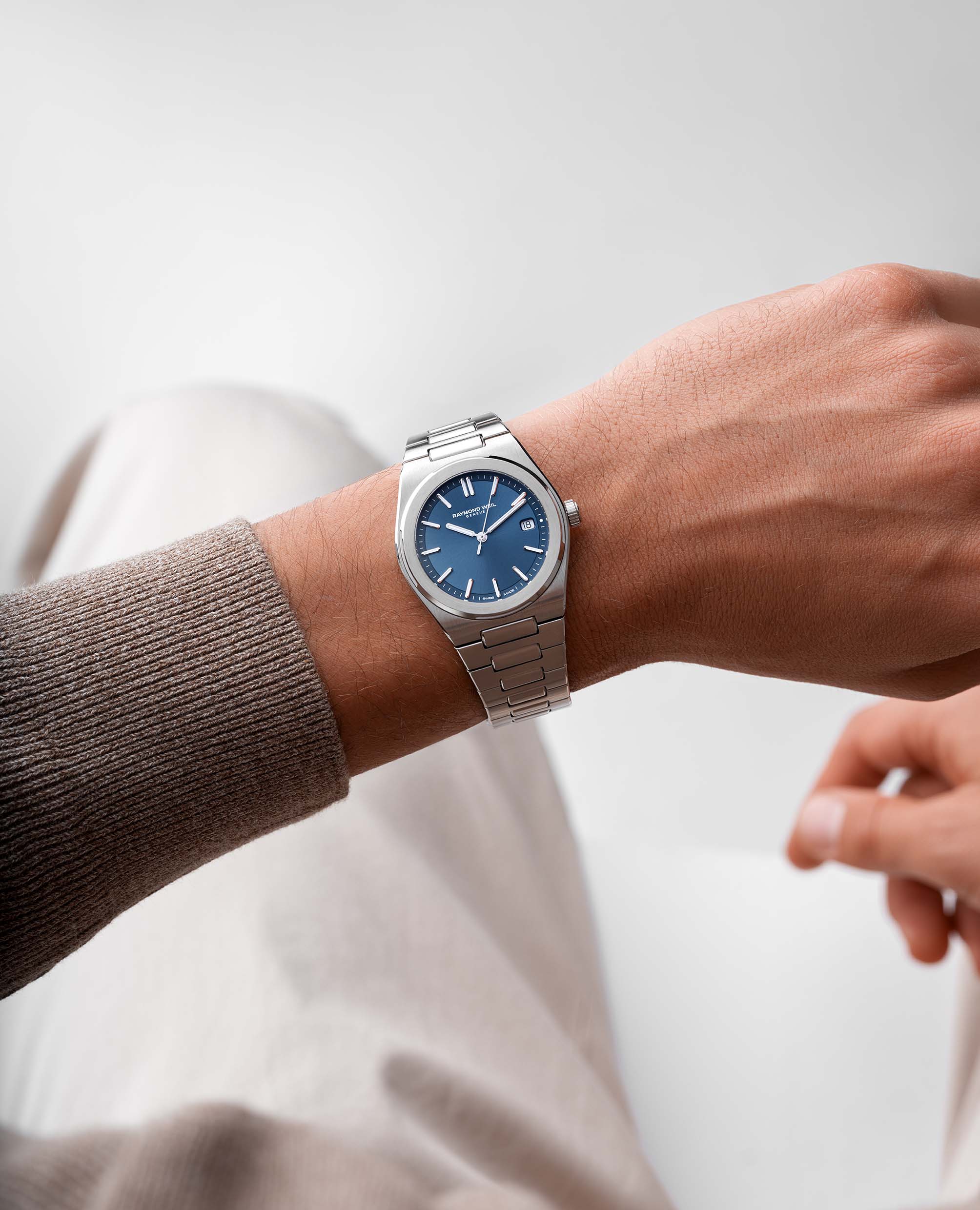
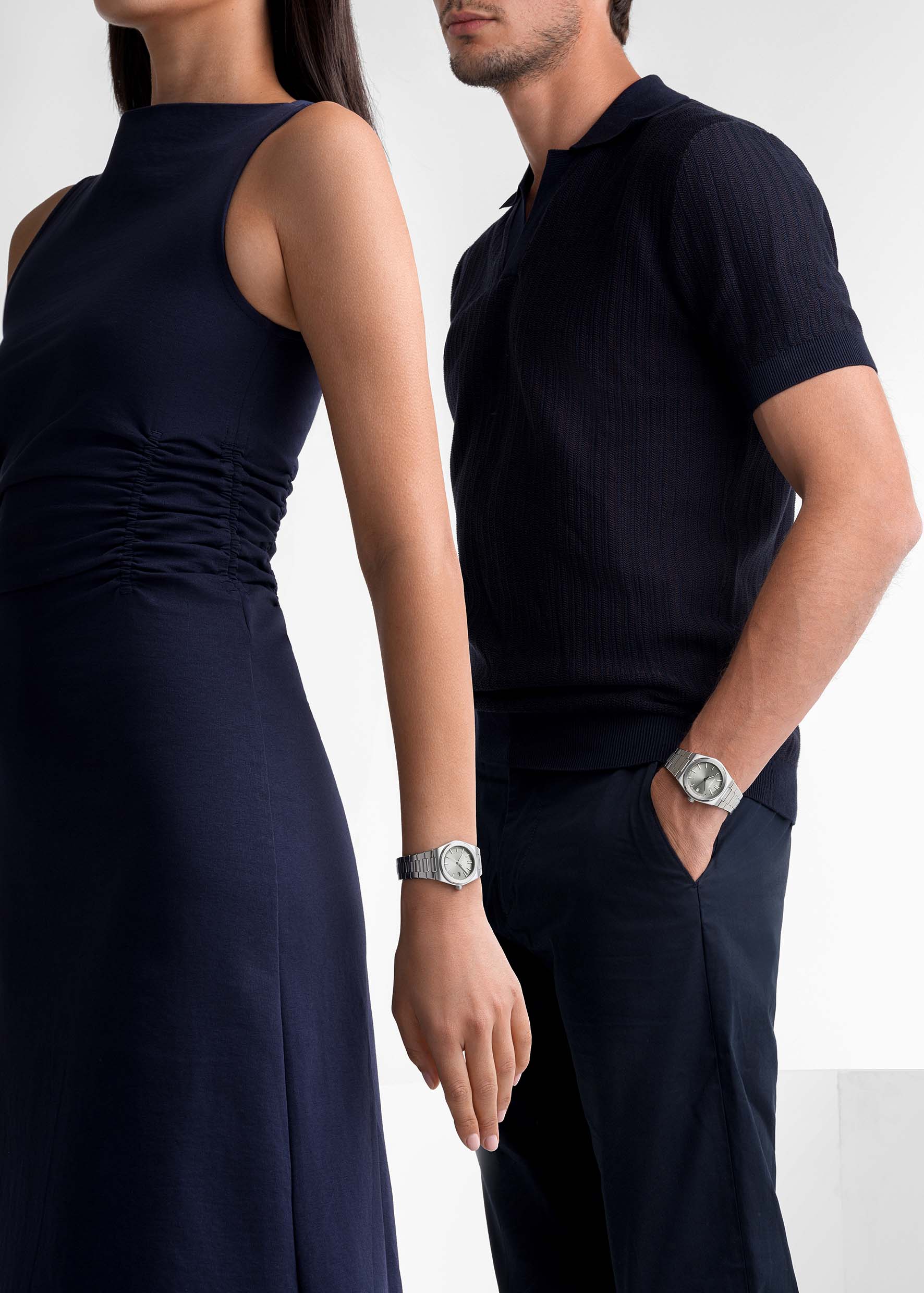
The fluted crown echoes some of the bezel’s geometric details, while the bracelet follows the curve of the wrist and features a folding clasp. These details give the concept of integration a more tangible meaning: the case, bracelet components and distribution of finishes have been conceived as elements of a single design, rather than separate parts simply joined together. The 38 mm diameter chosen for the automatic version also deserves closer attention, particularly because, with an integrated-bracelet watch, diameter tells only part of the story of how it wears. Here, the case middle flows directly into the first links, increasing its perceived presence on the wrist, but a thickness of just 9.95 mm helps keep the overall proportions in check, preserving a slim, balanced profile despite the integrated architecture.
RAYMOND WEIL A.R.T. AUTOMATIC: FIVE REFERENCES
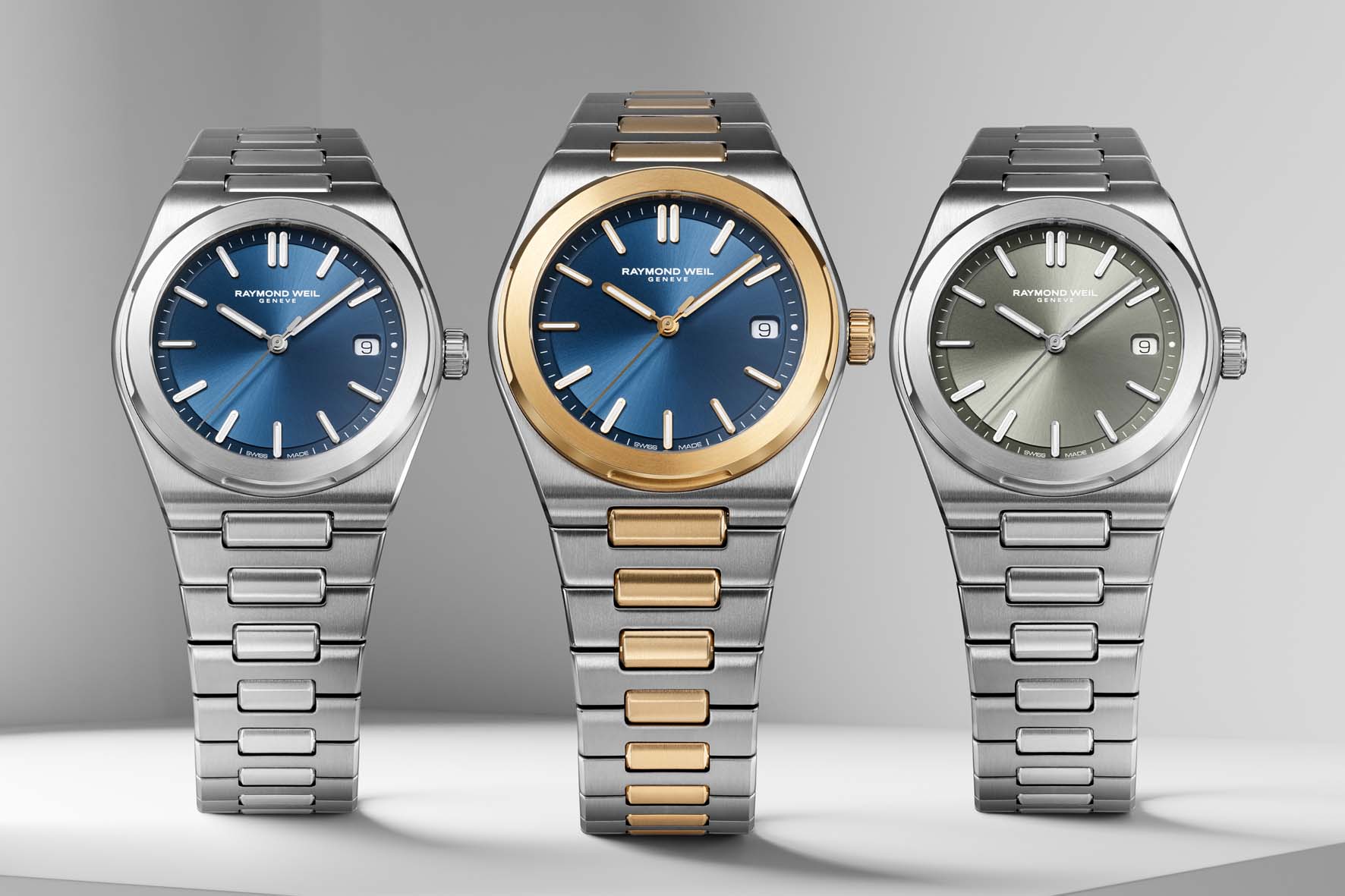
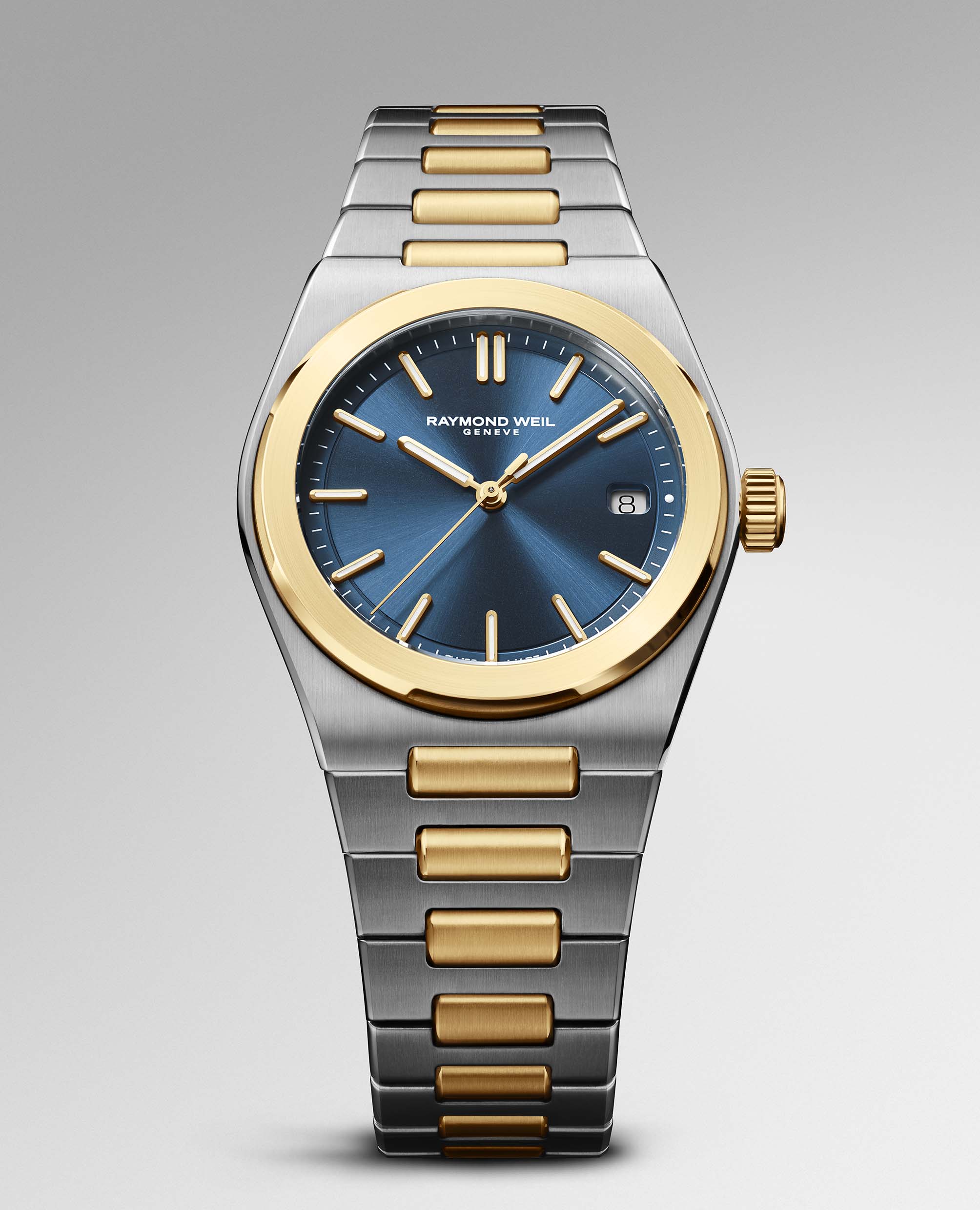
The automatic A.R.T. debuts in five references built around three dial colours: sage grey, metallic blue and graphite. The three all-steel configurations are joined by two two-tone versions with yellow-gold PVD details on the case and integrated bracelet, giving the watch a more refined character and a different visual presence.

Colour is only one aspect of the dial. Its central area features a sunray-brushed finish that produces changing shades as the light moves, while the outer minute track has a finer, more regular azuré finish. A recessed groove separates the two surfaces both physically and visually, adding depth to the dial. Applied indices and faceted hands are filled with green Super-LumiNova, while an additional luminous dot appears on the minute track. The date remains in its traditional position at 3 o’clock, but the window has a chamfered edge that integrates it more neatly into the dial’s geometry and helps keep the composition orderly.

On the front is a sapphire crystal with anti-reflective and anti-fingerprint coatings, while on the back the Maison has opted for a solid caseback that can be personalised with an engraving. It is a less theatrical solution than a display back, but one that makes sense for a watch whose principal points of interest lie on the outside, in the dial, case and bracelet.
AUTOMATIC MOVEMENT, 41-HOUR POWER RESERVE AND 100-METRE WATER RESISTANCE
The 38 mm A.R.T. is powered by a Swiss Made automatic movement displaying hours, minutes, central seconds and date, with a 41-hour power reserve. This choice completes a configuration designed for everyday use and fits a watch whose character is largely expressed through its external construction and proportions.

In this context, the water resistance of up to 100 metres is particularly noteworthy, especially when paired with a case measuring less than 10 mm thick. Sapphire crystal, luminescent material, a steel bracelet and this level of water resistance genuinely broaden the A.R.T.’s everyday versatility, while its restrained diameter and carefully considered finishes preserve the elegance that makes the Maison’s sport-chic description appropriate.
RAYMOND WEIL A.R.T. 30 MM: NINE QUARTZ REFERENCES
At 30 mm in diameter, the same architecture inevitably takes on a different character, leaving more room for precious materials and details. The nine women’s references retain the integrated bracelet, sunray-brushed dial, applied indices and luminous hands, but use a Swiss Made quartz movement that brings the case thickness down to just 7.5 mm. Water resistance remains at 100 metres, with a sapphire crystal, date at 3 o’clock and a bracelet with folding clasp.

Above all, the range offers greater aesthetic variety: three steel references feature sage grey, charcoal blue and mother-of-pearl dials, while four versions have a bezel set with 48 lab-grown diamonds totalling 0.40 carats, offered in different combinations of mother-of-pearl, steel, two-tone finishes and rose-gold PVD. The final two configurations introduce yellow-gold PVD, first in a two-tone version and then across the entire watch, completing a broader and more refined women’s collection.
RAYMOND WEIL A.R.T.: PRICES AND FINAL THOUGHTS
The pricing places the 38 mm Raymond Weil A.R.T. firmly within the Maison’s established positioning: the all-steel versions cost € 1,995, rising to € 2,095 for the two-tone configurations. The women’s references cover a wider price range, starting at € 1,525 and reaching € 2,975 for the most precious interpretation in the collection.

A comparison with the Millésime is almost inevitable. One continues to explore the proportions and codes of classical watchmaking; the other opts for a more architectural case, metal as the dominant element and, above all, the integrated bracelet that has become one of the central themes of contemporary watchmaking in recent years. The two collections are very different in form, but share an ambition to interpret recognisable categories without exaggerating their defining traits.
In its 50th-anniversary year, Raymond Weil thus places a collection with an entirely different design language alongside the Millésime, turning the first integrated-bracelet watch in its history into a fully realised family. Having captured enthusiasts’ attention with the Millésime’s retro appeal, the Maison is now engaging with one of the most popular categories in contemporary watchmaking. The challenge will be to make A.R.T. what the Millésime has already become for Raymond Weil: a collection recognisable for its design even before the name on the dial.
By Elisa Copeta