

Some watches simply work. Others appeal. A very few go further, redefining the rules entirely. The Nautilus belongs firmly to that last category. It was never conceived to please, but to redefine what a Patek Philippe watch could be. When it was introduced in 1976, the Maison was not simply launching a new model, it was challenging its own definition of luxury. A large steel sports watch with a deliberately industrial aesthetic, everything Patek Philippe was not supposed to be. And precisely for that reason, it worked.
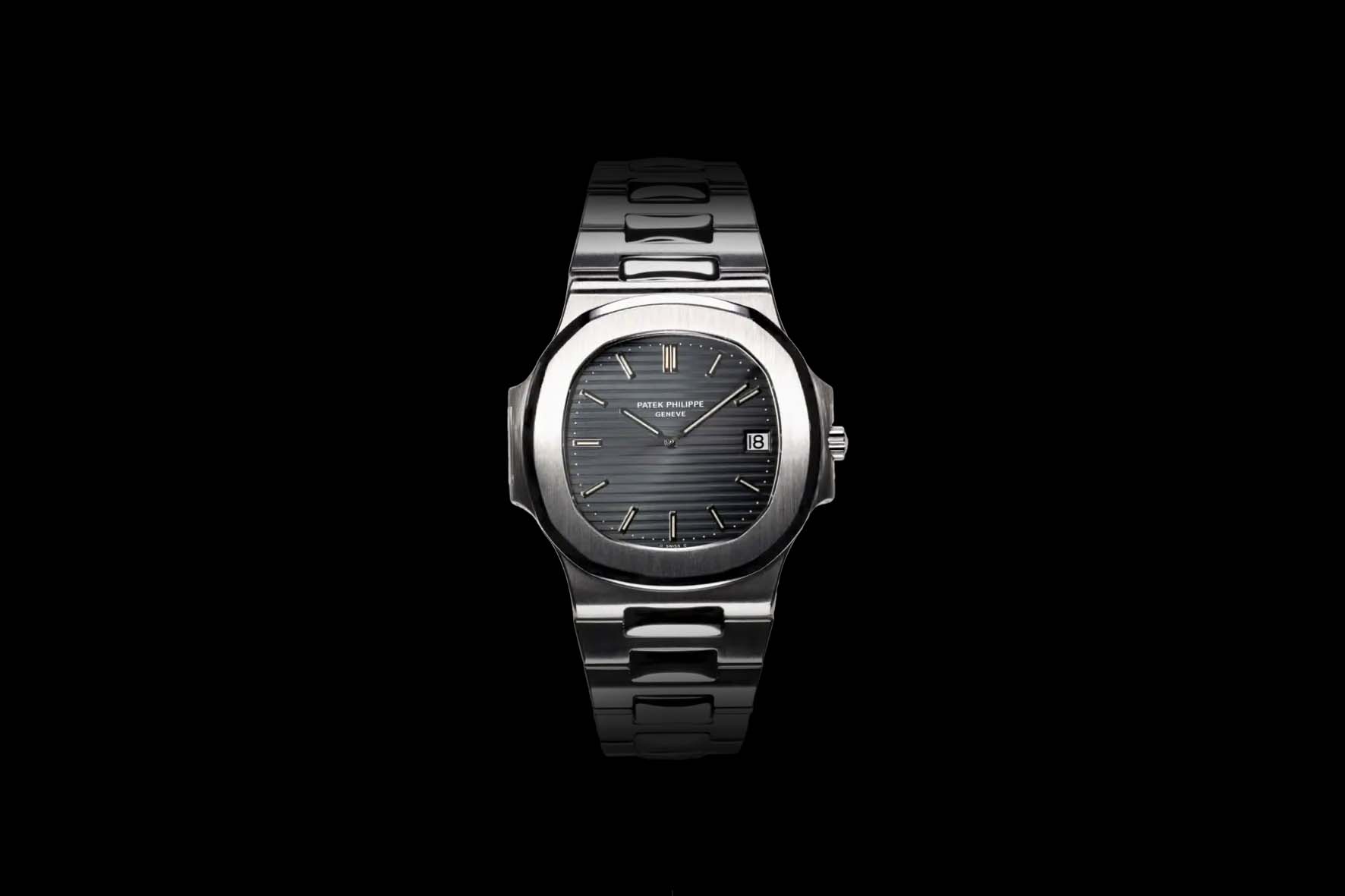
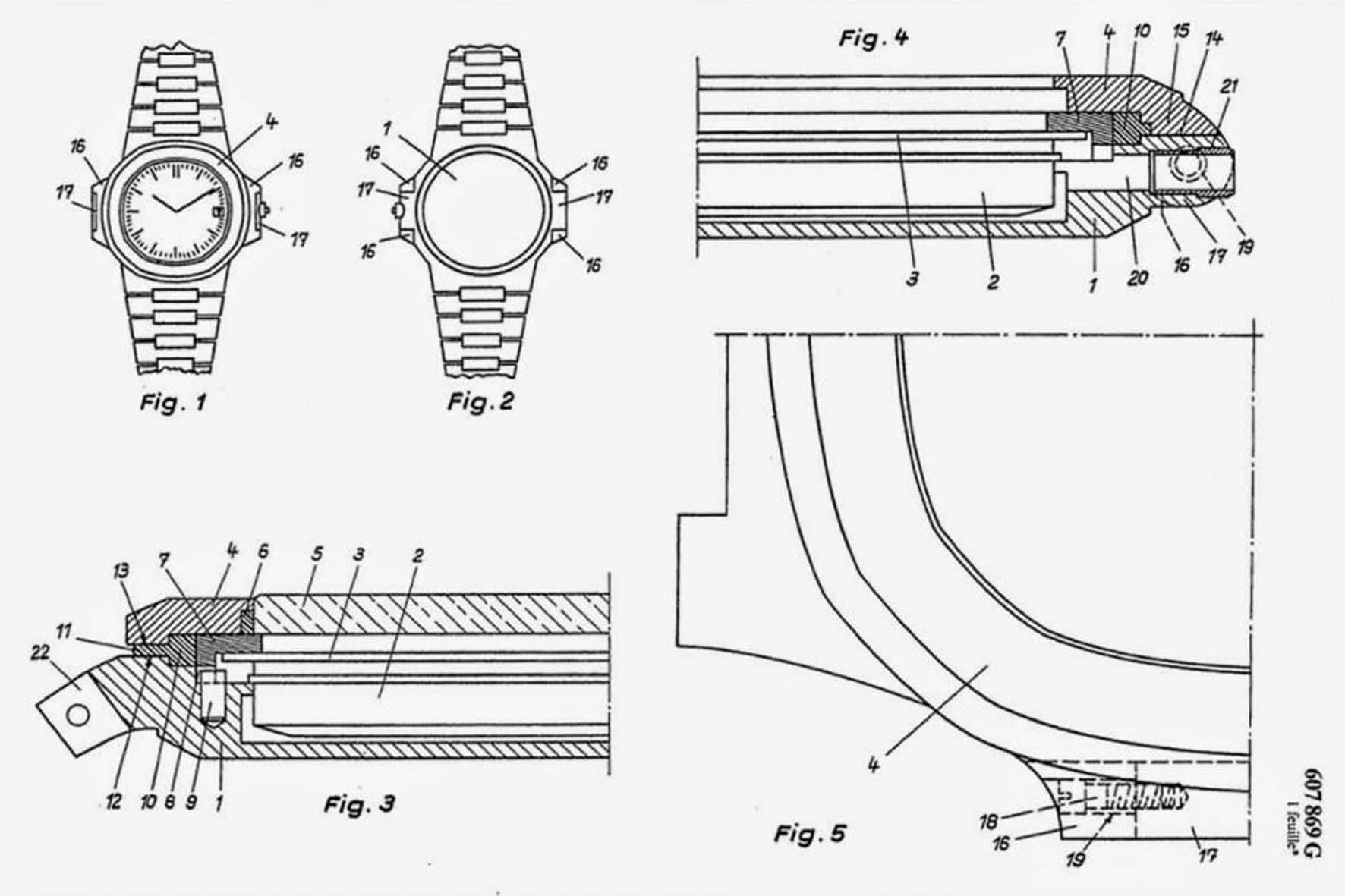
Its origin has since become part of watchmaking lore. Gérald Genta conceived the first Nautilus (Ref. 3700) from an idea as simple as it was radical: a ship’s porthole, observed and translated into a case. A form that was technical before it became aesthetic, where construction plays a central role. The case is built in two parts: the case middle integrates the caseback and features a single opening for the winding stem, while the bezel is fixed and compressed onto the case through a system of lateral hinges and four locking screws. An architecture directly inspired by the portholes of transatlantic liners, engineered to ensure a watertight seal and structural integrity.
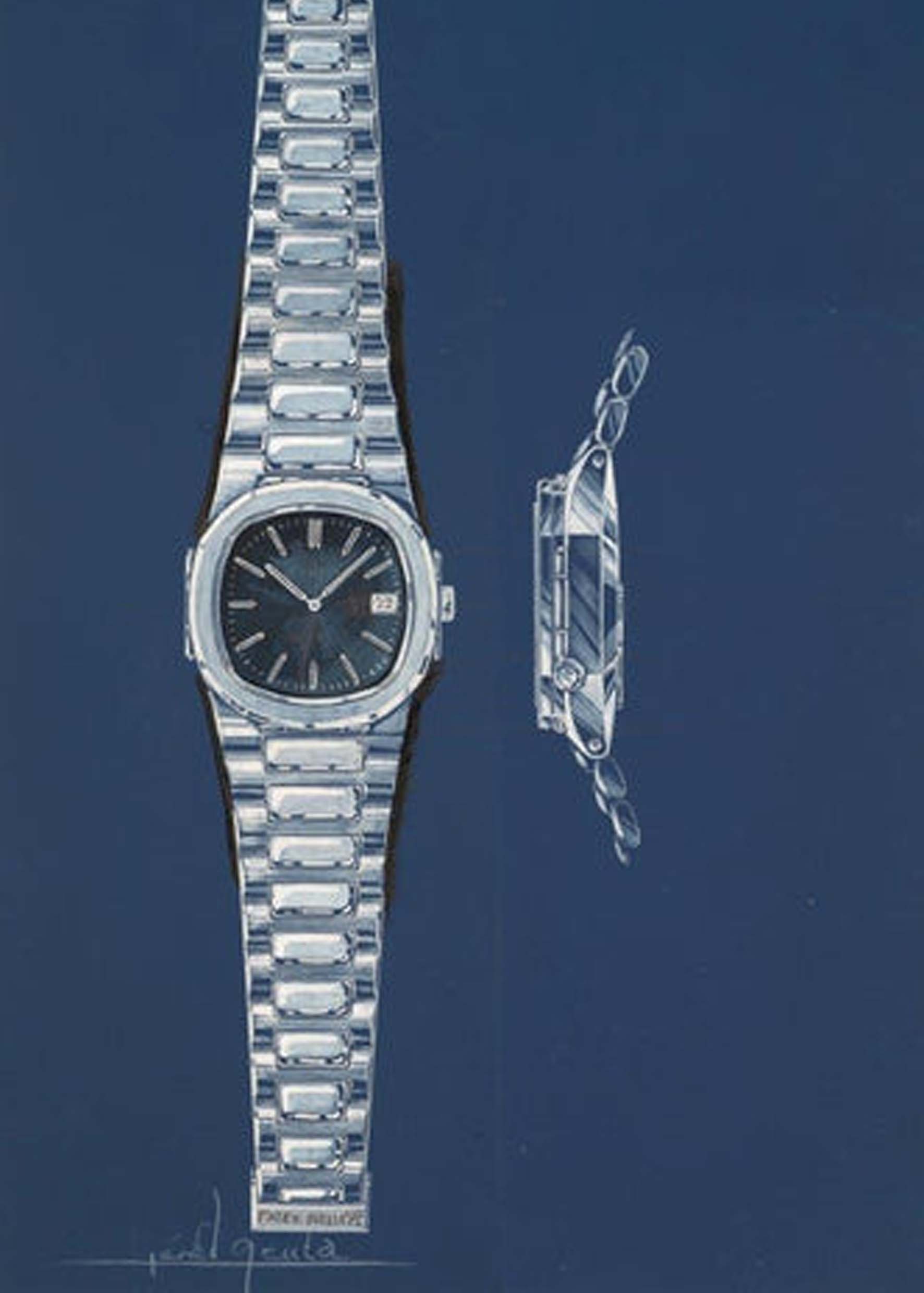
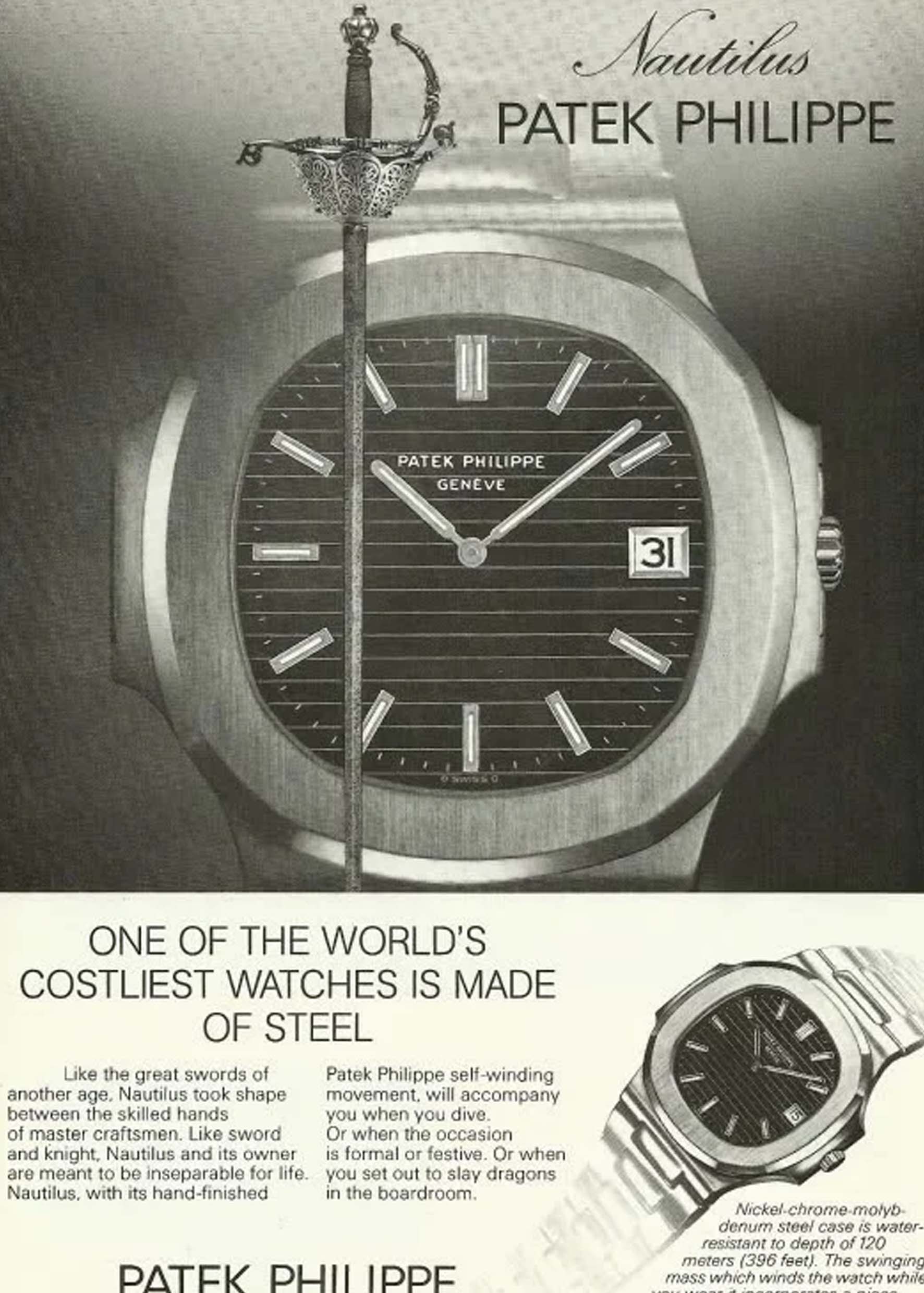
Behind every detail lies a technical rationale: a construction designed to guarantee water resistance and robustness at a time when luxury was still closely tied to gold and formality. The strength of this architecture is matched only by the case’s water resistance, which at the time represented a true technical achievement for a watch so slim and refined and a genuine breakthrough for a serially produced sports watch. The horizontally embossed dial reinforces its character, while underlining its sporting identity.
It was never meant to appeal to everyone. It was large, made of steel, and fundamentally different. Yet it is precisely this tension between sportiness and formal rigor that defines it. The integrated bracelet, the interplay of satin-brushed and polished surfaces, the horizontally embossed dial, each element contributes to a design language that is instantly recognizable and remarkably consistent. Not a stylistic exercise, but a design grammar that Patek Philippe has never truly altered, only refined with exceptional discipline. The Nautilus did not become iconic through change, but by remaining remarkably true to itself across decades, complications and variations. A rare balance that has transformed it from a controversial proposition into one of the most desirable and recognizable watches in the world.
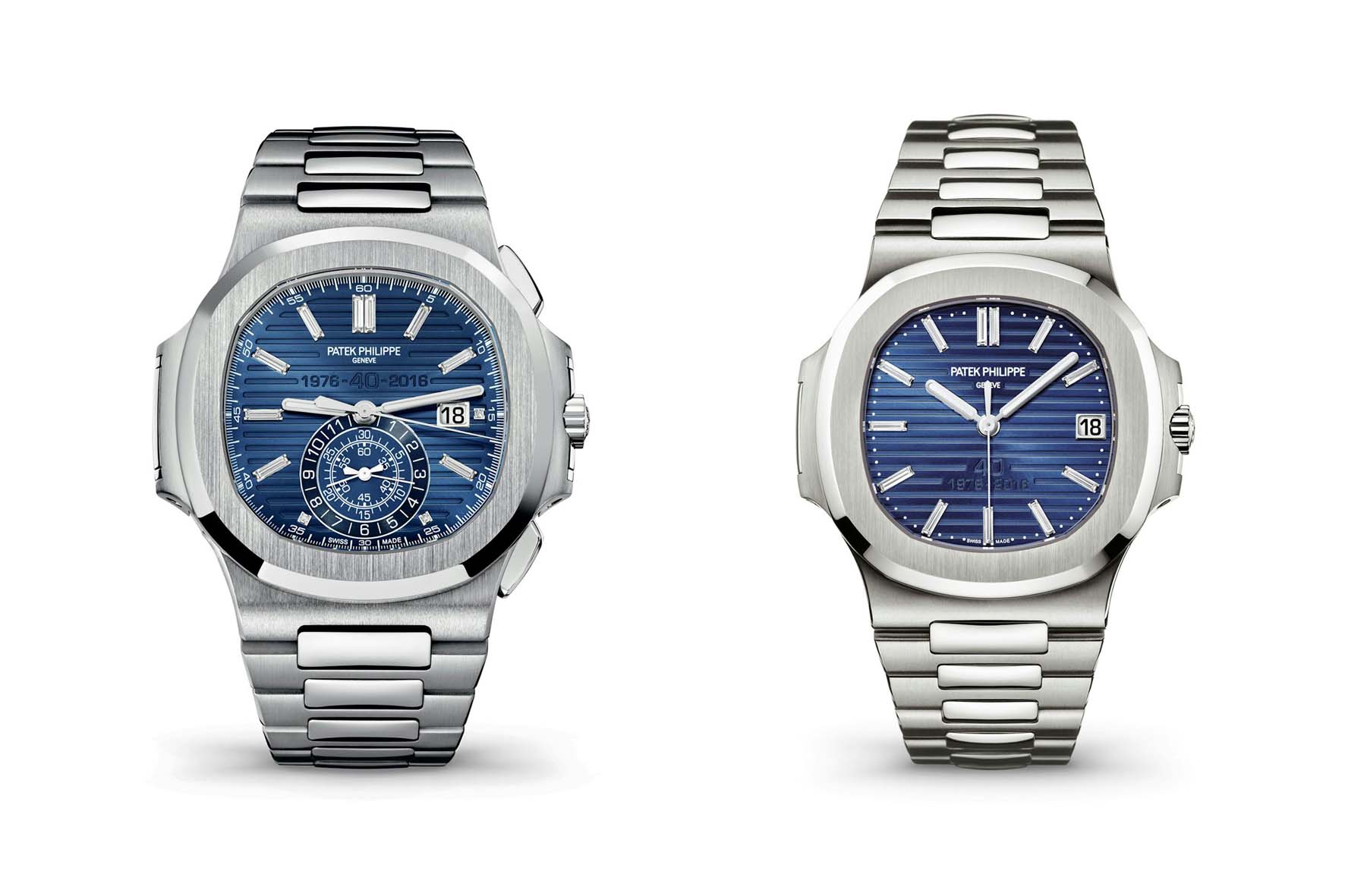
This is not the first time Patek Philippe has revisited the Nautilus to mark a milestone. In 2016, for its fortieth anniversary, the Maison introduced two clearly defined commemorative editions: the platinum Ref. 5711/1P, recognizable for its blue dial with baguette-cut diamond hour markers and the inscription “40–1976–2016”, and the Ref. 5976/1G, a 44 mm white gold chronograph with noticeably enlarged proportions. Two interpretations that worked explicitly through materials, scale and wrist presence. A different approach from the one adopted today, where the focus shifts toward more subtle, controlled refinements without intervening on the structure that defines the model.
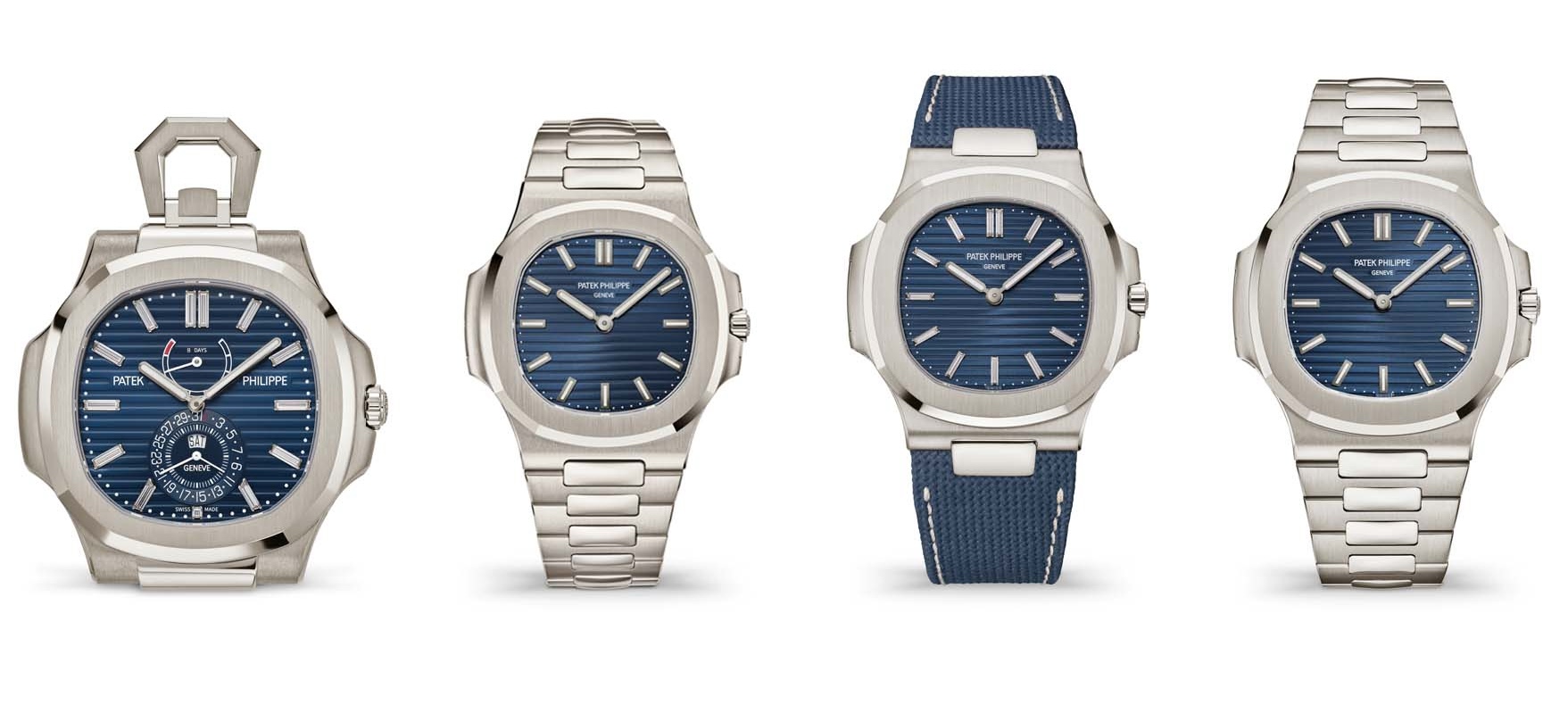
Fifty years later, Patek Philippe returns to the Nautilus with an approach fully aligned with its philosophy: not to revolutionize, but to refine. For Watches and Wonders 2026, the Maison introduces four limited editions defined by remarkably slim proportions and an ultra-thin profile, while leaving intact the structure that defines the contemporary Nautilus. All wristwatch versions deliberately return to essentials: no date, no seconds, only hours and minutes, a more distilled reading of the collection’s original codes.
PATEK PHILIPPE NAUTILUS: THREE INTERPRETATIONS IN WHITE GOLD AND PLATINUM
The three wristwatch references share the same underlying design logic, while distinguishing themselves through materials, configuration and wrist presence.
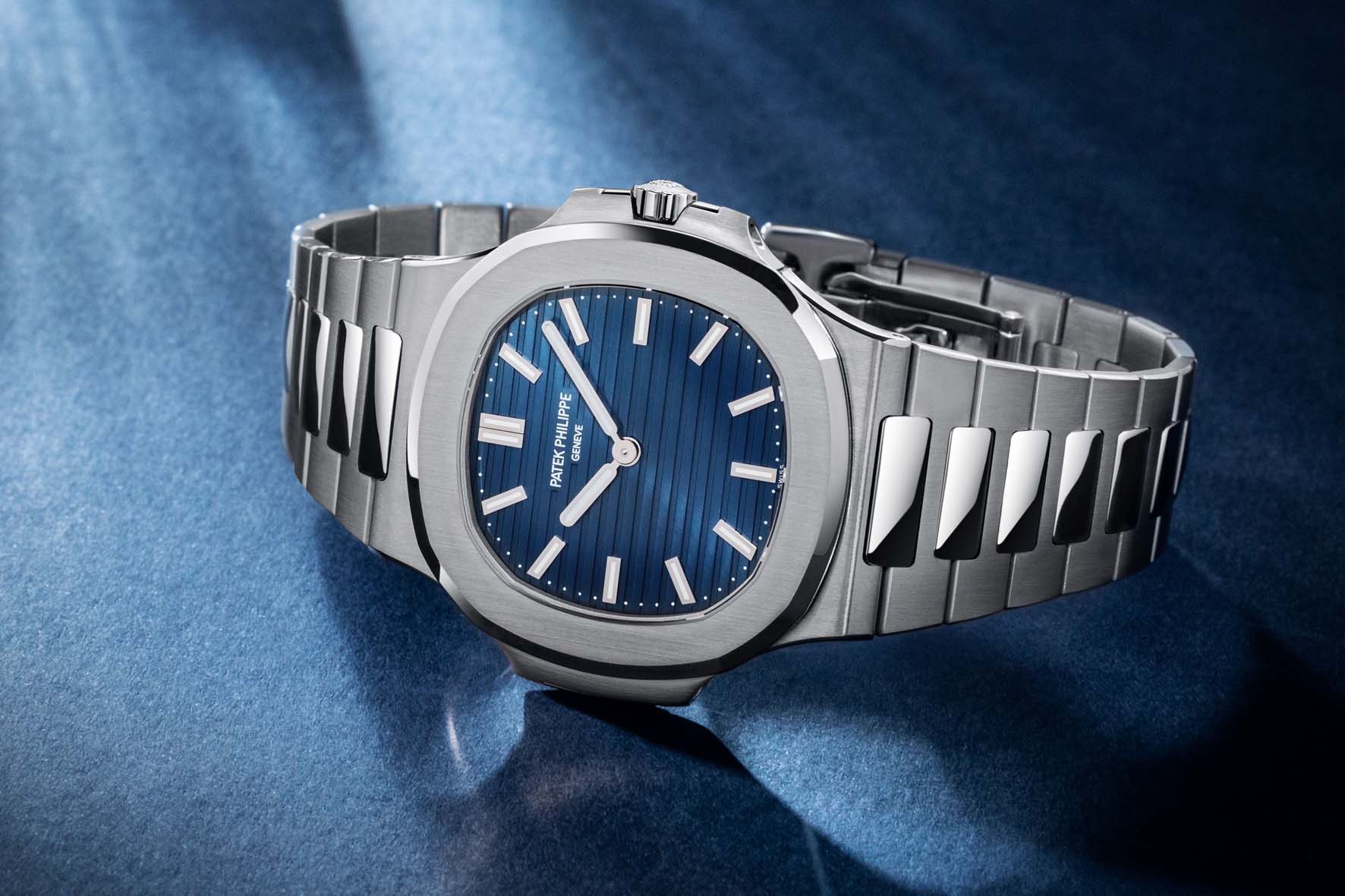
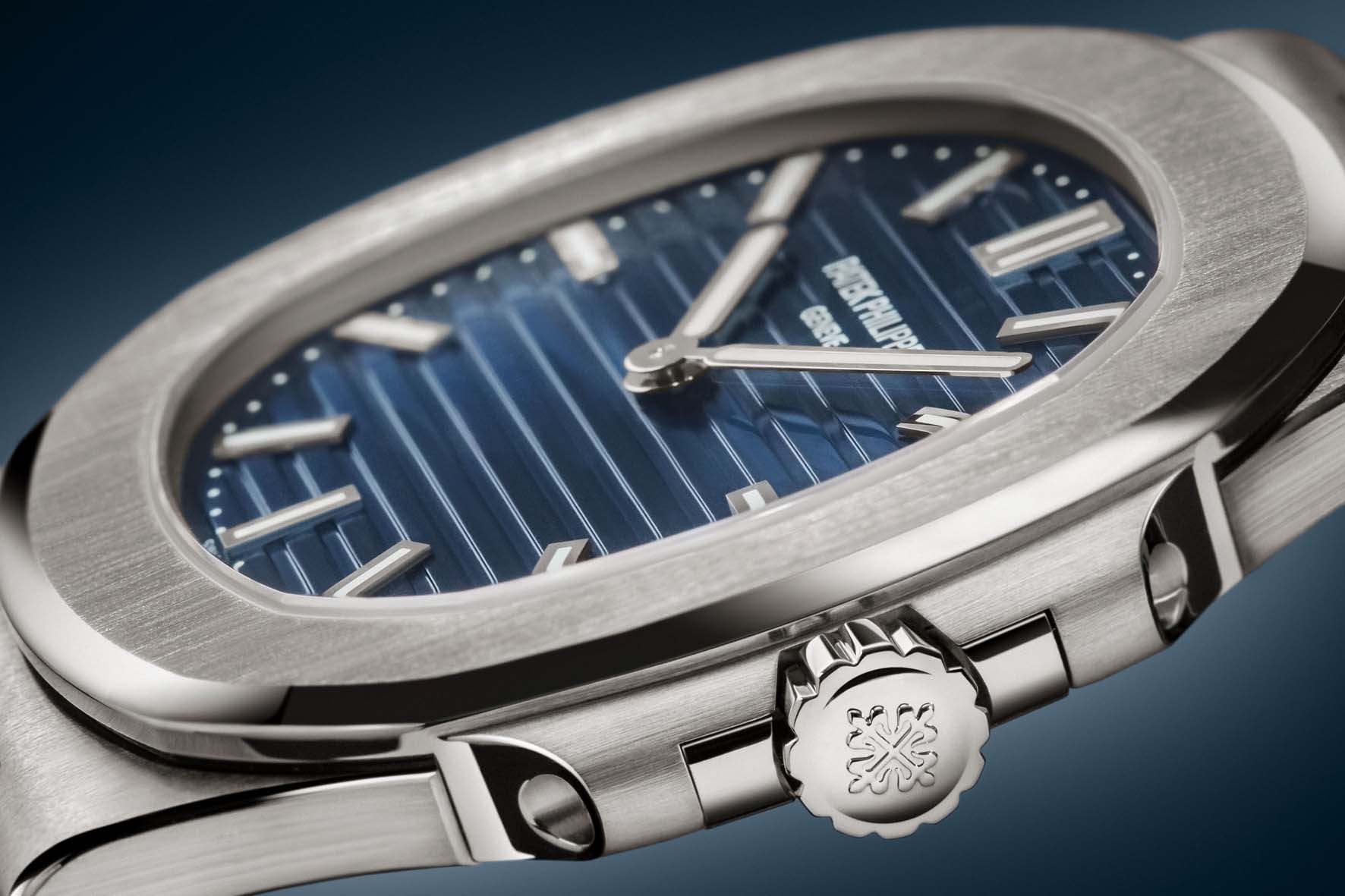
The two 41 mm references, the so-called Jumbo models, represent the most direct expression of the contemporary Nautilus. They share the same white gold architecture, an ultra-thin profile of 6.9 mm, and a construction faithful to the original 1976 design, with its rounded octagonal bezel and compact, porthole-inspired structure. The case is completed by a screw-down crown and a sapphire crystal caseback, with water resistance guaranteed to 30 meters under the Manufacture’s unified standard.
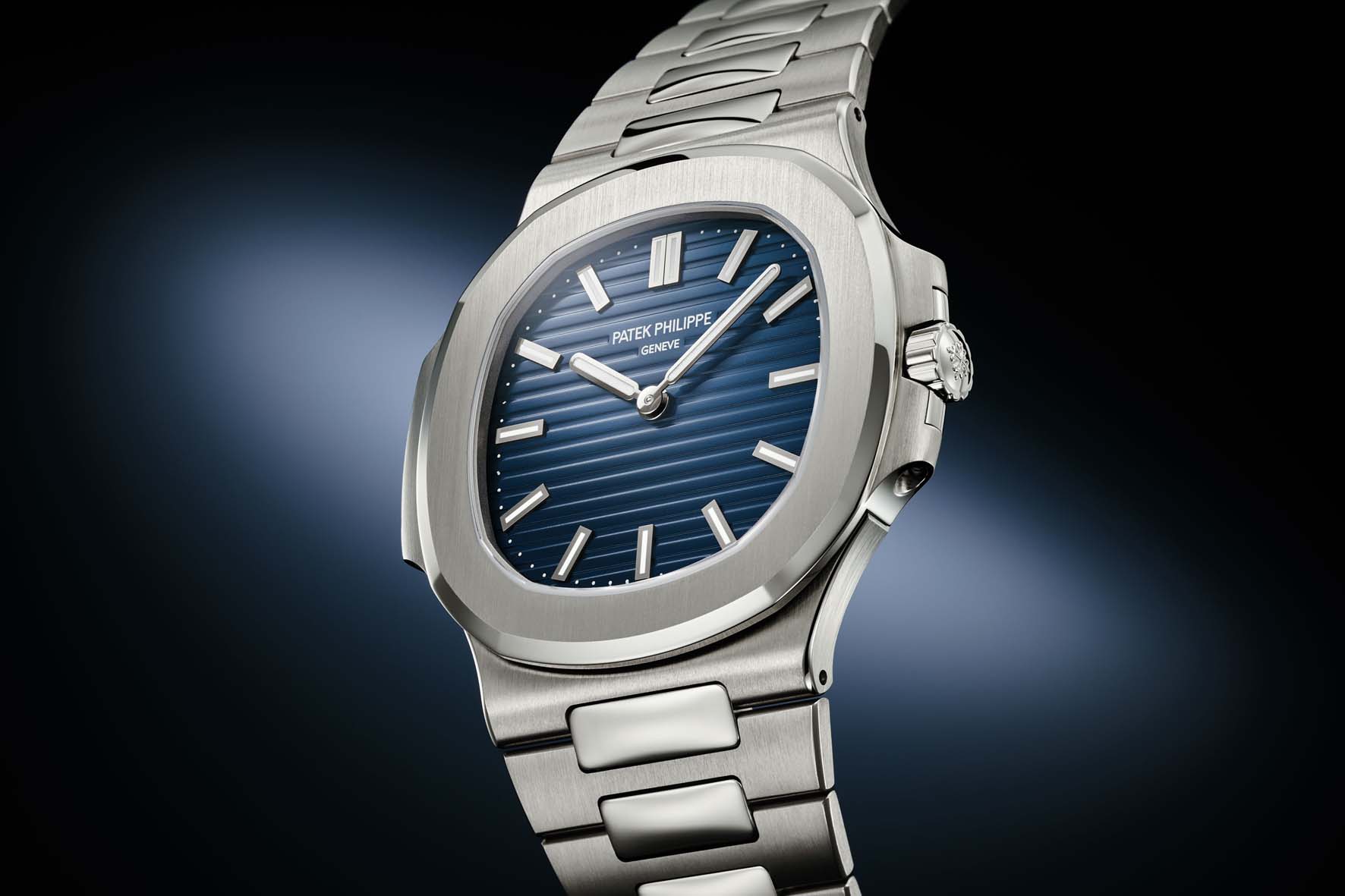
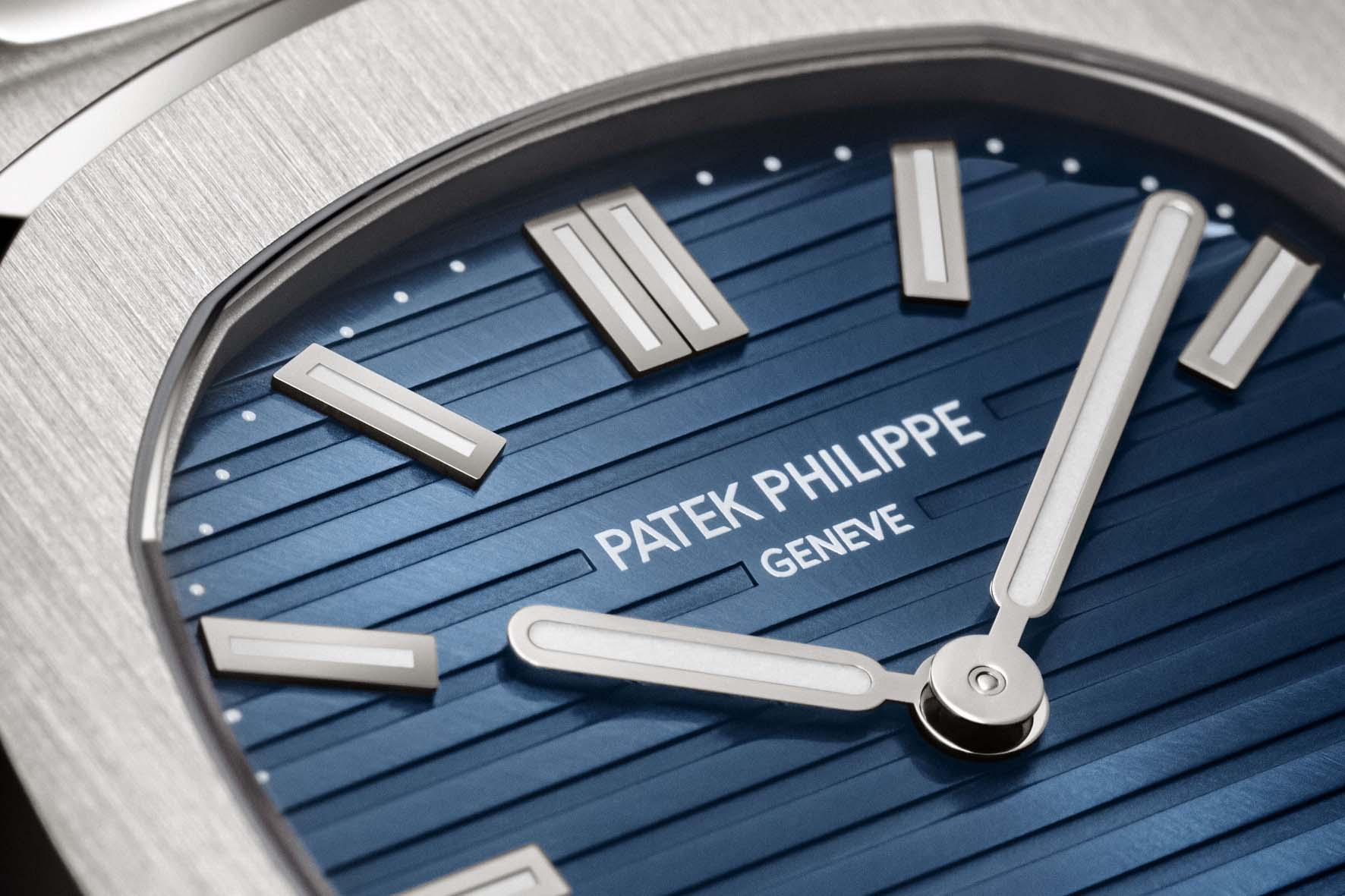
The blue sunburst dial with its horizontally embossed pattern preserves the model’s defining visual codes, with rounded baton-style hands and a display limited to hours and minutes, without date or seconds. It is on this shared foundation that two distinct interpretations take shape.
The Ref. 5810/1G-001 stands as the most faithful expression of the Nautilus. Its integrated white gold bracelet, finished with alternating satin-brushed and polished surfaces, ensures visual continuity with the case and a wrist presence aligned with the model’s historical language. Applied white gold baton hour markers preserve maximum visual clarity, reinforcing the overall sense of restraint. Produced in a limited run of 2,000 pieces, it condenses technical rigor and formal purity without introducing variations to the original codes. Price: €89,099.
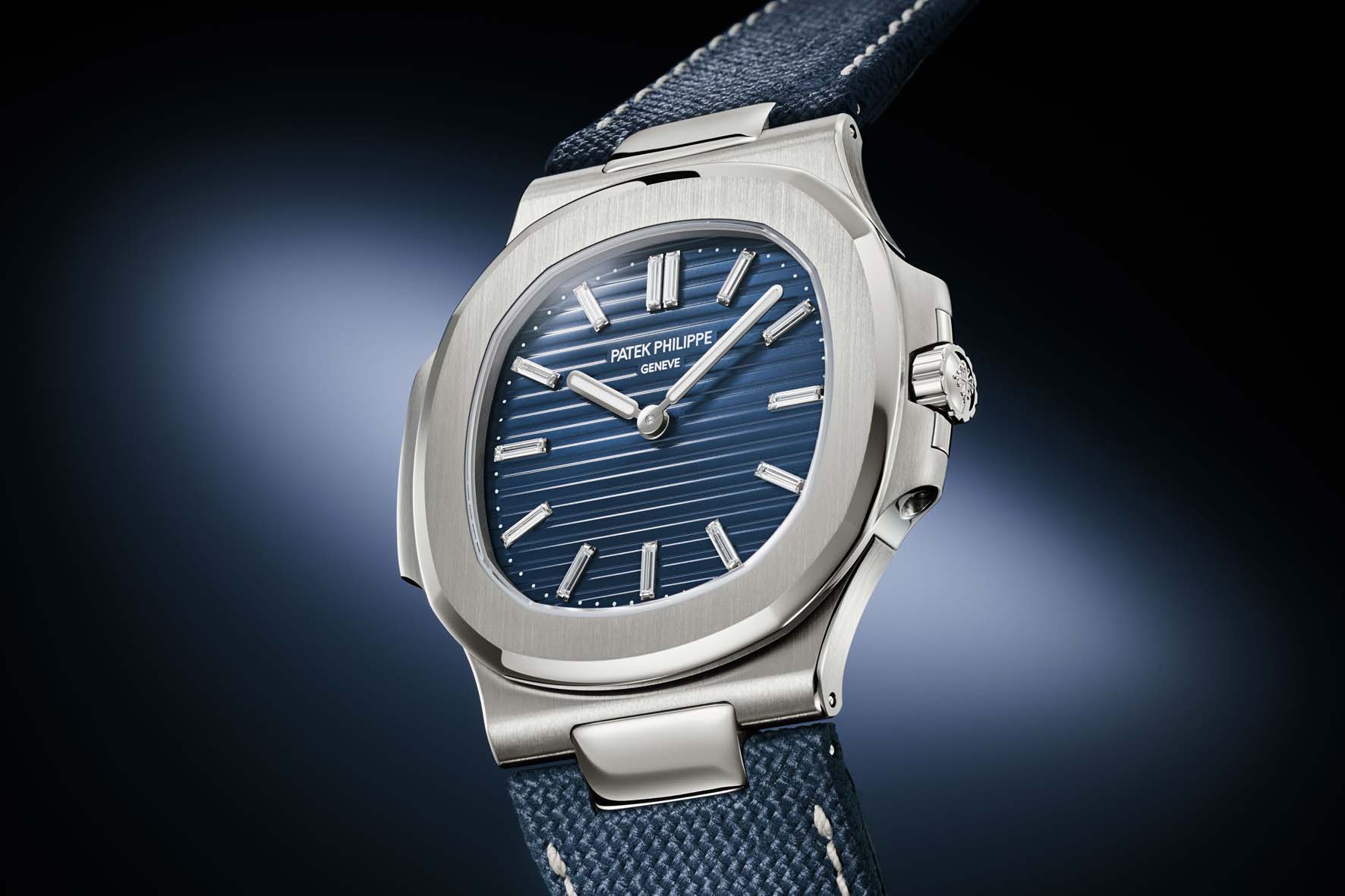
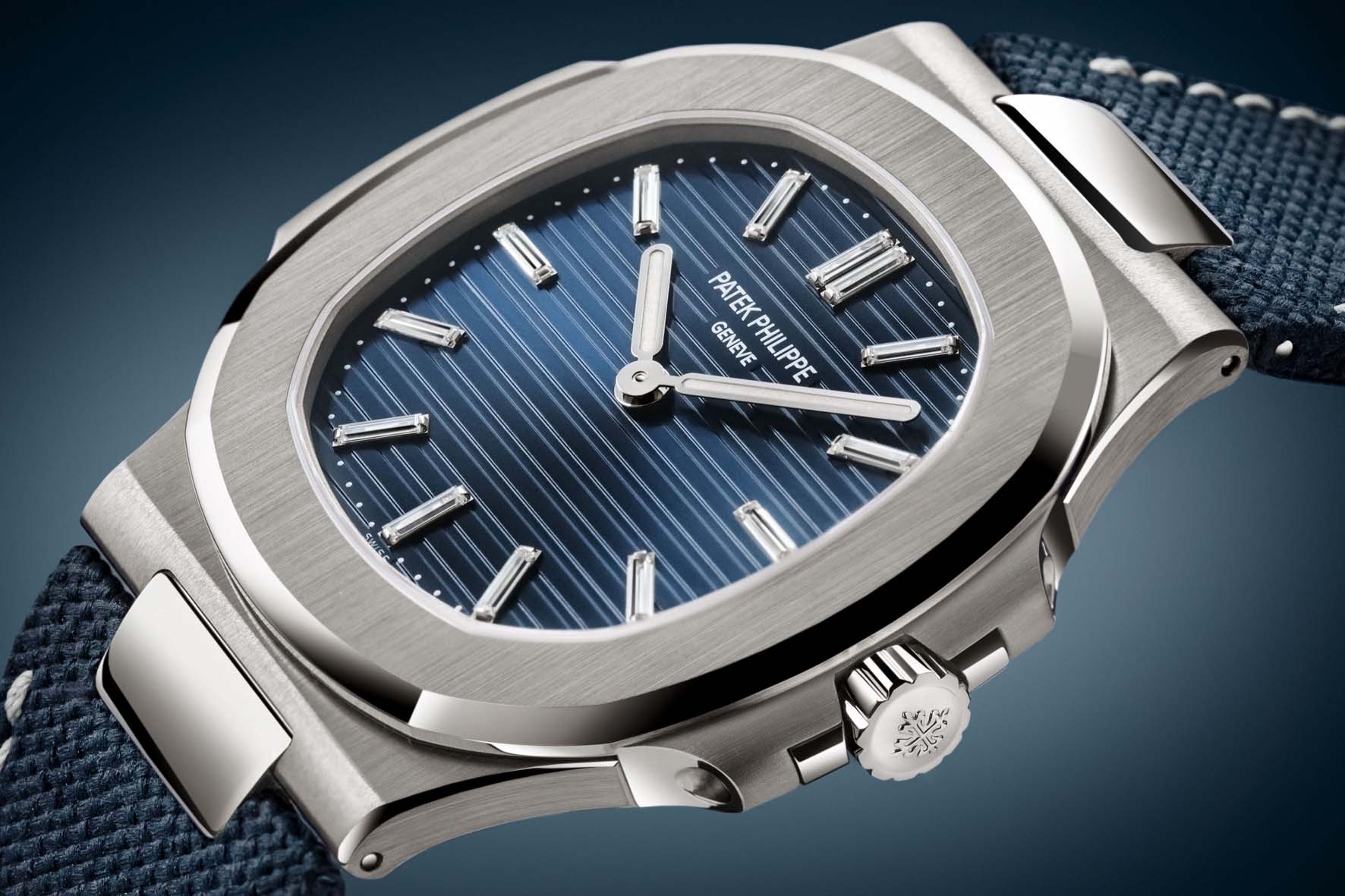
The Ref. 5810G-001 introduces a more sophisticated interpretation, where the sporting dimension is complemented by a more explicitly precious character. White gold hour markers are set with baguette-cut diamonds totaling 0.39 carats, subtly altering the dial’s balance. Instead of a bracelet, this version is paired with a navy composite strap featuring a textile pattern and contrasting cream stitching, enhancing its more contemporary and relaxed feel. The white gold Nautilus folding clasp completes the ensemble. Limited to 1,000 pieces, it represents one of the most balanced expressions within the collection, positioned between sport and jewelry. Price: €71,280.
The Ref. 5610/1P-001 introduces a variation in proportions without altering the Nautilus’ design language. Its 38 mm diameter (measured from 10 to 4 o’clock) returns the model to an intermediate format already explored in the collection’s history, while maintaining the ultra-thin 6.9 mm profile.
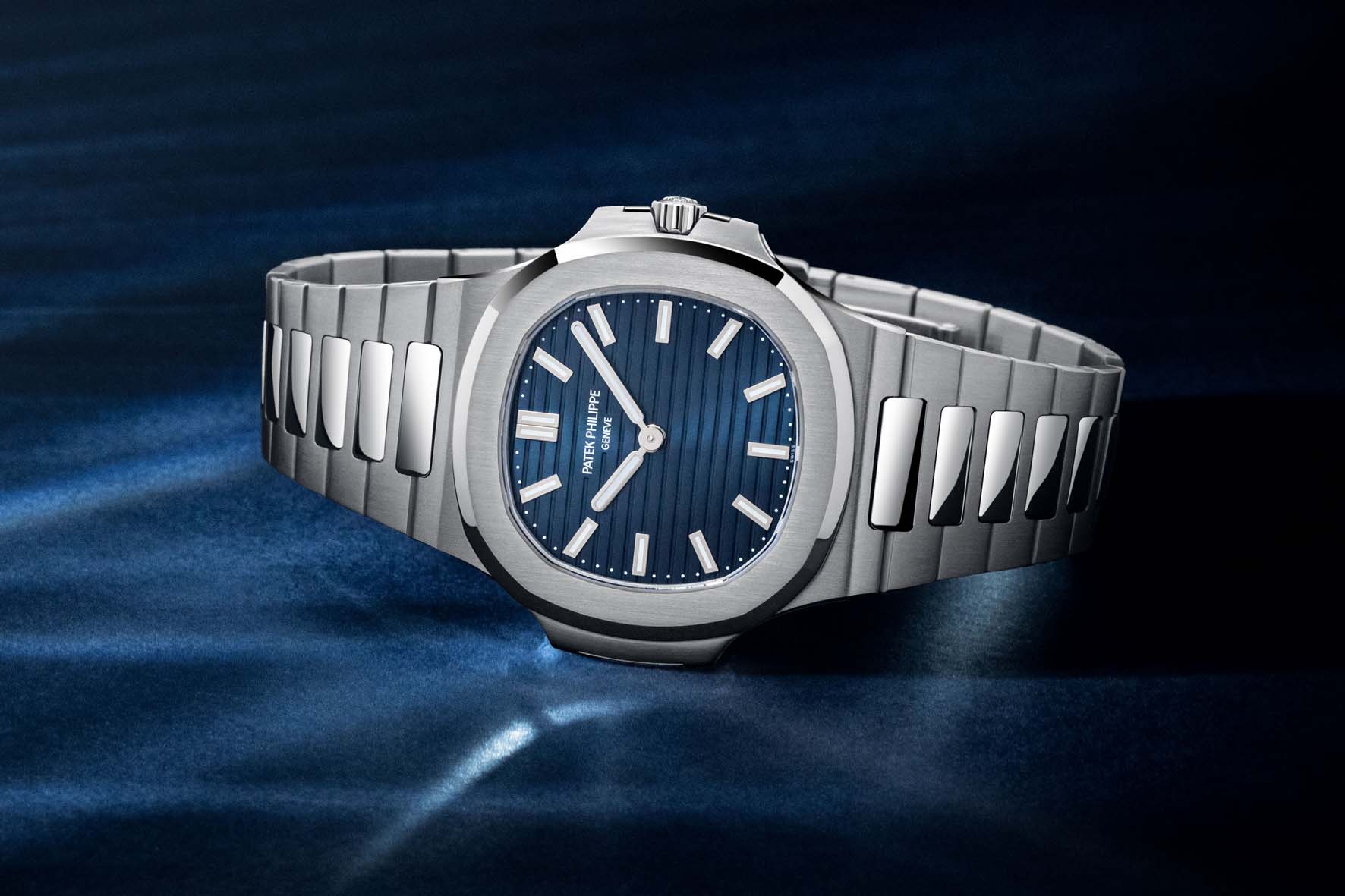
The platinum case subtly transforms the watch’s presence on the wrist, introducing greater visual density and a more compact feel compared to the white gold versions. As is customary for Patek Philippe platinum models, a diamond is set at 9 o’clock within the hinge.
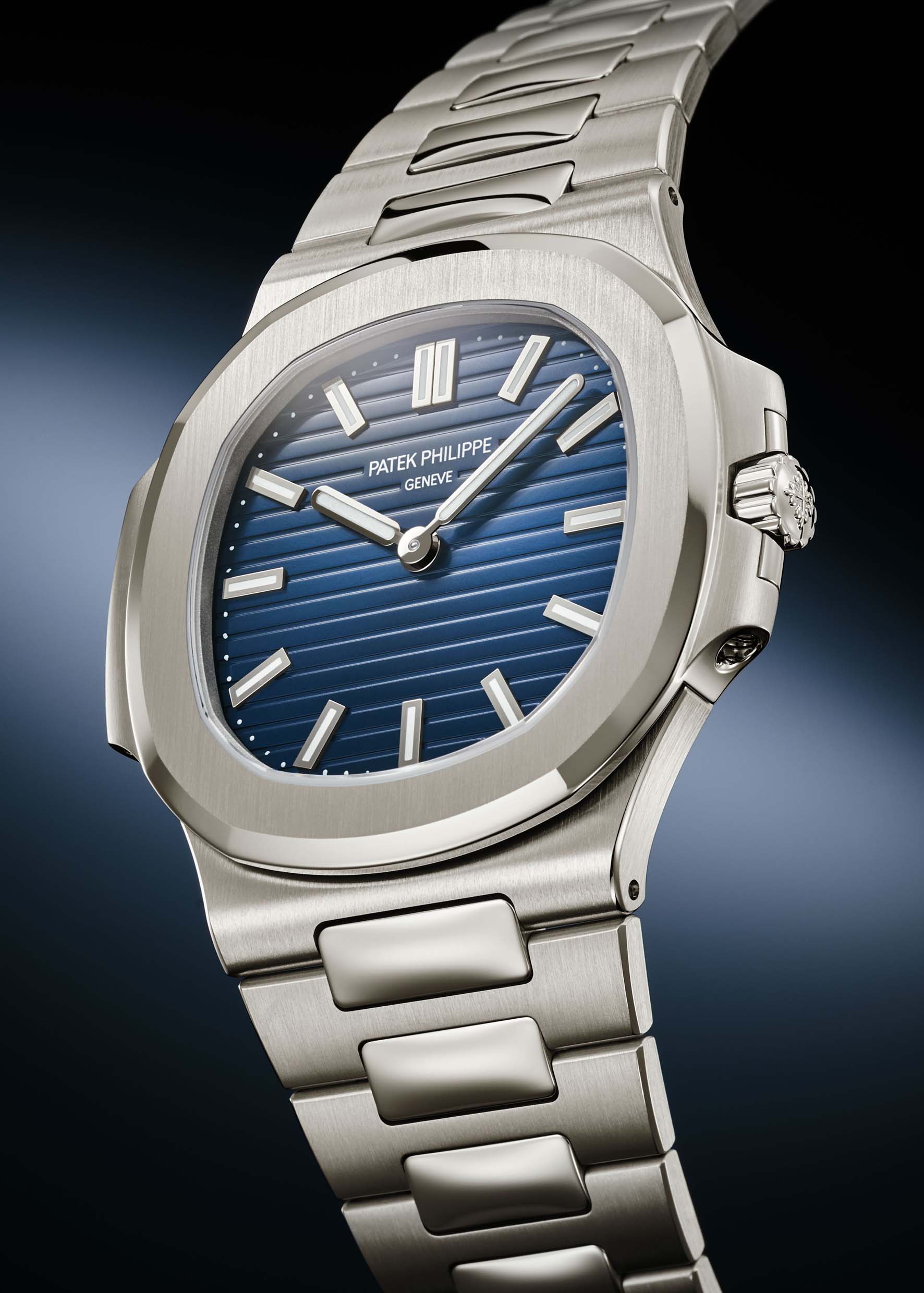
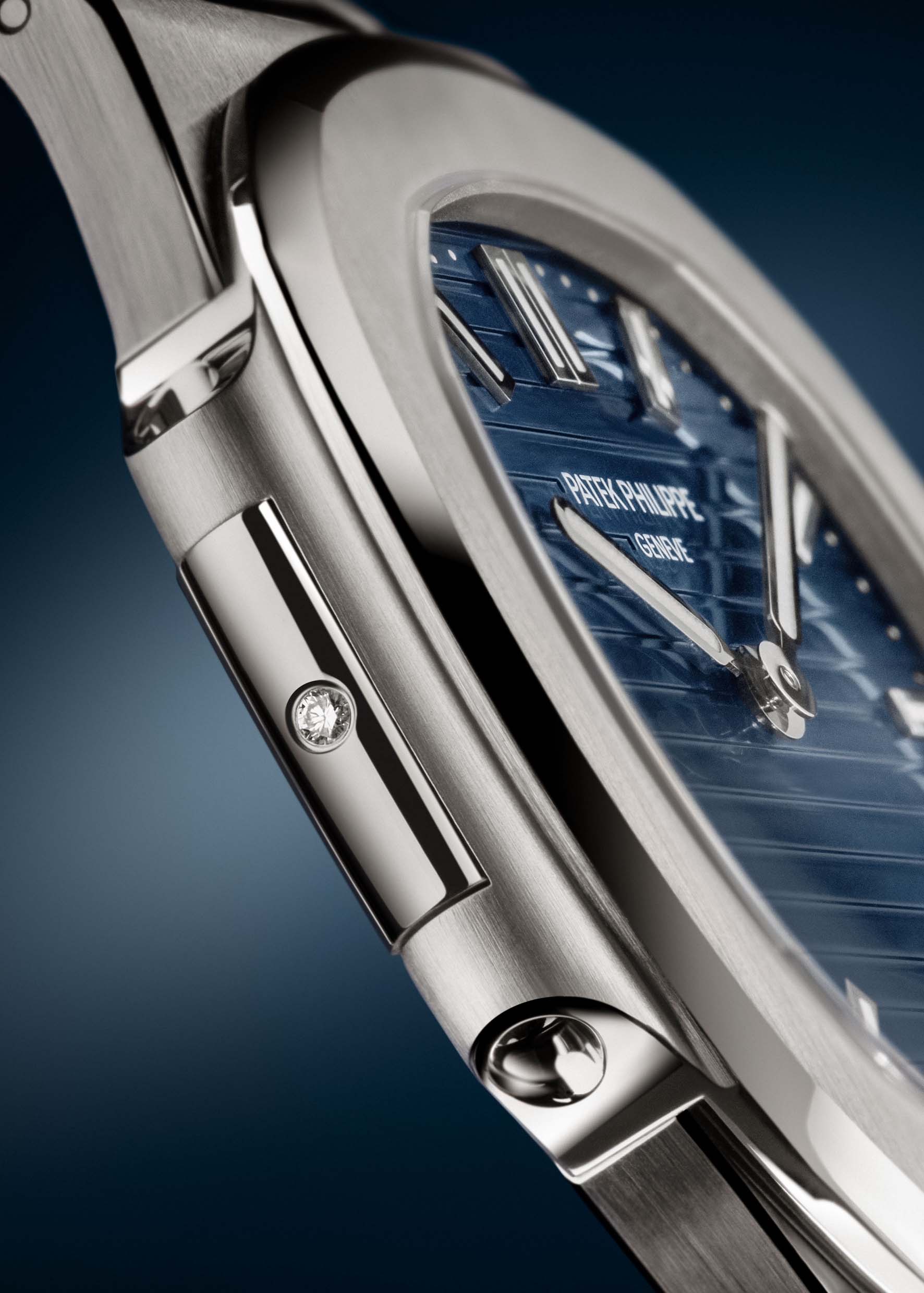
The blue sunburst dial retains the same visual structure, with applied white gold baton hour markers and rounded baton-style hands with luminescent coating. Here too, the display is limited to hours and minutes, without date or seconds. The integrated platinum bracelet, finished with alternating satin-brushed and polished surfaces, ensures continuity with the case.
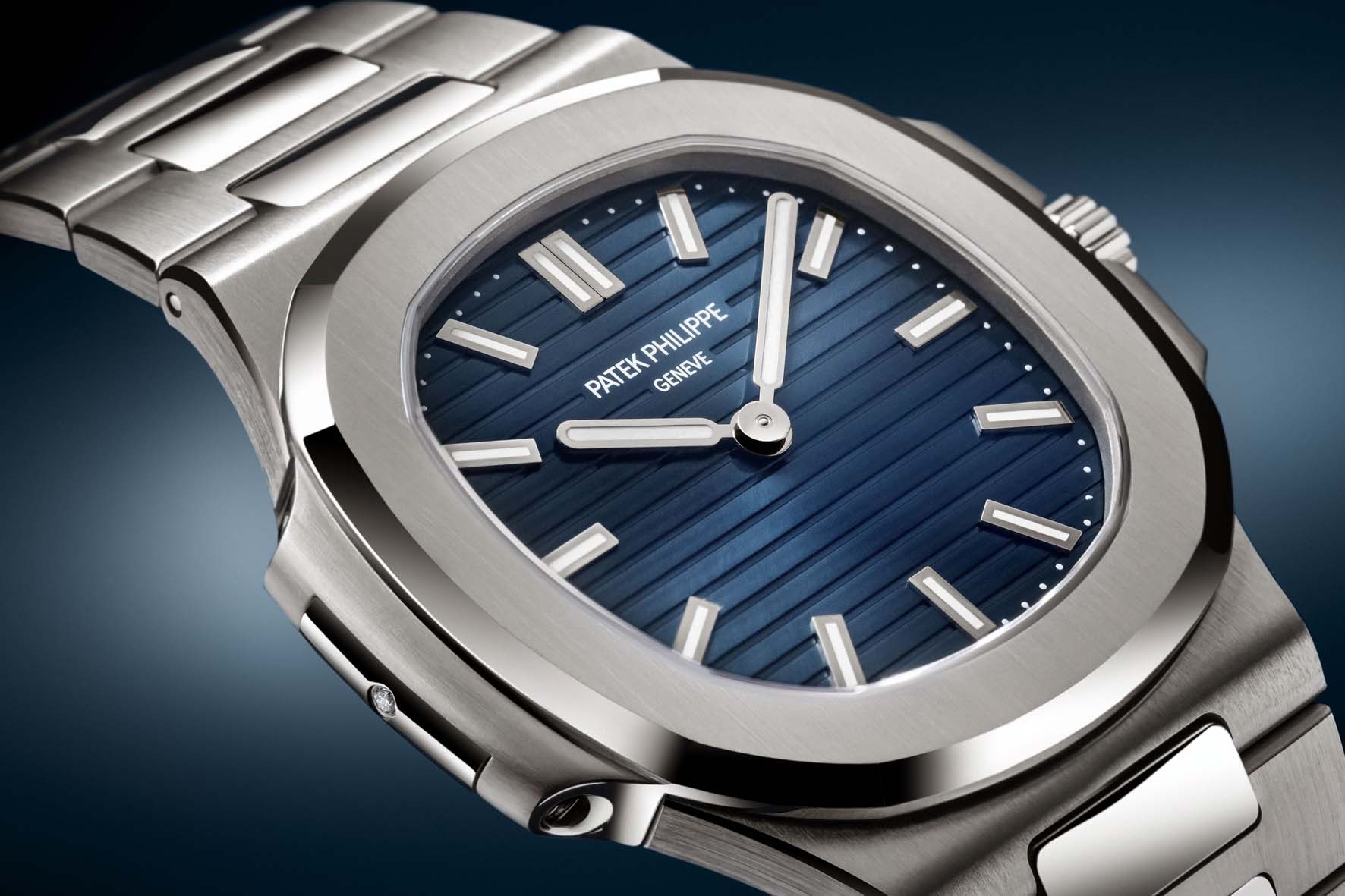
Produced in a limited run of 2,000 pieces, the Ref. 5610/1P-001 stands as the most compact and measured interpretation within the anniversary collection. Price: €106,919.
CALIBER 240: ULTRA-THIN ARCHITECTURE AND TECHNICAL CONTINUITY
Despite their different aesthetic interpretations, the three references share the same mechanical foundation. At the heart of each is the caliber 240, an ultra-thin self-winding movement that remains one of the defining benchmarks of Patek Philippe’s production. Measuring 2.53 mm in thickness and 27.5 mm in diameter, it comprises 152 components, incorporates 27 jewels, and operates at 21,600 vibrations per hour, delivering a minimum power reserve of 48 hours.
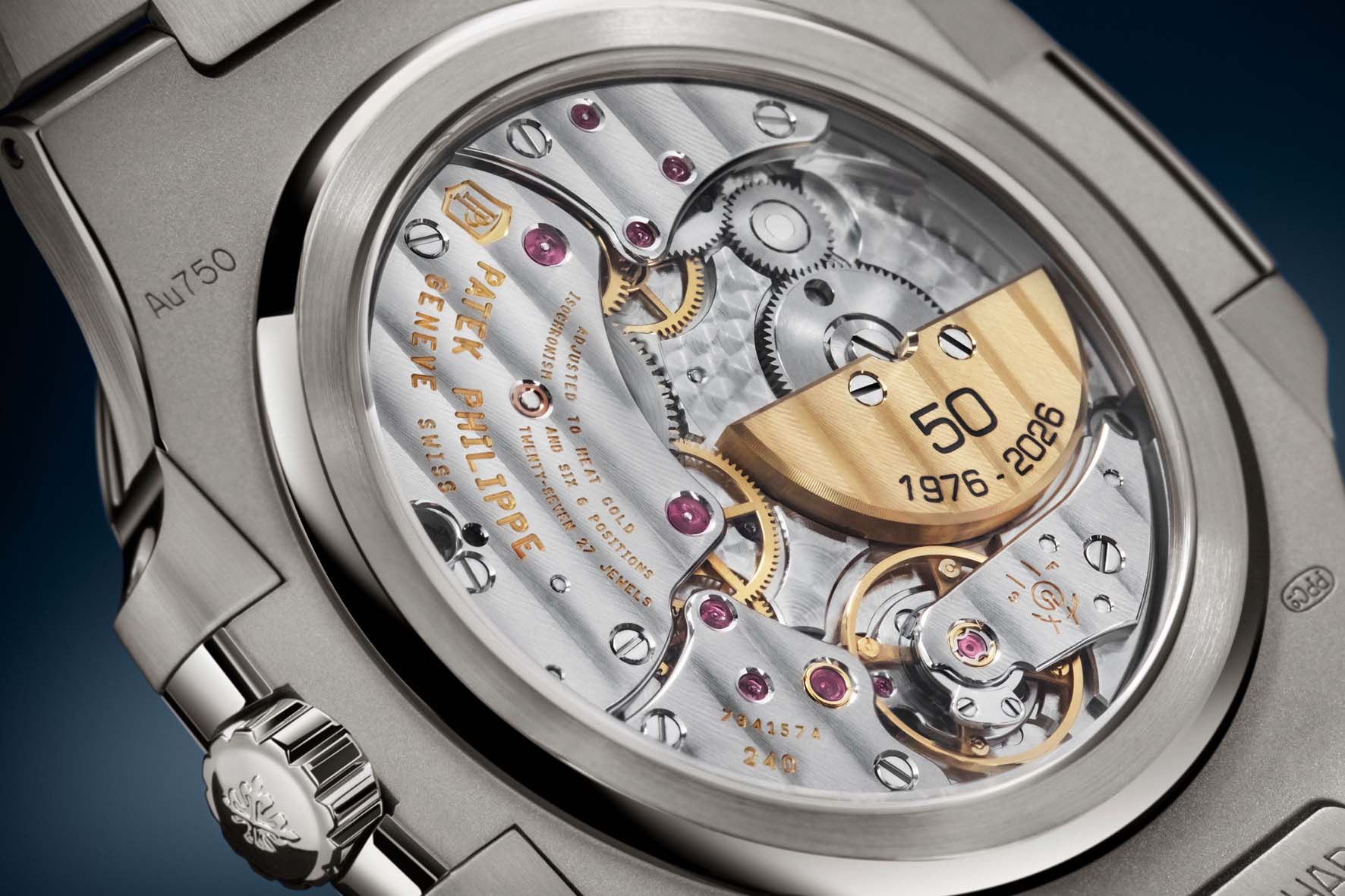
Winding is ensured by an off-center 22k gold mini-rotor with unidirectional winding, engraved for this edition with the inscription “50 1976–2026”. The Gyromax balance and Spiromax balance spring in Silinvar complete a configuration focused on long-term stability and precision. The display remains limited to hours and minutes, with a two-position crown for winding and time setting, a deliberate choice that reinforces the principle of reduction at the heart of this anniversary collection.
PATEK PHILIPPE NAUTILUS REF. 958G-001: A COLLECTOR’S PIECE
Of the four interpretations presented for this milestone, the Ref. 958G-001 is the one that moves furthest from the collection’s traditional territory, transforming the Nautilus into an elegant table clock. Rather than modifying its language, it translates it into a different context.
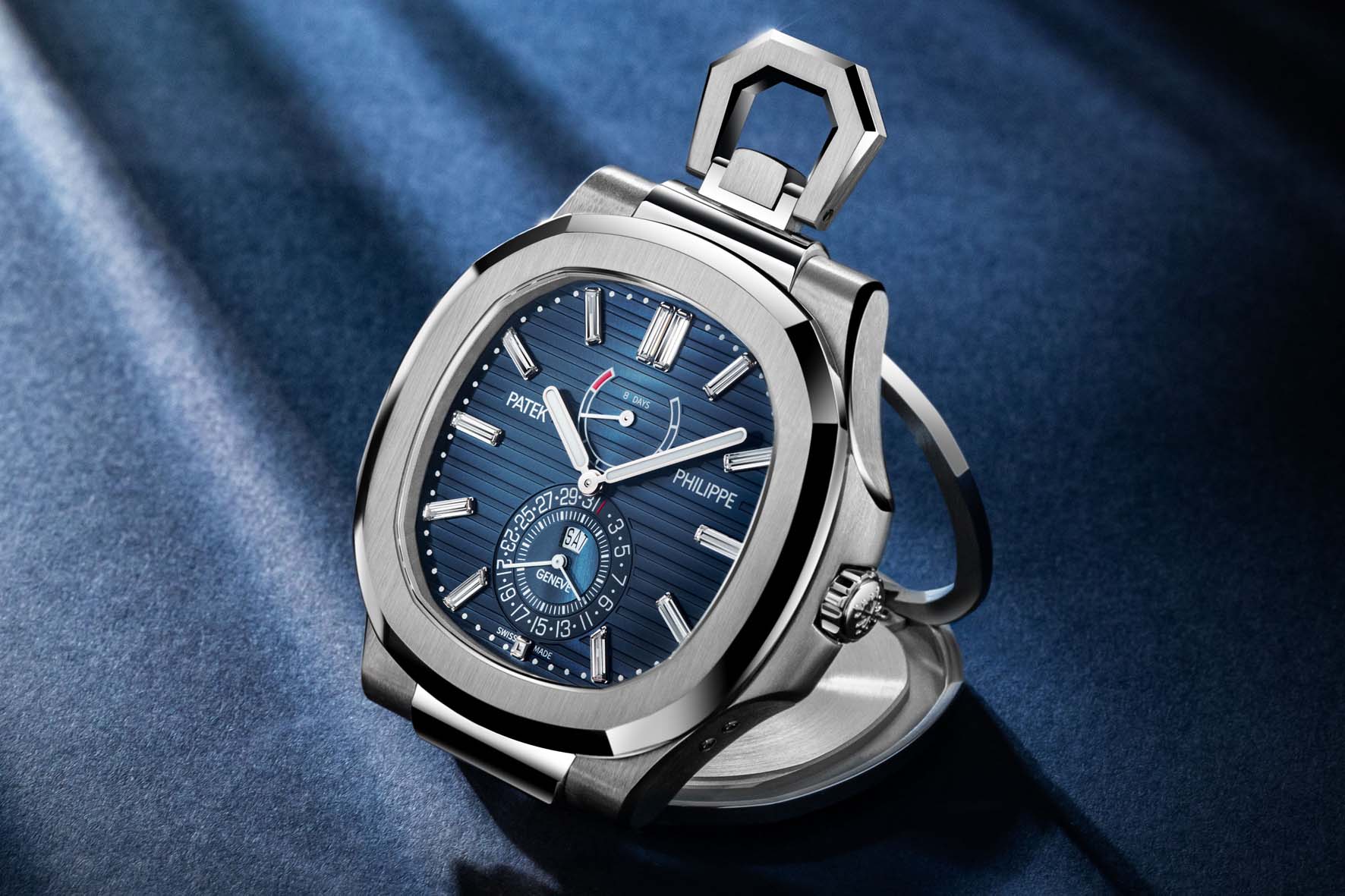
The white gold case, measuring 50.65 mm in diameter and 13.5 mm in thickness, reprises the Nautilus’ characteristic construction, with its rounded octagonal bezel and alternating satin-brushed and polished surfaces. Despite the absence of a bracelet, its proportions and lines remain immediately recognizable. The sapphire crystal caseback is protected by a hinged cover incorporating a decoration with an applied Calatrava cross in satin-finished white gold, which also functions as a support. An engraved ring bears the inscription “50th Anniversary Nautilus 1976–2026 Patek Philippe”. The case is not water-resistant, but protected against humidity and dust.
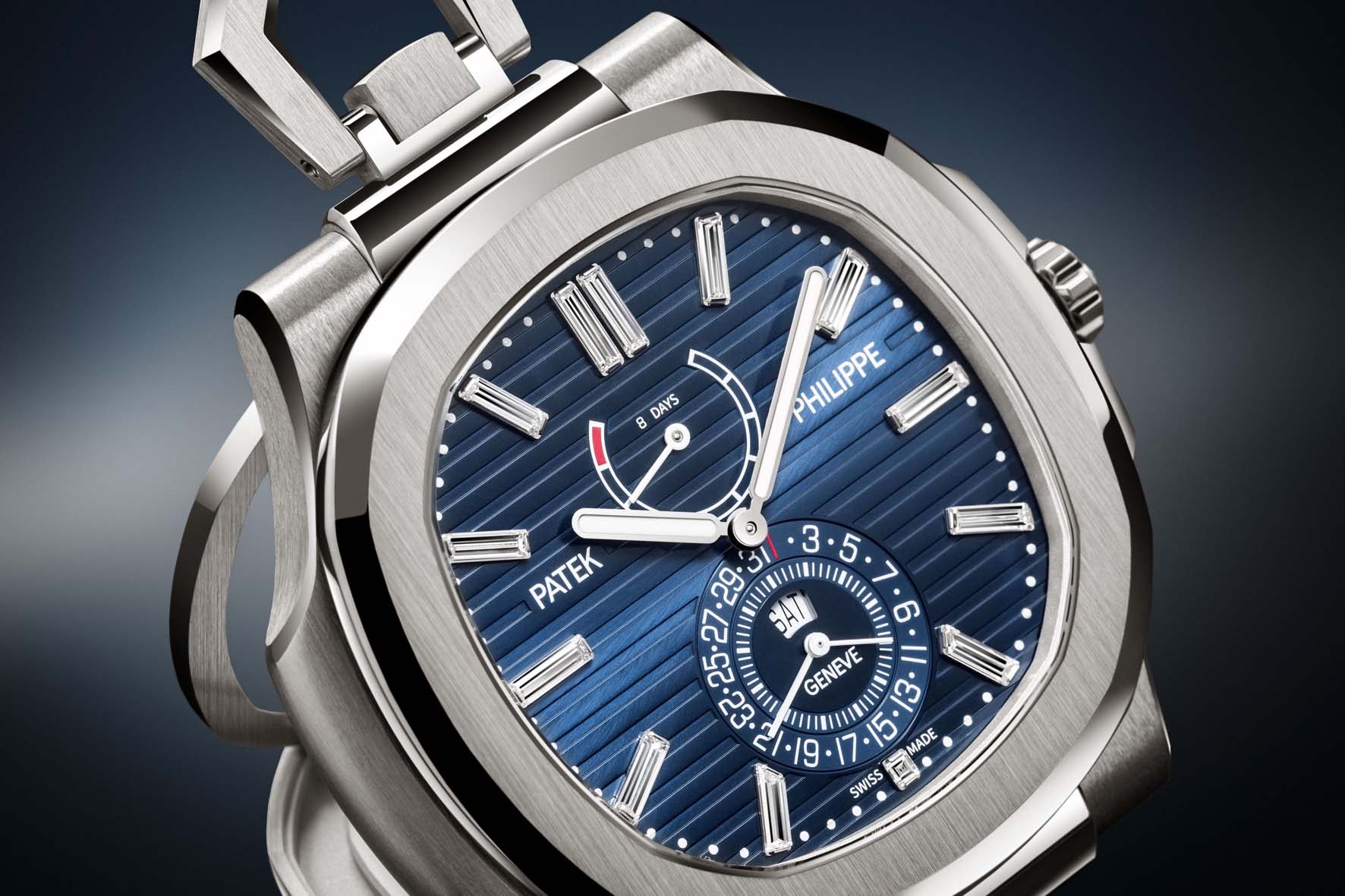
The blue sunburst dial with its horizontally embossed pattern introduces a more precious dimension, with baguette-cut diamond hour markers totaling 0.96 carats. At 12 o’clock, the power reserve indicator is integrated into the dial.
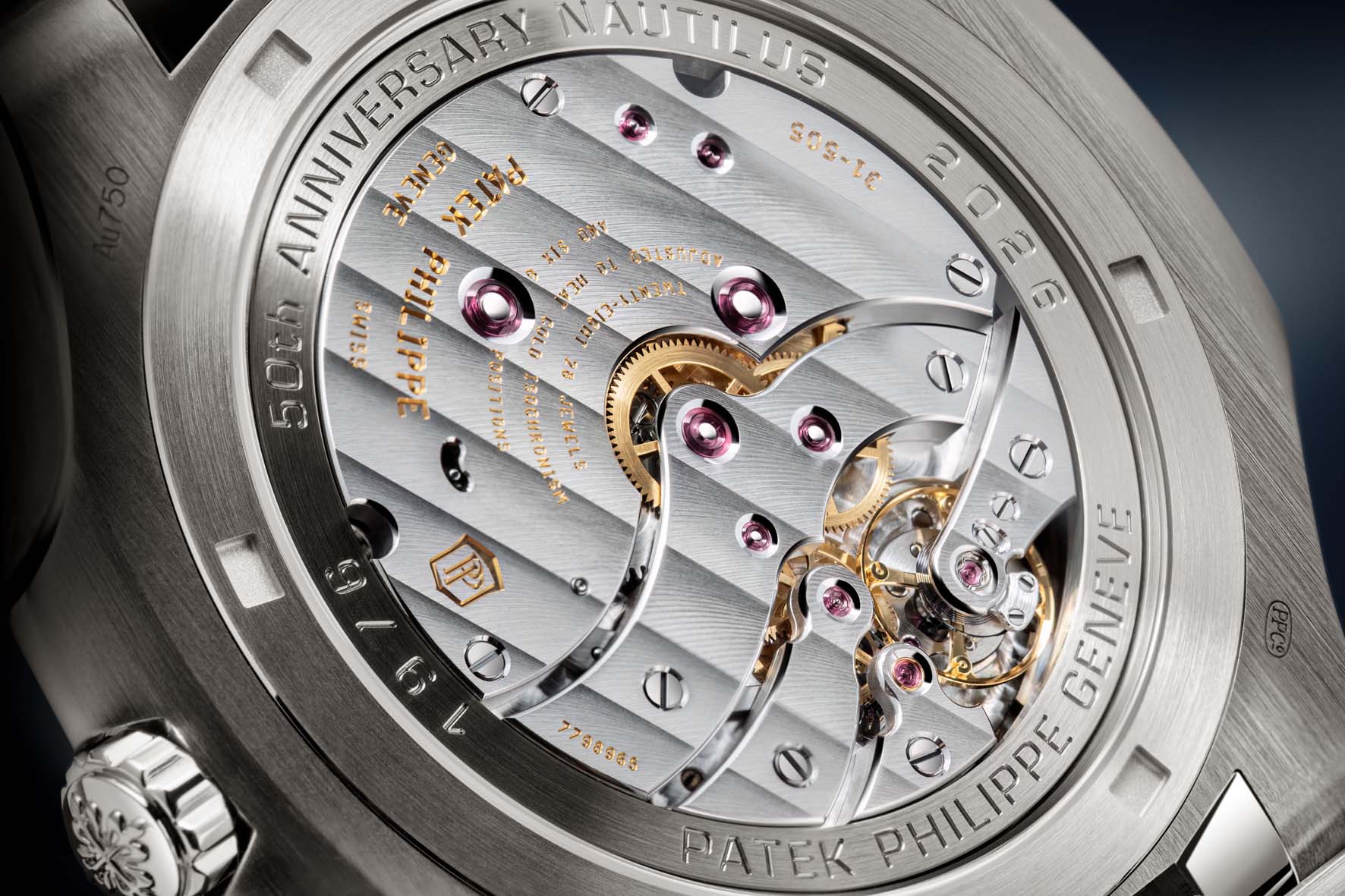
This reference is powered by the manually wound caliber 31-505 8J PS IRM CI J. Two barrels mounted in series deliver an eight-day power reserve (192 hours). The movement, measuring 32 mm in diameter and 5.05 mm in thickness, comprises 256 components, beats at 28,800 vibrations per hour, and integrates a Pulsomax escapement and Spiromax balance spring in Silinvar. It displays central hours and minutes, instantaneous pointer date, day in an aperture, small seconds, and power reserve. Dedicated correctors allow independent adjustment of day and date. The hinged cover doubles as a support, ensuring stability and readability.
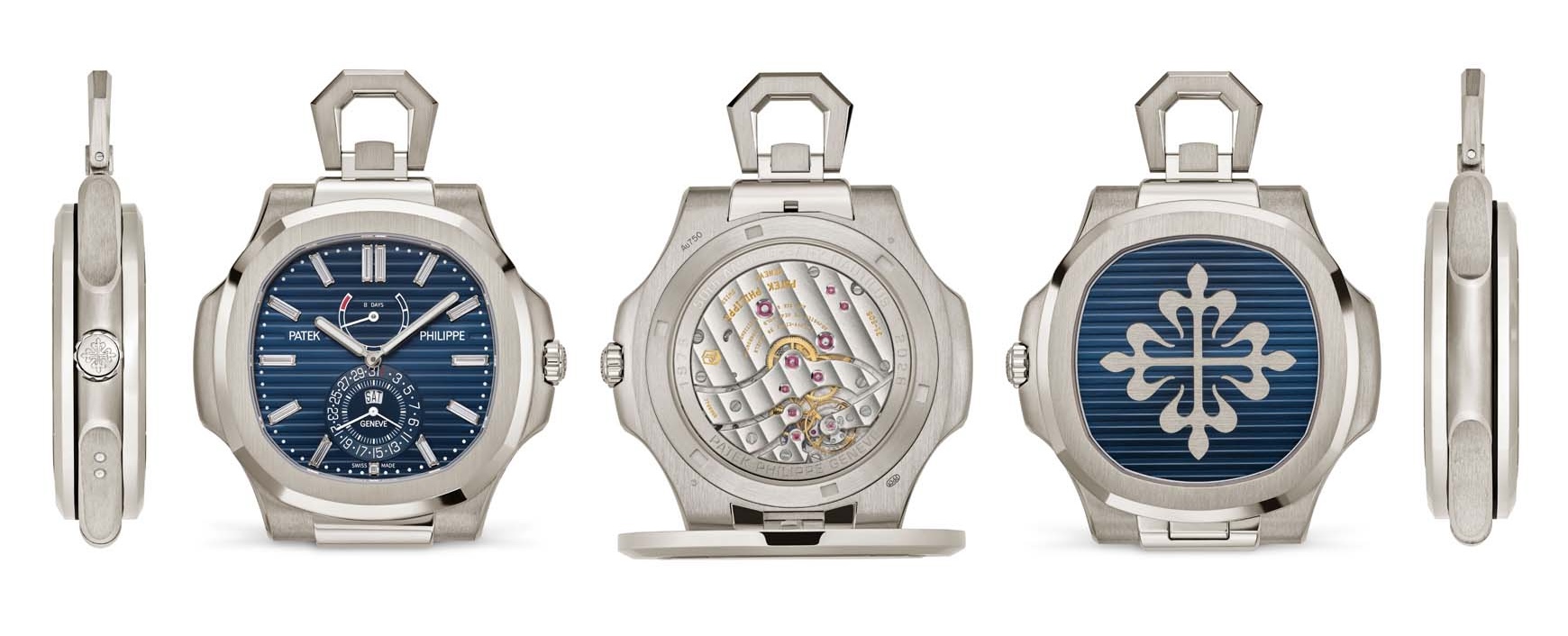
Limited to 100 pieces, and priced at €243,537, it stands as a true collector’s object.
DESIGNED TO REMAIN
Fifty years after its introduction, the Nautilus continues to embody a rare quality: it does not need to change in order to remain relevant. The four references presented by Patek Philippe at Watches and Wonders 2026 do not attempt to rewrite its language, but to explore its margins. From the purity of the Ref. 5810/1G-001 to the more precious interpretation of the 5810G-001, through the more compact 5610/1P-001 and the transformation into a table clock with the 958G-001, each model intervenes on a specific aspect without altering the overall balance. It is precisely this discipline that defines the Nautilus today: not an icon that evolves through rupture, but a form that reasserts itself through continuity and precision.
By Elisa Copeta