

Placing technique at the service of aesthetics. This is the idea that has always shaped Cartier’s vision and still defines its language today: an approach in which form is not the result, but the starting point from which proportions, lines and material are constructed. In Geneva, the French Maison does not follow the logic of complication for its own sake, but reaffirms a vision of watchmaking that finds in form its founding principle. It is an approach that runs throughout the entire history of Cartier, in which the construction of the watch originates from a design gesture, allowing technique to integrate with coherence and discretion. The creations presented this year at Watches and Wonders 2026 fit seamlessly within this continuity, revisiting some of the most emblematic icons of the repertoire and renewing them through a careful study of materials, surfaces and internal architectures. From the Santos-Dumont to the Crash, through to the return of the Roadster and the more Haute Joaillerie interpretations of Baignoire and Myst, Cartier constructs a dialogue between different eras and registers.
CARTIER SANTOS-DUMONT
The history of the Santos-Dumont is intrinsically linked to the birth of the modern wristwatch. In 1904, Louis Cartier conceived for his friend Alberto Santos-Dumont a watch that could be read in flight without resorting to a pocket watch, giving rise to what is considered the first men’s wristwatch in history — translating a practical need into a form destined to become canonical. Since then, the Santos-Dumont has preserved its design intact, passing through the twentieth century and its reinterpretations without losing its connection to its origin: that of a watch created to accompany movement.
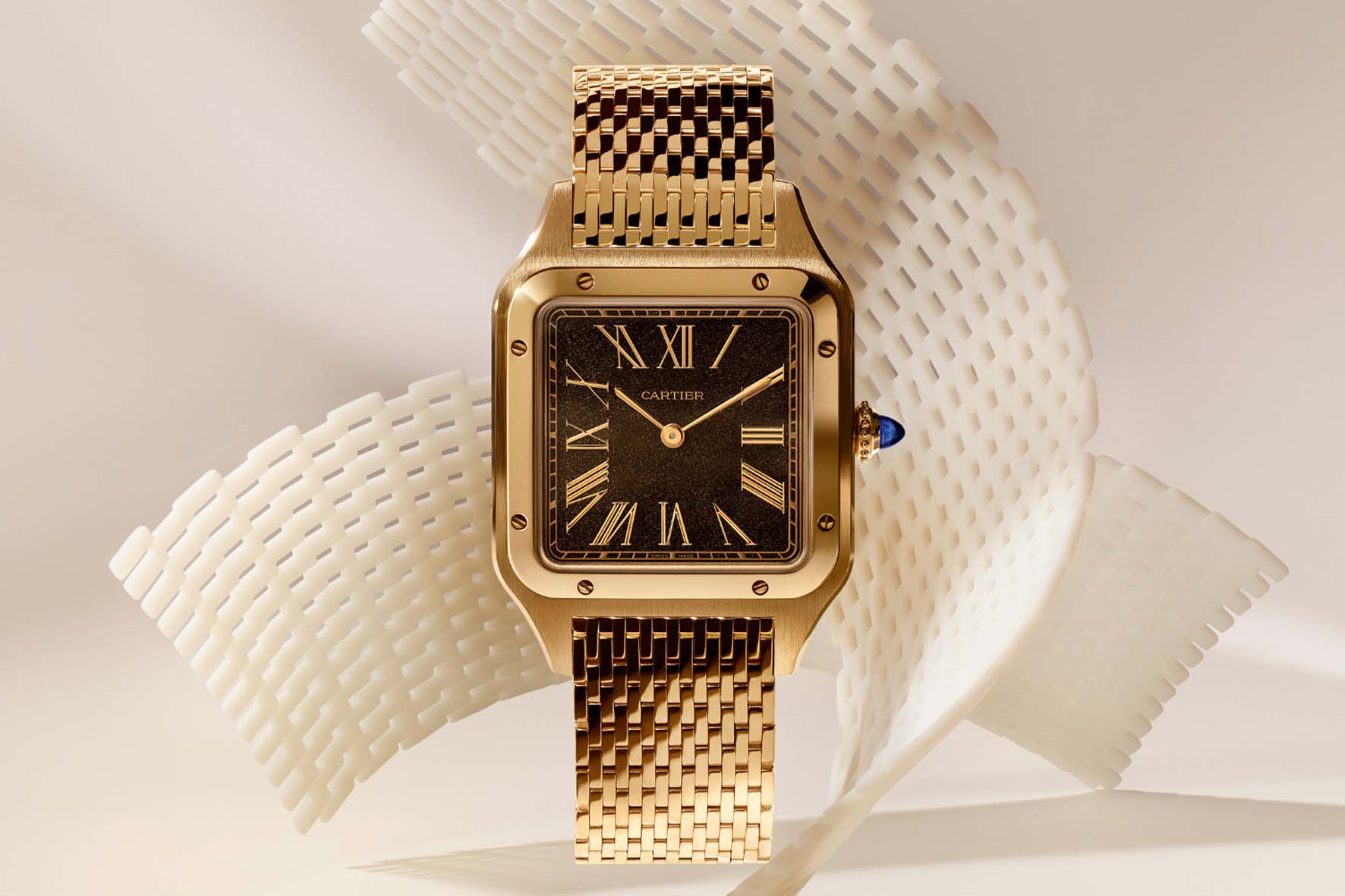
In the new version presented at Watches and Wonders 2026, Cartier intervenes with extreme precision on two structural elements of the Santos-Dumont — dial and bracelet — redefining both visual and tactile perception. In the yellow gold version, the most fascinating dial is crafted from golden obsidian, a volcanic stone originating from Mexico, whose iridescent reflections derive from micro air bubbles trapped within the glassy mass; bringing it down to a thickness of just 0.3 mm requires absolute control of the material’s internal tensions and workmanship close to that required for glass, with extremely tight tolerances. On this surface, Cartier’s graphic codes are applied, with Roman numerals, chemin de fer minute track and gilt sword-shaped hands, while the crown set with a blue cabochon introduces a chromatic accent consistent with the Maison’s tradition.
In this configuration (Ref. WGSA0123), the 43.5 x 31.4 mm case with a thickness of 7.3 mm is paired with a matching bracelet and integrates the in-house manual-winding calibre 430 MC. Water resistance is guaranteed to 3 bar (30 metres).
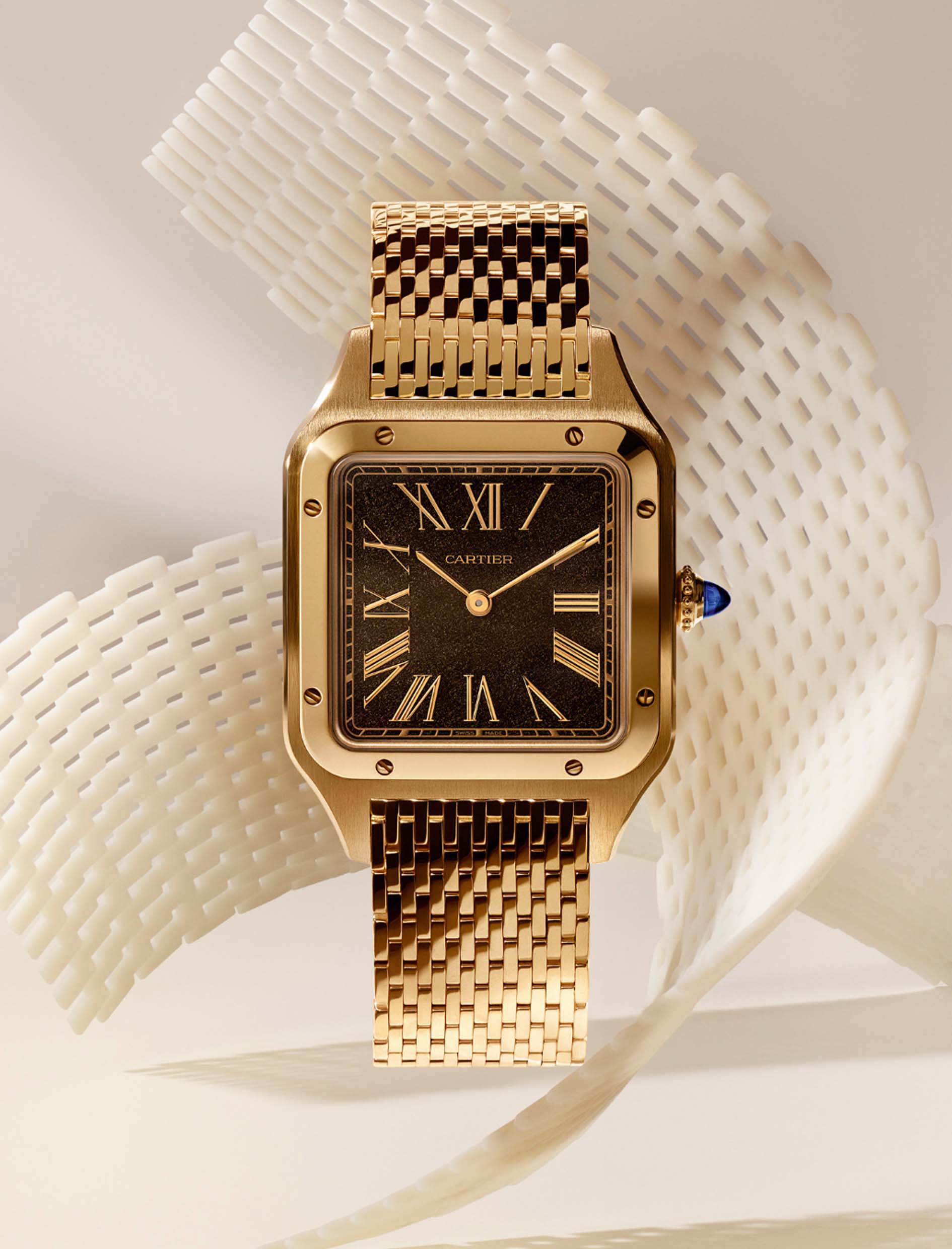

Complementing this complexity is the bracelet, constructed as a true flexible architecture: 394 links each 1.15 mm thick, arranged across 15 rows, each individually crafted, finished and assembled in the Manufacture to achieve controlled deformability and a nearly organic continuity with the case. The ensemble is completed by a triple folding gold clasp, discreetly integrated into the overall construction.
The price of Ref. WGSA0123 is € 52,000. This model is also available in yellow gold with a silvered dial (Ref. WGSA0122) at € 49,300, and in platinum (Ref. WGSA0124) with a silvered dial at € 62,000.
CARTIER PRIVÉ CRASH
Among the Maison’s most emblematic creations, the Crash occupies a truly unique place. Born in London in 1967, it introduced an asymmetrical and deliberately unstable form that breaks away from all traditional construction, transforming distortion into a design principle. Over time, this silhouette has become one of Cartier’s most recognisable, preserving its expressive strength intact. Today, to celebrate the tenth chapter of Cartier Privé, the Maison returns to this icon, reaffirming its radical character through skeletonisation. A choice rooted in a much broader history: Cartier’s first skeleton watches date back to the 1920s and were pocket watches conceived as true exercises in technical elegance, where mechanics became a visible part of the design.
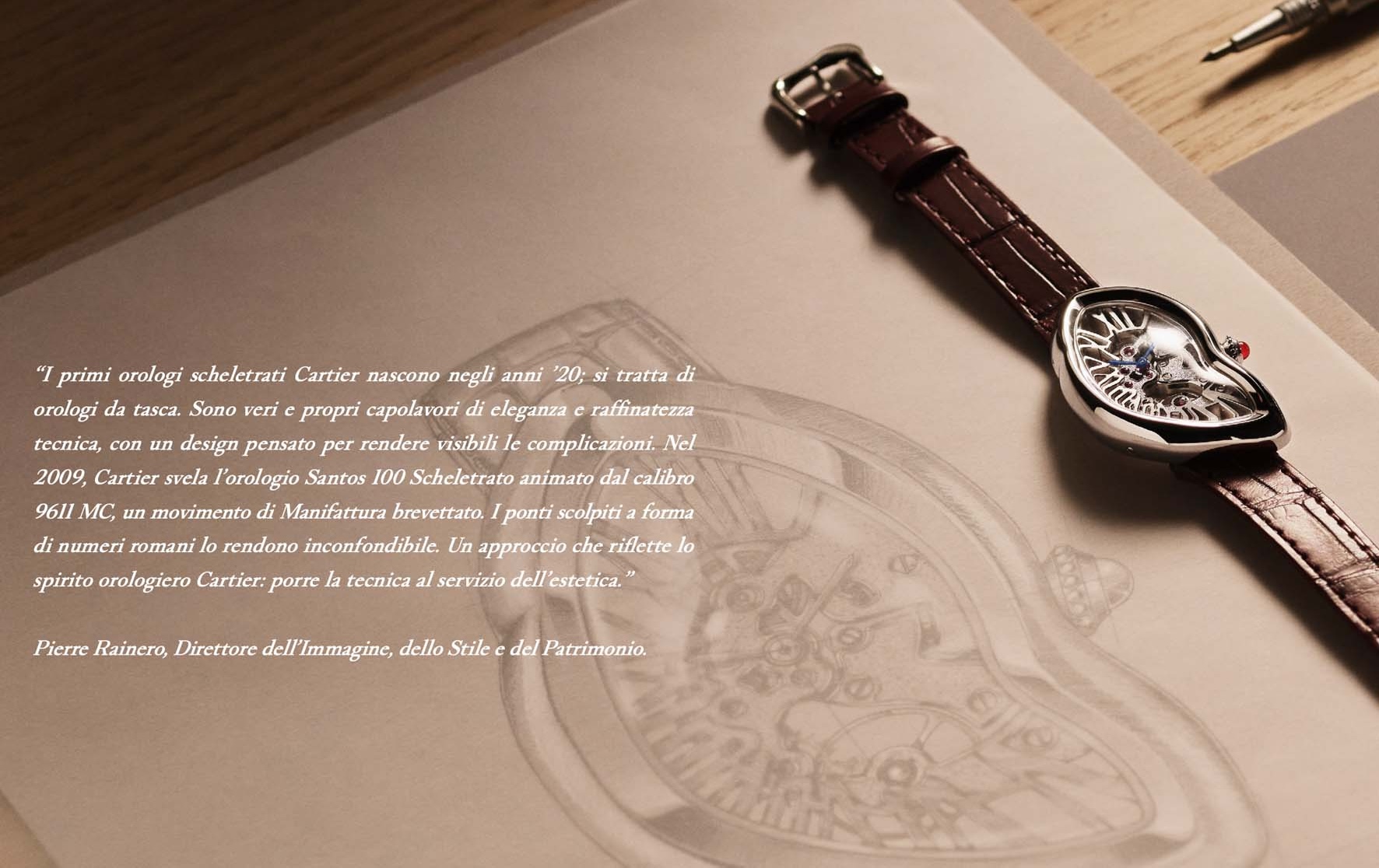
The new Crash skeleton represents one of the most emblematic cases in which Cartier brings technique to fully align with form. The manual-winding in-house calibre 1967 MC, composed of 142 components, has been specifically developed to adapt to the irregular geometry of the case, transforming a formal constraint into a constructive principle. Skeletonisation here is not applied, but structural: the bridges, hand-shaped according to the design of the Roman numerals, simultaneously fulfil both structural and aesthetic functions, following a typically Cartier logic in which the movement becomes an integral part of the dial.
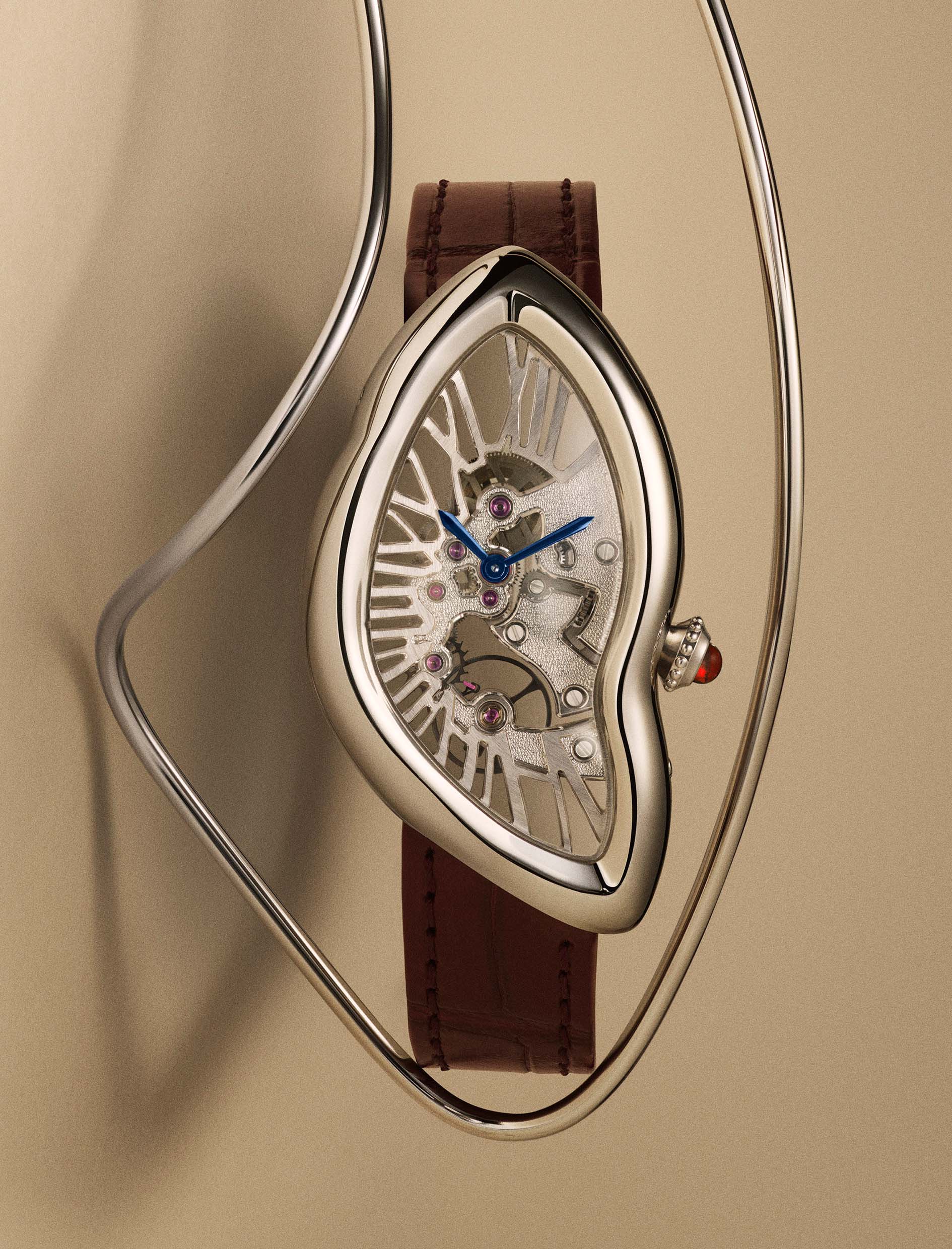
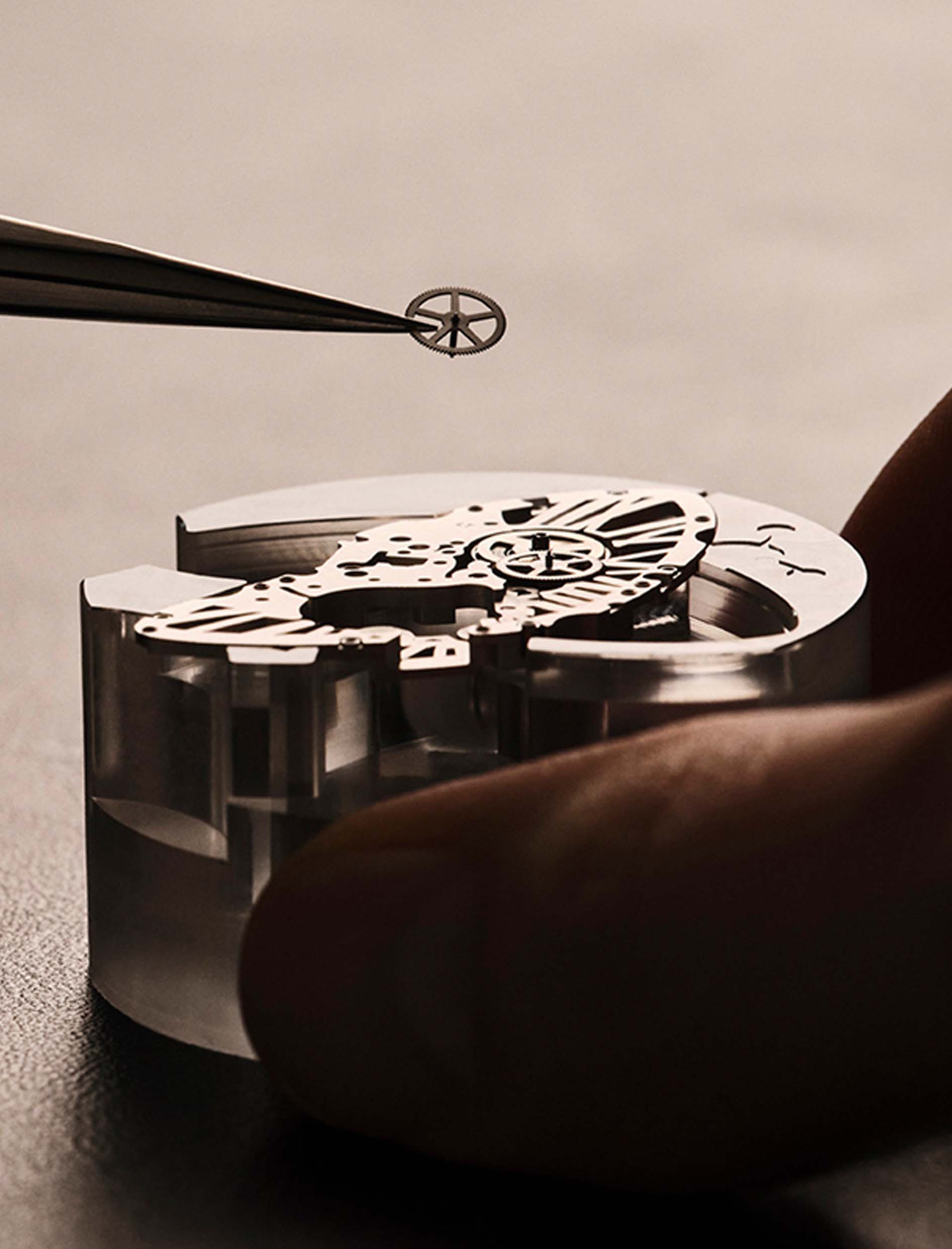
The case, made of platinum, measures 45.35 x 25.2 mm with a thickness of 12.97 mm, and is completed by a crown set with a ruby cabochon; the construction is protected by a mineral crystal on the front and a sapphire crystal on the caseback, while water resistance up to 3 bar (30 metres) is ensured. The model is paired with a semi-matte burgundy alligator strap with a 950 platinum pin buckle. Each piece requires approximately two hours of manual work for the finishing of the bridges, with meticulous control of surfaces and openings. The absence of a traditional dial reveals an openworked construction in which the balance between solid and void is calibrated to ensure legibility without compromising the visual tension of the whole. The distortion of the case is further emphasised by the layout of the movement, as if the crown exerted a pull on the entire structure, making this configuration one of the most advanced expressions of Cartier’s ability to integrate movement and form into a single architecture.
Produced in a limited and numbered edition of 150 pieces, the new Crash is presented at a price of € 119,000, positioning it within the highest segment of the Maison’s watchmaking.
CARTIER ROADSTER
First introduced in the early 2000s, the Roadster brought into the Cartier repertoire a more dynamic language, expressed through a direct reference to the automotive and aeronautical worlds. The elongated tonneau case, defined by taut lines and fluid surfaces, evokes the tension of bodywork and fuselages, yet is brought back to a rigorous balance typical of the Maison.

In 2026, Cartier reintroduces the Roadster by precisely refining its proportions. The tonneau case is streamlined to achieve greater continuity between surfaces, while the crown, fully integrated into the caseband, contributes to a more harmonious balance between bezel and side profile. The slightly curved crystal engages directly with the metal structure, visually integrating the magnified date window and creating optical continuity between functional elements. References WSRD0019 and WSRD0020 are available in steel, with dimensions of 42.5 x 34.92 mm and 47.2 x 38.7 mm respectively, and thicknesses of 9.7 mm and 10.06 mm, both featuring a fluted steel crown and sapphire crystal. The silvered opaline dial is paired with blue sword-shaped hands treated with Super-LumiNova, while water resistance up to 10 bar (100 metres) is ensured.
The dial also reprises Cartier’s aesthetic codes, with Roman numerals, chemin de fer minute track and blued steel hands, but reorganises them within a surface that follows the curvature of the case, improving readability along the longitudinal axes. The magnified date window integrates without disrupting the overall graphic rhythm, while the metallic cabochon on the crown recalls the Maison’s tradition in a more technical key. Case dimensions, available in multiple variations, are designed to optimise wearability and weight distribution on the wrist.
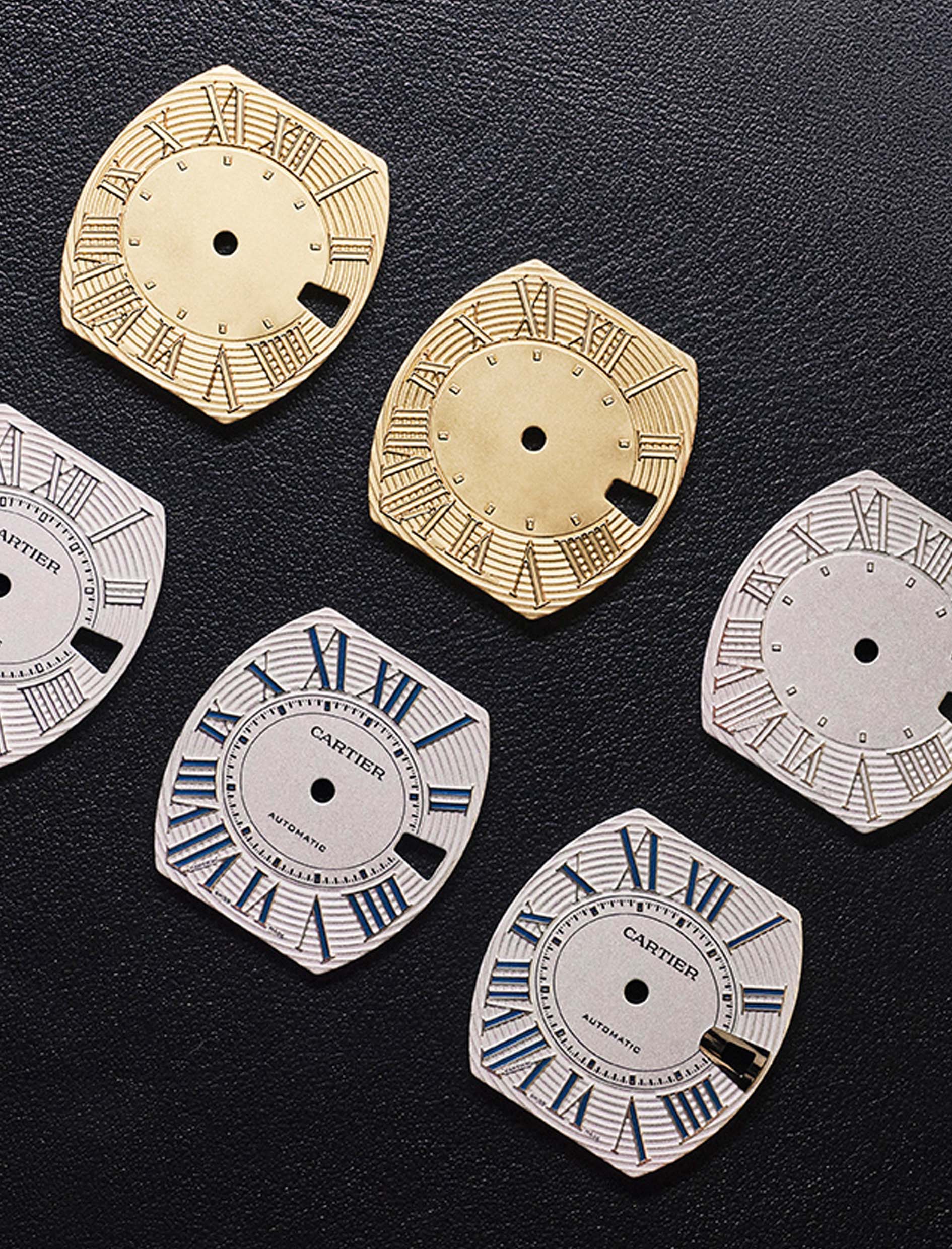
Both versions are powered by automatic in-house movements, with calibre 1899 MC for Ref. WSRD0019 and calibre 1847 MC for Ref. WSRD0020, offering power reserves of 39 and 40 hours respectively, and a frequency of 28,800 vibrations/hour (4 Hz). The QuickSwitch system allows interchangeability between the steel bracelet and a semi-matte navy blue alligator strap, completed by an interchangeable steel folding clasp.
The price is € 9,300 for Ref. WSRD0019 and € 10,200 for Ref. WSRD0020; the collection also includes additional variants in steel, two-tone and gold, offered in different sizes and configurations.
CARTIER BAIGNOIRE AND THE CLOU DE PARIS MOTIF
The Baignoire belongs to that lineage of creations through which Cartier defined, from the early decades of the twentieth century, an idea of watchmaking deeply connected to jewellery. Its origins trace back to the Maison’s first oval watches, already appearing at the beginning of the century, at a time when Cartier was experimenting with unconventional forms to adapt the watch to the body. The name itself, Baignoire— meaning “bathtub”—derives from this elongated and enveloping silhouette, evoking a soft and continuous shape. Formalised in its current configuration during the 1950s, the model stands out for its fluid, non-rigid line, designed to follow the wrist naturally. Its form, both simple and sophisticated, belongs to that tradition so dear to Cartier, in which the watch is conceived as an object to be worn before it is read.
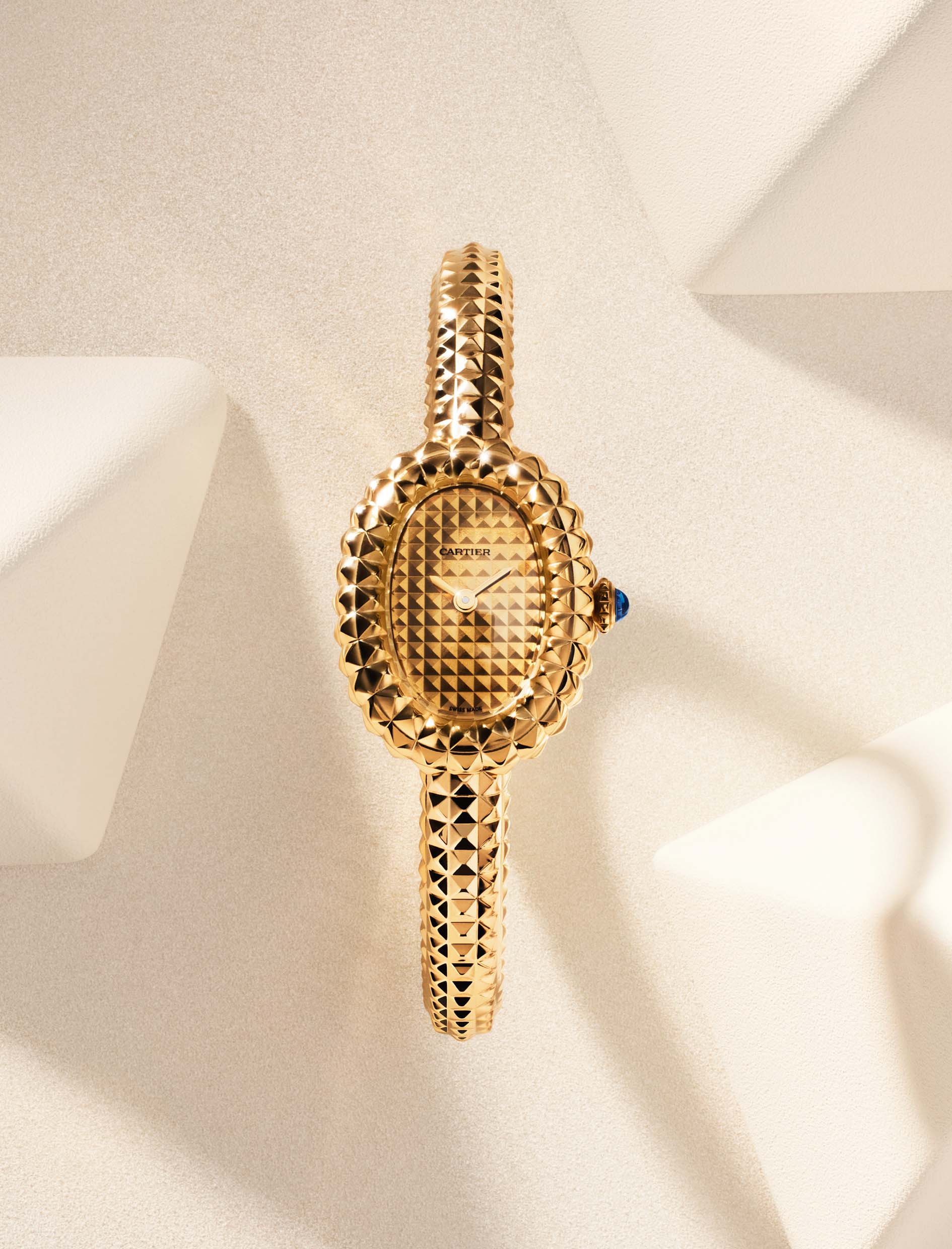
For this new model, Cartier intervenes on surface and construction by introducing the Clou de Paris motif, a distinctive element of its vocabulary since the 1920s, which here takes on a structural role. The monochromatic gold is worked using a specific savoir-faire to ensure continuity of form, creating a regular pattern that runs across bracelet and case, building a true architectural geometry. Proportions have been recalibrated and the yellow gold pushers are shaped to integrate perfectly with the sinuous bracelet, while the hand-polishing, entirely executed manually, requires extremely precise control to enhance brilliance without wearing down the relief. The watch is powered by a quartz movement, in line with a design approach oriented towards purity of form.
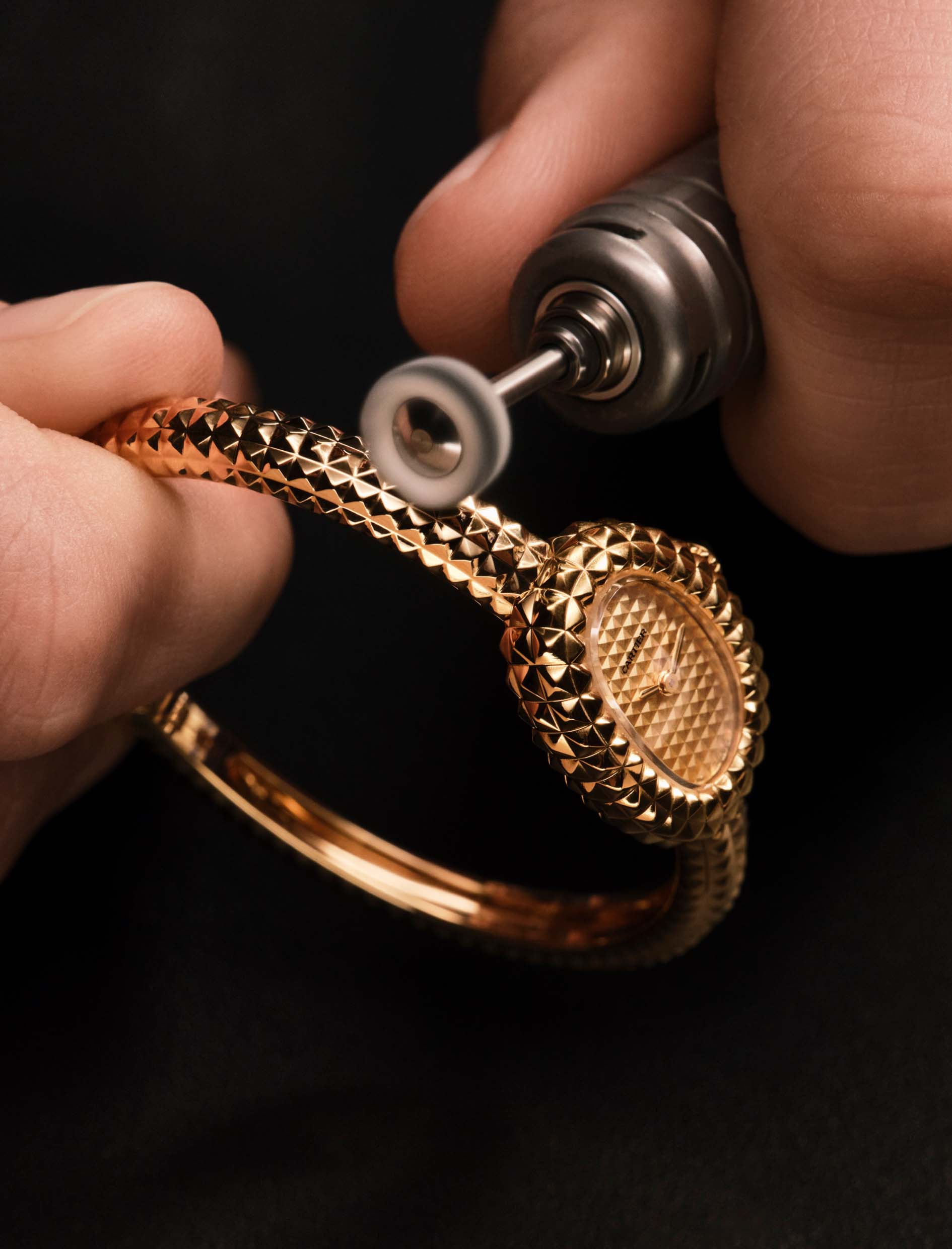
The compact case is paired with a rigid yellow gold bracelet that extends and enhances the Clou de Paris motif across its entire surface, transforming decoration into a continuous structural element. The beaded crown, also in yellow gold, is set with a sapphire cabochon, in line with the Maison’s aesthetic codes. In the diamond-set version, the snow setting on the dial, composed of 100 brilliant-cut diamonds, is combined with an inverted pavilion setting on the case, extending to the bracelet, where diamonds of varying sizes are arranged to construct volumes and reflections, according to a logic that combines technical precision and aesthetic outcome.
Models with rigid yellow gold bracelet (Refs. WGBA0070, WGBA0071 and WGBA0072) are priced at € 23,200, while fully set versions (Refs. WJBA0067 and WJBA0068) reach € 65,500.
THE WATCHMAKING ART OF MYST DE CARTIER
The Myst de Cartier belongs to one of the most fascinating strands in Cartier’s history: creations in which time seems to elude the eye even before revealing itself. As early as the beginning of the twentieth century, with the famous mystery clocks developed by the Maison in collaboration with watchmaker Maurice Couët, Cartier introduced an idea of watchmaking in which the movement disappears — or rather becomes invisible — through technical solutions that create the illusion of hands suspended in space. In the 1930s, under the creative direction of Jeanne Toussaint, this principle extended to jewellery watches. Within this continuity, the Myst stands as a contemporary reinterpretation of this approach, where time display does not impose itself, but is discovered within an elegant composition.
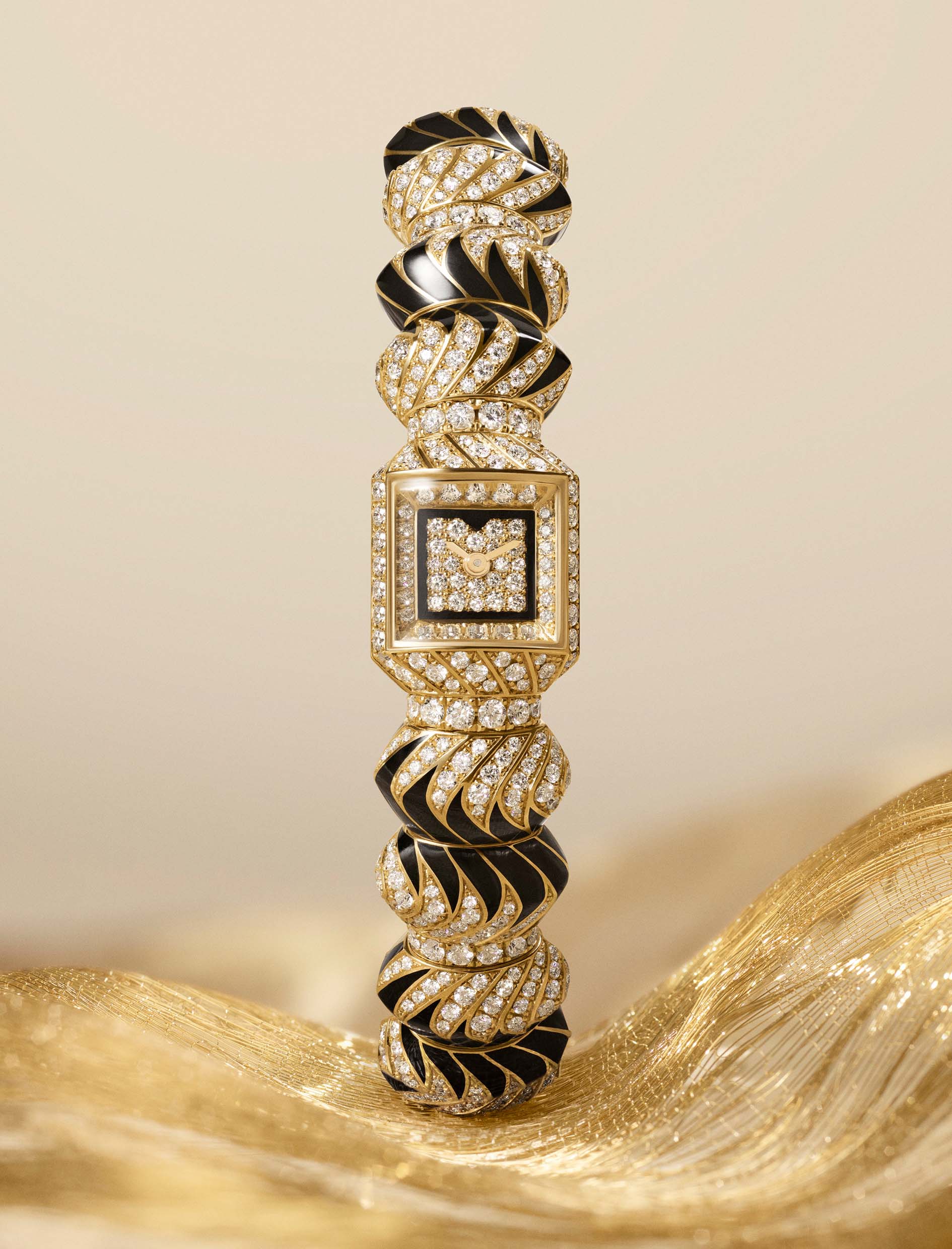
The version presented in 2026 is based on a precise balance between lines, materials and techniques. The contrast between the curves of the domed crystal and the sinuous lines of the structure interacts with the geometry of the pavé dial, framed by onyx and defined by a triangular index. Graphic elements are arranged according to a principle of symmetry, emphasised by touches of black lacquer manually applied by the artisans of the Maison des Métiers d’Art. The case is made in white gold or black-lacquered yellow gold and is entirely crafted to house a pavé diamond dial, with 45 or 47 stones respectively, integrated with onyx elements. The absence of the crown, replaced by a setting system activated via a discreet push-button on the caseback, contributes to maintaining the purity of the lines and reinforcing the visual effect of suspension.
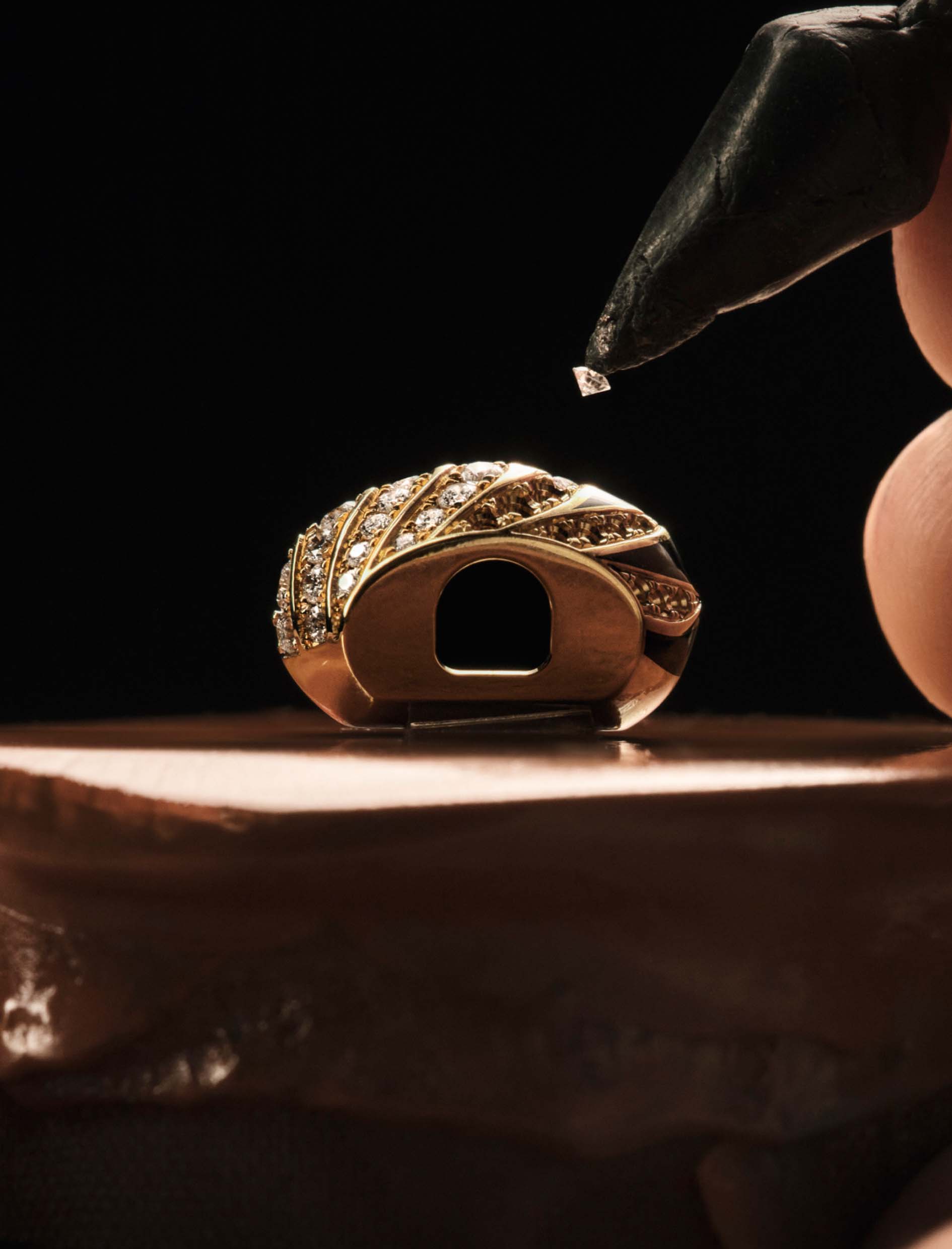
The watch is powered by a quartz movement, a choice that allows for a more essential case construction and uninterrupted formal continuity. The elastic bracelet, without clasp, is composed of a succession of lacquered and pavé elements and integrates hundreds of brilliant-cut diamonds, selected and set according to a calibrated arrangement to create effects of volume and visual continuity: up to 998 diamonds in the white gold version and over 600 diamonds in the yellow gold version with black lacquer. The four-prong setting, executed over 112 hours of work, uses stones of different sizes to create perspective and volume effects, resulting in a three-dimensional architecture in which watchmaking and jewellery merge inseparably.
The Myst de Cartier is priced at € 190,000 for the white gold version and € 159,000 for the yellow gold version with black lacquer.
THE BALANCE POINT
Rather than introducing new forms, for this Watches and Wonders 2026 Cartier has chosen to work by subtraction, intervening with precision on what already exists, refining proportions, surfaces and constructions until they become essential. In an increasingly complexity- and performance-driven context, the Maison chooses a different path—one that expresses a deeply contemporary elegance. And it is precisely in this ability to subtract, rather than to add, that Cartier continues to define its own language.
By Elisa Copeta