

In 2025, some celebrated their anniversary by highlighting history and tradition through events and appointments around the world. Others, such as Breguet, accompanied these events with the launch of a series of watches, in a crescendo of mechanical excellence that began in April with the Classique Souscription 2025 presented in Paris and culminated in the very recent Expérimentale 1. This watch is, to all intents and purposes, a meeting point between the past and the future, yet another manifestation of what Breguet is capable of in terms of research and development. If Abraham-Louis Breguet was the most famous watchmaker in the world in his day, the Experimentale collection anticipates what Breguet watchmaking will be in the future.
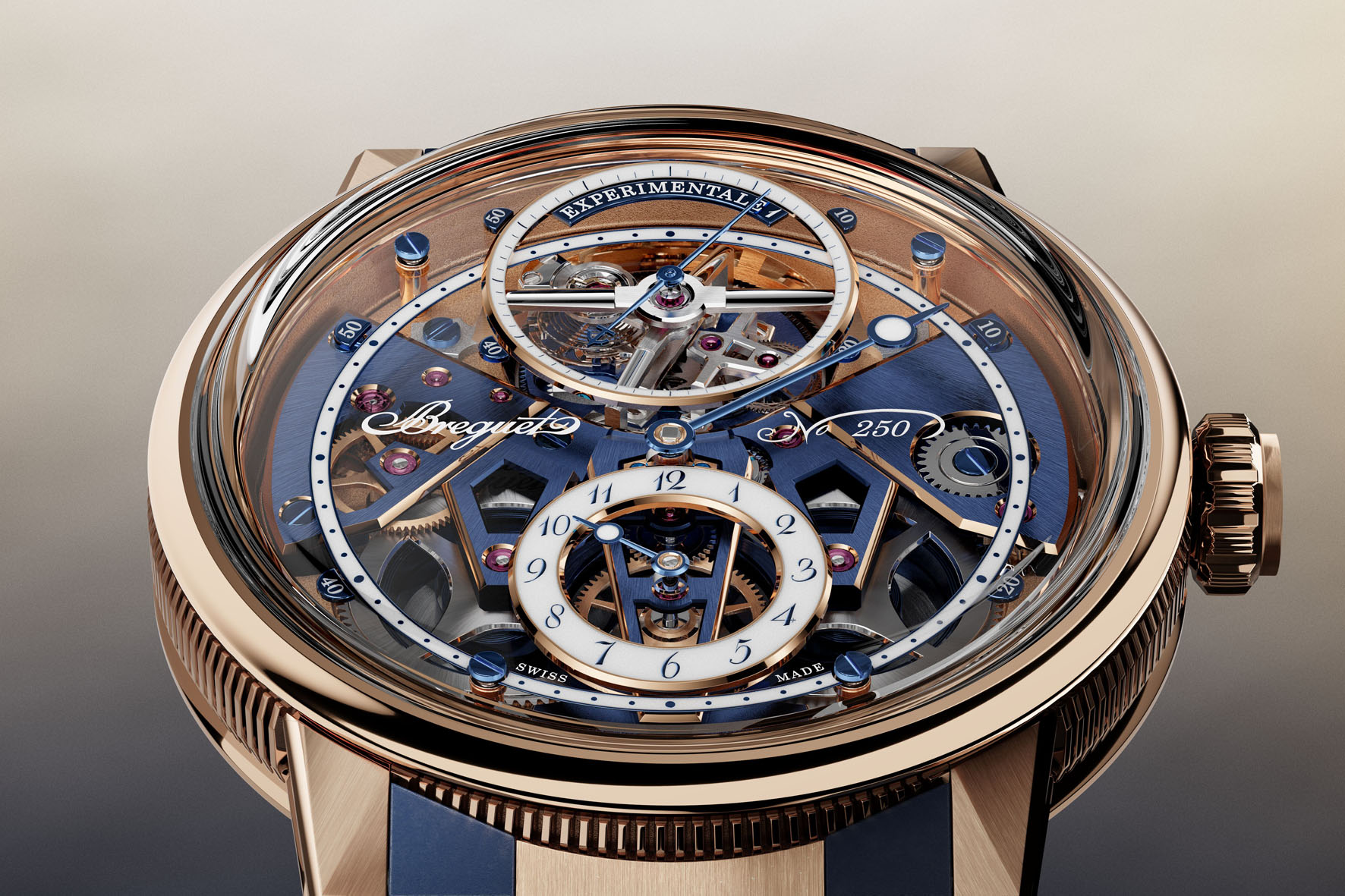
The Breguet Expérimentale 1, as the first watch in this collection and the final chapter in the celebrations of the brand’s 250th anniversary, brings together several elements that characterise the Maison’s history. It is a tribute to the title of Horloger de la Marine Royale conferred on Breguet by the Bureau des Longitudes in Paris in 1814; it offers a new vision of the Maison’s most famous invention, the tourbillon; and it represents the evolution of the research into magnetism that Breguet began in 2013 with the Classique Chronométrie 7727 and perfected with the Classique 7225, presented just a few weeks ago.
MAGNETISM AND HIGH FREQUENCY
The uniqueness of the Breguet Expérimentale 1 lies precisely in its engineering features, combined with the design language of the Marine collection. We are referring to the 10 Hz high-frequency tourbillon with a constant-force magnetic escapement, and to the evolution of magnetism in watchmaking already seen in the Classique Chronométrie 7727 and the Classique 7225. In these two watches, magnetism—applied intelligently—becomes a valuable ally rather than a nightmare for timepieces.
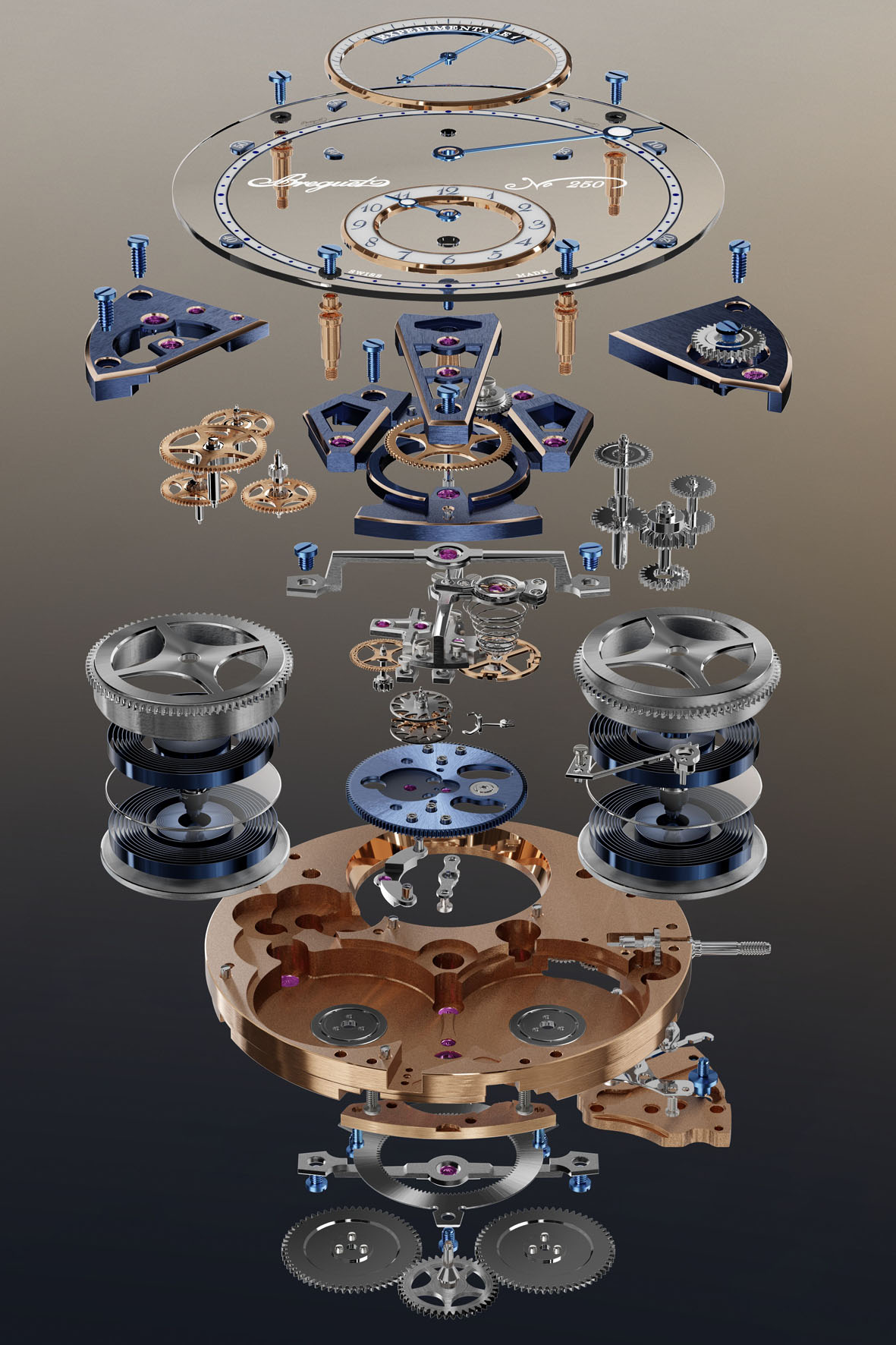
In the 7727 and 7225, Breguet used a pivot in which two micro-magnets, each inserted into a terminal stone, generate opposing magnetic fields to keep the balance wheel perfectly centred. This solution almost completely eliminates positional errors, increases shock resistance, and reduces friction between mechanical parts as well as component wear. Building on these results, the Breguet Expérimentale 1 takes the concept of the magnetic pivot even further by introducing controlled magnetism into the escapement in order to further increase precision. The result is a new system combining a high-frequency tourbillon with a constant-force magnetic escapement, uniting traditional watchmaking with scientific research—the very meeting point between past and future mentioned at the beginning.
BREGUET EXPÉRIMENTALE 1: PRECISION ABOVE ALL ELSE
The primary objective of the new system remains the pursuit of precision, which requires addressing three fundamental issues: inconsistent balance-wheel amplitude, the effect of gravity on the regulating organ (balance wheel and hairspring), and shock resistance. The first issue arises from the decrease in torque as the power reserve is depleted: it is impossible to maintain constant amplitude if the energy delivered to the balance wheel is not constant, unless a constant-force device is employed. The second issue was solved by Breguet himself with the invention of the tourbillon. The third stems from the accelerations and shocks to which the movement is subjected, which disrupt its regular operation and, consequently, its precision.
The Breguet Expérimentale 1 addresses all three challenges with a single solution: a 10 Hz tourbillon equipped with a constant-force magnetic escapement. Thanks to the use of magnetism, a stable impulse is delivered to the balance wheel throughout the entire power reserve, while the impulse function is decoupled from the rotation of the escapement wheel, the tourbillon cage and the entire gear train.
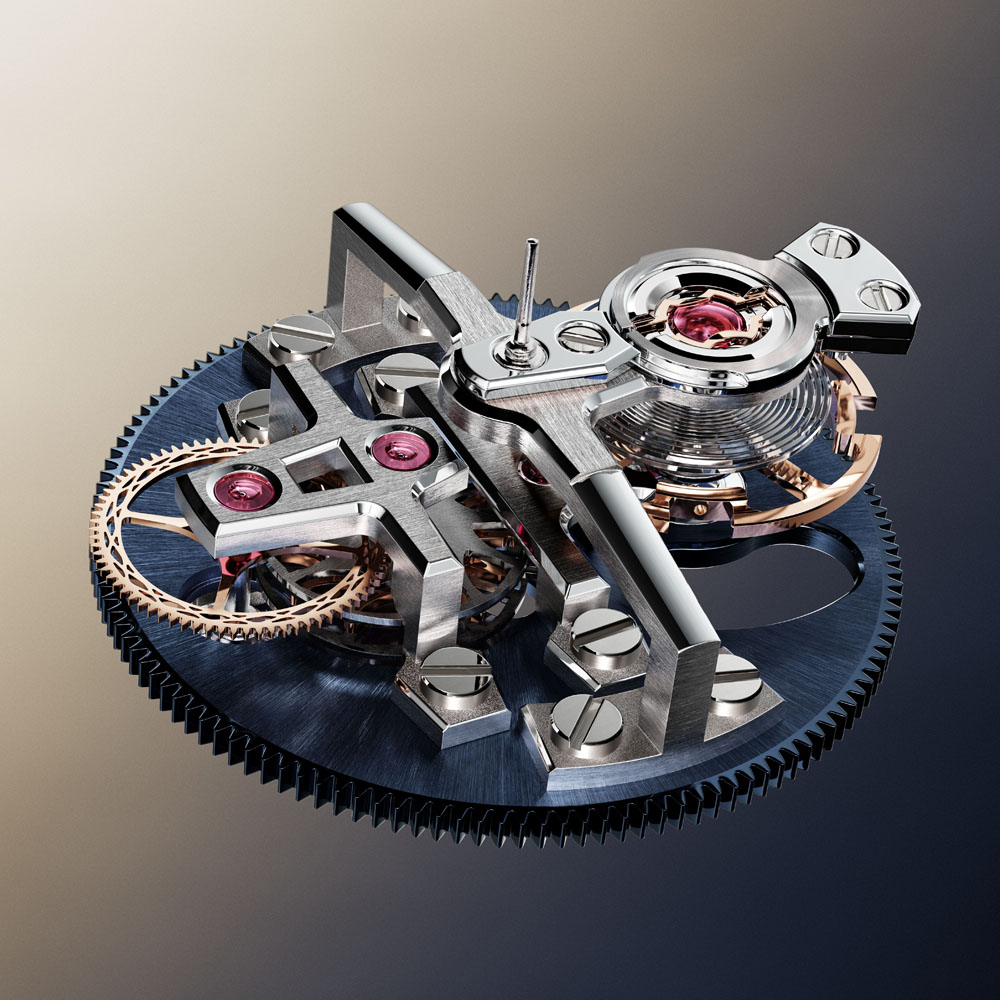
This device features two escapement wheels, each equipped with a magnetic track, at the centre of which operates a lever with magnetic pallets—a system inspired by constant-force escapements. Below a certain torque threshold, the tourbillon stops rapidly; above it, the balance wheel oscillates at its maximum amplitude. The escapement developed by Breguetalso allows the impulses transmitted to the balance wheel to be decoupled from the rotation of the escapement wheel and, therefore, from the rest of the gear train. Between the two escapement wheels with magnetic tracks, an intermediate stop wheel prevents unwanted jumps. Furthermore, most of the other components of the tourbillon are non-magnetic, in order to avoid interference that could compromise smooth operation.
In this triumph of avant-garde technology, the technical architecture of the system retains traditional features. It incorporates an anchor activated by magnetic impulse which, by eliminating physical contact, reduces friction to a minimum. This is why a constant-force device such as a remontoire d’égalité is not required. The system generates constant force because it is free of friction and unaffected by the state of the mainspring or barrel torque. Thanks to these solutions, the Breguet Expérimentale 1 is certified by the Maison in the “Scientific” category, guaranteeing an accuracy of ±1 second per day.
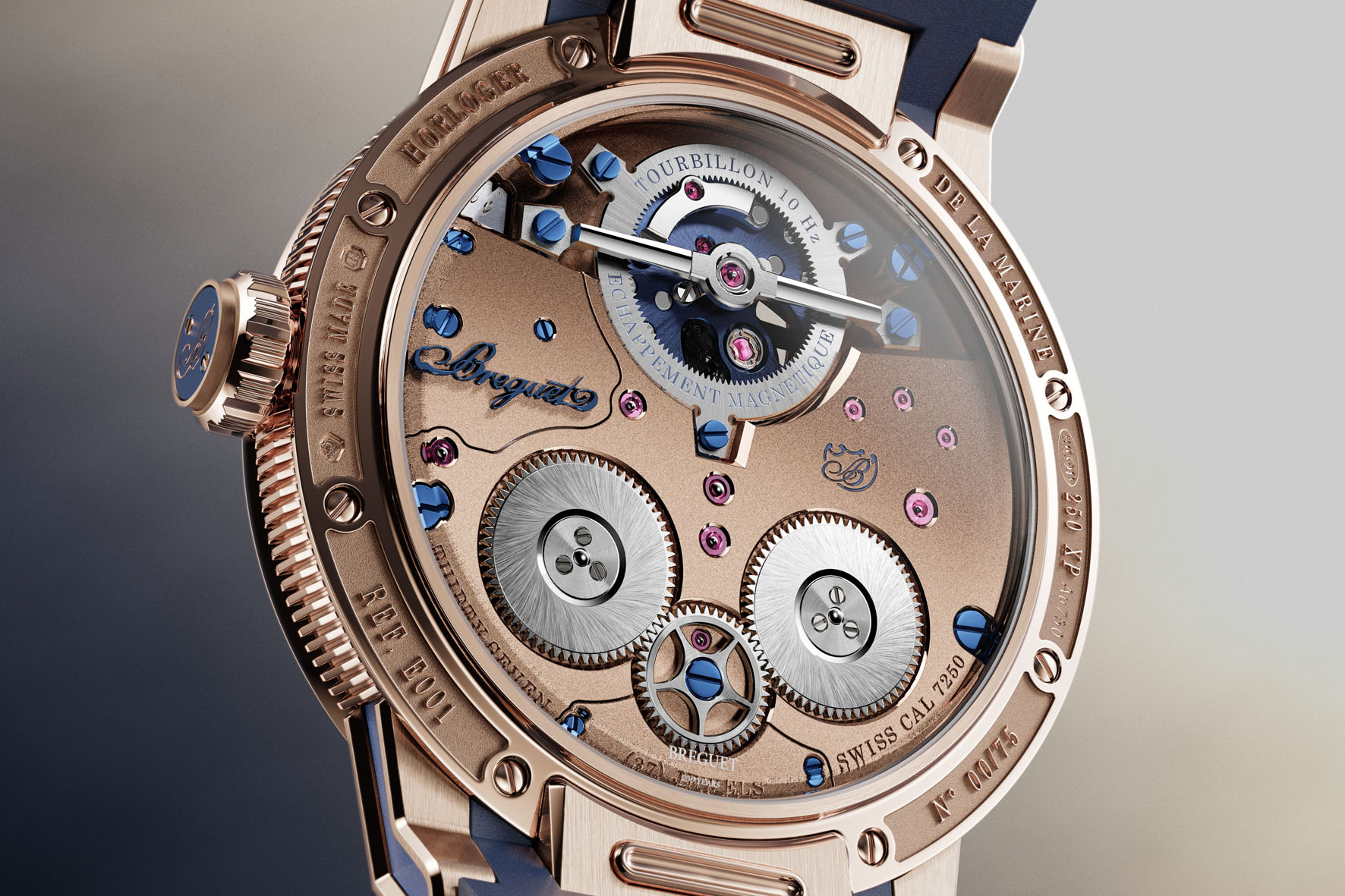
The system is an integral part of the new in-house Calibre 7250, which offers a 72-hour power reserve. Crafted in 18-carat Breguet gold with elegant matte surfaces, the movement features a patented double-barrel system arranged on two levels. Each barrel contains a double spring separated by a sapphire spacer and is positioned symmetrically on either side of the hour axis, at 4 o’clock and 8 o’clock. In total, four springs optimise energy management within the available space. The movement is finely decorated, combining traditional techniques—such as a tourbillon bridge polished with bercé and anglage with internal angles—with a technical, contemporary aesthetic that defines the Breguet Expérimentale 1.
THE STYLE OF THE BREGUET EXPÉRIMENTALE 1
From an aesthetic standpoint, inspiration from Breguet’s Marine collection is immediately apparent, though translated into a fundamentally new stylistic language. This fusion of modernity and tradition defines the watch’s character, as noted at the outset. Far removed from the aesthetics of the Classique Chronométrie 7727 and 7225, and still within the realm of high frequency, the clean, contemporary design marks a clear evolution of the Marine collection.
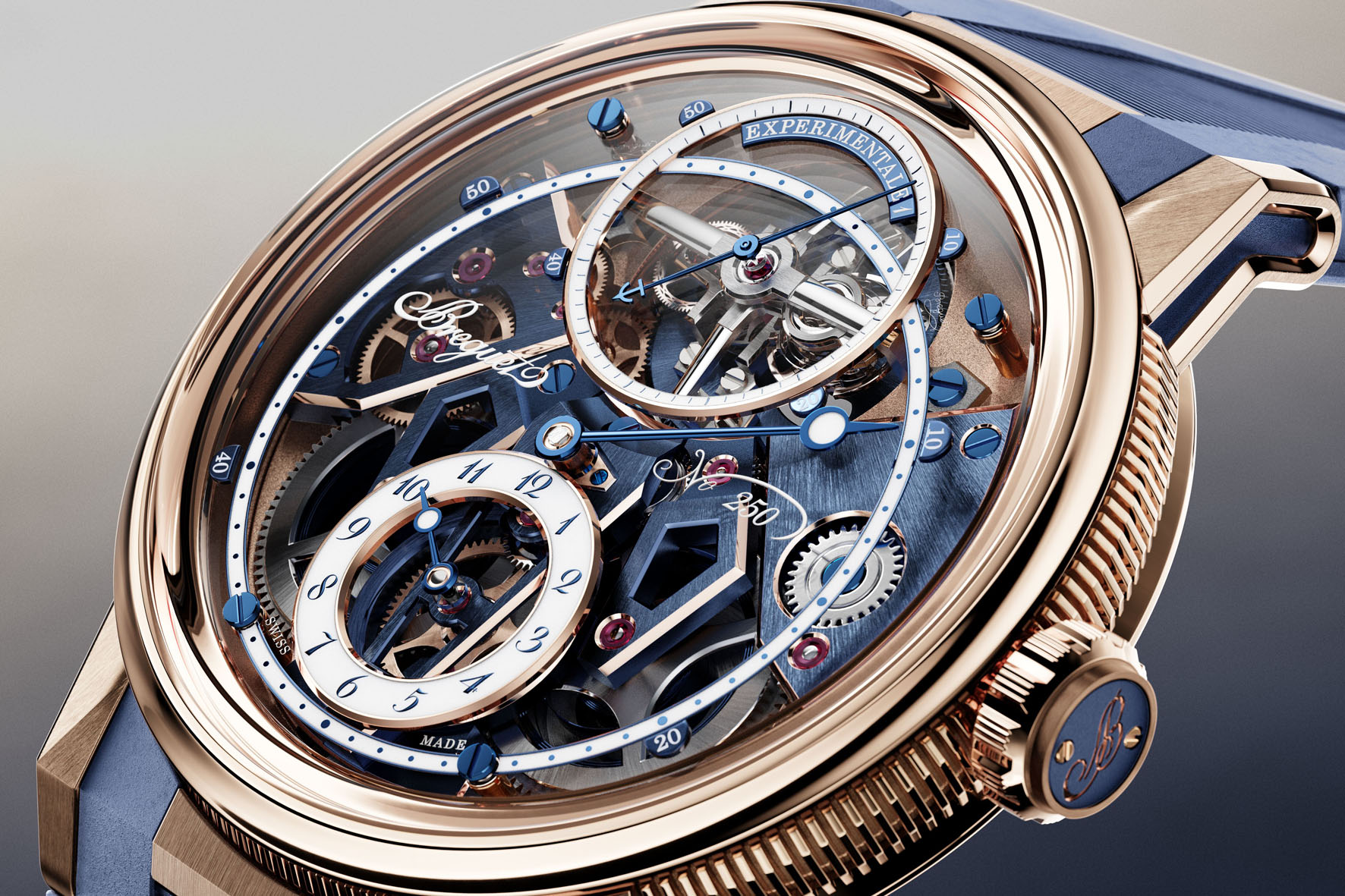
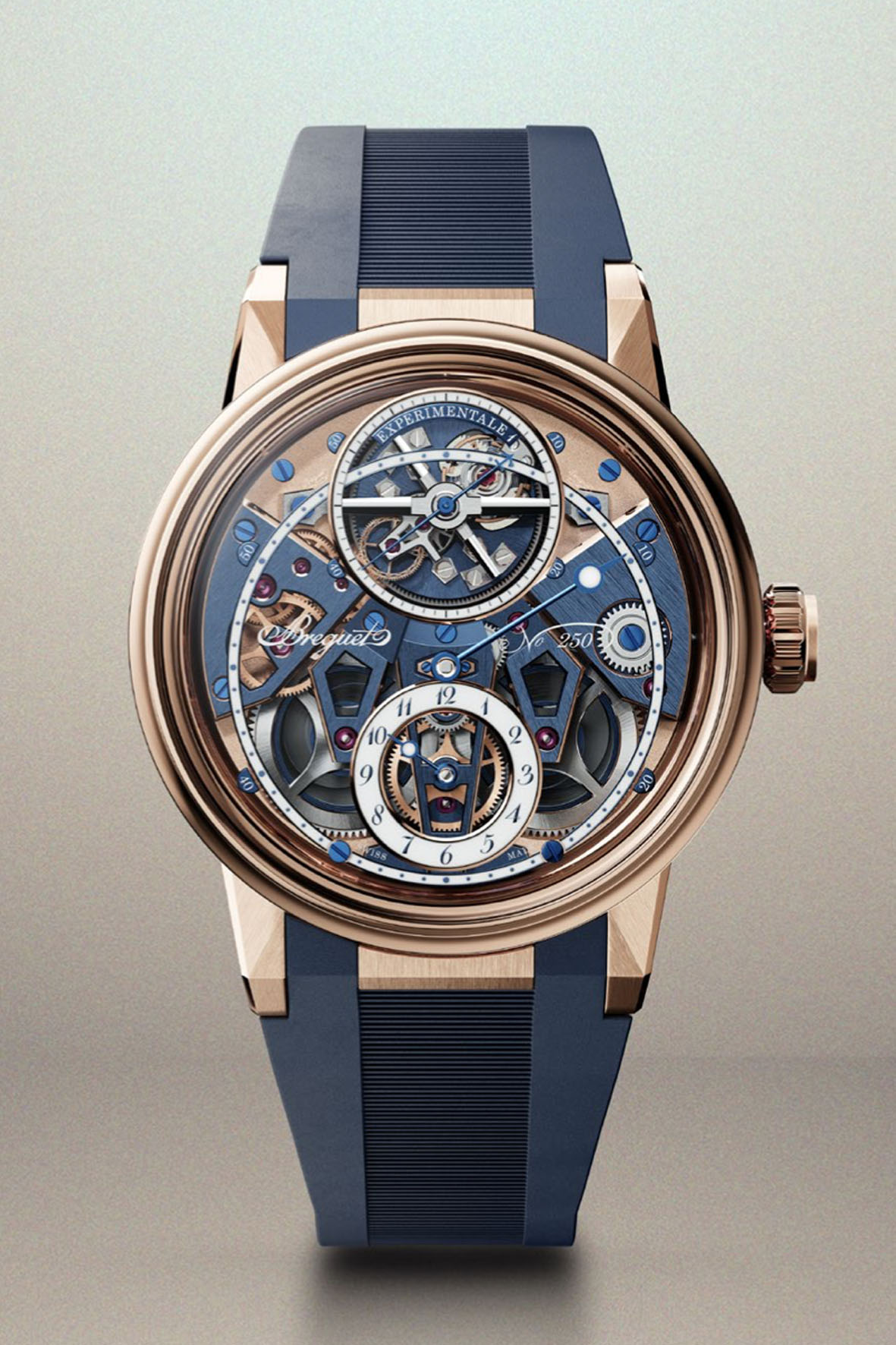
The case, crafted in 18-carat Breguet gold, is imposing at 43.5 mm in diameter and 13.30 mm thick, with pronounced facets and angular forms. The lugs, including the central module, are openworked and alternate sandblasted, blued and satin finishes, along with an inlay in Breguet gold treated with blue ALD. The caseband retains a signature Breguet feature – the fluted middle – here reinterpreted with a more contemporary approach and paired with a stepped bezel.
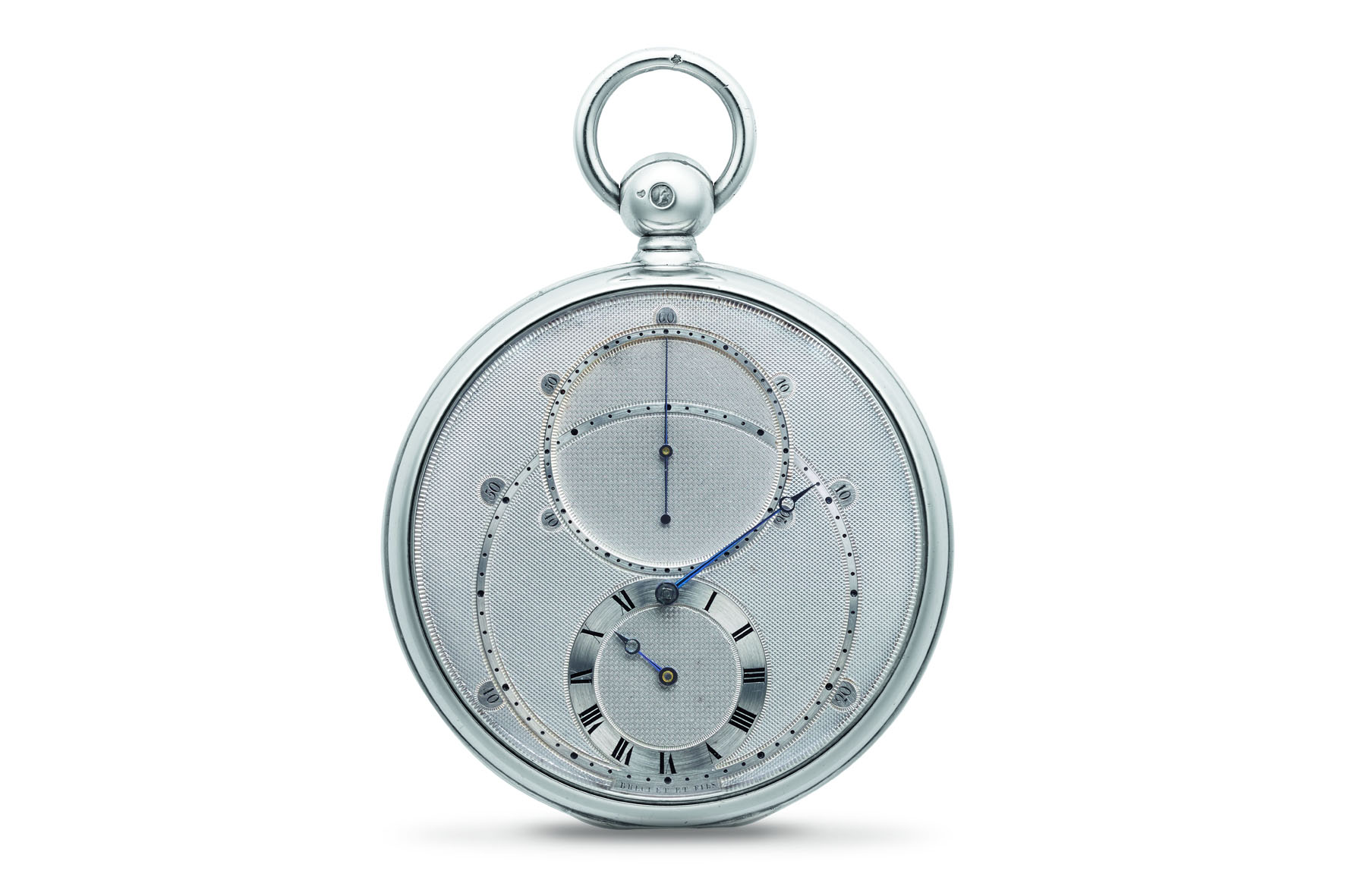
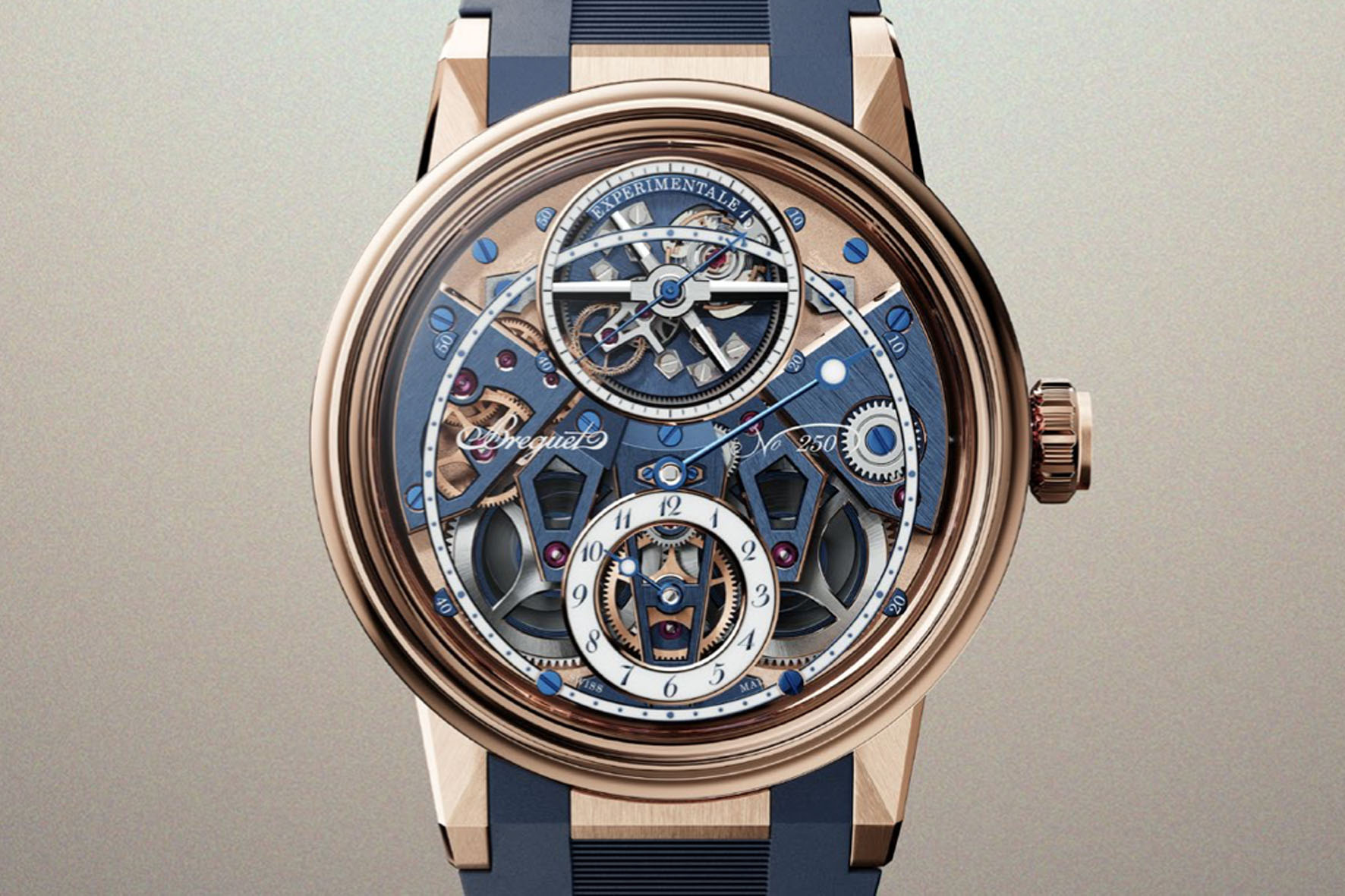
From a historical perspective, Breguet traces the inspiration for the Expérimentale 1 back to one of its early creations: pocket watch no. 3448, featuring a regulator-style display. The sapphire dial strongly emphasises symmetry. The upper section houses the 10 Hz tourbillon, while the lower section contains the hour counter, flanked by the two twin barrels visible beneath the sapphire crystal. The bridges are either left in untreated Breguet gold or satin-finished with hand-polished bevels and coated in navy blue.
The seconds are displayed traditionally on the tourbillon, whose anchor-shaped titanium counterweight recalls the Marine collection. The minutes are offset downward on a large suspended white ring that intersects the tourbillon and runs tangentially to the hour counter. The hands are an evolution of the classic Breguet pomme évidée hands, filled with Super-LumiNova. The sapphire dial rests on four gold pillars and bears the secret Breguet signature at 11 o’clock and 1 o’clock on the hour ring.
THE BREGUET HALLMARK
Like the Maison’s other exceptional timepieces, the Experimentale 1 is certified by the Breguet Hallmark, the guarantee seal applied to the finished watch case and buckle. Through it, the Maison certifies the quality of components, the performance of the watch and ethical manufacturing practices. Each watch is identified by an individual number, finished and assembled, inspected at every stage of production and certified during final inspection to verify its overall performance.
Based on these criteria, Breguet classifies each timepiece according to daily precision under the Puncheon system: “Scientific” (±1 second), “Civil & Sport” (±2 seconds) or “Evening & Jewellery” (–2/+6 seconds). The Breguet Hallmark also guarantees that all components are manufactured in Switzerland to the highest standards of fine watchmaking.
FOR A SELECT FEW
The Breguet Expérimentale 1 retains its modern, avant-garde character with a blue rubber strap seamlessly integrated into the case and fitted with a quick-release system operated by buttons on the reverse of the lug modules. It is secured by an 18-carat Breguet gold pin buckle, ensuring comfort despite the watch’s substantial dimensions.
Designed to showcase the Maison’s latest technical and aesthetic developments, the Expérimentale collection offers collectors early access to extremely prestigious timepieces produced in strictly limited editions, whose scientific concepts will later be developed in subsequent collections. The Experimentale 1 will be produced in a limited edition of 75 pieces, with pricing available upon request.
By Davide Passoni