
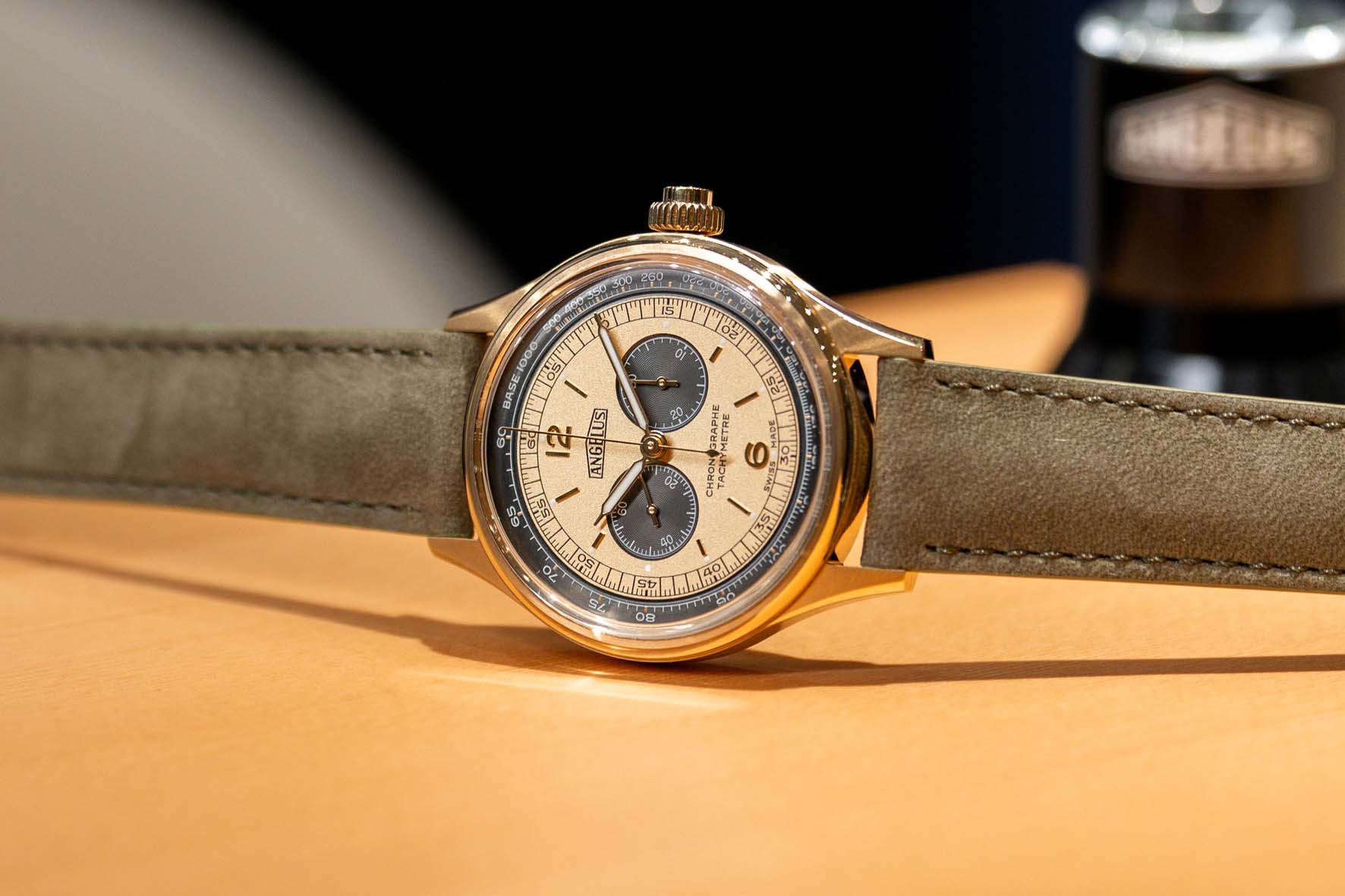

When it comes to historic chronographs, Angelus is a name well worth rediscovering. Founded in Le Locle in 1891 by the Stolz brothers, the Swiss manufacture built much of its identity around instruments designed to measure time. As early as 1925, it was producing its earliest wristwatch chronographs, including monopusher models powered by the in-house SF 15 calibre. That story continued in 1942 with the celebrated Chronodato, a complete-calendar chronograph that would become one of the brand’s most recognisable creations. These are just a few chapters in a remarkably rich history, one Angelus continues to draw on through its La Fabrique collection.
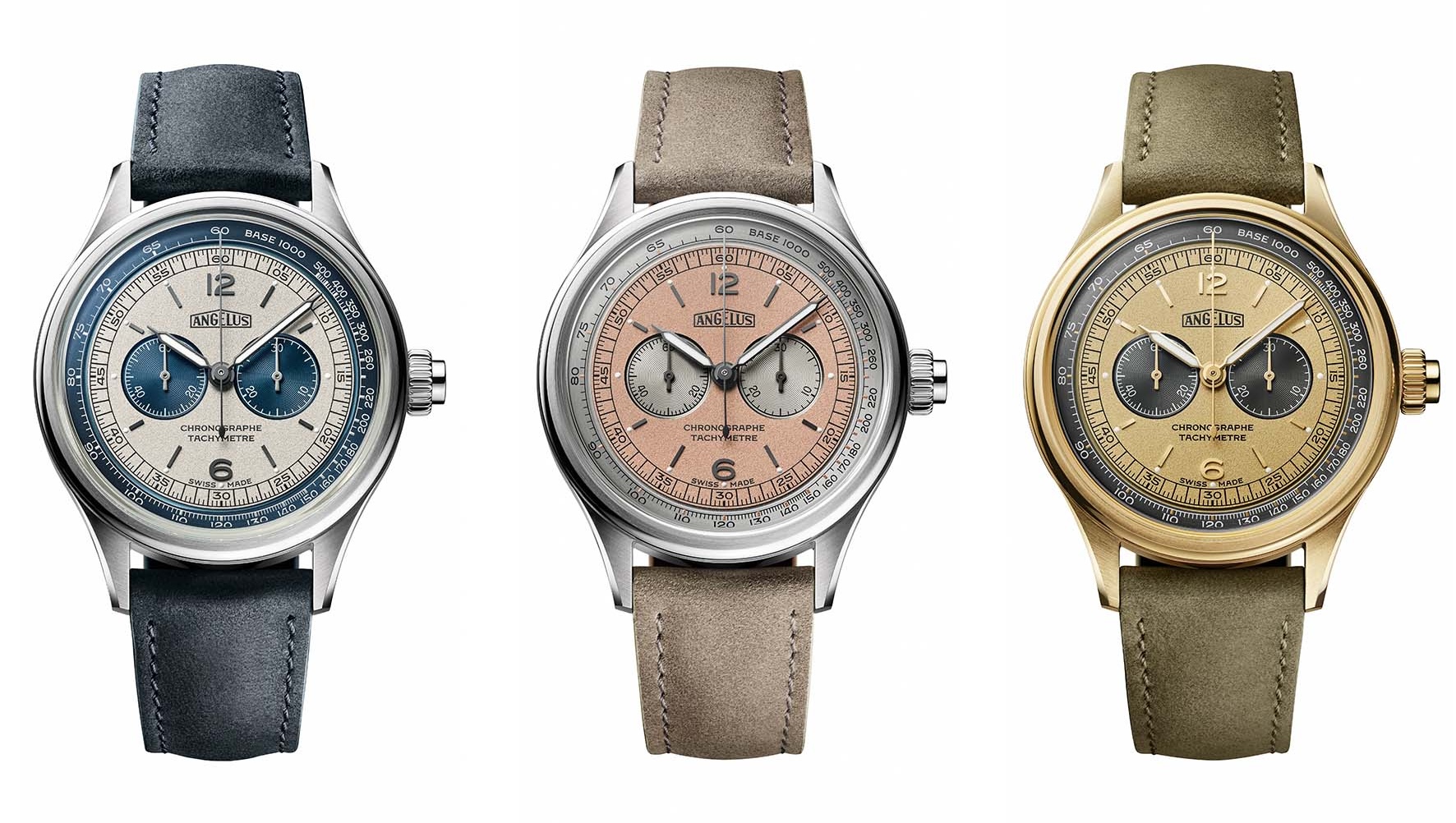
Following the Chronographe Télémètre, winner of the Chronograph Watch Prize at the 2025 Grand Prix d’Horlogerie de Genève, Angelus returns to this heritage with the new Chronographe Tachymètre, a hand-wound monopusher chronograph that recalls the timing instruments associated with motoring. Offered in three limited editions, one in yellow gold and two in steel, it has proportions that are increasingly uncommon for this type of watch: a diameter of 37 mm and a thickness of just 9.25 mm.
ANGELUS CHRONOGRAPHE TACHYMÈTRE: FROM MOTOR RACING TO THE WRIST
The relationship between chronographs and motor racing runs through much of twentieth-century watchmaking history. Before electronic timing systems arrived, these instruments made it possible to measure elapsed times and calculate average speeds, proving invaluable both on racing circuits and in road competitions. The Chronographe Tachymètre revives that function on a dial that seems to belong to another era.
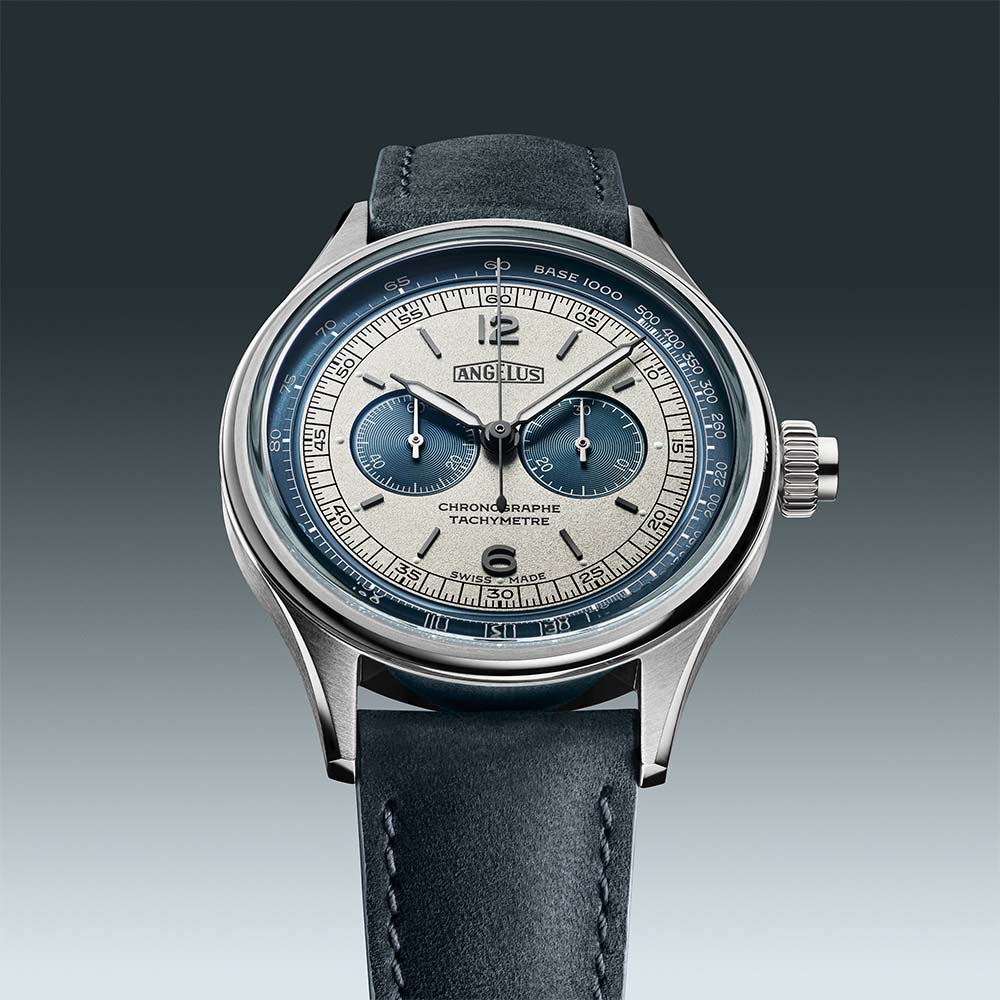
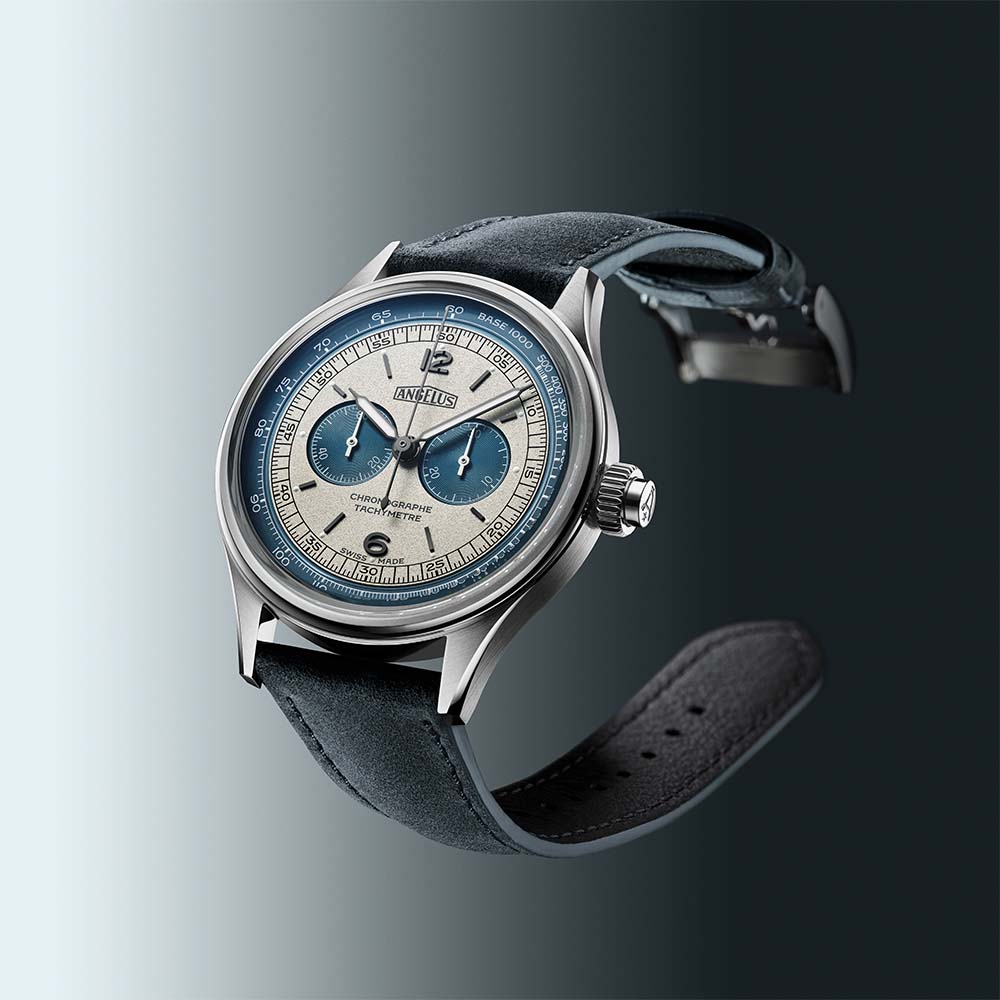
The base-1,000 tachymeter scale, set around the dial flange, allows the average speed over a given distance to be calculated. Simply start the chronograph using the pusher integrated into the crown and stop it after travelling one kilometre or one mile: the central seconds hand then points to the corresponding speed on the scale, while the 30-minute counter at 3 o’clock records the elapsed time. One particularly striking detail is the scale’s starting point of 500 km/h, far beyond the speeds we normally associate with road cars.
The choice of a monopusher chronograph, however, deserves a closer look. Unlike a conventional two-pusher layout, all three operations – starting, stopping and resetting – are controlled by a single button. It is a solution that harks back to the earliest wristwatch chronographs and helps preserve the clean lines of the case, without the usual pushers on its flank. More than a stylistic decision, it offers a different way of engaging with a complication that continues to fascinate enthusiasts.
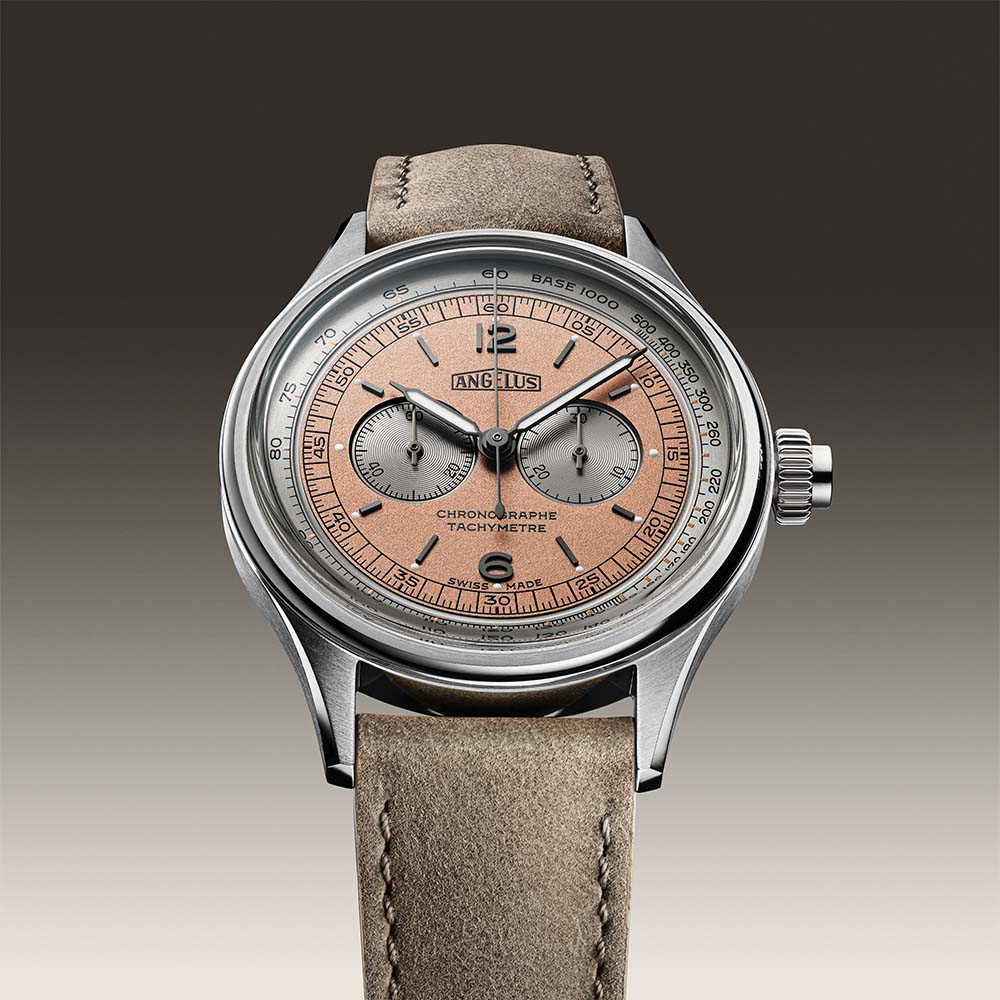
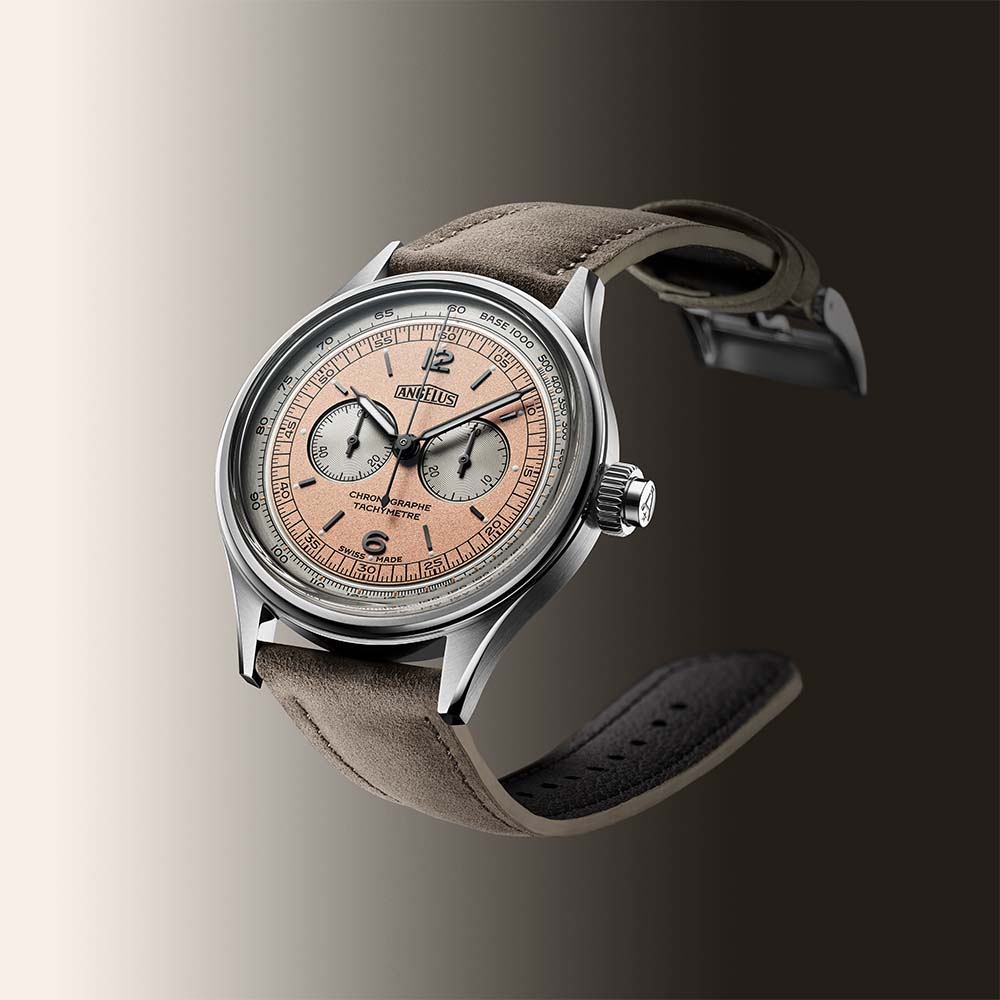
Beyond its practical purpose, what makes the result so appealing is how naturally the tachymeter scale sits within the dial. Rather than simply adding a motoring-inspired graphic detail, Angelus has drawn on a design language rooted in its own history, with carefully arranged indications, contrasting counters and balanced proportions.
ANGELUS CHRONOGRAPHE TACHYMÈTRE: A 37 MM CASE AND THREE VINTAGE-INSPIRED DIALS
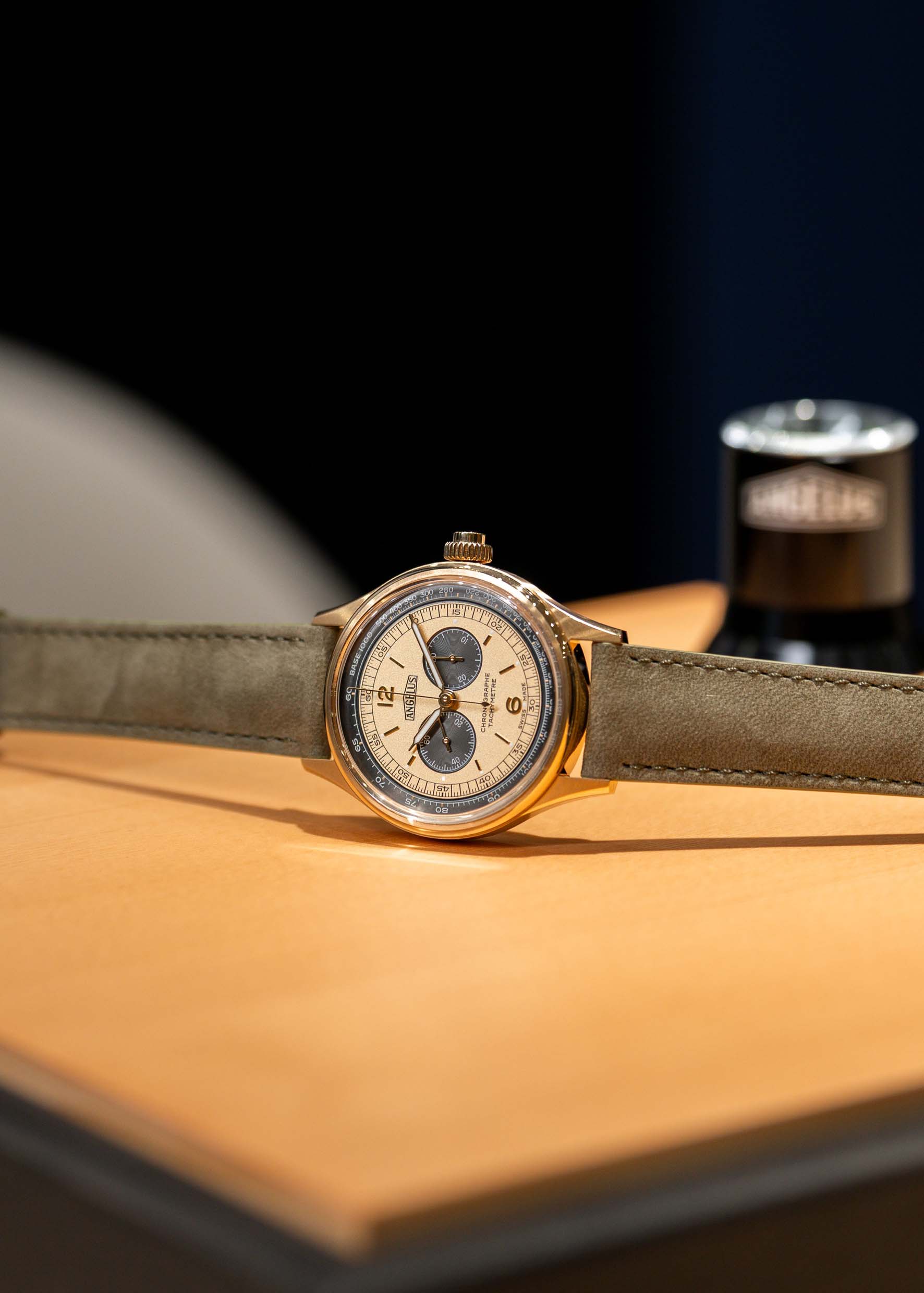
One of the most successful aspects of the Chronographe Tachymètre is undoubtedly its case. At 37 mm in diameter and just 9.25 mm thick, it is among the more compact interpretations of the contemporary chronograph. The lugs are particularly intricate, with a curve running from the caseband towards the lugs, which sweep down to follow the contours of the wrist. Far from being an incidental detail, this helps define the watch’s character, ensuring that its connection to the past goes well beyond the dial.
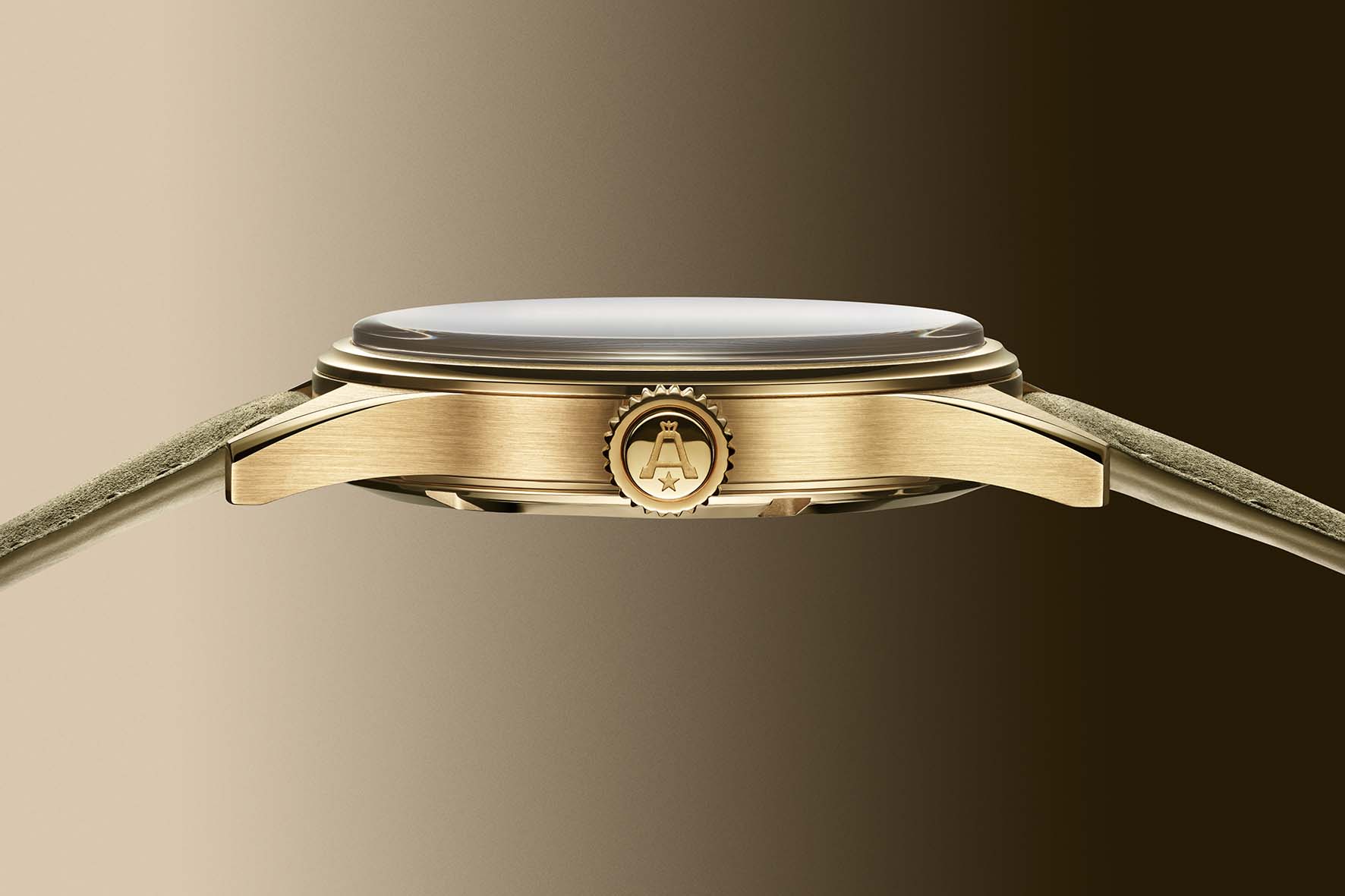
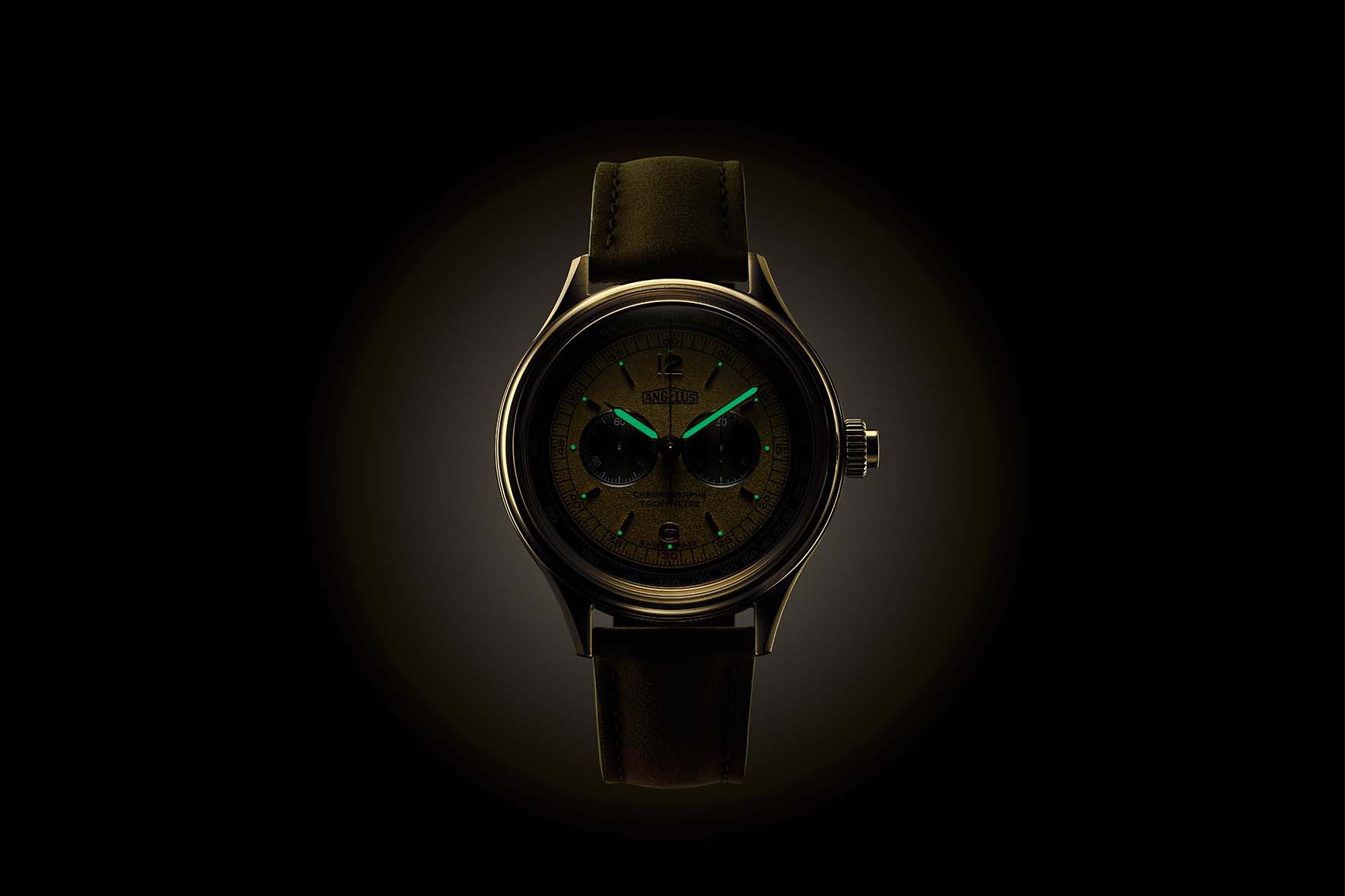
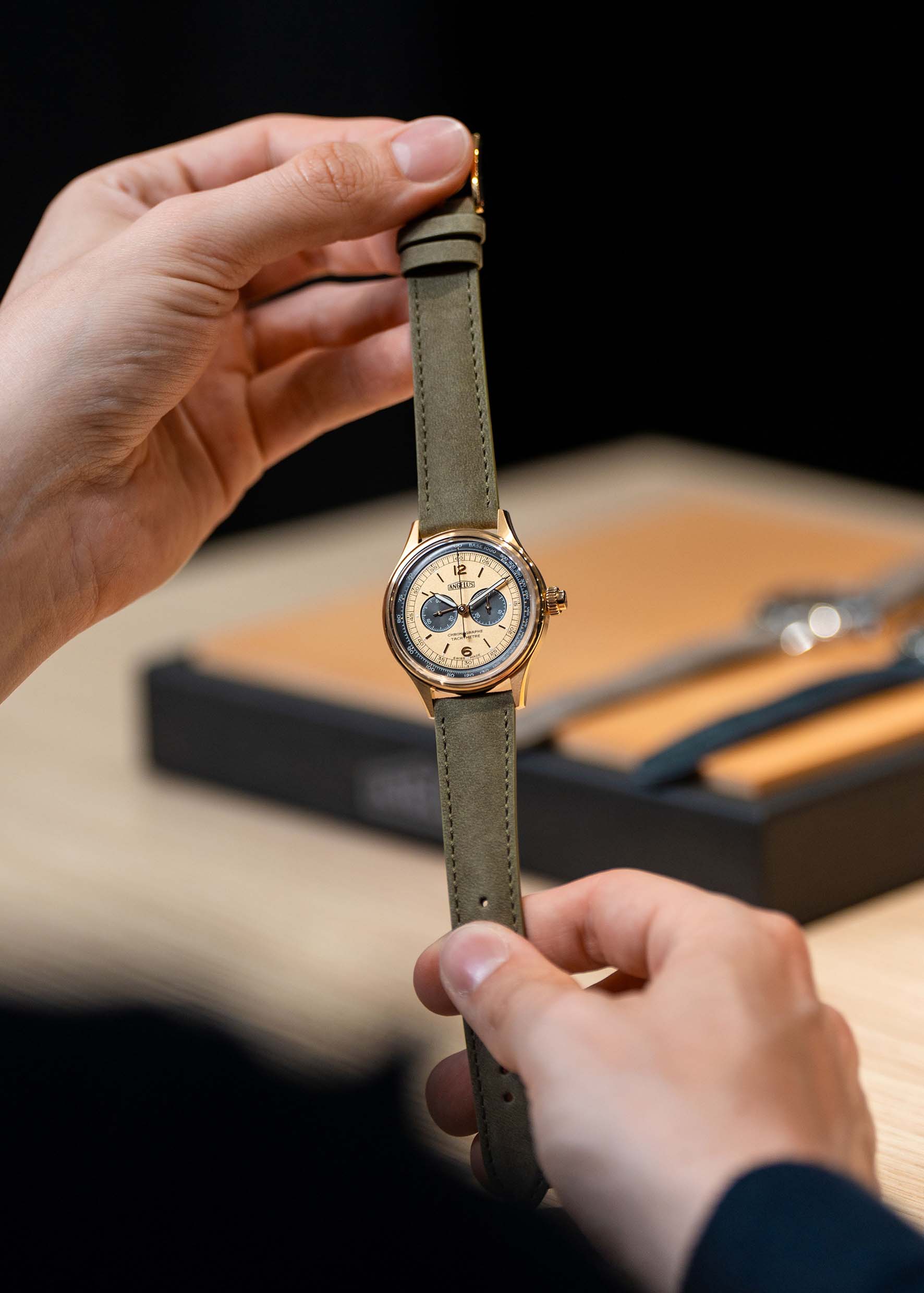
The dial itself is gently domed, with a grained finish achieved by hammering, complemented by a satin-finished rehaut and snailed counters. Small seconds sit at 9 o’clock, with the 30-minute chronograph counter at 3 o’clock. Applied hour markers and Arabic numerals complete a distinctly period-inspired composition, framed by a box sapphire crystal. A sapphire caseback offers a view of the movement, while water resistance is rated at 30 metres.
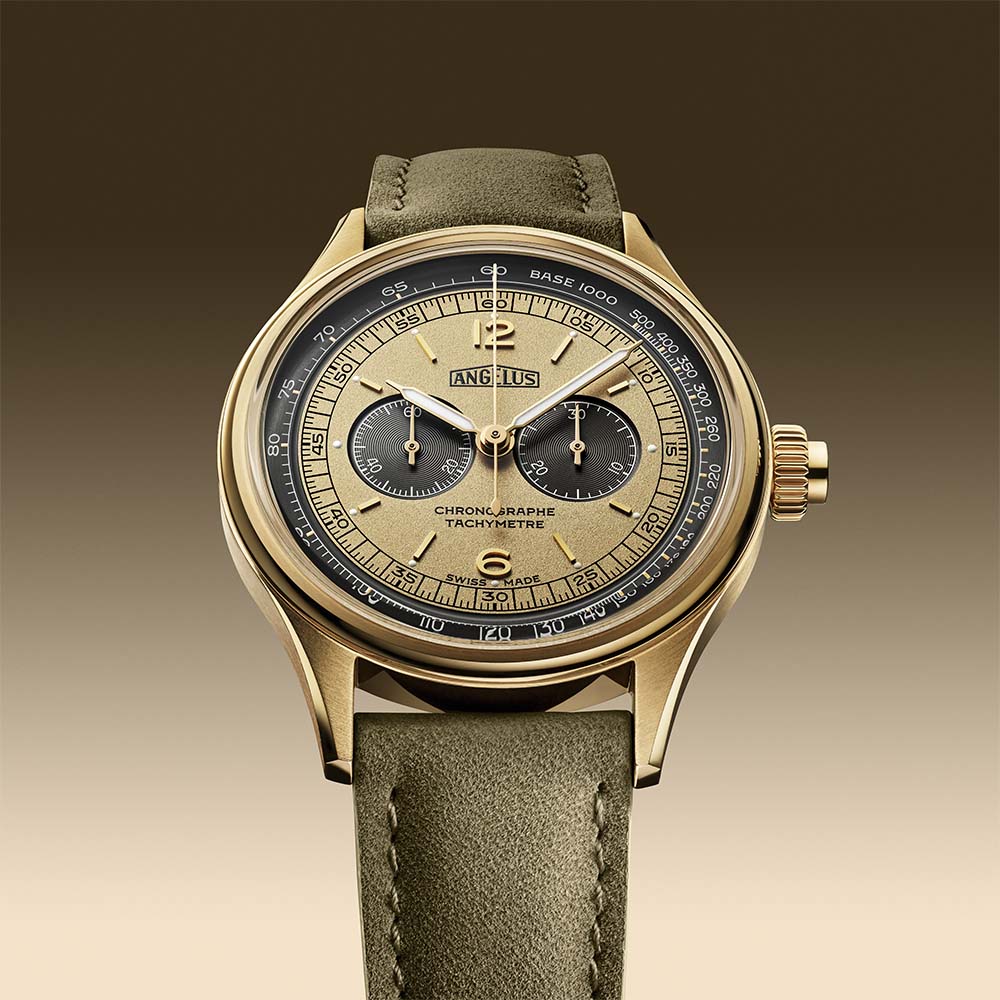
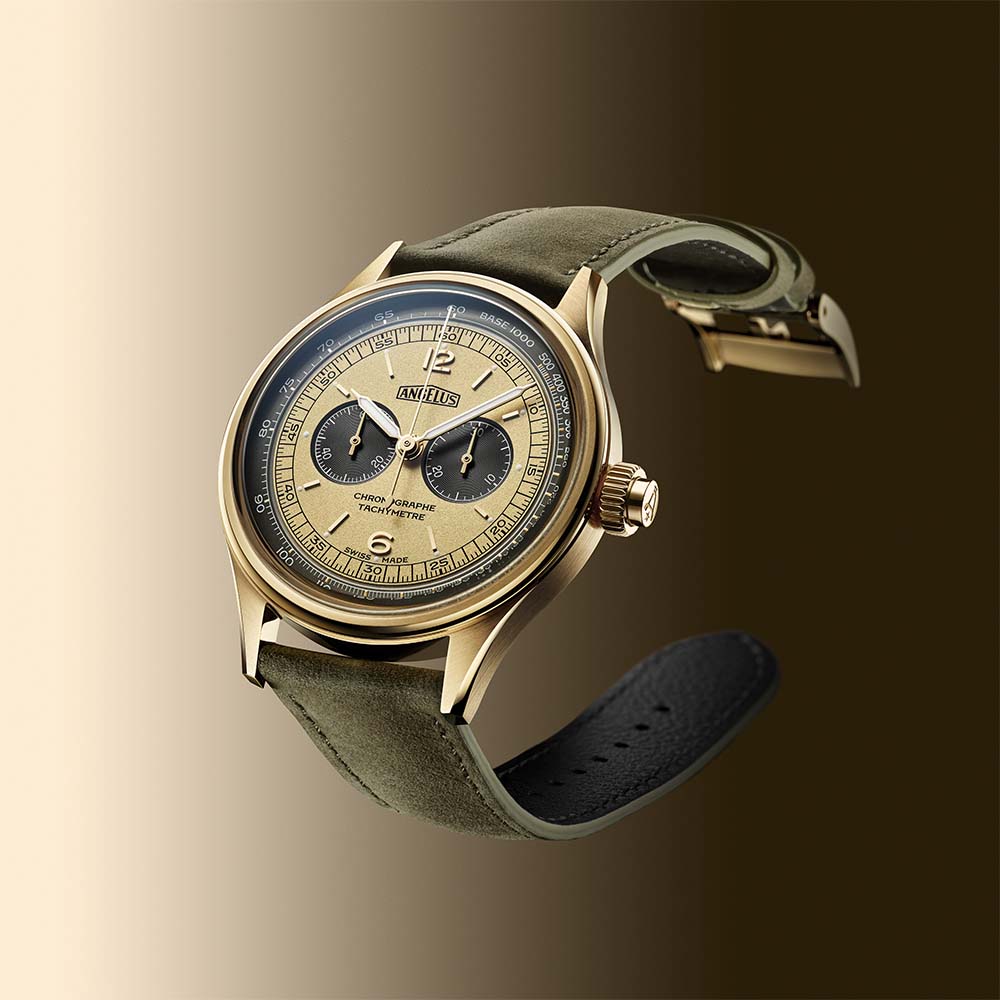
The three versions differ primarily in their materials and colour combinations. The yellow-gold version features an 18-carat 3N yellow-gold case, paired with a golden dial featuring British racing green accents and a sage-green calfskin strap. The combination evokes the colours of classic British sports cars while retaining the elegance associated with traditional chronographs.
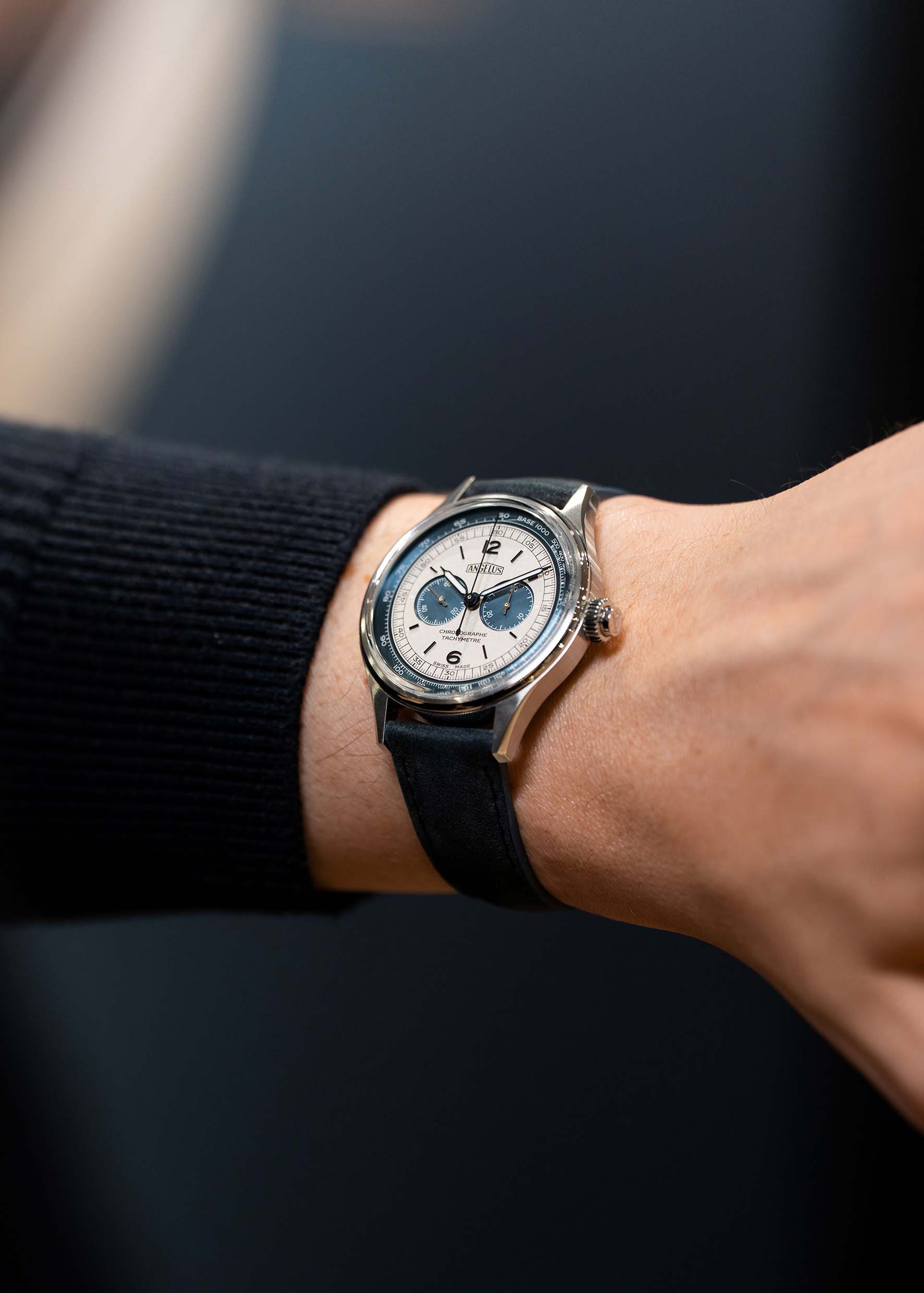
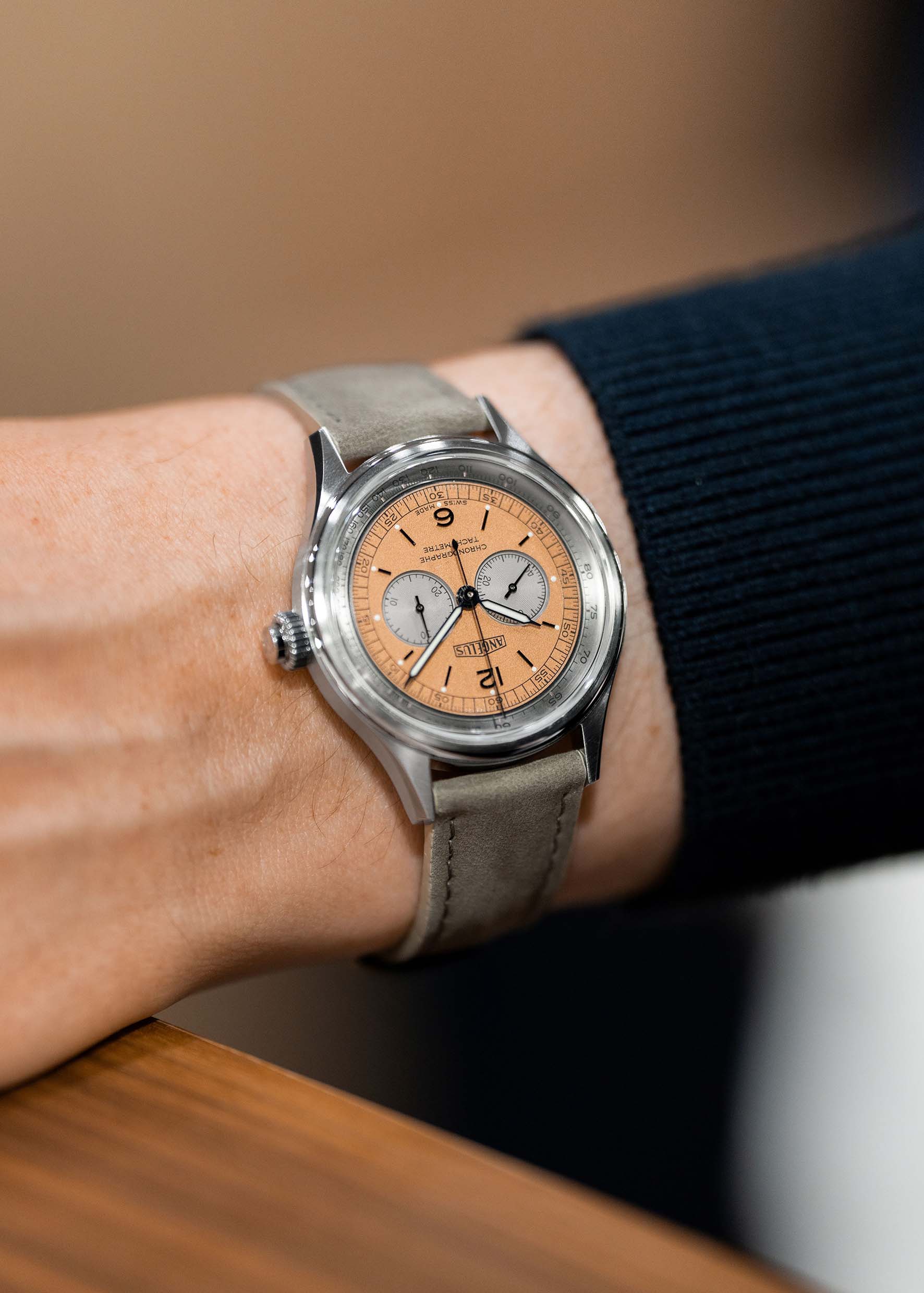
The other two interpretations use steel and more contemporary colour palettes. The first combines a coral-pink dial with steel-grey details and a sepia-grey calfskin strap. The second has a pearl-grey centre, surrounded by a petrol-blue flange and counters, and is finished with a blue calfskin strap. Three distinct personalities share the same aesthetic and mechanical foundations, showing just how much a choice of colour can change a watch’s character.
THE A5000 CALIBRE: MECHANICS ROOTED IN TRADITION
The movement plays an equally important part in the Chronographe Tachymètre’s vintage identity. Through the transparent caseback, we can admire the A5000 calibre, a hand-wound mechanical chronograph movement whose architecture follows that of traditional chronographs. This is where the monopusher concept finds its mechanical expression, with a system that operates all the chronograph functions through a single control.
The movement employs a column wheel and horizontal clutch, both long associated with classically constructed mechanical chronographs. It beats at 21,600 vibrations per hour, provides a 42-hour power reserve and measures just 4.20 mm thick, an important factor in keeping the overall case height down.
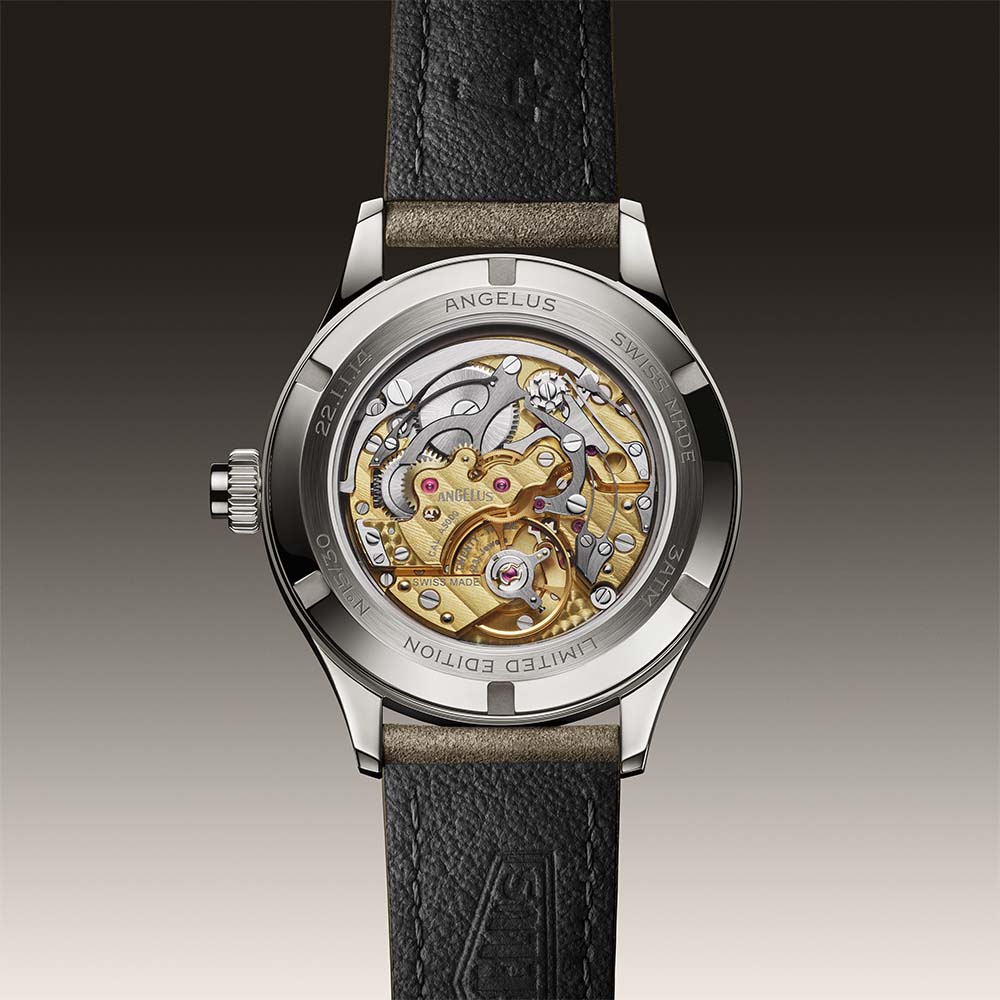
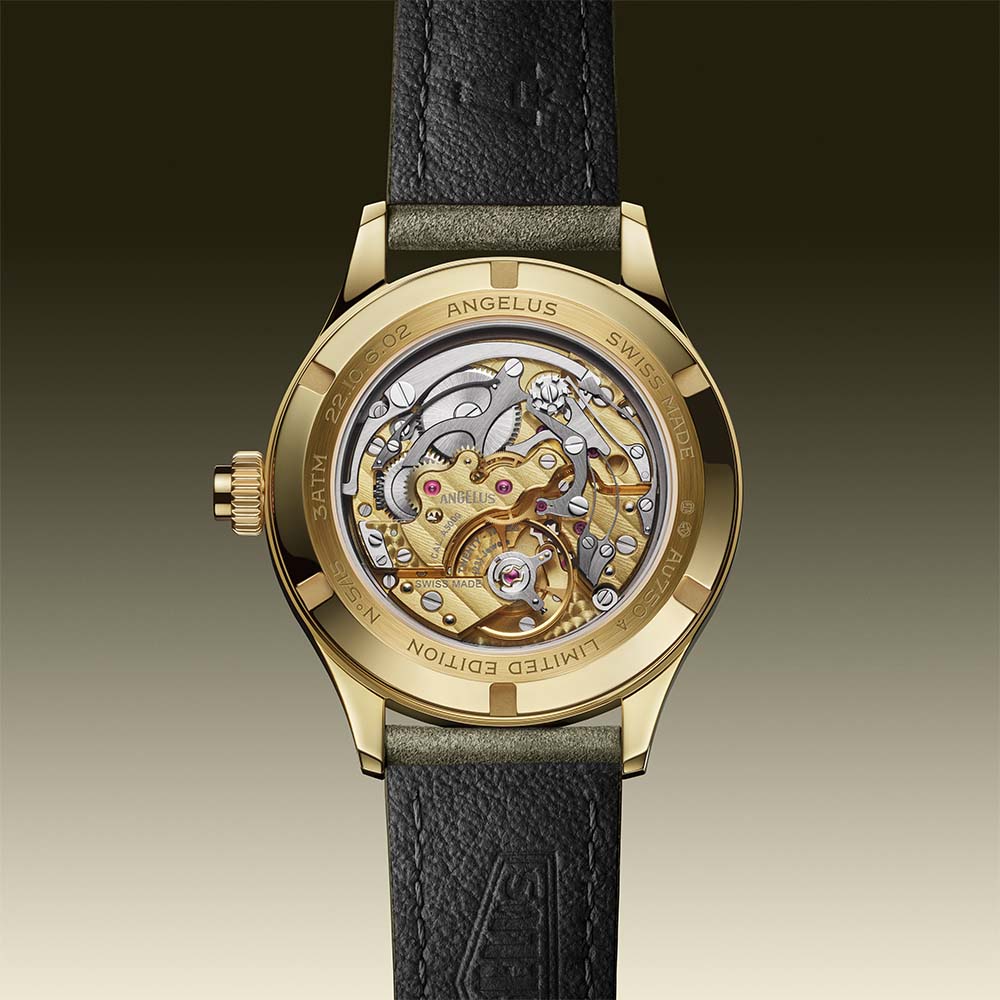
The finishing is particularly noteworthy. The mainplate and bridges have a 3N gilded finish, while the chronograph mechanism is rhodium-plated. The contrast does more than enrich the appearance: it makes the movement’s different layers easier to distinguish, giving its architecture a greater sense of depth and visual richness. This effect is enhanced by Côtes de Genève, circular graining, chamfered bridges and polished screws, details that give the calibre a refined appearance in keeping with the watch’s identity.
ANGELUS CHRONOGRAPHE TACHYMÈTRE: LIMITED EDITIONS AND PRICES
The Chronographe Tachymètre comes in three limited editions, each with its own combination of case and dial. The yellow-gold version is limited to just 15 pieces, while the two steel models are produced in runs of 30 pieces with the coral-pink dialand 50 with the pearl-grey and petrol-blue dial, respectively.
Swiss retail prices are CHF 18,500 for each steel version and CHF 34,600 for the yellow-gold model, inclusive of Swiss VAT.
As enthusiasts, we know how hard it is to resist a good chronograph, especially when engaging mechanics are matched by equally compelling design. And the new Angelus has plenty going for it. The colour combinations are exceptionally well judged, giving each version its own personality without compromising the design’s historical character. The proportions are equally convincing: at a time when watchmaking is rediscovering smaller sizes, a 37 mm diameter and a case less than 10 mm thick are choices we particularly welcome.
There is, of course, the question of price. These are certainly substantial sums, yet considering the monopusher complication, the movement’s finishing and the very limited production numbers, the positioning still strikes us as interesting. Particularly for anyone looking beyond the more familiar options, in search of a chronograph with a strong historical identity and a combination of qualities rarely found together today.
Perhaps that is what we find most convincing about the Chronographe Tachymètre: rather than merely adopting a vintage look, it recaptures the proportions, mechanical solutions and character of chronographs from another era, interpreting them through the sensibility of contemporary watchmaking.
By Jacopo Giudici