

2025 marks Zenith’s 160th anniversary, and the brand has chosen an original way to celebrate it: by dressing three existing watches in a Zenith blue ceramic suit – Chronomaster Sport, Defy Skyline Chronograph and Pilot Chronograph – produced in a special limited edition. However, alongside these, it has pulled a real novelty out of its hat, one that makes the hearts of aficionados flutter. A novelty called the G.F.J.
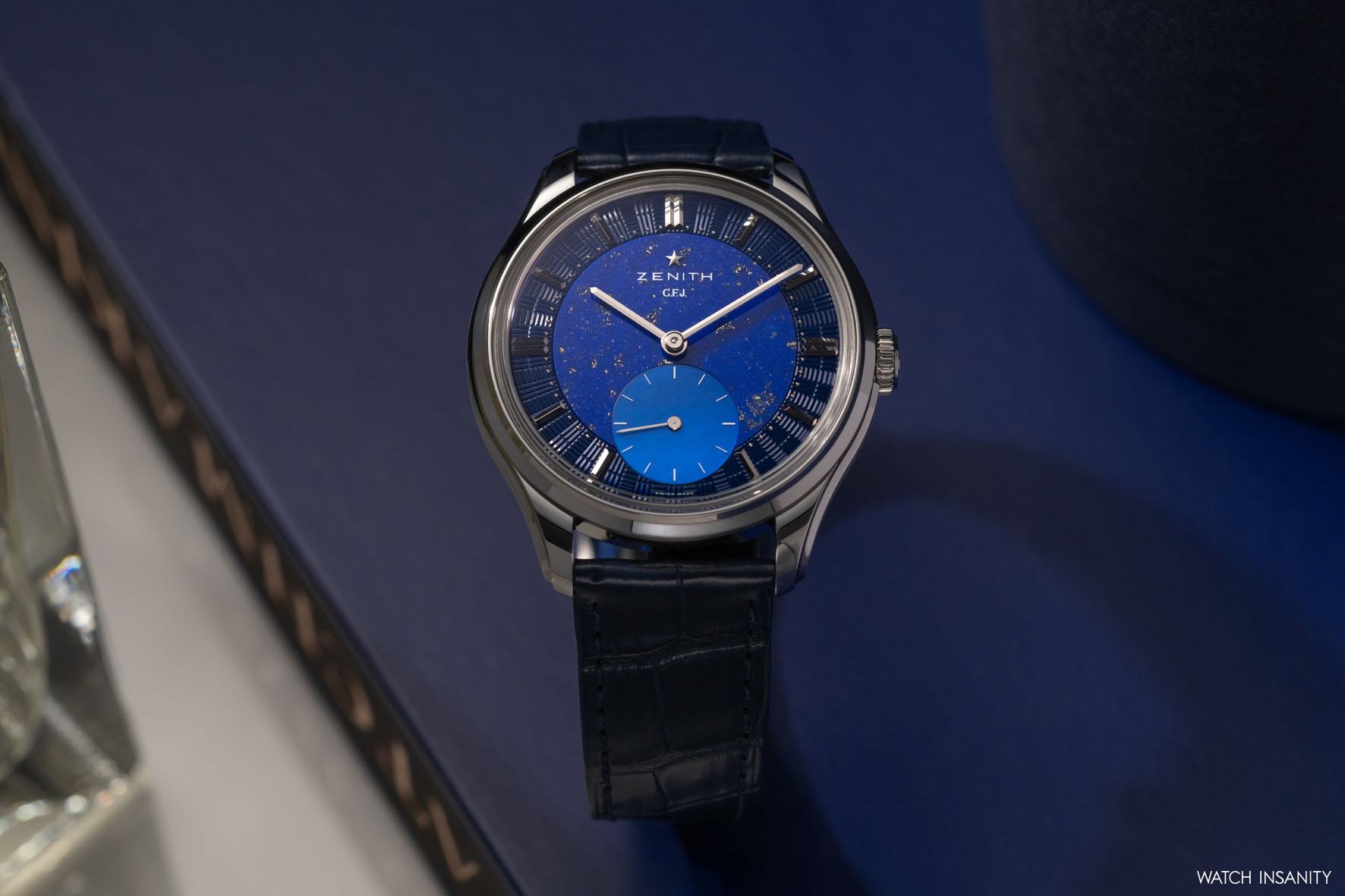
Those who know even just a little about watchmaking history, and about Zenith in particular, are aware that those three letters, G.F.J., are none other than Georges Favre-Jacot’s initials, the man who founded the glorious Le Locle company in 1865. This watch, however, is not a homage or simply a celebratory edition. It is something that digs into the fertile soil on which Zenith was established, to bring to light some of its precious roots. Which, in the case of the G.F.J., are mechanical roots that take shape in the legendary calibre 135, restored to its former glory, modernised and enclosed at the heart of the watch.
ZENITH AND THE ORIGINAL CALIBRE 135
The revival of a historic calibre is, for every vintage lover, a dream come true. When it comes to Zenith’s calibre 135, this dream is even more precious because it is linked to the golden age of chronometry competitions. Decades ago, these observational tests were extremely important in watchmaking, because the fame associated with them was considerable among insiders.
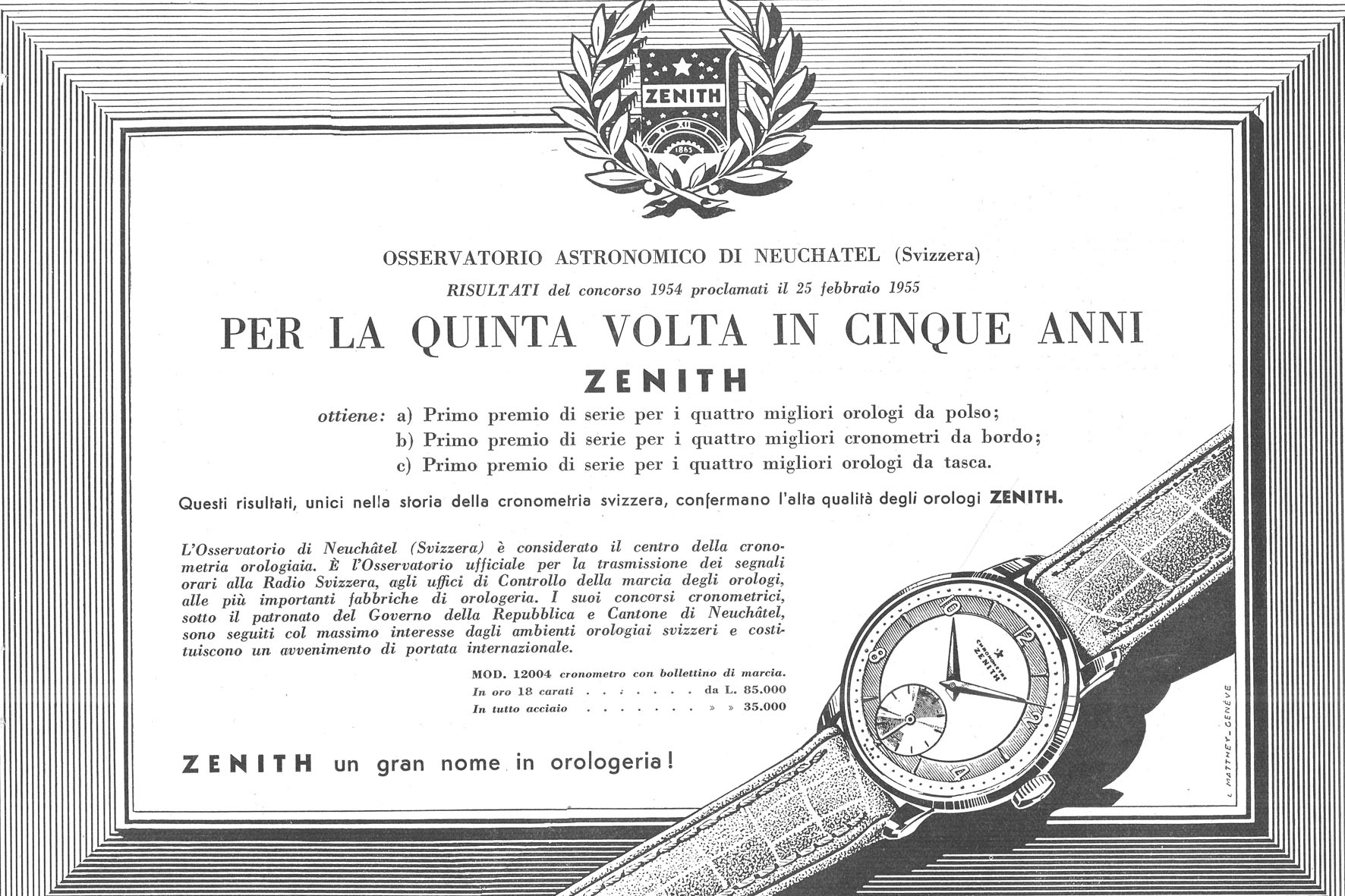
Observers were witnesses and guarantors of the level of precision that expert watchmakers were able to achieve with their movements. Precisely because these competitions brought prestige to the brands and legitimised their strength on the market, in the past there were not only a few manufacturers who produced calibres specifically for chronometry competitions. The 1950s and 1960s were the era that considered chronometry a fundamental principle to build a good brand on. In fact, before quartz, it was essential for a Maison to have at least one three-handed, hand-wound watch with absolute precision among its collections.
Although Zenith is associated with the El Primero, it was already known for its precision long before that calibre, having participated in chronometry competitions since the late 19th century. An assiduous presence in these competitions that, over the decades, earned the movements from the manufacture in Le Locle the still unbeaten record of 2,333 chronometry prizes. Among those movements, the calibre 135 holds a special place.
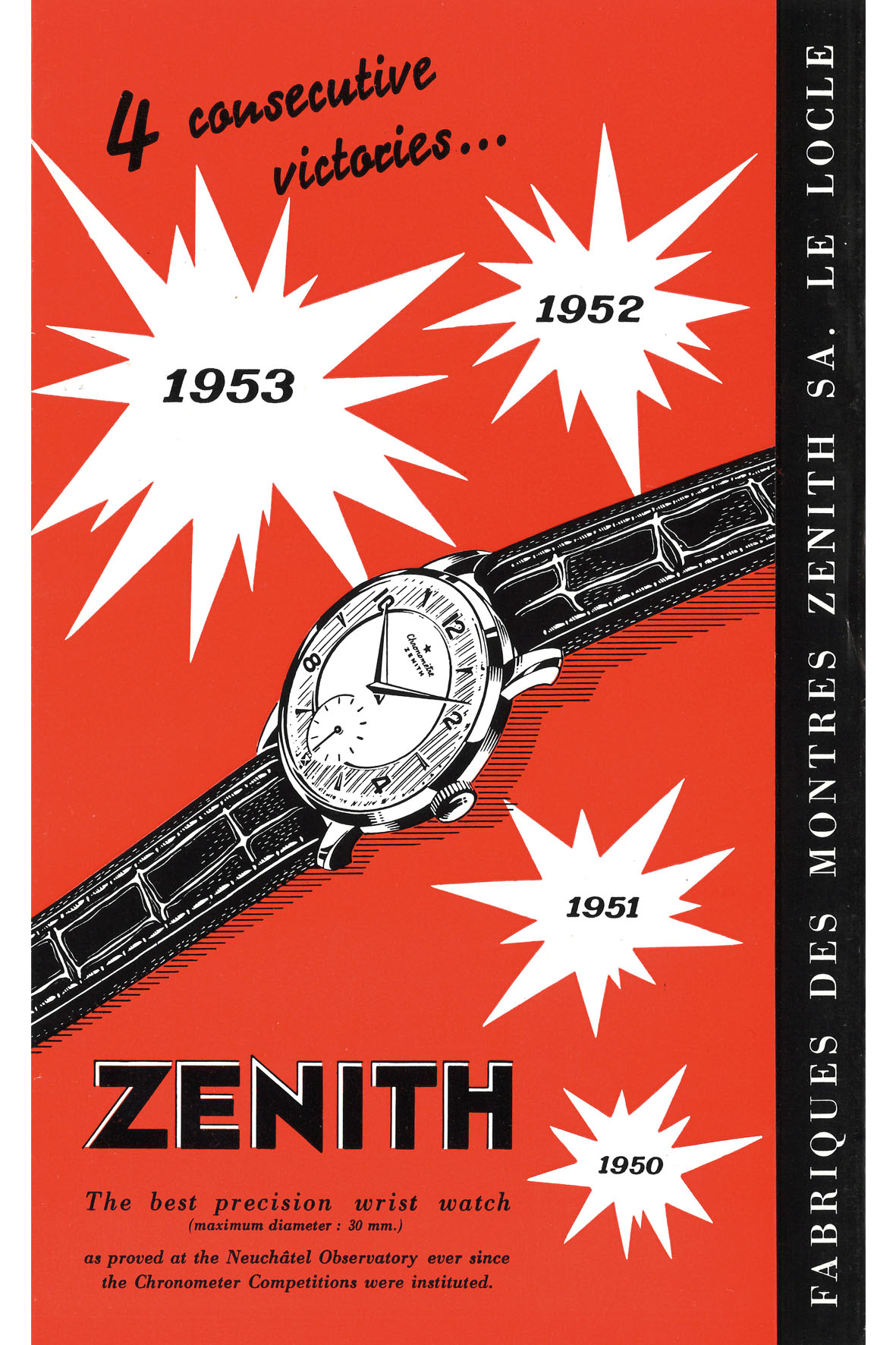
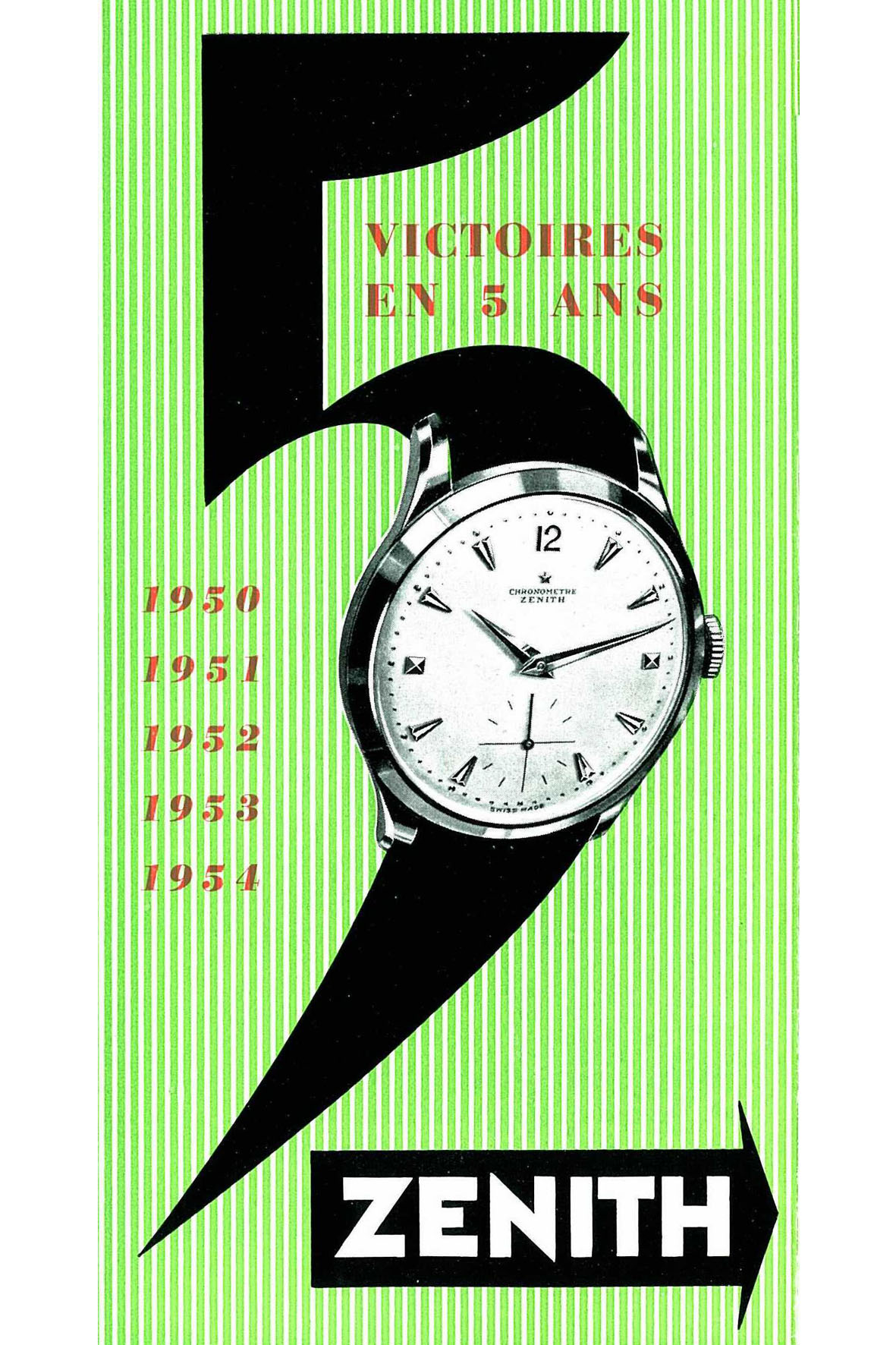
Designed at the end of the 1940s by engineer Ephrem Jobin at the request of Zenith’s then technical director Charles Ziegler, it was produced between 1949 and 1962 in two versions: a commercial one (135) and an ‘O’ variant (135-O), intended specifically for timekeeping competitions. This variant won 235 prizes over the years, also an unbeaten record.
THE 2022 PRECEDENT
Zenith had recently started working on the calibre again. One of the most extraordinary releases of 2022 came out of a collaboration between the brand, Kari Voutilainen and the Phillips auction house: the Zenith calibre 135 Observatoire. Limited to just 10 pieces, the reference included original examples – restored – of the calibre 135-O. Zenith and Phillips enlisted the assistance of Voutilainen to restore and decorate the vintage movements and to create a unique case and dial.
The re-edition of Zenith’s calibre 135 Observatoire – with the original movements – introduced a once legendary movement to many modern consumers. Unfortunately for them, however, that watch was very expensive and limited and could not satisfy most enthusiasts. By creating the new G.F.J., Zenith has thus accomplished something very few brands are willing to do: rebuild an old movement almost from scratch, while improving it.
ZENITH G.F.J. AND THE NEW CALIBRE 135
If for the calibre 135 Observatoire, Zenith had taken and restored ten movements created between 1950 and 1954, for the new hand-wound calibre 135 driving the G.F.J., the brand decided that it could not simply take the old designs and transpose them exactly as they were into a modern watch. If only because of practical problems, such as the fact that earlier watches’ bridges had different tolerances: the risk was to design a timepiece with some parts that would not fit.
The new calibre 135 is therefore, in fact, a new movement. In the meantime, it responds to the latest demands and tastes in terms of autonomy: its power reserve is 72 hours against the 40 of the 1950s version. The movement is also COSC-certified and exceeds its parameters with an accuracy of +/-2 seconds per day. Maintenance intervals are also set to be longer, thanks to the use of new materials and modern lubrication oils; all things that were not possible 60 years ago.
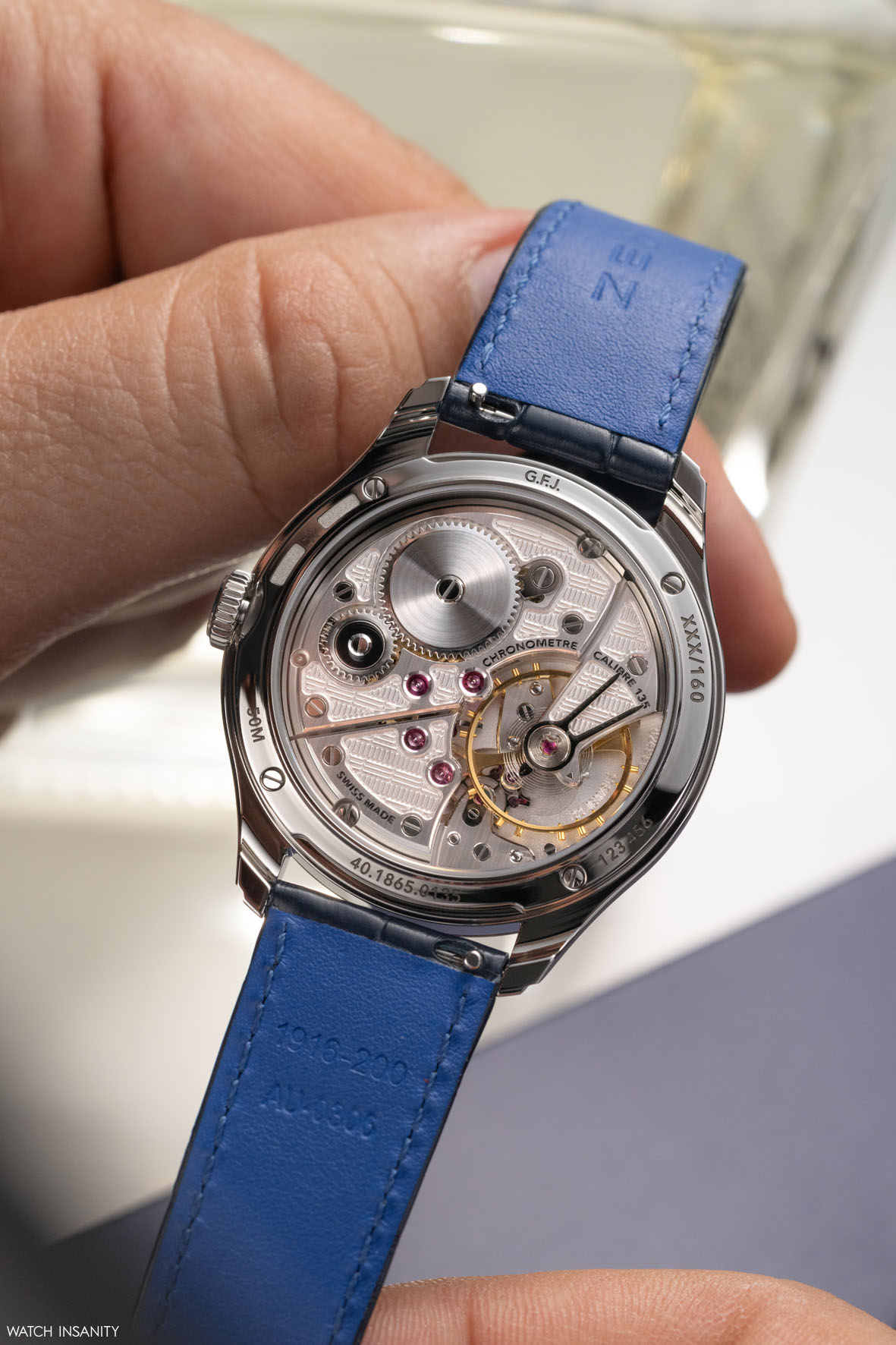
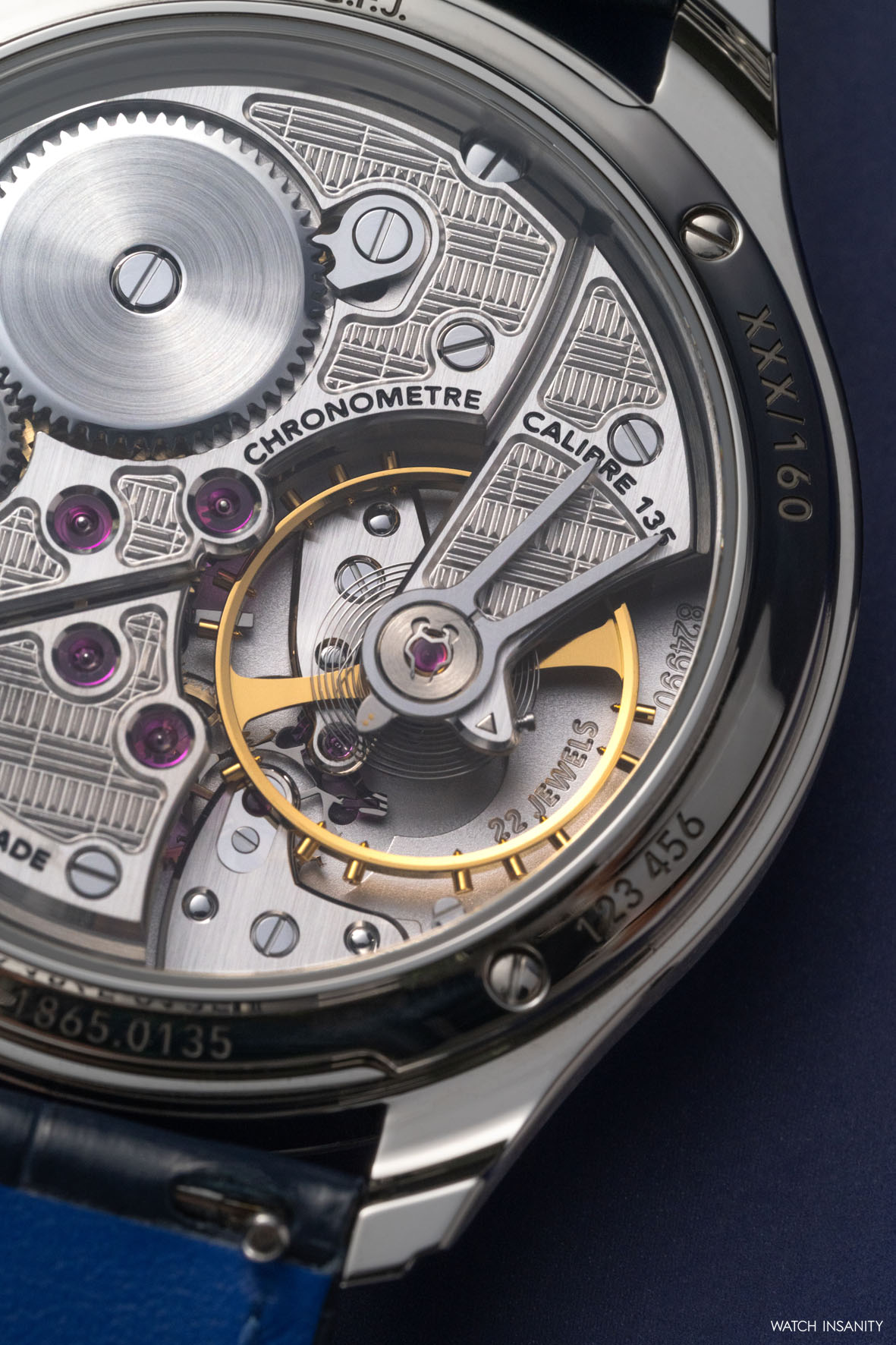
At the heart of the calibre is a new gear train with an optimised geometry for greater efficiency. Zenith has chosen to respect tradition by making the movement work at a low frequency – i.e. 18,000 vibrations per hour, or 2.5 Hz: half that of the El Primero, to be precise. The oversized balance wheel (14 mm) has adjusting screws and a Breguet balance spring; the special double-arrow regulator allows precise fine-tuning, while the hacking mechanism allows the seconds to be set to the nearest second. This mechanism, also known as ‘hacking seconds’, was not present in the 1950s calibre.
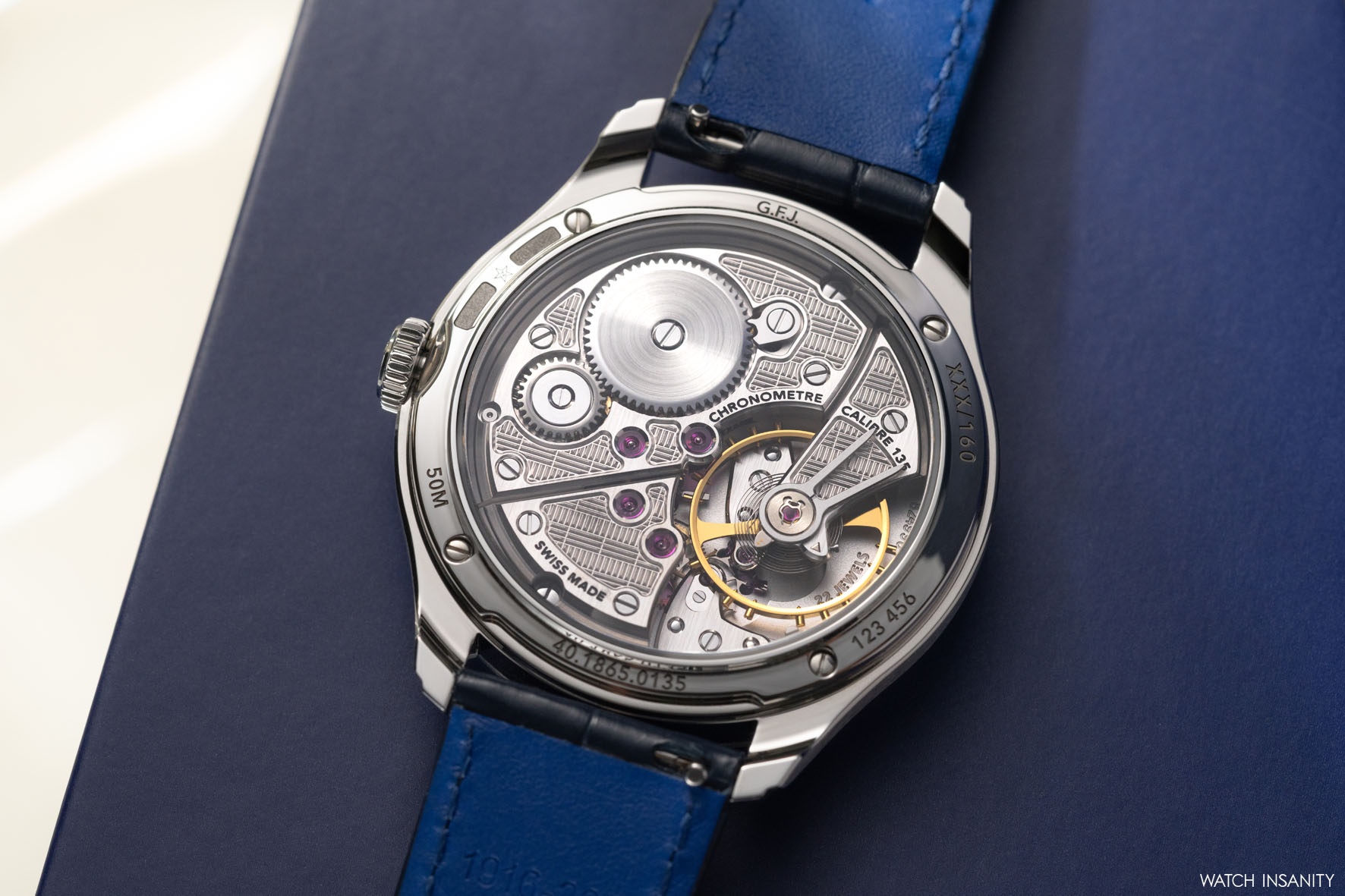
In addition to technical refinement, Zenith has also chosen to make the movement beautiful and enjoyable from an aesthetic point of view. Sober yet elegant, it stands out for the decoration of the bridges, bevelled and polished by hand, with a special brick pattern that has a profound historical raison d’être. When he built the factory, with the idea of taking ‘integrated manufacturing’ to a completely new level, Georges Favre-Jacot owned the company that produced the bricks used in the Le Locle factory. These red and white bricks can still be seen today in the factory buildings, and now also on the back and front of the clock.
ZENITH BLUE: THE ELEGANCE OF A SHADE
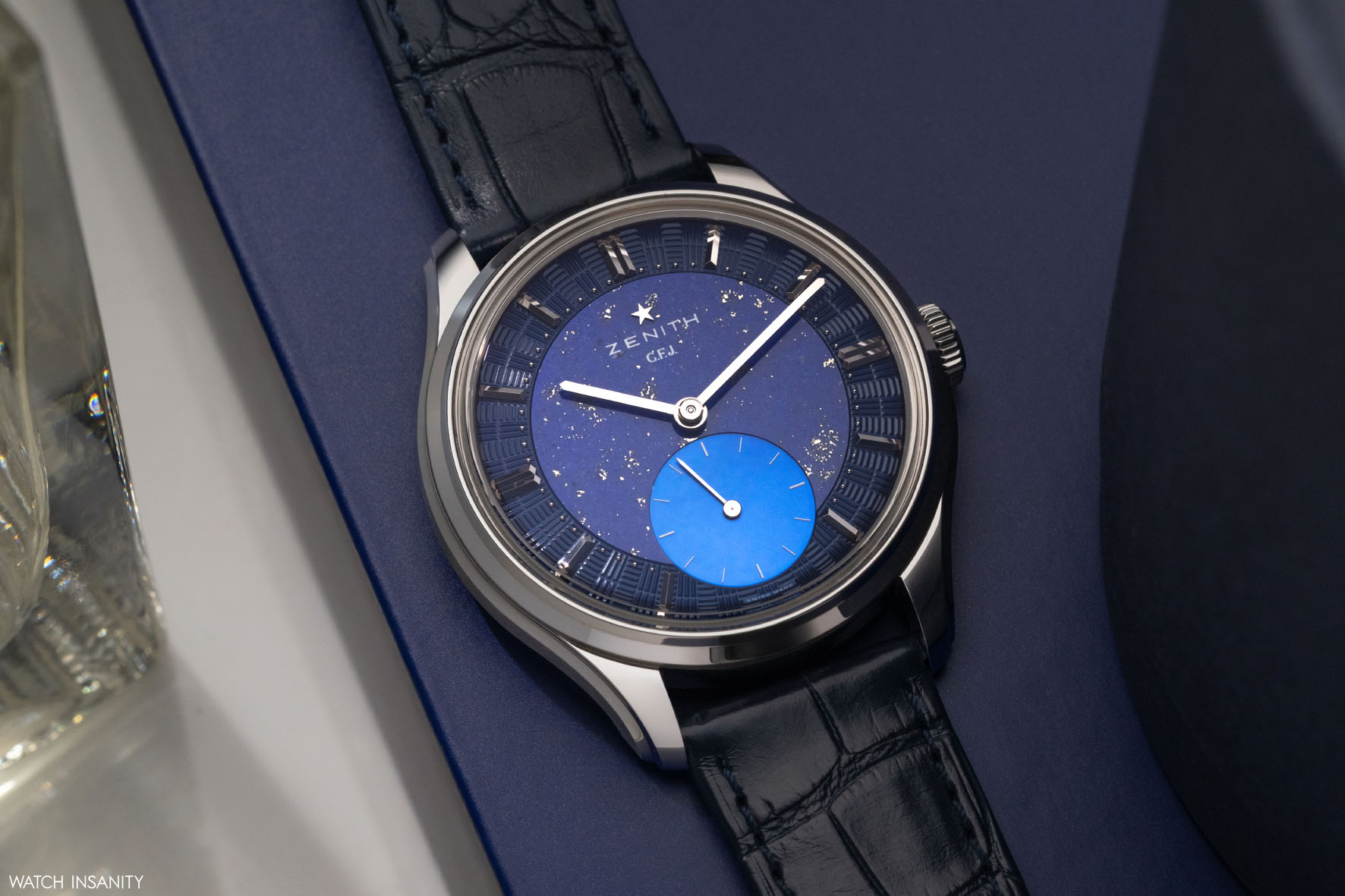
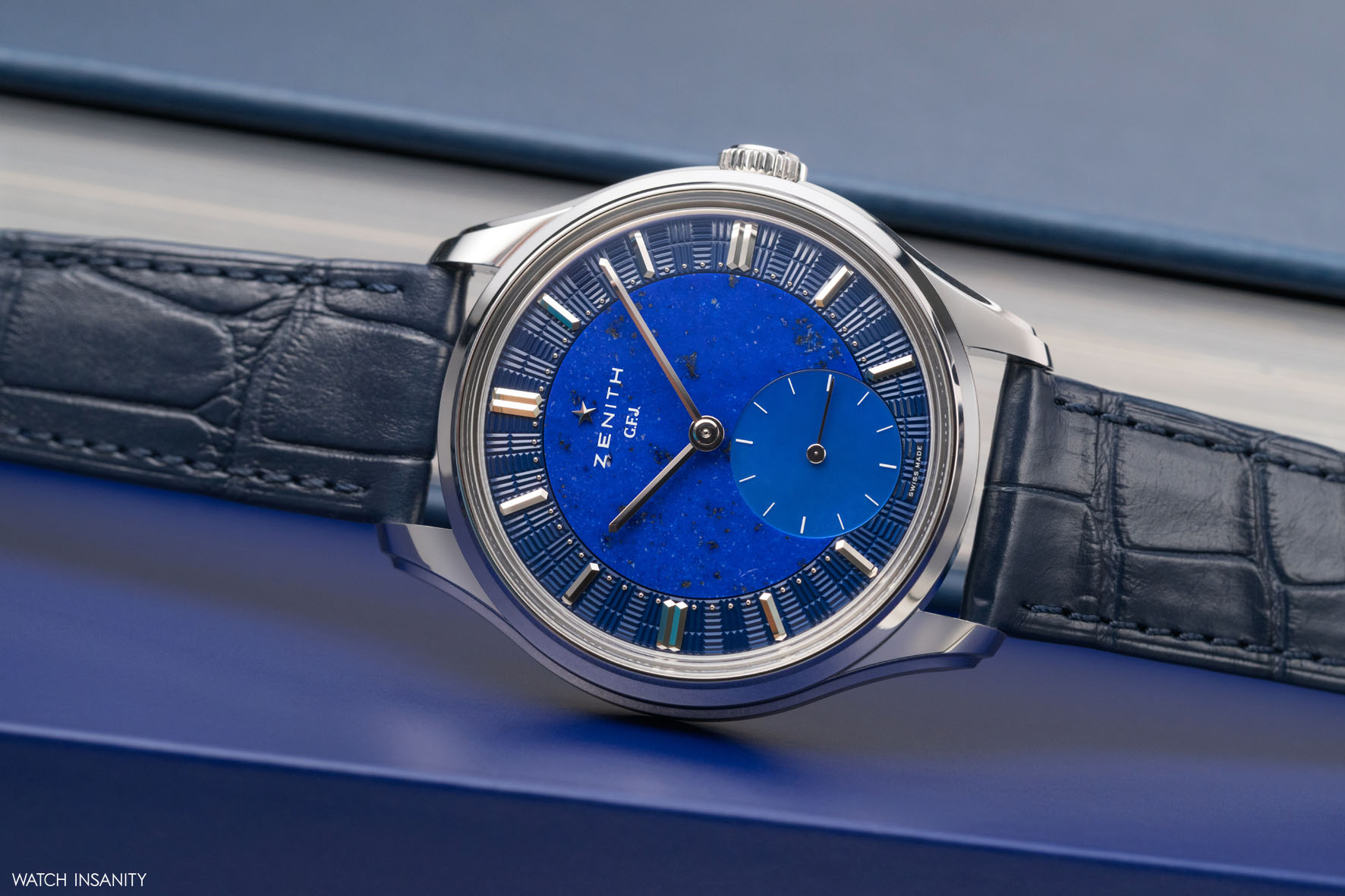
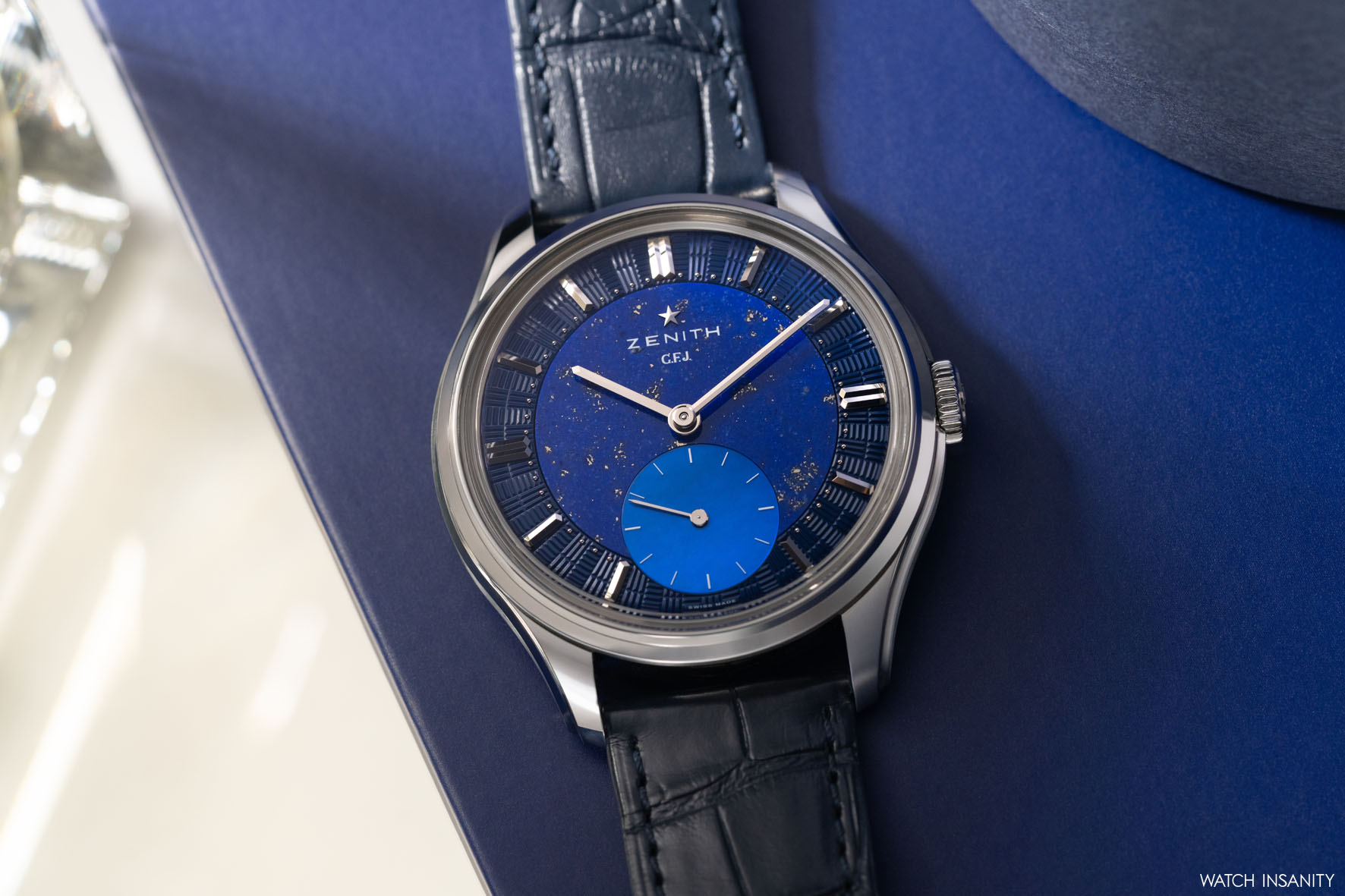
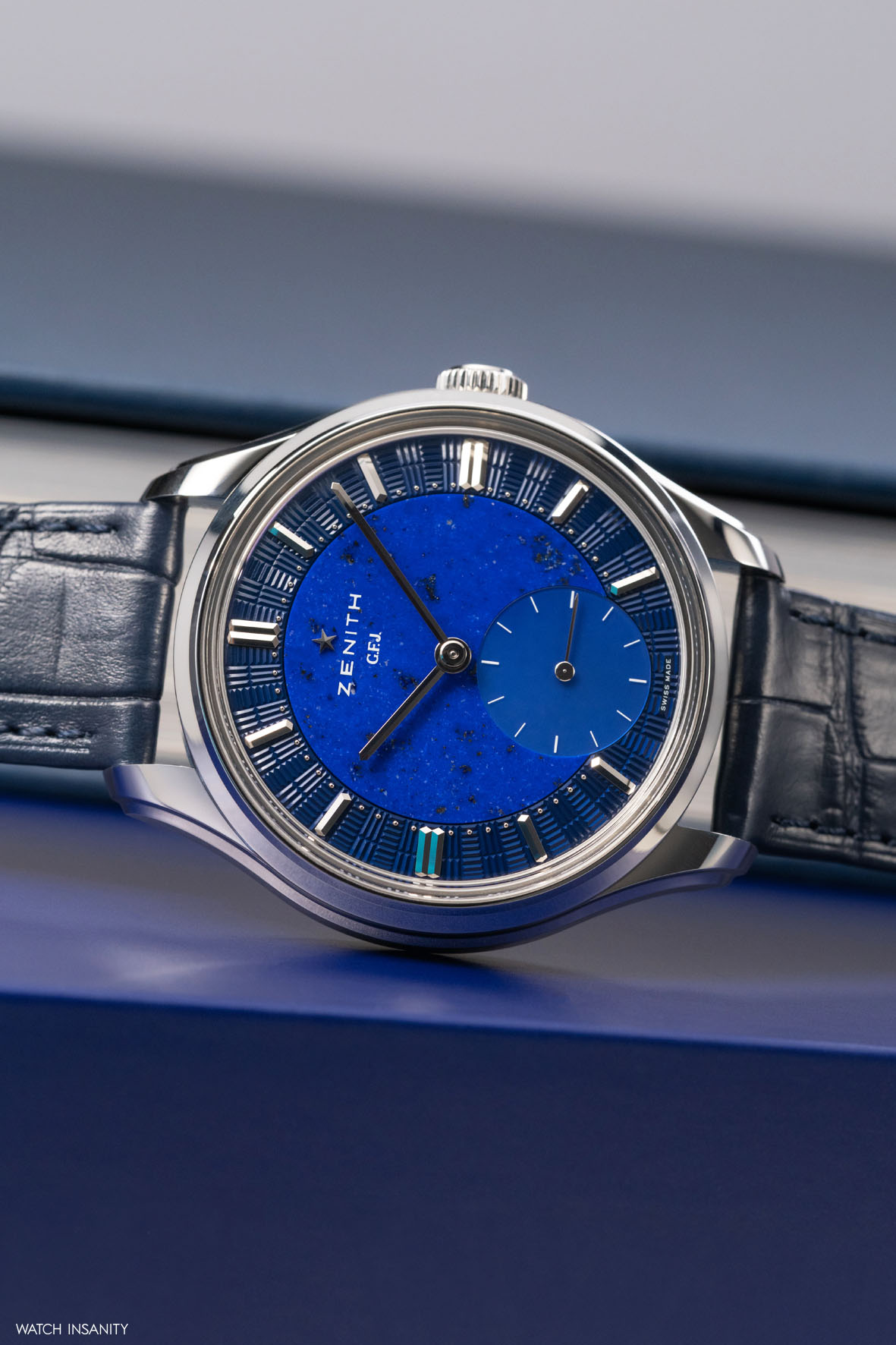
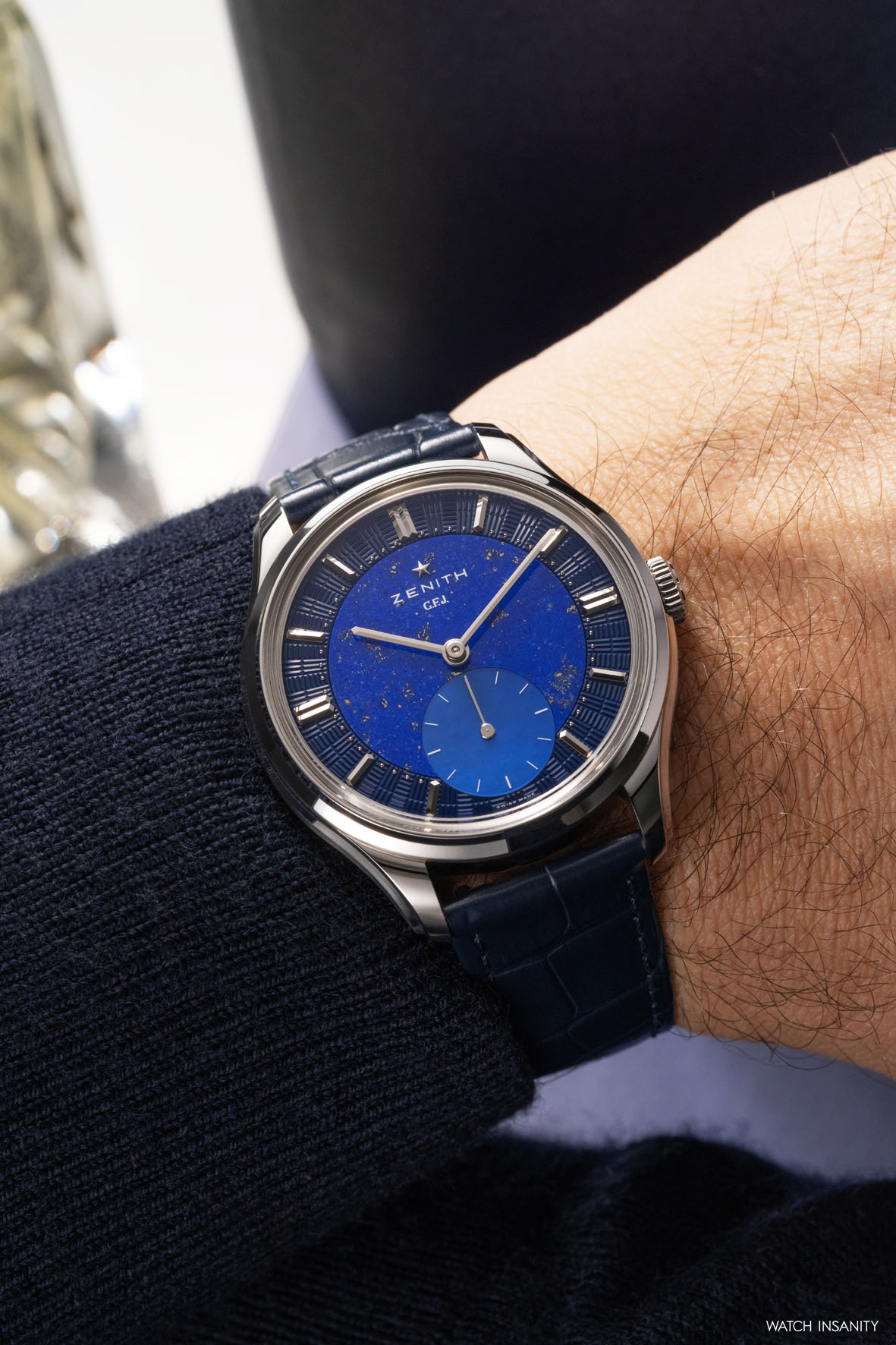
While the revamped calibre 135 is clearly the G.F.J.’s highlight, its dial is no less sophisticated and elegant. Created in blue – a tribute to the distinctive colour that Zenith has reserved for its 160th anniversary – it is structured in three distinct parts, each refined and precious.
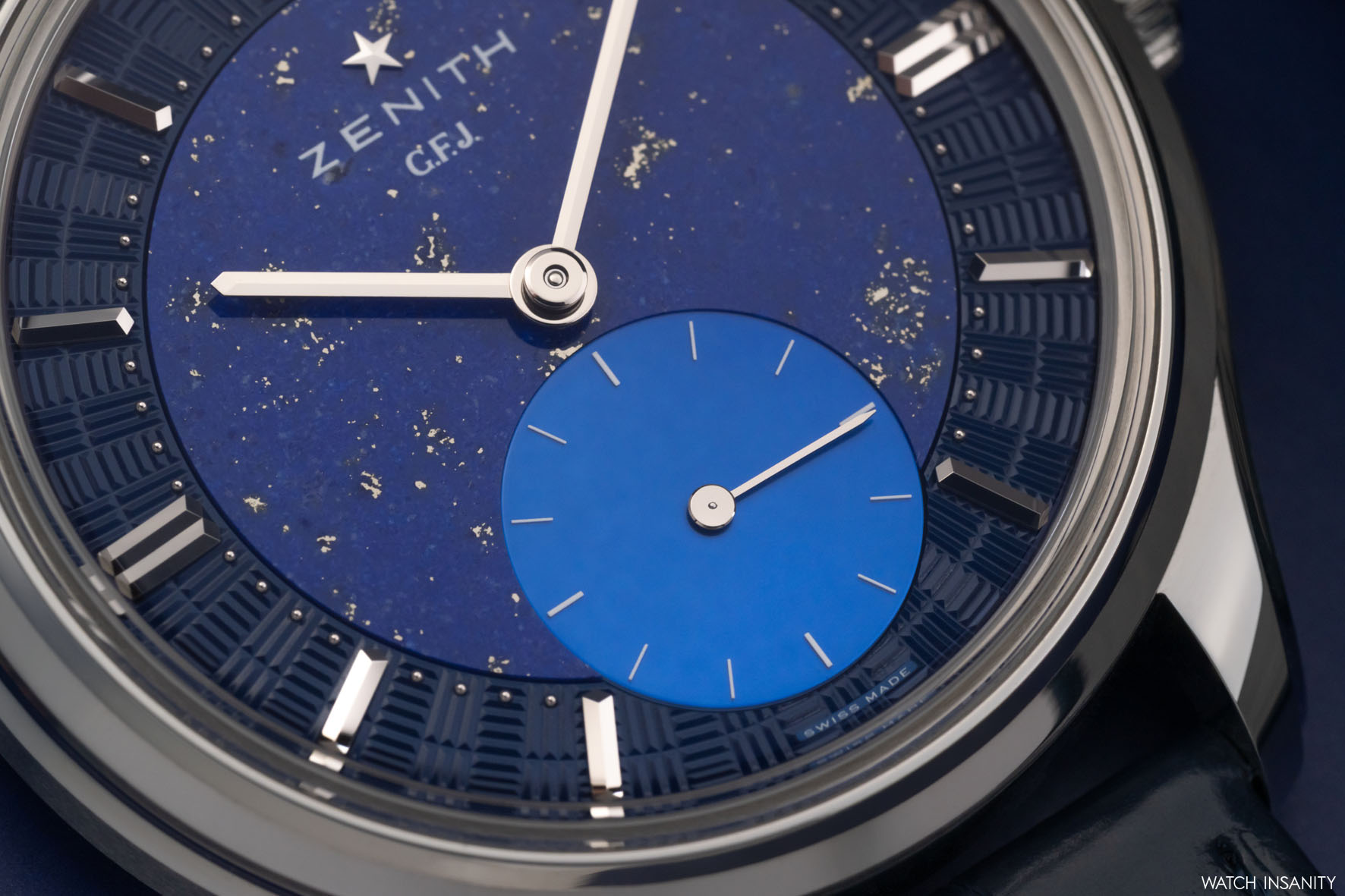
The central section, the largest one, is made of a thin lapis lazuli disc. As a hard stone, it goes without saying that no two discs ever have the same cut, thus accentuating the idea of each watch being unique. The small seconds counter, positioned at 6 o’clock, is instead made of blue mother-of-pearl. Finally, the outer perimeter is composed of a blue metal ring worked with a brick-shaped guilloché motif, echoing the finishes of the movement we have just seen.
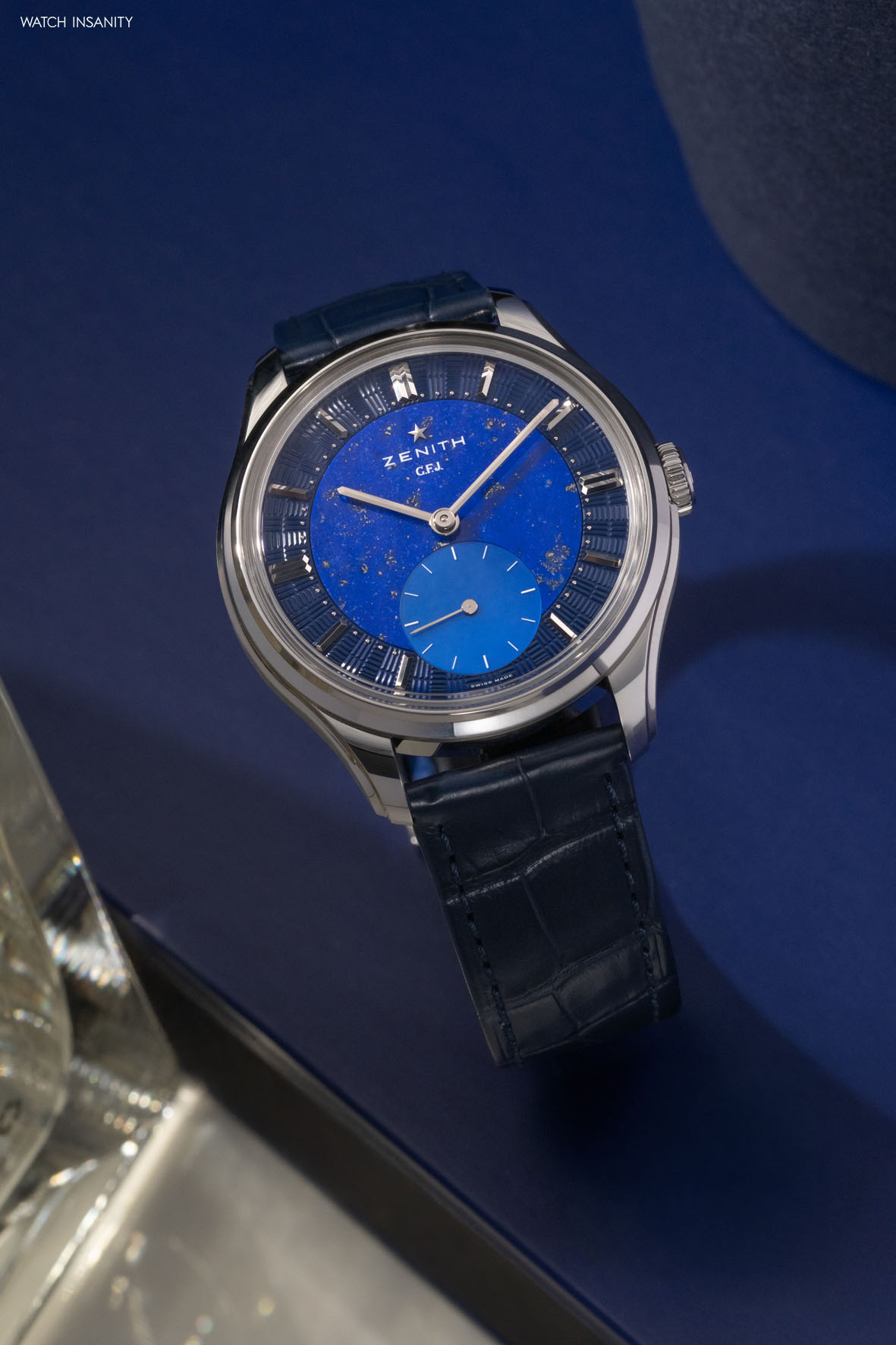
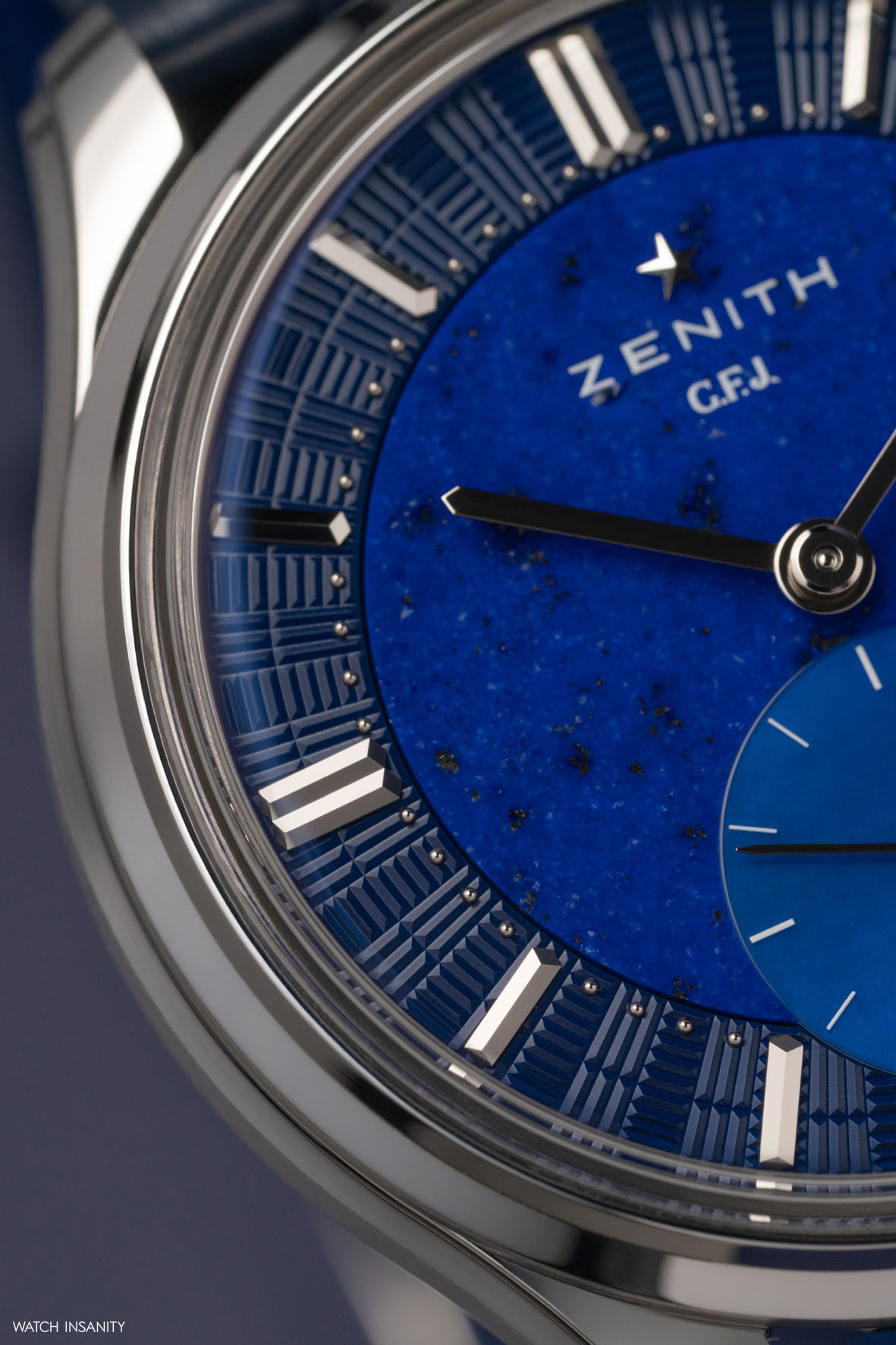
Applied along this perimeter are the hour markers – facetted, in white gold and double at 3, 9 and 12 o’clock – and the minute track. The latter is truly refined, as it is composed of 40 tiny white gold pearls, each applied by hand. Also in white gold are the hour and minute hands, baton-shaped and facetted. No date window spoils the elegant balance of the overall aesthetic.
THE PLATINUM CASE
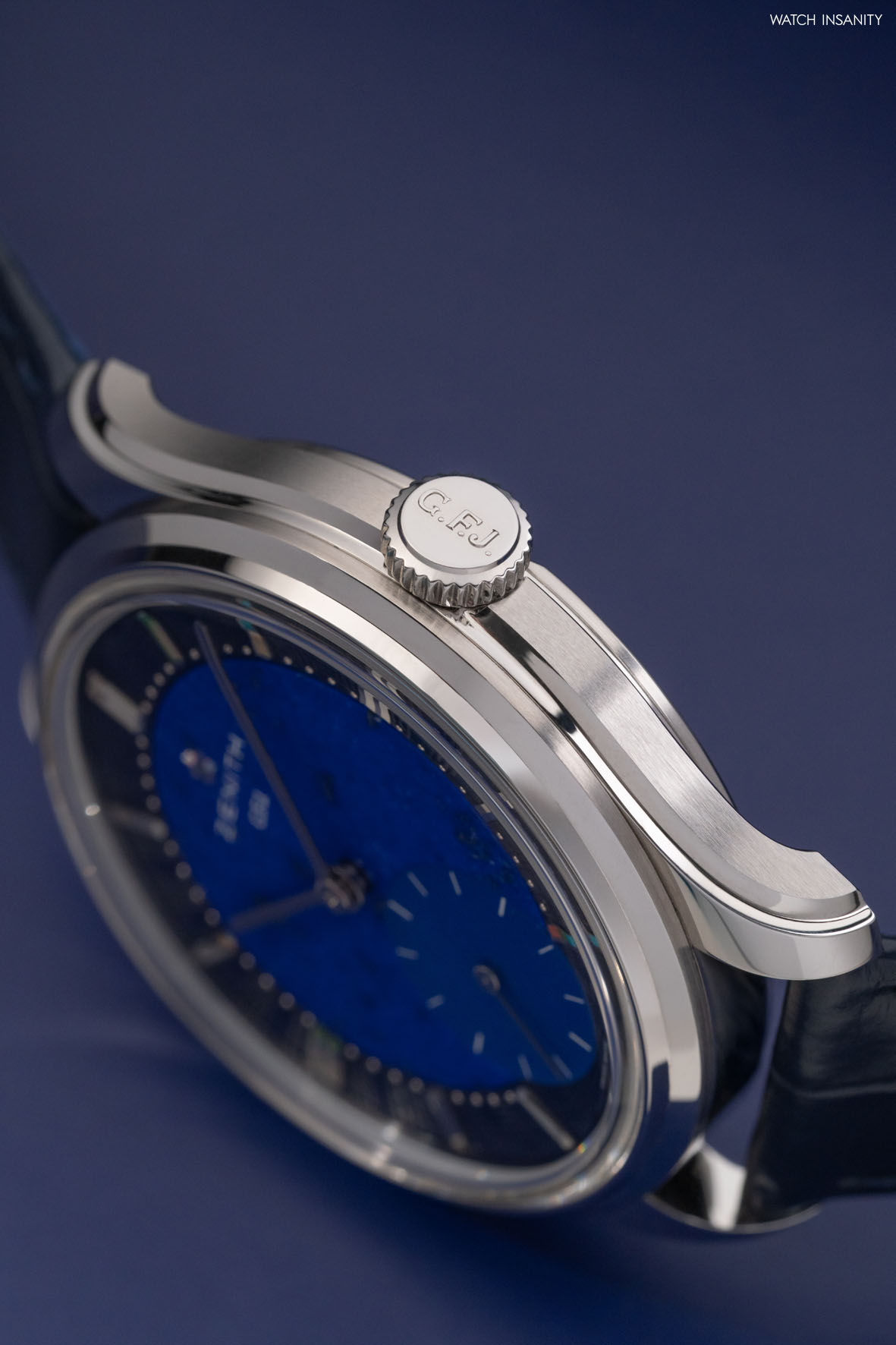
The 950 platinum case also deserves a careful examination, firstly because its size is unorthodox. To consider the Zenith G.F.J. a 39 mm is not entirely correct. The actual diameter is in fact 39.15 mm, a non-round figure that seems to hint at a time gone by when, in order to make the tolerances within the movement work, the dimensions of the cases might not have been accurate to the millimetre.
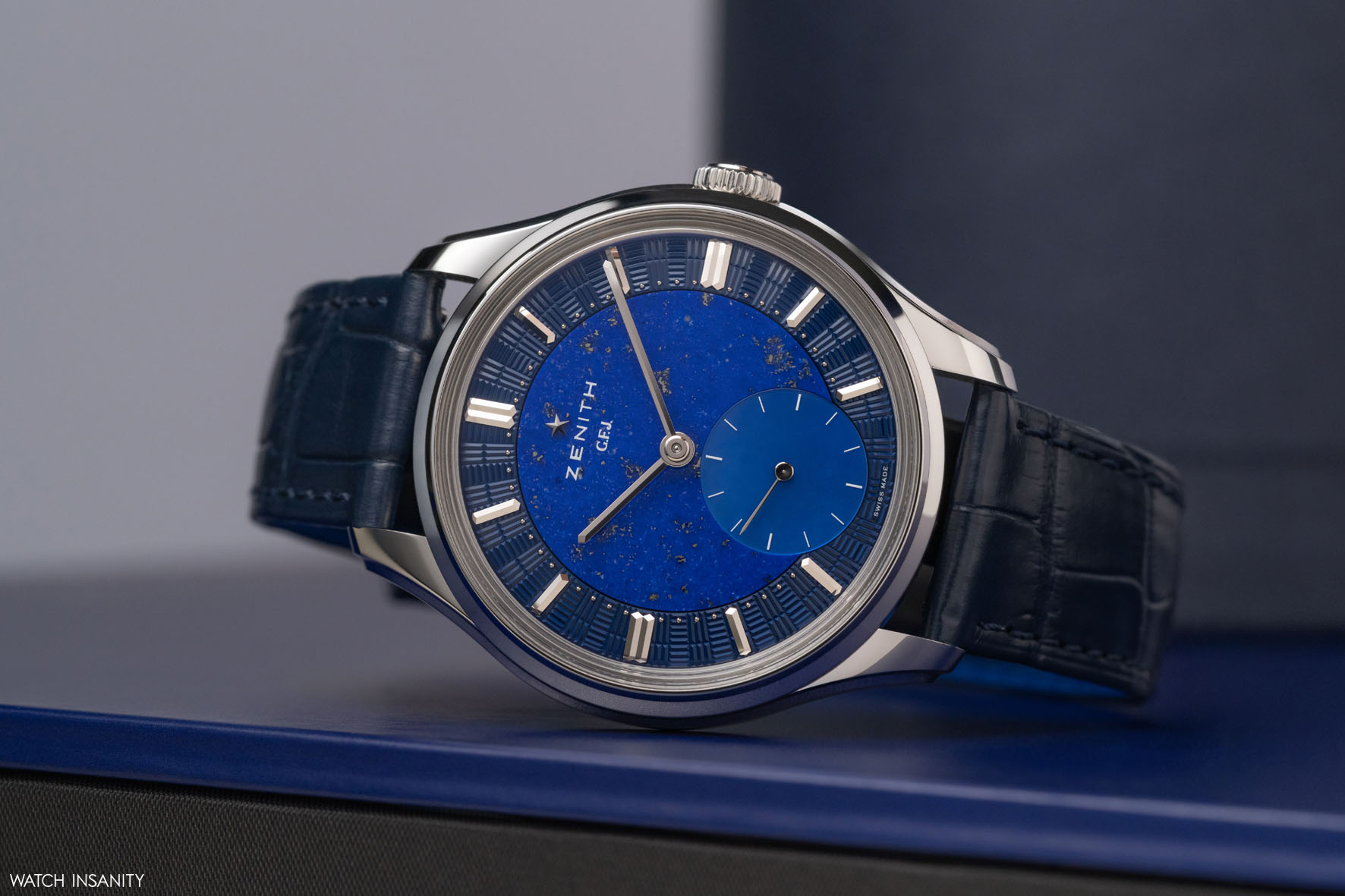
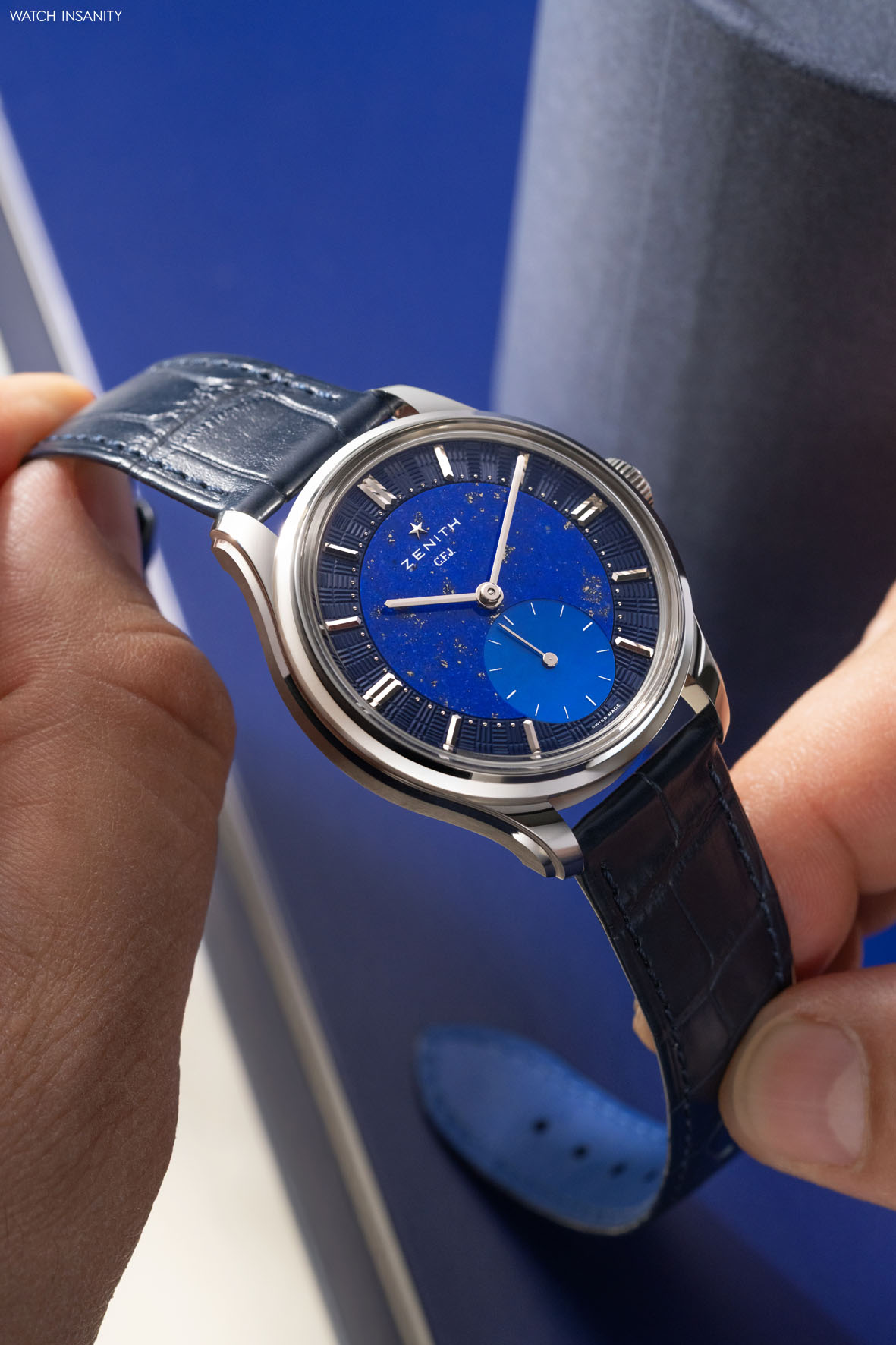
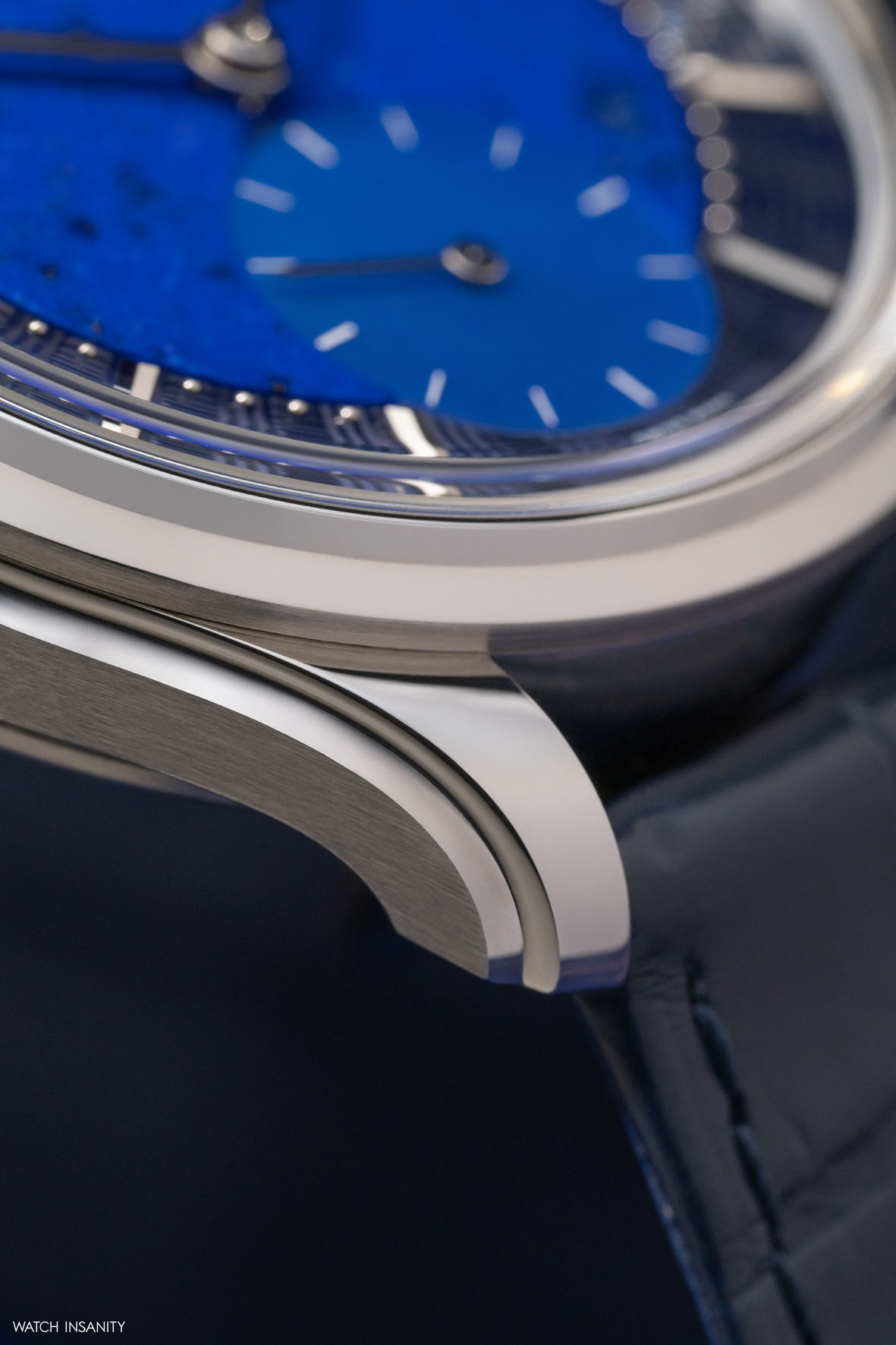
The overall shape of the G.F.J. case has been perfected. With a thickness of 10.5 mm and a lug-to-lug distance of 45.75 mm, it is finished with mirror-polished surfaces and horizontally brushed sides. The overall impression is one of timeless, traditional aesthetics, with its stepped bezel and stepped lugs. All elements reminiscent of the days when manufactures took care of all the small details on each watch. The water-resistance at 5 bar is more than sufficient for a watch that has no sporting soul or performance demands other than precision.
THE IMPORTANCE OF THE G.F.J. IN ZENITH’S COLLECTIONS
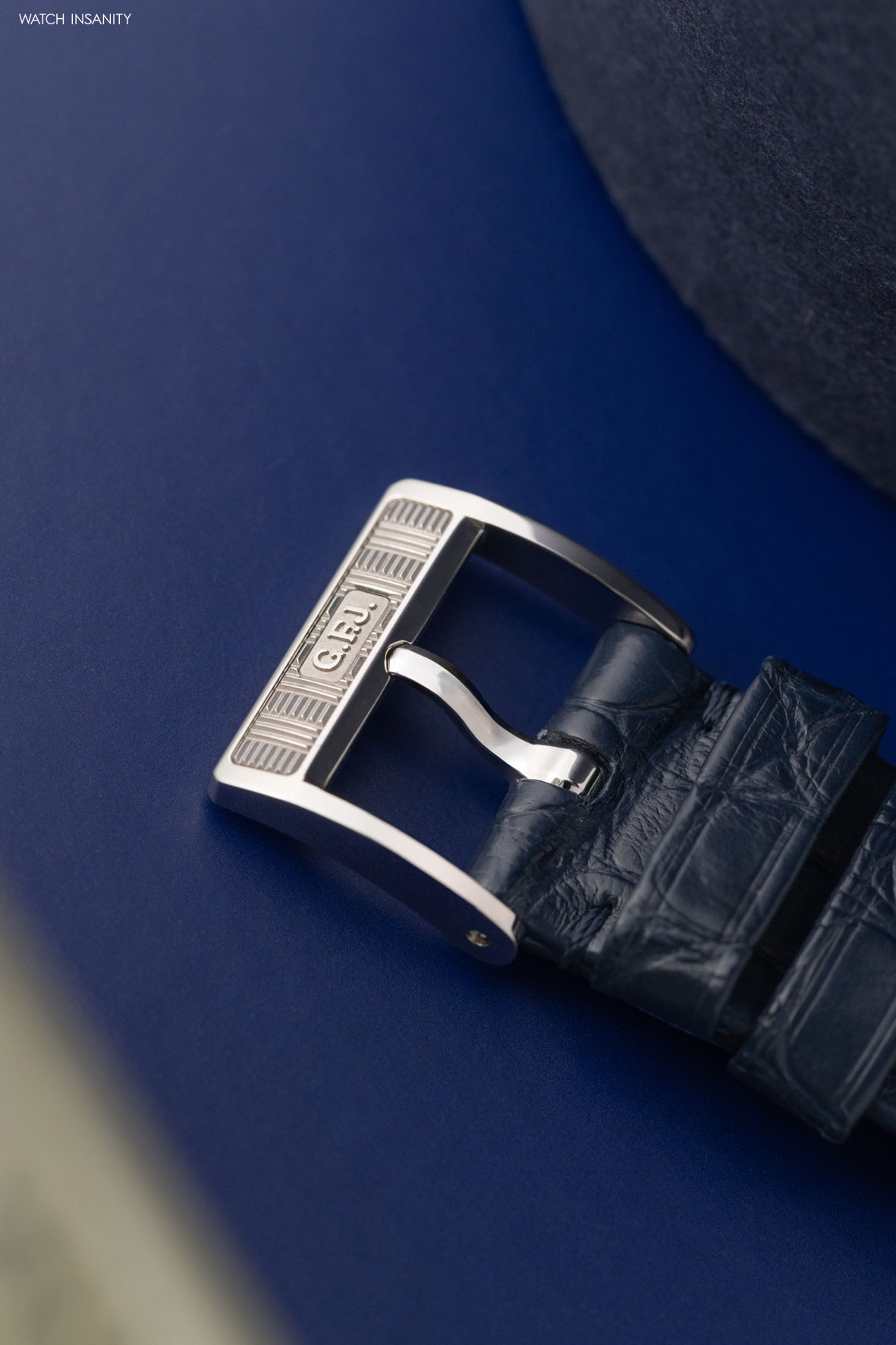
The Zenith G.F.J. is produced in a limited edition of 160 pieces, with an in-house movement and a platinum case. It goes without saying that all these elements place it in a very high price bracket: 52,900 euros. This price applies to the strap version, which is triple and easily replaceable thanks to a quick release system: in dark blue alligator leather with a platinum pin buckle, or in black or blue ‘Saffiano’ calfskin.
There is also the option of purchasing a platinum bracelet, whose central links have the same brickwork as the calibre and dial. The bracelet version almost doubles the price of the watch to €98,000, and brings it close to weighing 250 grams. Let’s say that the bracelet is a ‘brave’ option – not for everyone.
Surely it is for those who understand that the G.F.J. really stands out in Zenith’s offering, because it is something we do not expect from a brand usually associated with high-frequency chronographs and sports models. A dress watch, made of precious materials and powered by a low-frequency, hand-wound movement is quite the opposite of the legendary El Primero. Despite this, the watch represents an equally interesting part of the brand’s rich history. It is therefore understandable that Zenith has chosen to celebrate its 160th anniversary by recalling its chronometry records in an unexpected way. A touch of class that demonstrates the seriousness of the Maison.
By Davide Passoni