

To mark its 30th anniversary, Roger Dubuis chose to return to its roots, bringing one of the most distinctive complications in its history back into the spotlight. The result is the Excalibur Monobalancier Biretrograde Calendar, a watch that revisits the aesthetic language of the Geneva Maison’s earliest creations through contemporary proportions, materials and design details.
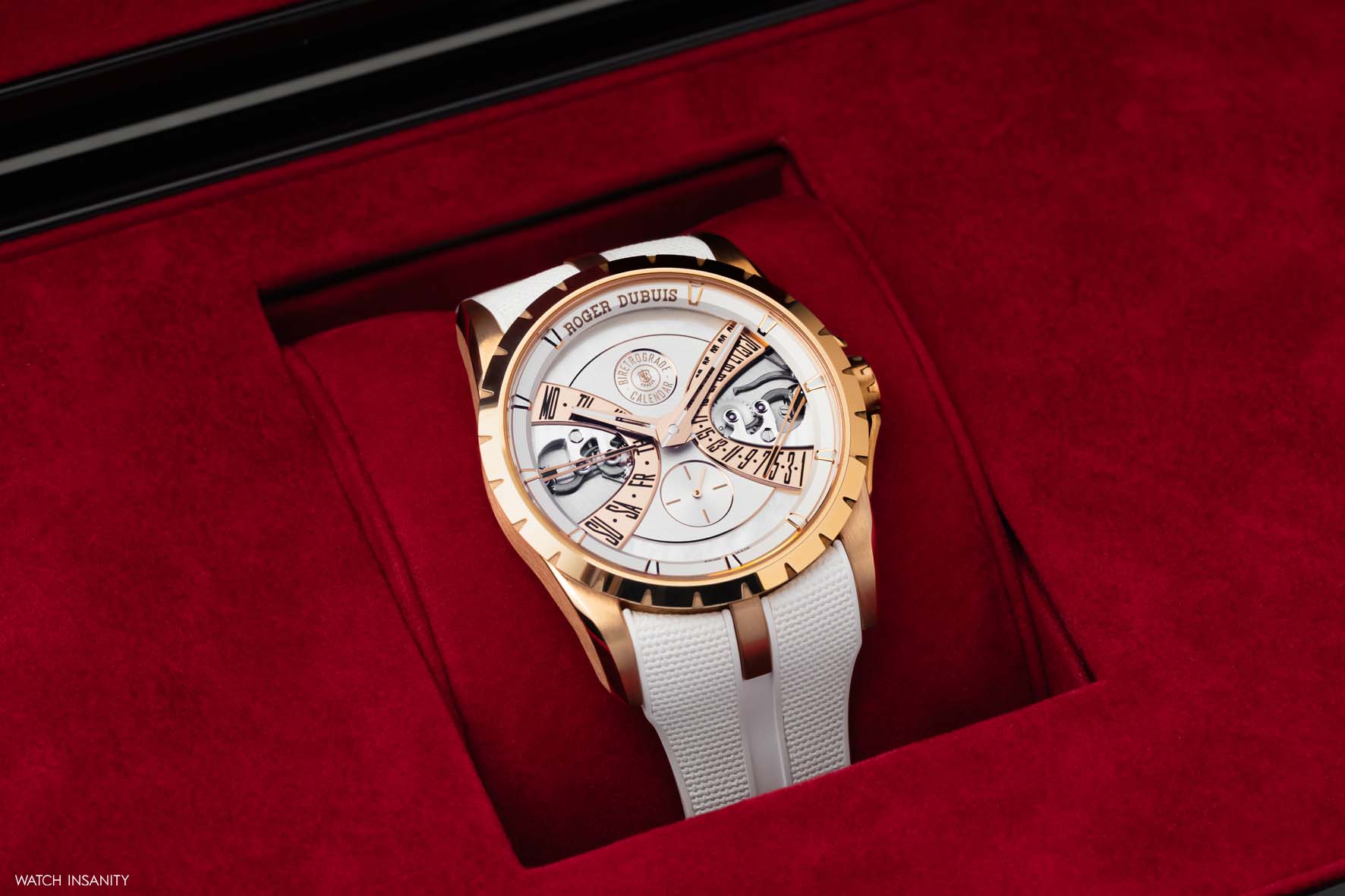
Unveiled at Watches and Wonders Geneva 2025, the model draws inspiration from the timepieces that helped define the manufacture’s identity in the 1990s and early 2000s. Rather than simply reproducing a historic watch, it offers a new interpretation in which the biretrograde complication once again takes centre stage.
The historical connection extends beyond the design. Roger Dubuis worked with Jean-Marc Wiederrecht on the development of a biretrograde mechanism even before the brand was founded in 1995. Its return in an anniversary creation is therefore more than a stylistic reference: it reflects how the brand established its identity by reinterpreting the codes of traditional Geneva watchmaking through a distinctive, personal approach.
EXCALIBUR MONOBALANCIER BIRETROGRADE CALENDAR: THE DIAL AND ITS 1996 INSPIRATION
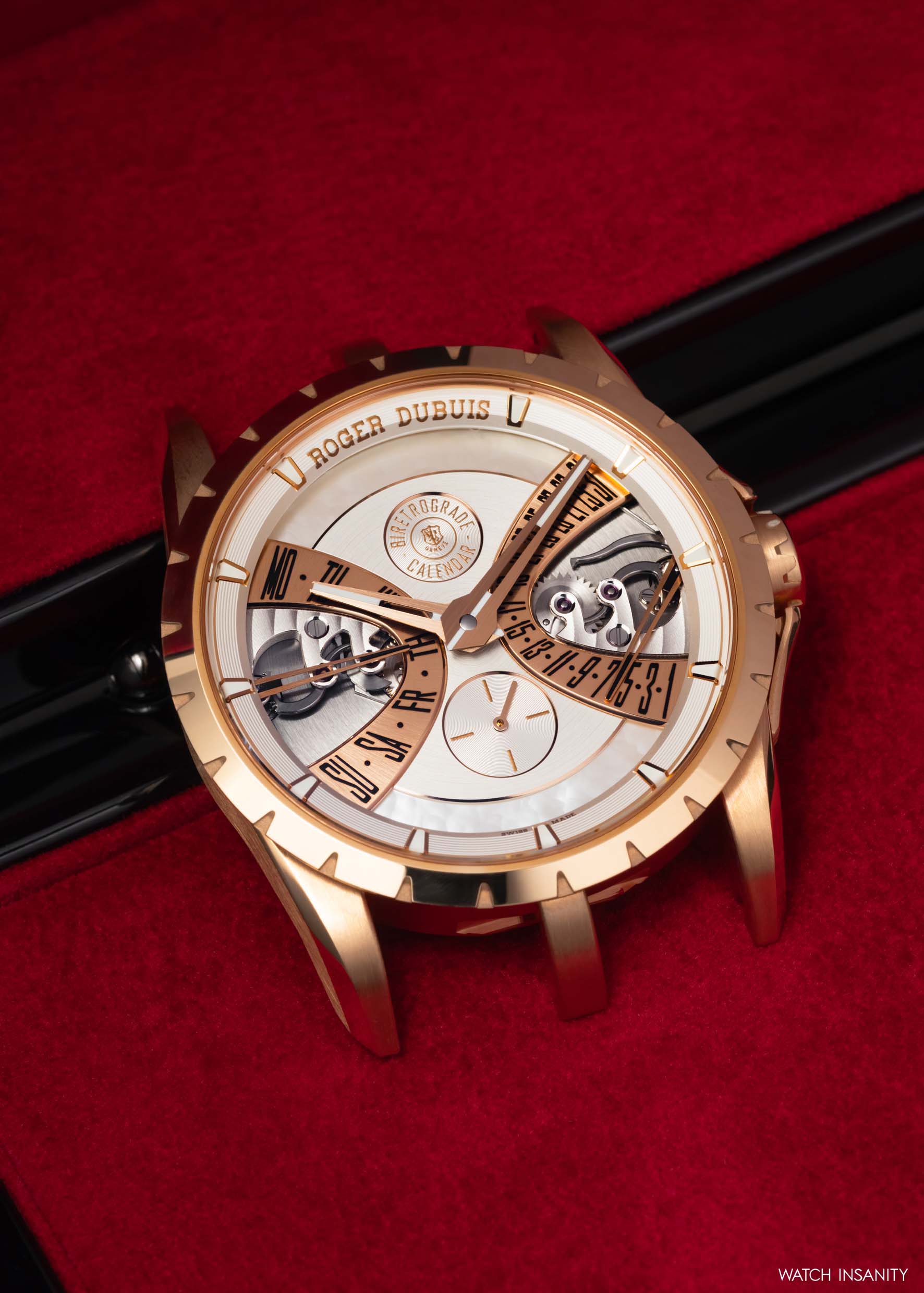
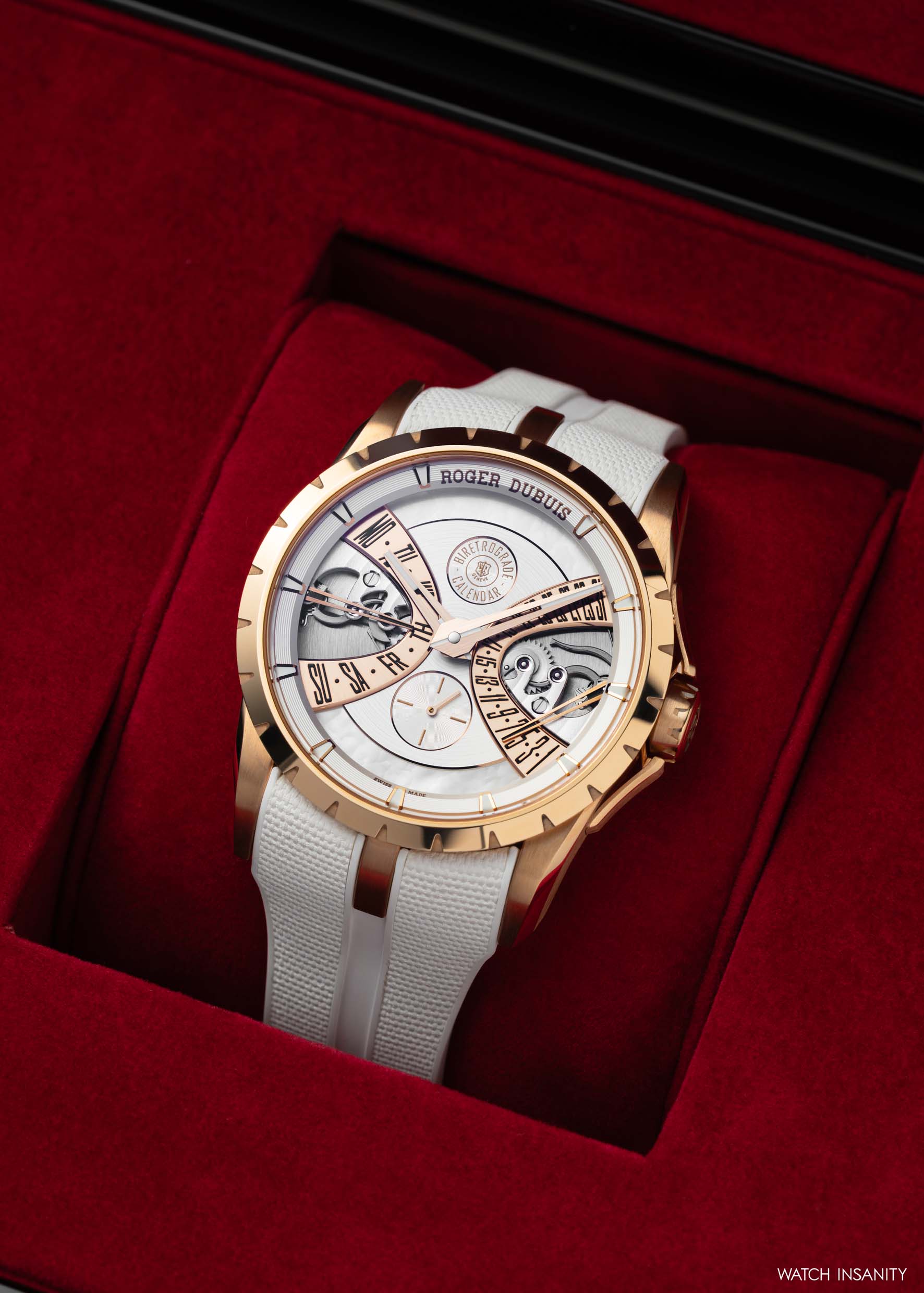
The connection with the Maison’s history is especially apparent in the dial layout. The two biretrograde scales revisit a design found on models from 1996: wider at the outer ends and gradually narrowing towards the centre, they trace curves that lend depth to the composition and accentuate the impression that the hands are suspended above the dial. The typography of the calendar indications reinforces this tapered design, with letters and numerals stretched towards the edges and compressed in the centre to follow the contours of the scales. The eye is drawn towards the two skeletonised brass hands and the openings that reveal glimpses of the automatic movement beneath.
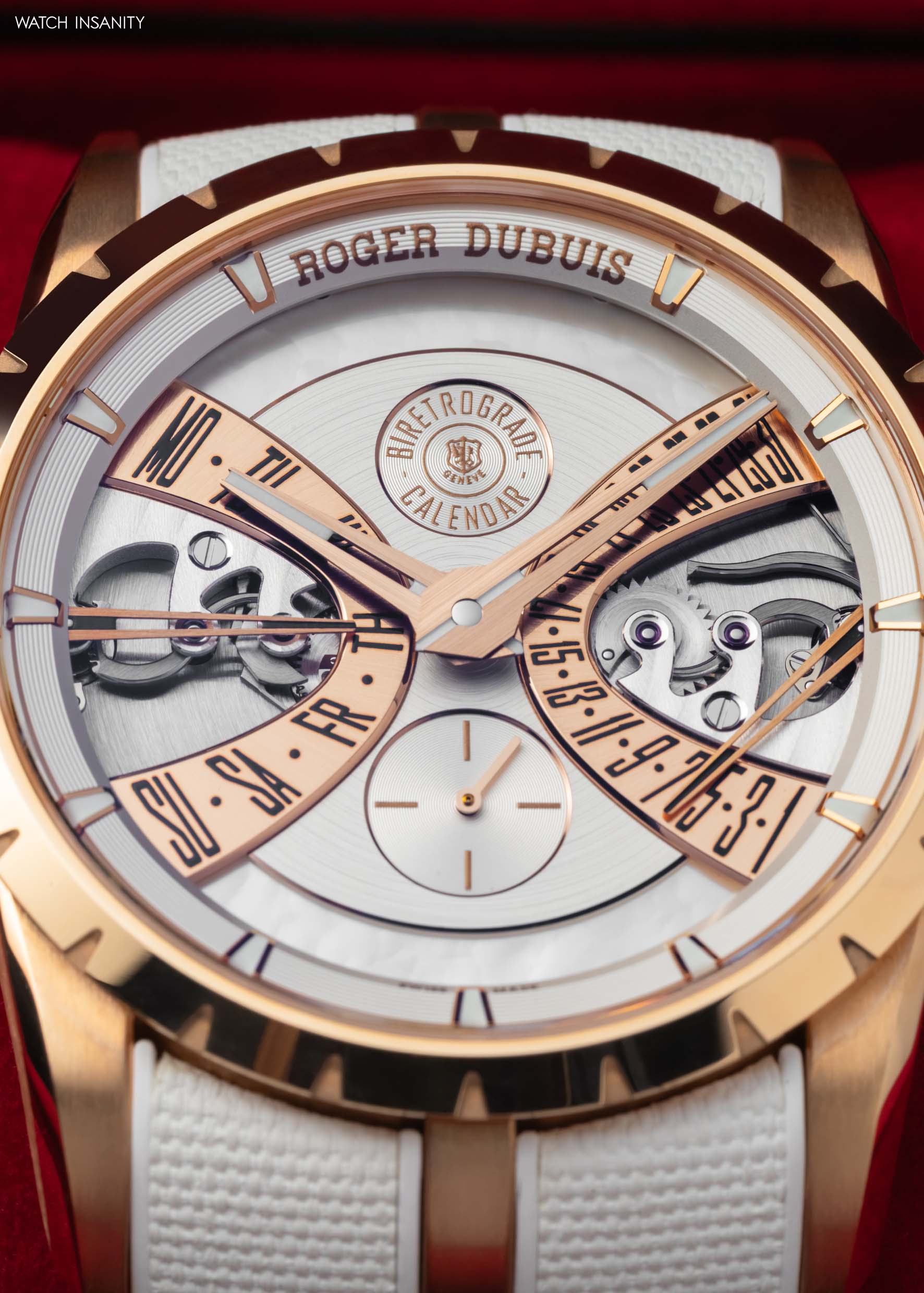
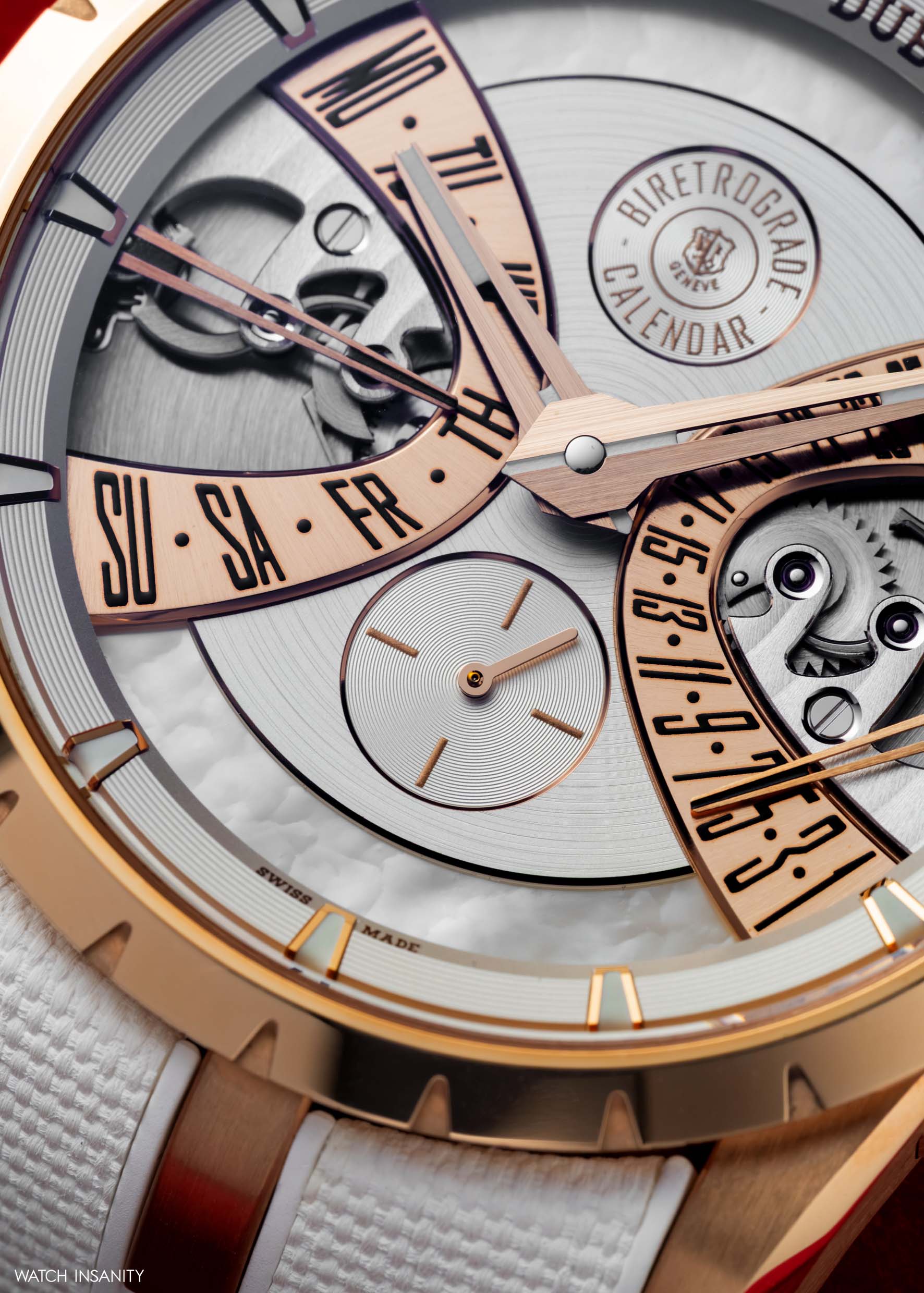
The symmetrical arrangement of the indications adds balance to the composition. A small-seconds subdial sits at 6 o’clock, aligned with the “Biretrograde Calendar” inscription at 12 o’clock. The lettering recalls Roger Dubuis’ historic typography and is accompanied by the Poinçon de Genève emblem, while other aesthetic cues evoke the Much More Biretrograde Calendar from the early 2000s.
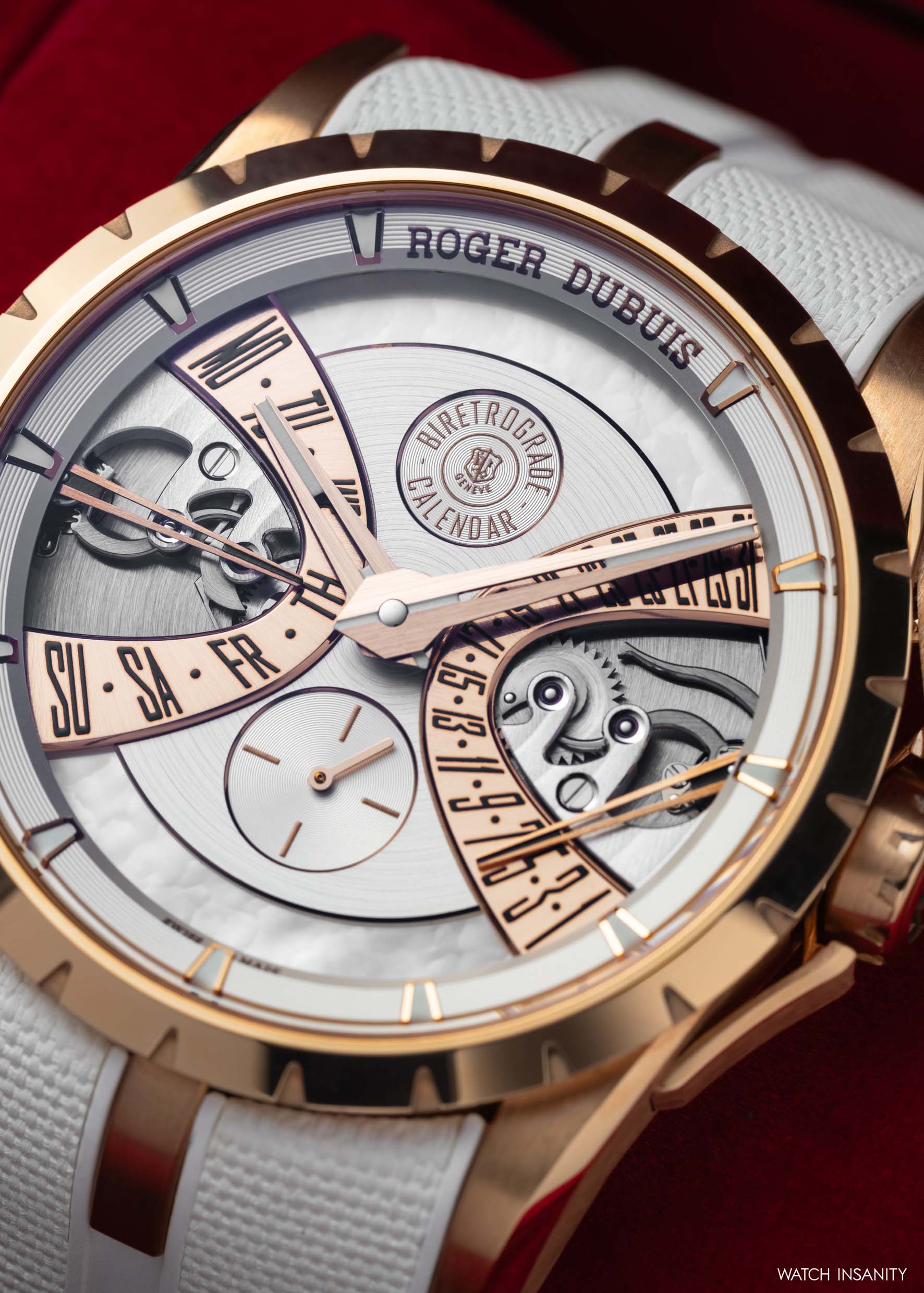
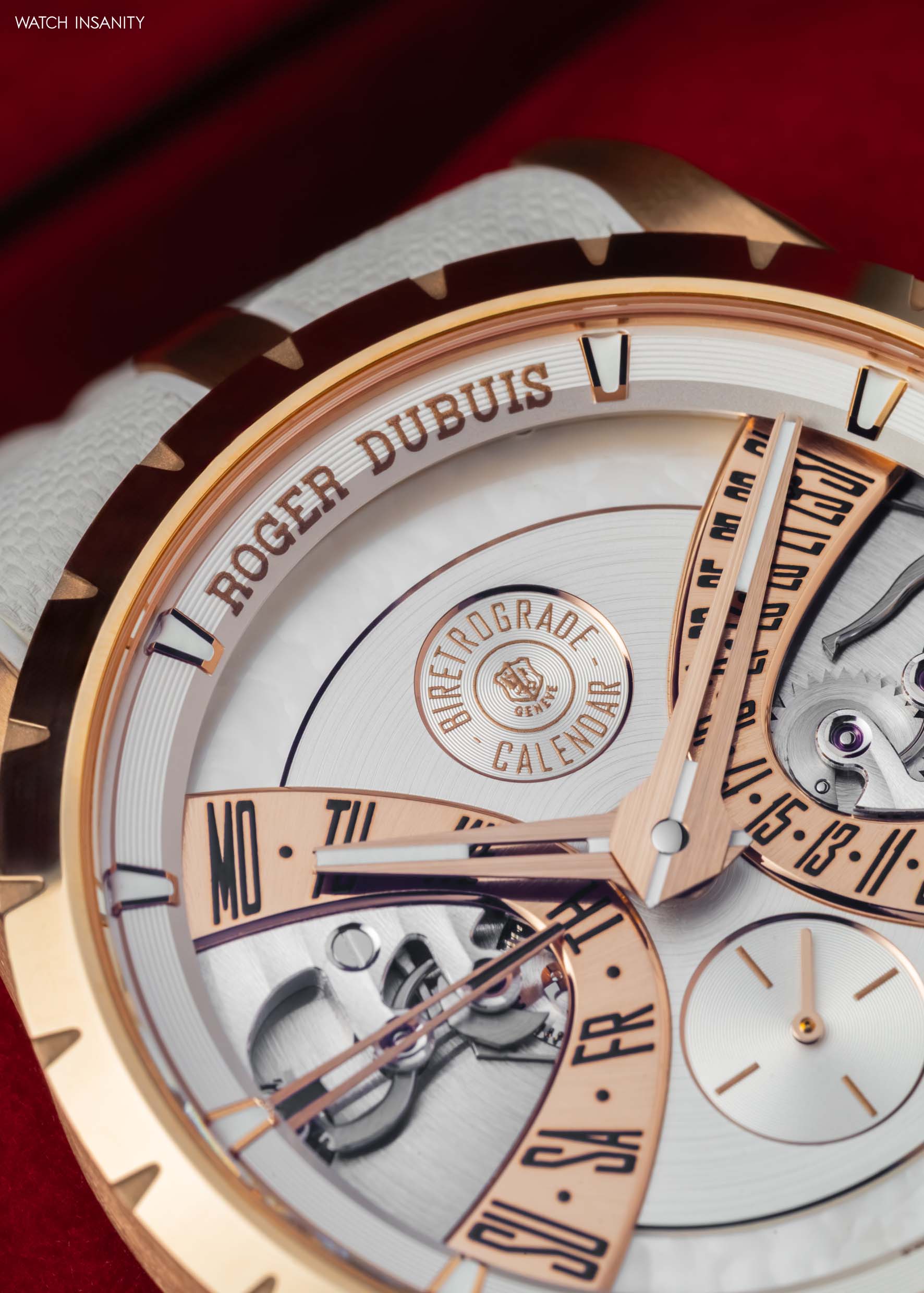
The skeletonised rose gold hour and minute hands, with their distinctive dagger-shaped profiles, further lighten the composition. The silver-toned dial, accented by mother-of-pearl details, is framed by a finely fluted rehaut with framed, gold-plated hour markers, guiding the eye towards the centre. Together, these details reveal a thoughtful exploration of the Maison’s visual codes and design heritage. References to the past emerge through the proportions, inscriptions and graphic elements, without turning the new Excalibur into a replica of its predecessors.
ROSE GOLD AND MOTHER-OF-PEARL DETAILS: MATERIALS AND IDENTITY
The 18-carat rose gold case, measuring 40 mm in diameter and 11.25 mm thick, establishes the elegant character of the Excalibur Monobalancier Biretrograde Calendar. It is paired with a silver-toned dial embellished with mother-of-pearl inserts, a material that recalls an important chapter in Roger Dubuis’ history and some of its most individual interpretations of men’s watchmaking.
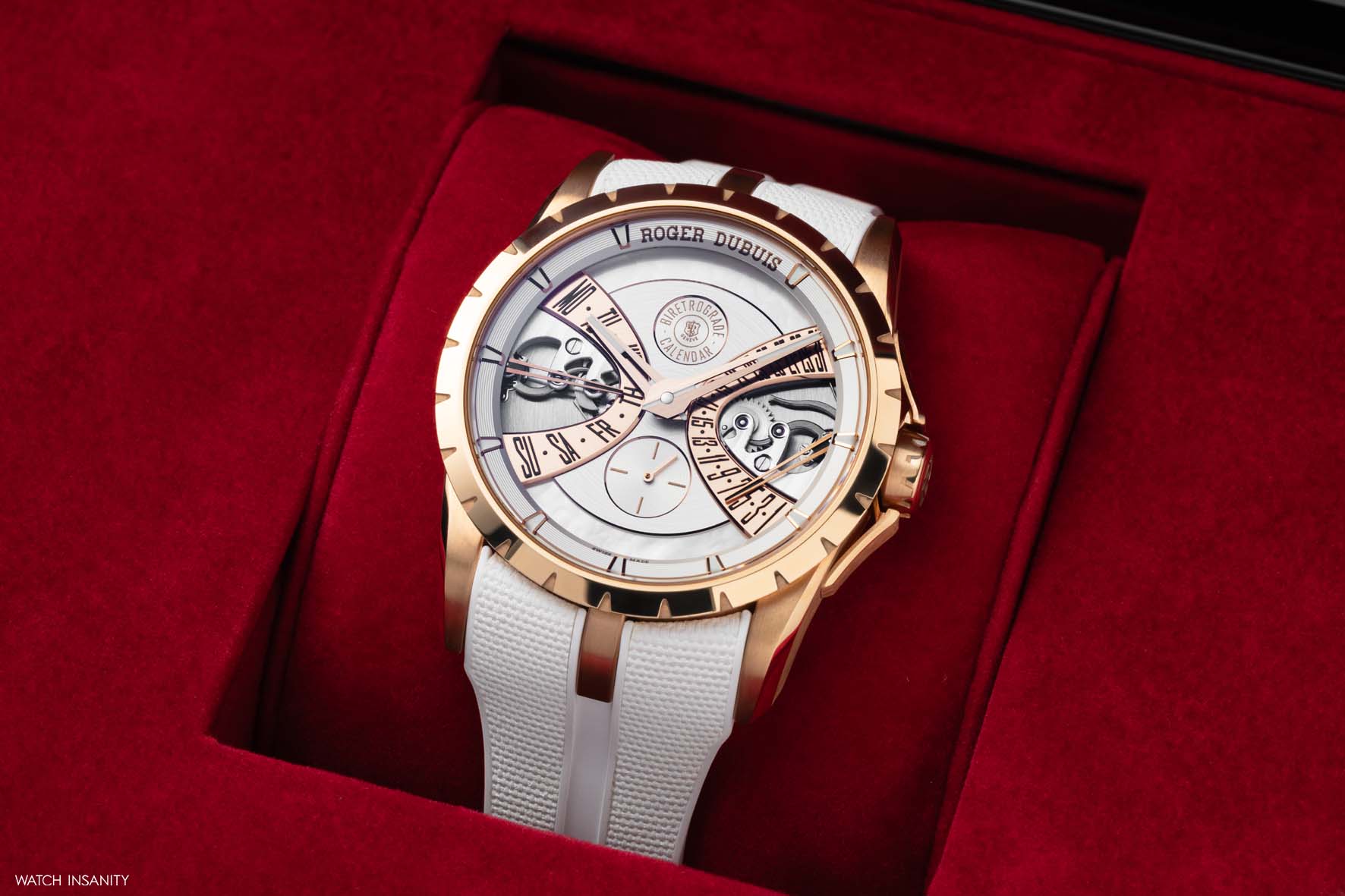
Mother-of-pearl brings a constantly changing visual dimension: depending on the light, its surfaces reveal different shades and reflections, creating a subtle contrast with the graphic structure of the biretrograde indications. The rose gold lends warmth to the composition and reinforces the model’s refined character.
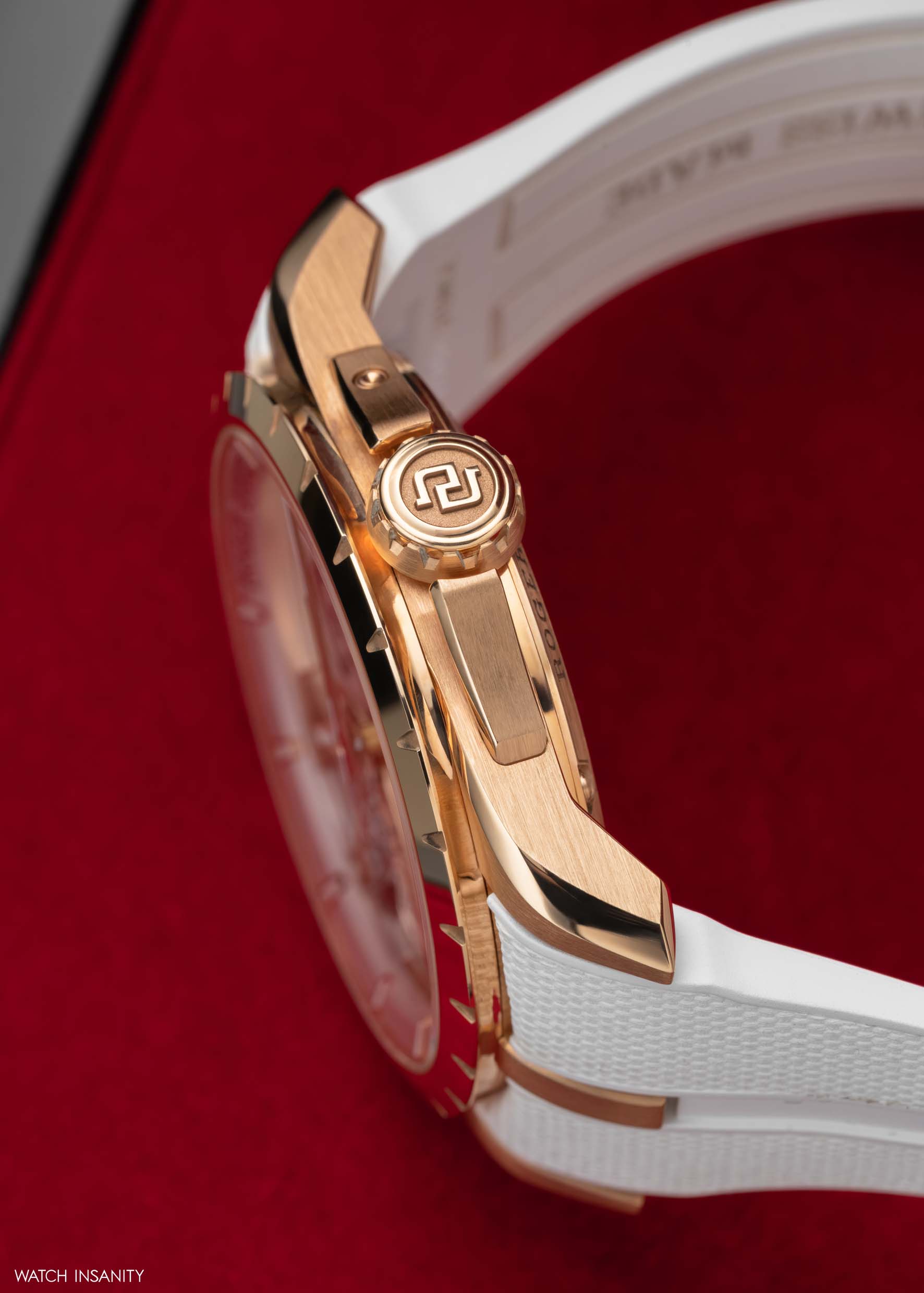
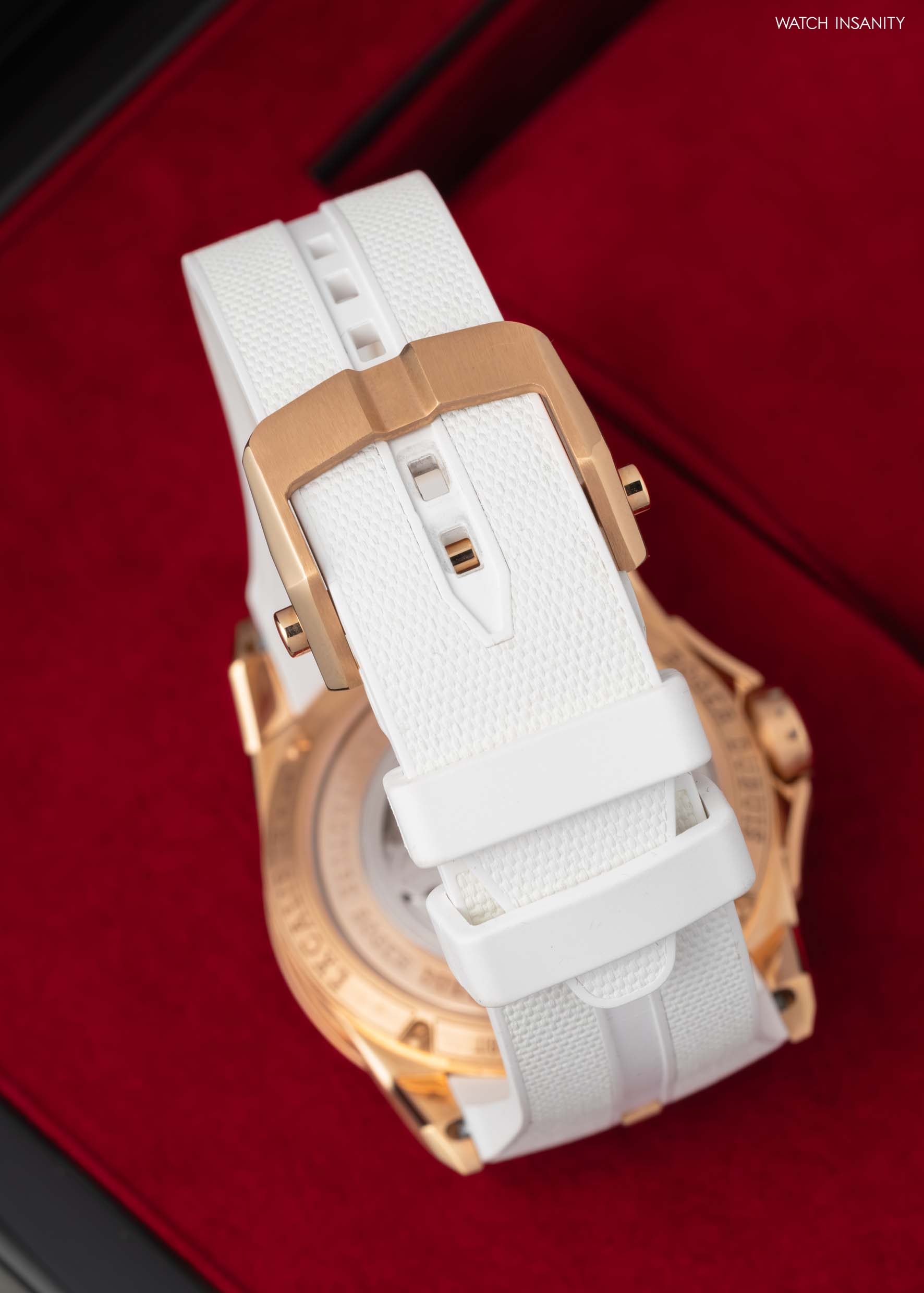
Completing the watch is a white rubber strap with a fabric-effect finish, equipped with the Quick Release System for easy changes and paired with a rose gold folding clasp. This combination creates another contrast between precious materials and contemporary styling.
RD840 CALIBRE: 60-HOUR POWER RESERVE AND POINÇON DE GENÈVE
The Excalibur Monobalancier Biretrograde Calendar is powered by the in-house automatic RD840 calibre, which delivers a 60-hour power reserve. Operating at a frequency of 4 Hz, the movement drives the hours, minutes and small seconds, along with the calendar’s two retrograde indications.
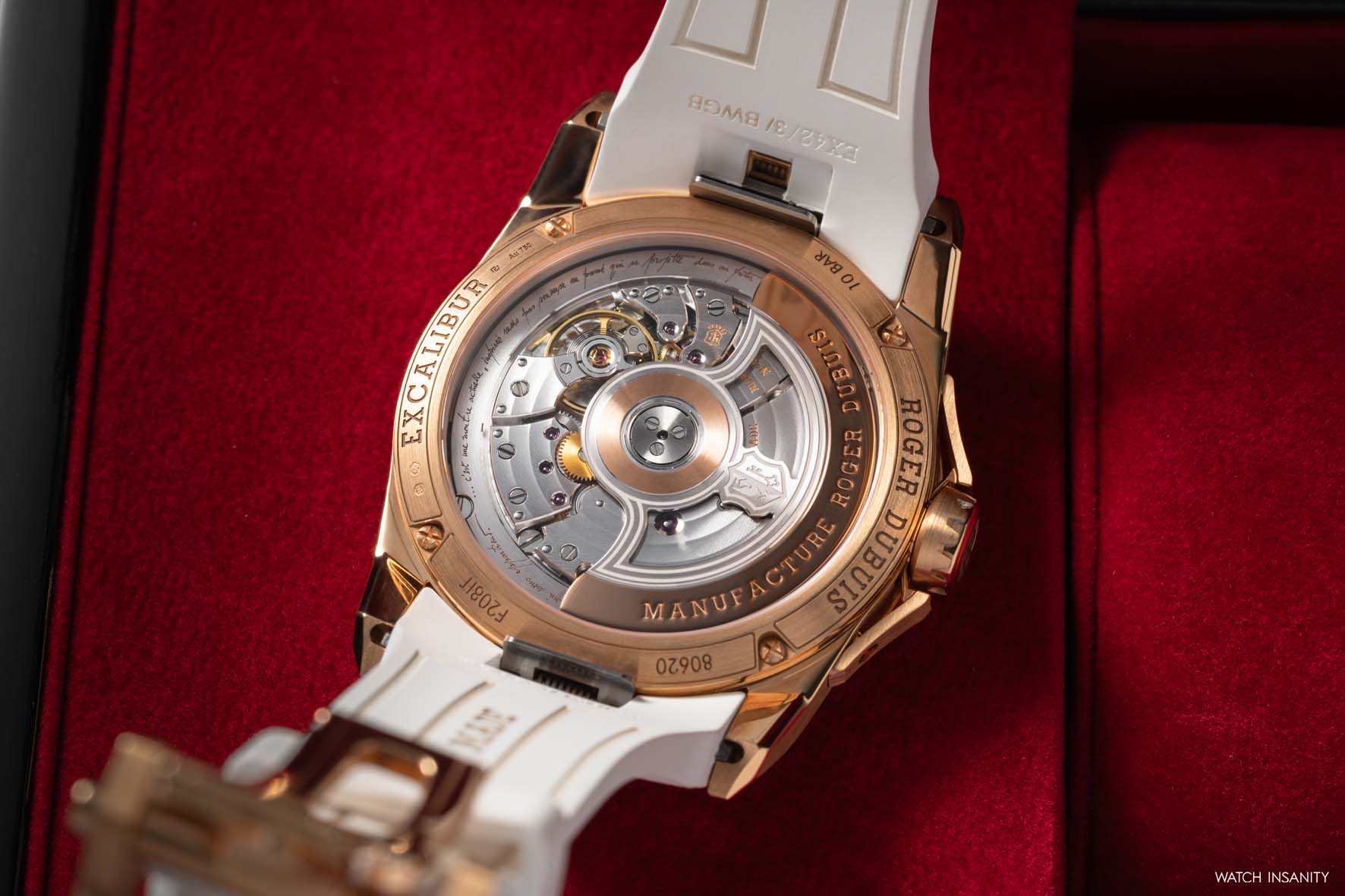
The sapphire crystal caseback reveals the movement’s architecture and oscillating weight. The latter revisits, in updated form, a design introduced by the Maison in 1996, establishing another connection with the earliest chapters of its history.
The RD840 calibre bears the Poinçon de Genève, a prestigious Swiss watchmaking certification with stringent requirements covering, among other things, construction, finishing and the operation of the watch. For Roger Dubuis, it also reflects a particular approach to manufacturing: the attention devoted to decorating and finishing the components contributes to the visual appeal of a movement designed to be admired as well as worn.
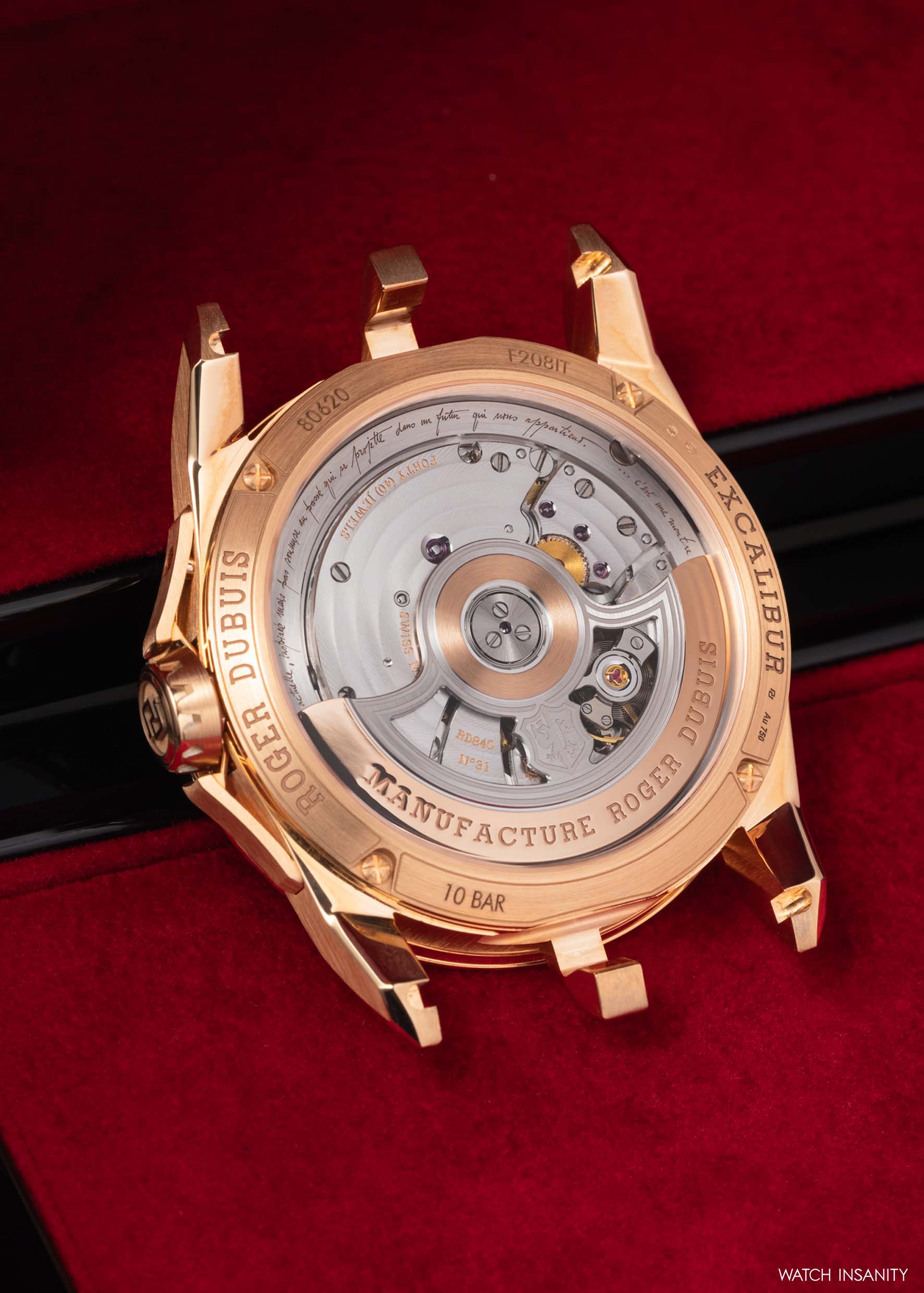
The caseback also carries an inscription expressing the Maison’s relationship with its history. One of the rings visible through the sapphire crystal bears an italicised phrase that has appeared on some of its earlier watches: “C’est une montre actuelle, inspirée mais pas soumise au passé, qui se projette dans un futur qui nous appartient.” In English: “It is a contemporary watch, inspired by the past but not bound by it, looking towards a future that belongs to us.”
HOW THE ROGER DUBUIS BIRETROGRADE CALENDAR WORKS
The defining feature of the Excalibur Monobalancier Biretrograde Calendar remains its system of retrograde indications. This complication holds a special place in Roger Dubuis’ history, turning a calendar function into a central element of the dial’s architecture.
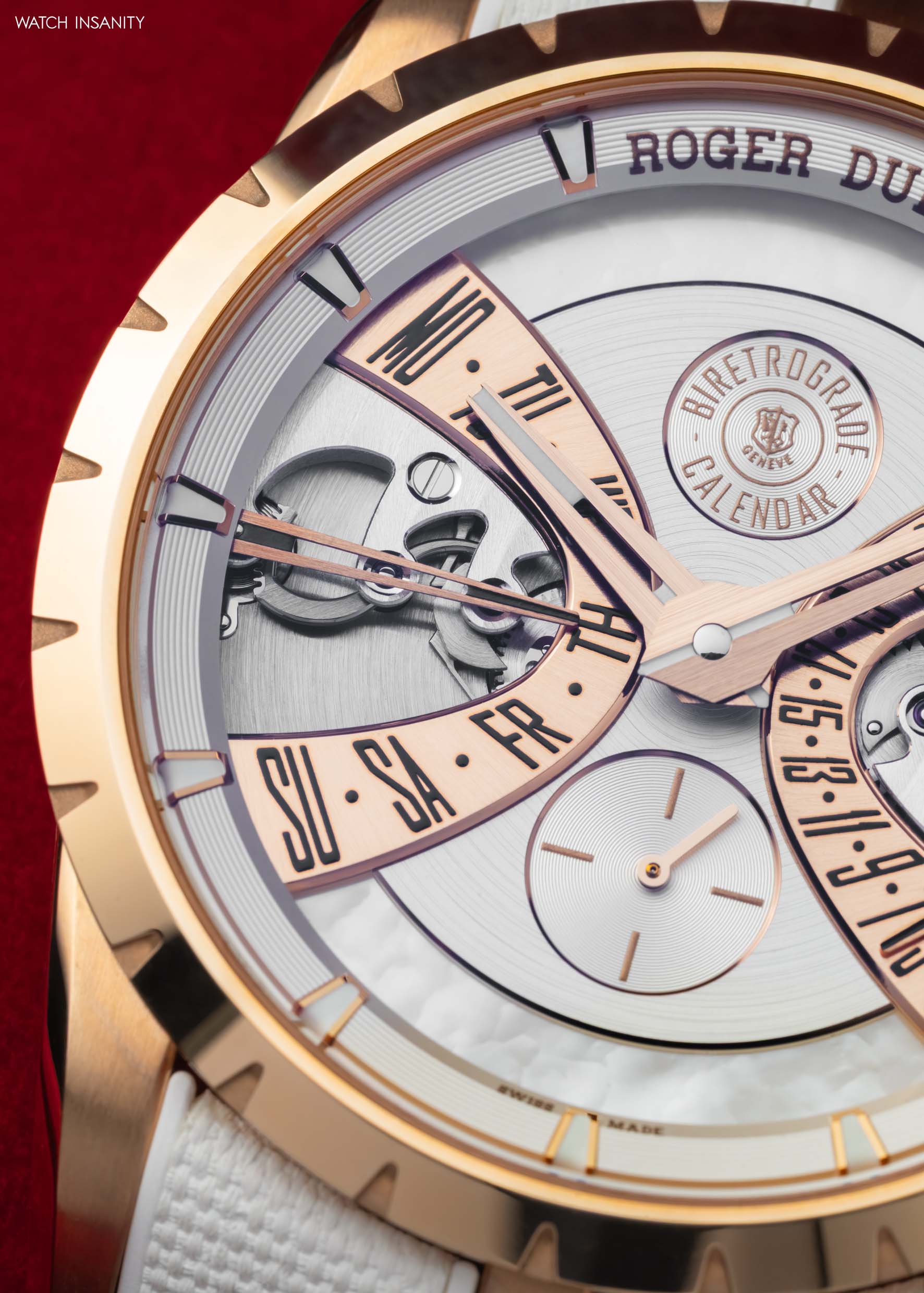
Drawn to mechanisms that could combine mechanical ingenuity with visual impact, the Maison’s founder saw retrograde displays as an ideal way to express his vision of haute horlogerie. In the late 1980s, he collaborated with Jean-Marc Wiederrecht on developing and modernising a biretrograde solution. This work predated the brand’s founding in 1995 and helped define some of its earliest creations.
The action is straightforward to observe, yet complex to engineer. Unlike a conventional hand that completes a full rotation, a retrograde hand advances along a graduated arc and, on reaching the end of its scale, snaps rapidly back to its starting position. On this model, the two scales display the day of the week and the date: each indication travels along its own arc before returning to the beginning at the end of its respective cycle.
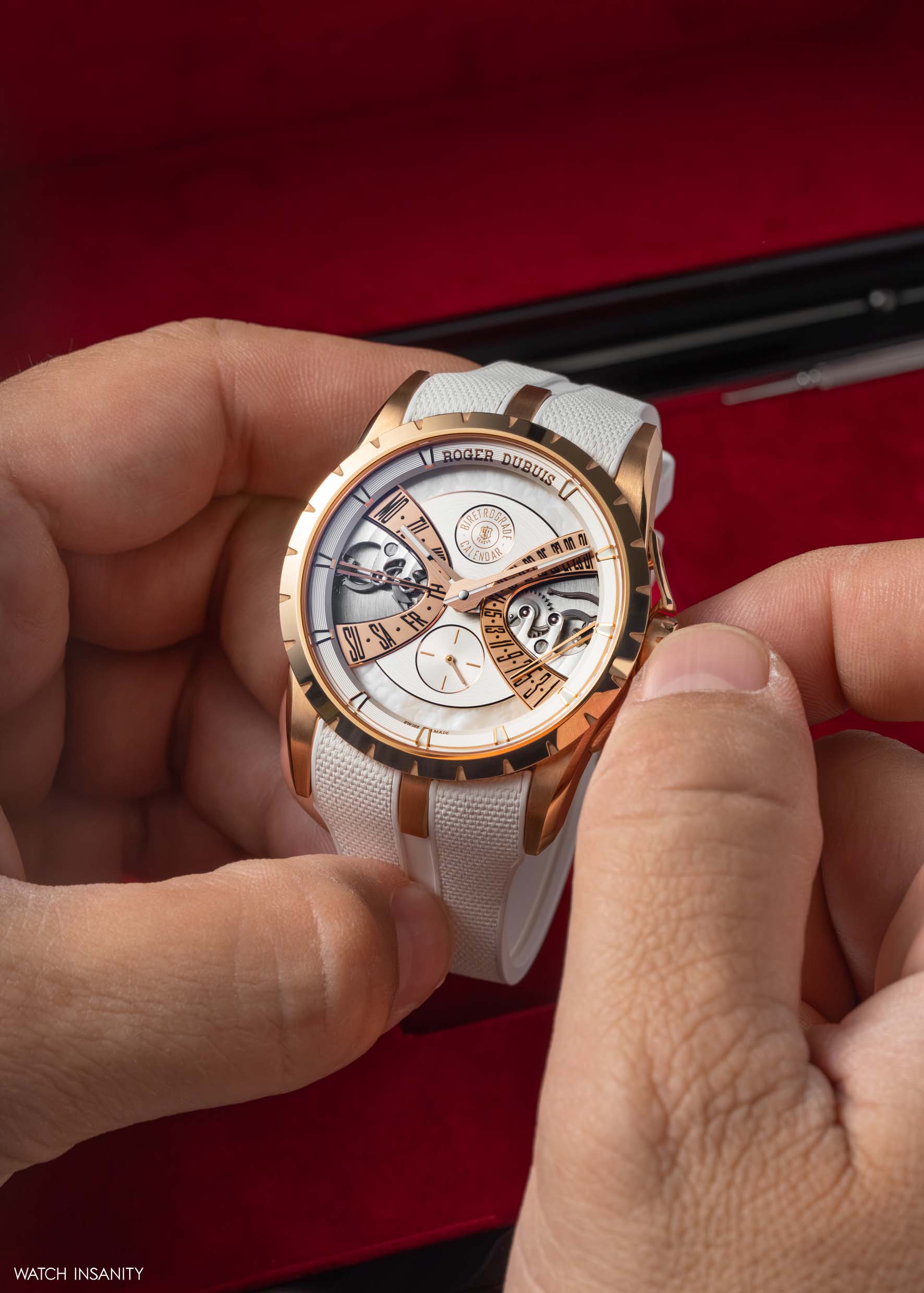
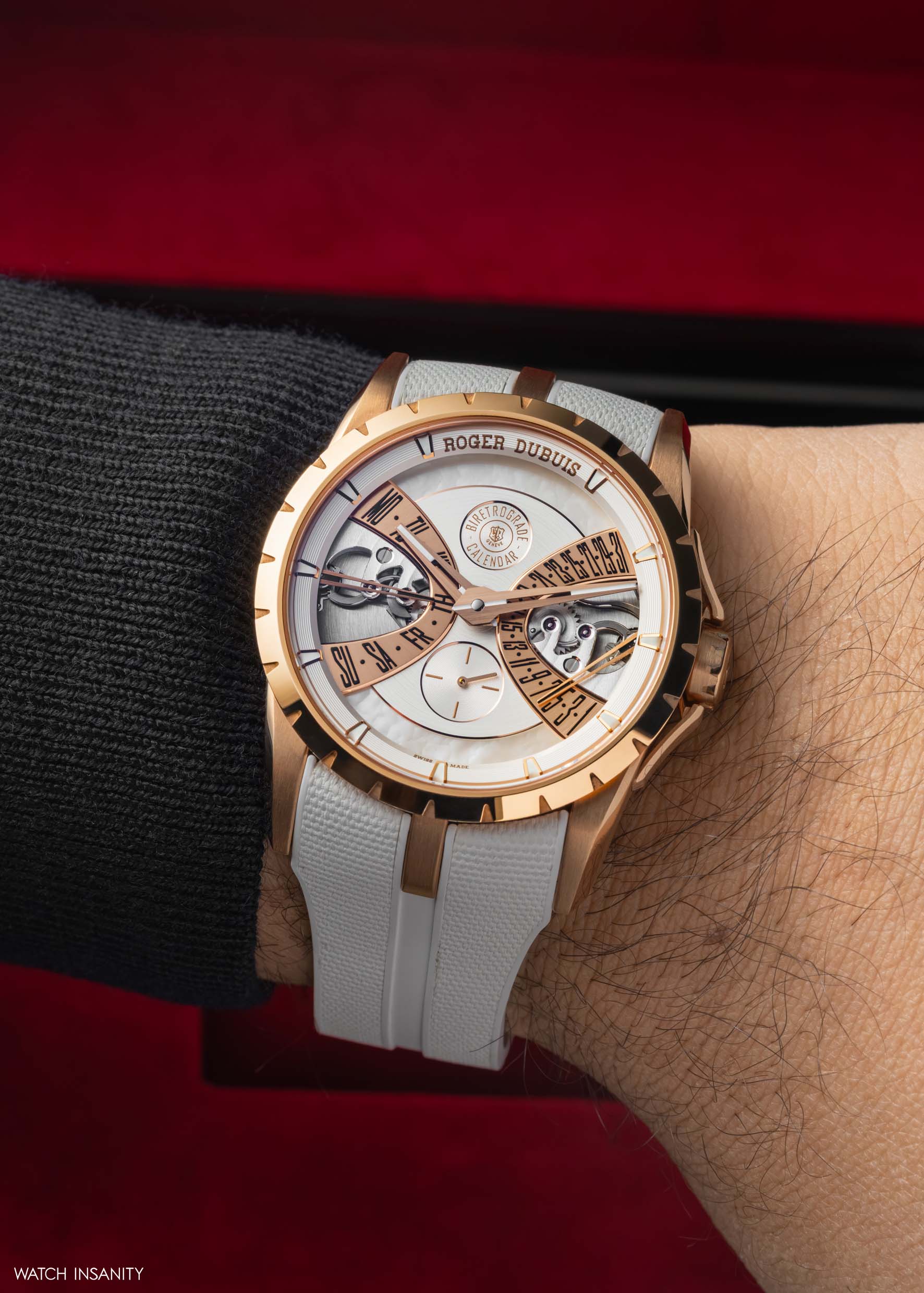
A series of mechanical components, including cams, levers and springs, controls the movement of the hands and their rapid return. Managing the energy and the forces generated during the jump is essential to the system’s reliable operation. What appears on the dial as a simple gesture is therefore the result of particularly careful engineering.
On the Excalibur Monobalancier Biretrograde Calendar, the angular, skeletonised design of the hands emphasises the motion of the displays, making the complication an integral part of the watch’s overall design.
ROGER DUBUIS EXCALIBUR BIRETROGRADE CALENDAR: PRICE AND FINAL THOUGHTS
With the Excalibur Monobalancier Biretrograde Calendar, Roger Dubuis celebrates the Maison’s 30th anniversary by bringing a complication closely associated with its origins back into the spotlight. The design combines historical references with contemporary choices, supported by selective distribution in Italy that includes the PISA 1940 Flagship Store in Milan.
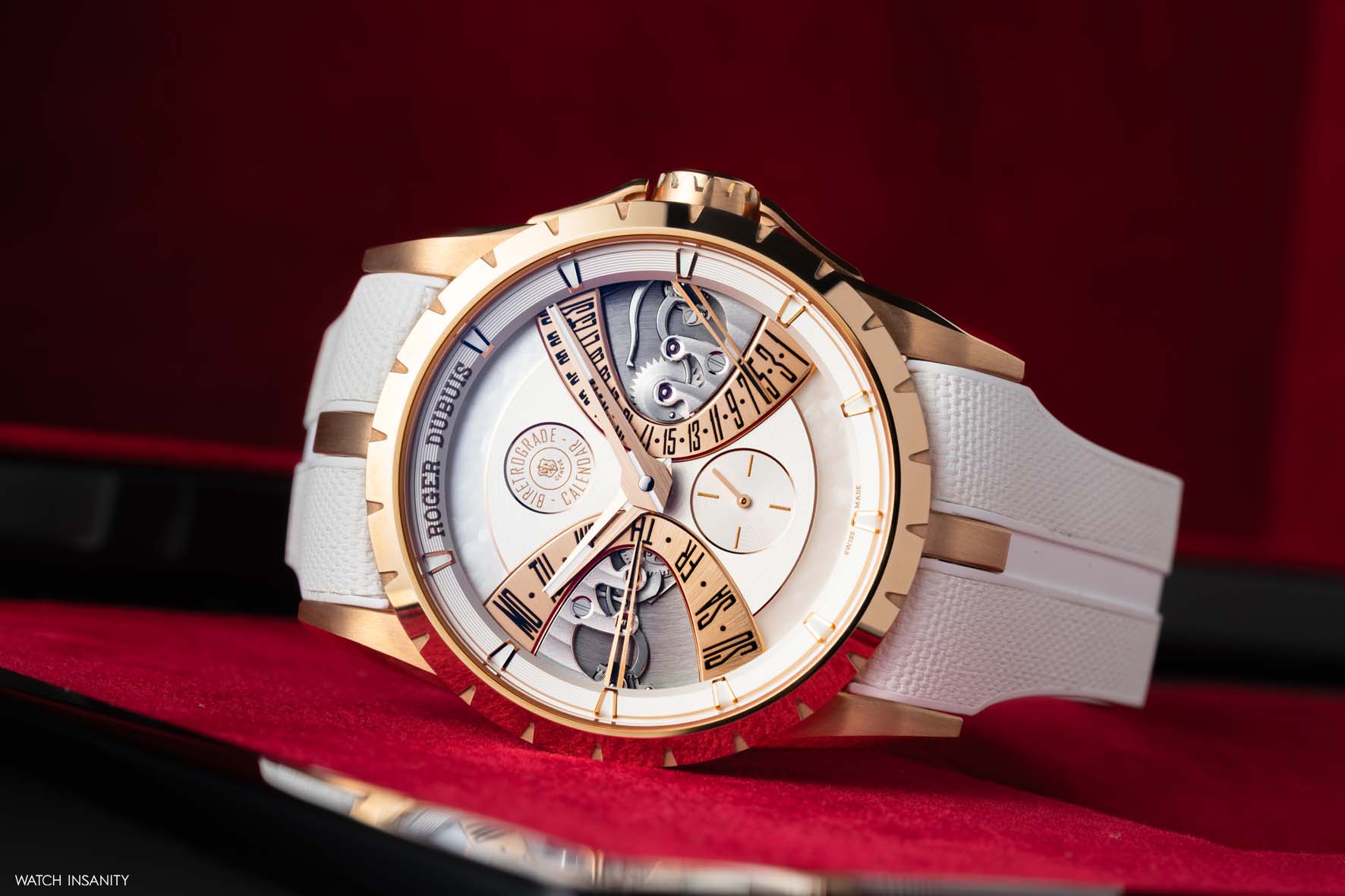
Rose gold, mother-of-pearl inserts, the automatic RD840 calibre and the Poinçon de Genève define a watch in which mechanical expertise and aesthetic exploration carry equal weight. The dial makes immediately apparent an idea that has accompanied the brand since its inception: transforming mechanics into a form of visual expression.
Priced at € 69,500, this Excalibur does more than mark an anniversary. It revives a recognisable technical signature and brings it into a creation that embraces the present without losing its connection to the Maison’s history.
By Davide Passoni