

For over seventy years, precision has been the language of the Constellation. Today, OMEGA is introducing a change that goes beyond the product itself and concerns the very method by which precision is measured.
The new OMEGA Constellation Observatory collection marks an absolute first: for the first time in the history of watchmaking, a two-hand watch has achieved Master Chronometer certification.

The turning point is not only technical, but conceptual as well. Thanks to a new methodology developed by the Laboratoire de Précision, the presence of a seconds hand is no longer required to certify precision. A requirement that once seemed structural suddenly becomes unnecessary, opening a new chapter in the measurement of time.
LABORATOIRE DE PRÉCISION AND DUAL METRIC TECHNOLOGY
The Laboratoire de Précision was created as an independent entity, certified by METAS and accredited by the SAS, with a structure designed to guarantee impartial and repeatable results. It is not simply a laboratory, but a new benchmark for the entire industry, capable of combining proprietary technology with direct control over measurement processes.

At the heart of this evolution is Dual Metric Technology, a system that radically changes the way a movement’s behaviour is observed. Unlike traditional tests, which rely on fixed readings based on the position of the seconds hand, this technology continuously records the sound of every tick while simultaneously integrating environmental data such as temperature, position, magnetic fields, and atmospheric pressure.

The result is a dynamic reading of precision. No longer an isolated data point, but a continuous trace running throughout the full 25-day testing cycle. This approach makes it possible to identify precisely both the moment and the cause of any variation, giving watchmakers a deeper understanding of the movement’s behaviour. It is precisely this continuity in measurement that has made it possible to eliminate the need for a seconds hand.

With the introduction of this methodology, the new Constellation Observatory models undergo both Chronometer and Master Chronometer testing without any change to the time display. It is a development that redefines the parameters of certification, keeping the standards unchanged while profoundly transforming the way they are achieved.

Since 2015, Master Chronometer certification has represented one of the most advanced benchmarks in precision testing. With the Constellation Observatory, this standard is extended for the first time to a pure two-hand watch, marking an evolution that is natural and radical at the same time.
OMEGA CONSTELLATION OBSERVATORY: INSPIRATION AND CONTINUITY
The new OMEGA Constellation Observatory collection maintains a direct link with the history of the Constellation, reinterpreting its aesthetic codes without disrupting them. The dodecagonal “pie-pan” dial, the star at 6 o’clock, and the Observatory medallion on the caseback remain central elements, as do the faceted kite-shaped indexes and the Dauphinehands, both of which recall historical models.




The reference to the 1948 Centenary is clear, as is the desire to preserve a visual continuity that spans generations. The “dog-leg” lugs and the nine-row brick-pattern bracelet revisit details already seen in the early years of the collection, placing them within a contemporary context. The 39.4 mm proportions reinforce this balance between past and present, offering a presence on the wrist that remains true to the model’s identity.
THE NEW MASTER CHRONOMETER CALIBRES
The collection introduces two new automatic Master Chronometer calibres with a 60-hour power reserve, built on a shared base but differentiated by their finishes and materials. The Calibre 8915 is reserved for the gold versions, while the Calibre 8914 powers the O-MEGASTEEL references, maintaining the same architecture but with a rhodium-plated finish.
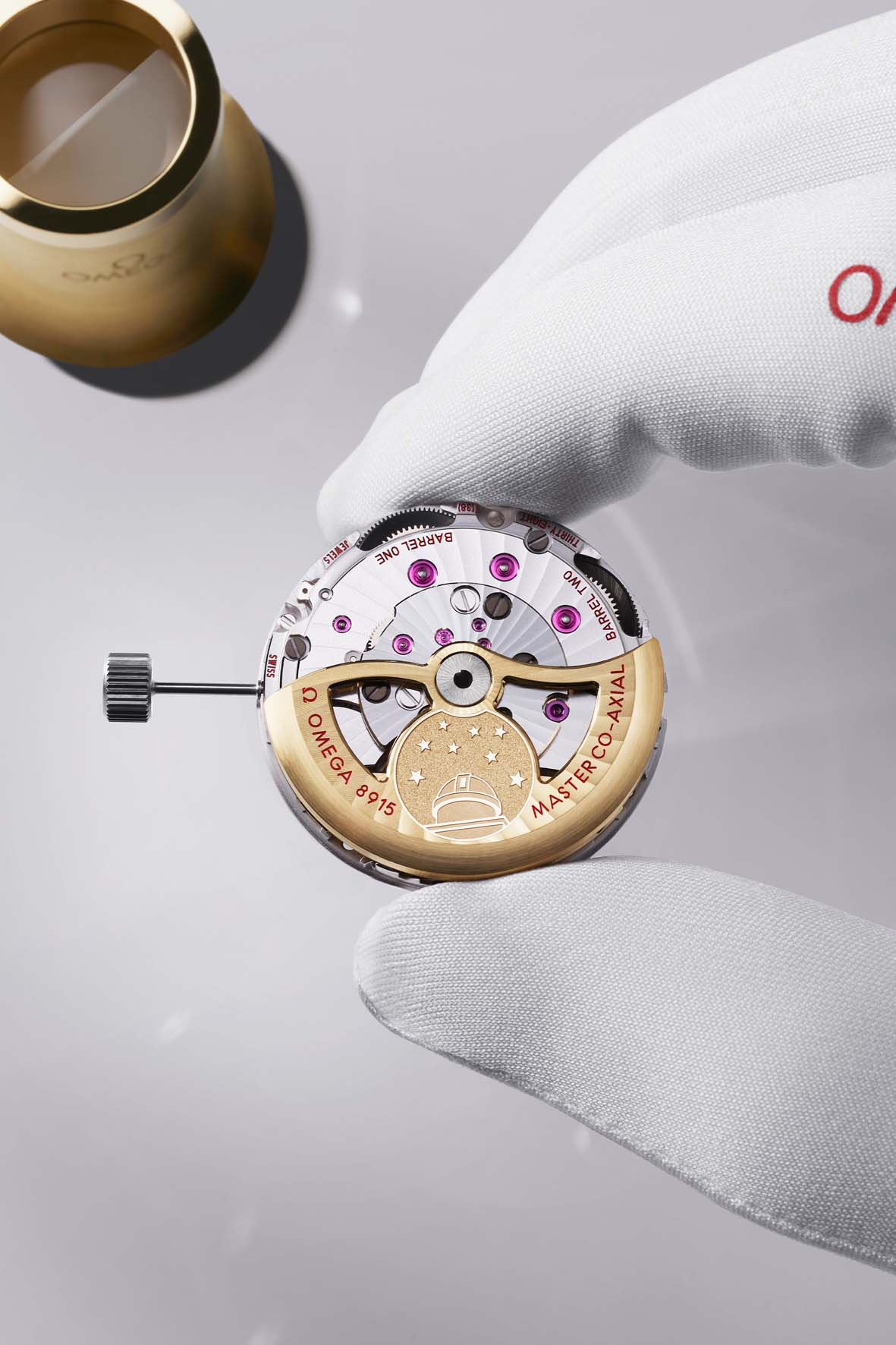

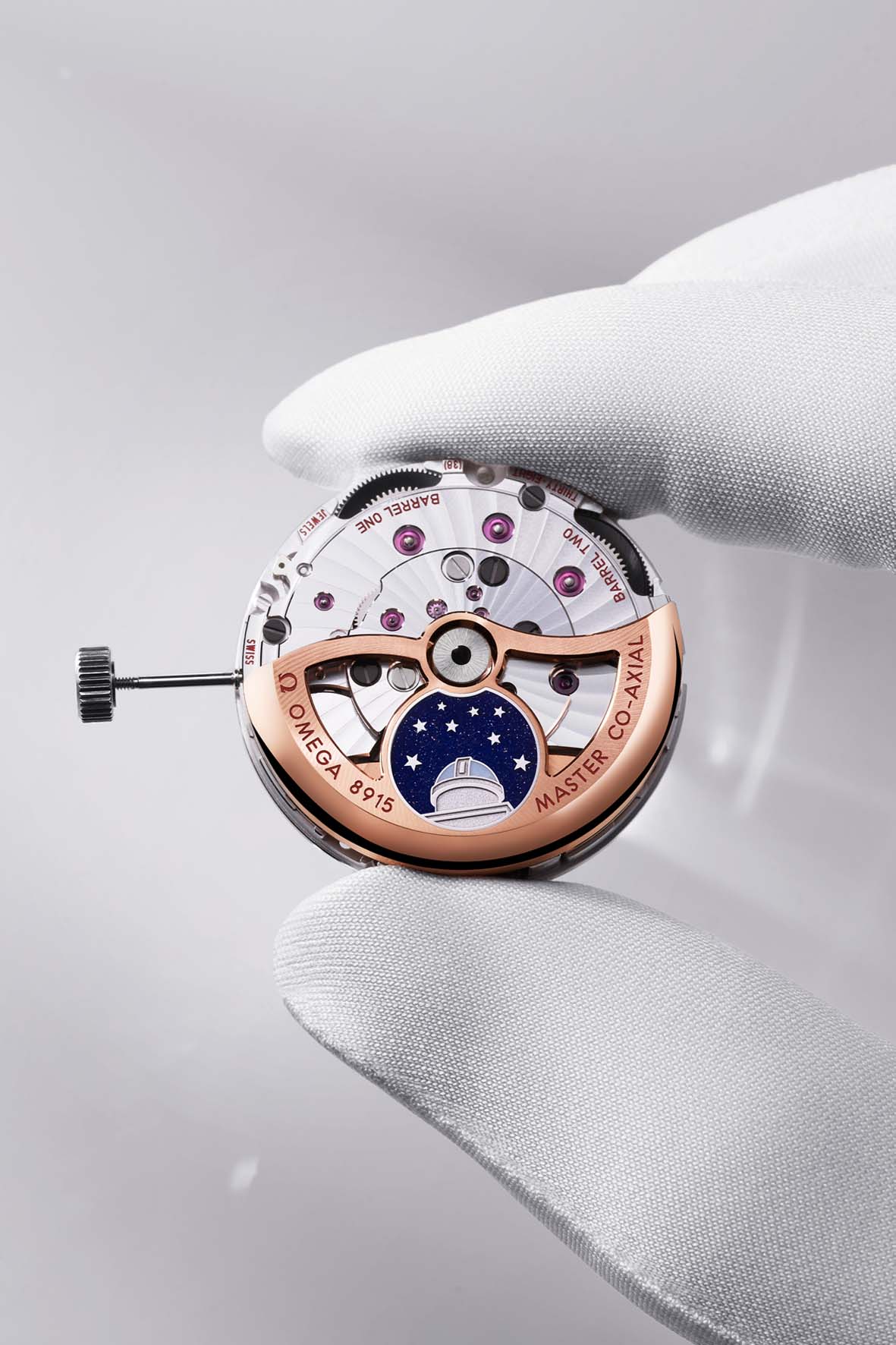
Both share a construction featuring a skeletonised rotor, carefully finished bevels, and an applied Constellation Observatory medallion, elements that highlight the attention to detail and the aesthetic coherence of the entire collection. The differences emerge in the workmanship and materials used, which become the true distinguishing elements across the various interpretations.
FIVE PRECIOUS METAL VERSIONS
The gold versions represent the highest level of the collection and showcase OMEGA’s proprietary alloys through different interpretations.
The Moonshine™ 18K gold version with bracelet sits at the top of the range with a price of €. 58,600 and features a skeletonised rotor in Moonshine™ 18K gold, enhanced by an applied medallion bearing the laser-engraved Constellation Observatory emblem, whose finish creates a bold visual contrast.


The two Sedna™ 18K gold versions with pink dials, together with the Moonshine™ 18K gold version with a yellow dial, all share a price of €. 37,600. In these models, the skeletonised rotor is decorated with a laser-engraved Observatory medallion, maintaining coherence between movement and case.

The Canopus Gold™ 18K model with a silver dial and hand-guilloché finish, priced at €. 43,700, features a skeletonised rotor in Sedna™ 18K gold with a laser-engraved Observatory medallion, characterised by a refined contrast between surfaces.

The Platinum Gold 950 version represents the most elaborate proposal, with a price of €. 57,400. Here, the Sedna™ 18K gold rotor is enhanced by a laser-engraved and enamelled white gold medallion, with a dark blue aventurine glass skyand an opaline dome, introducing a more narrative dimension to the decoration.
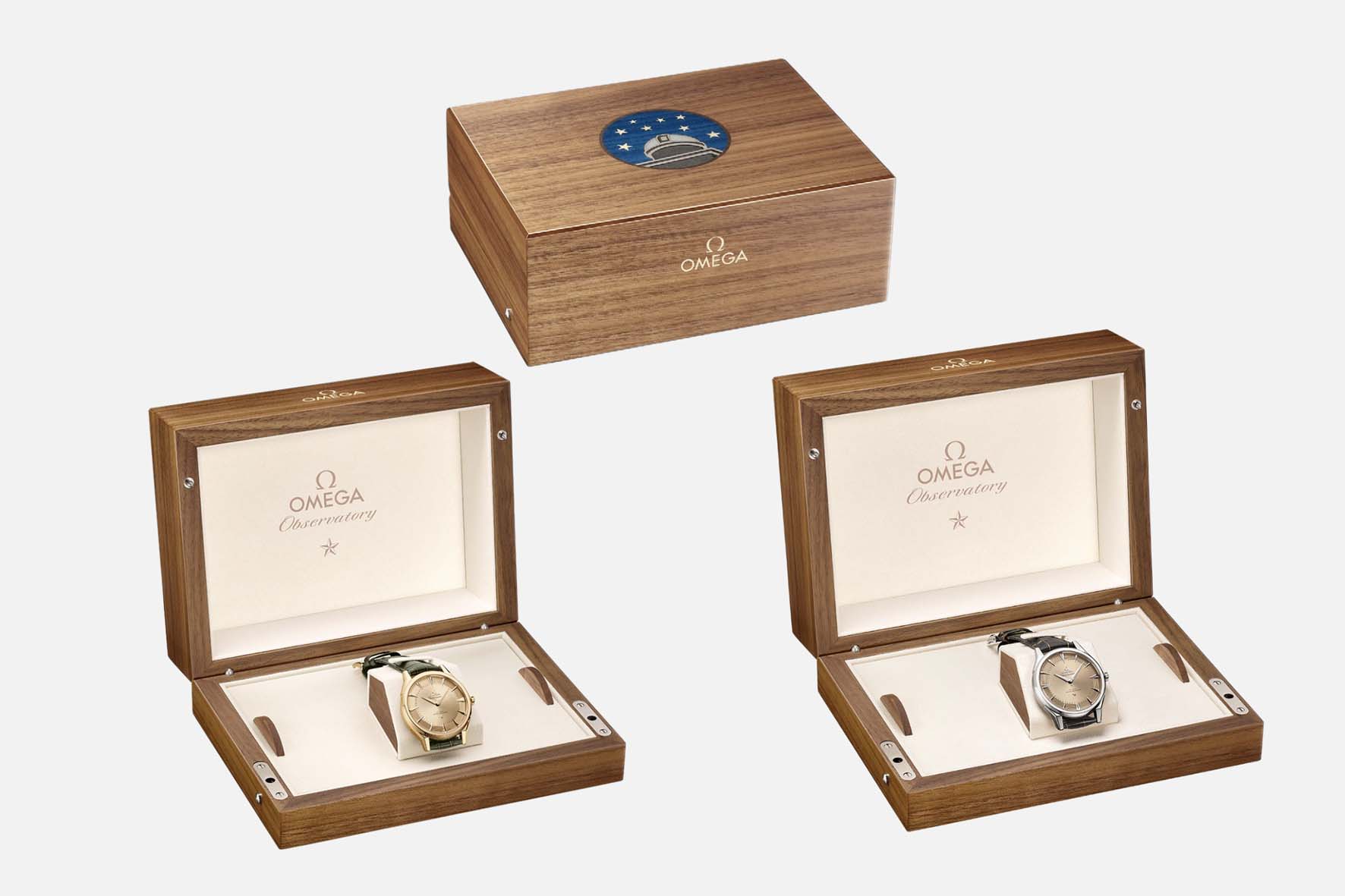
All precious metal watches in the collection are presented in a dedicated wooden box, with the Constellation Observatory emblem inlaid into it.
FOUR STEEL VERSIONS
The O-MEGASTEEL versions represent the collection’s more technical approach, while preserving a strong aesthetic identity. The “pie-pan” dial faithfully reprises the original 1952 model with its twelve-faceted structure, enriched by an opaline central section and surfaces worked with eight raised grooves, capable of creating depth and shifting plays of light.


The OMEGA logo and Constellation star are applied, while the diamond-polished “kite” indexes echo the hands of the same shape, which are also diamond-polished and crafted in Sedna™ 18K gold. Everything is protected by a domed sapphire crystal, bevelled and treated with anti-reflective coating on both sides, completing a construction that is consistent in both technical execution and finish.

The collection is offered in four variants. The versions with silver, green, and blue dials are priced at €. 10,800, while the black dial version is positioned at €. 12,100, reflecting a difference linked to the dial configuration.
A NEW METHOD
From the 1948 Centenary to the creation of the Laboratoire de Précision in 2023, OMEGA’s path has always been tied to the search for new standards of precision. Today, the Constellation Observatory stands as both a point of synthesis and, above all, a change in approach.
It is not only the first two-hand Master Chronometer. It is the first watch to demonstrate that precision can be measured in a different way.
By Jacopo Giudici