


There is an invisible road connecting ancient Mesopotamia to Switzerland. It starts in the mythical city of Ur, the cradle of the Sumerian people, and leads to Geneva via Zurich. At the end of this road is Urwerk, one of the most surprising haute-horlogerie manufacturers, born of the encounter between the creative flair of Martin Frei and the mechanical genius of Felix Baumgartner. Master watchmaker born into a family of watchmakers the latter, designer and artist the former, their partnership began in 1995 when Felix, his brother Thomas and Martin discovered a common passion for measuring and representing time. A long discussion sharing philosophies and dreams culminated in the decision to create their own watchmaking vision.
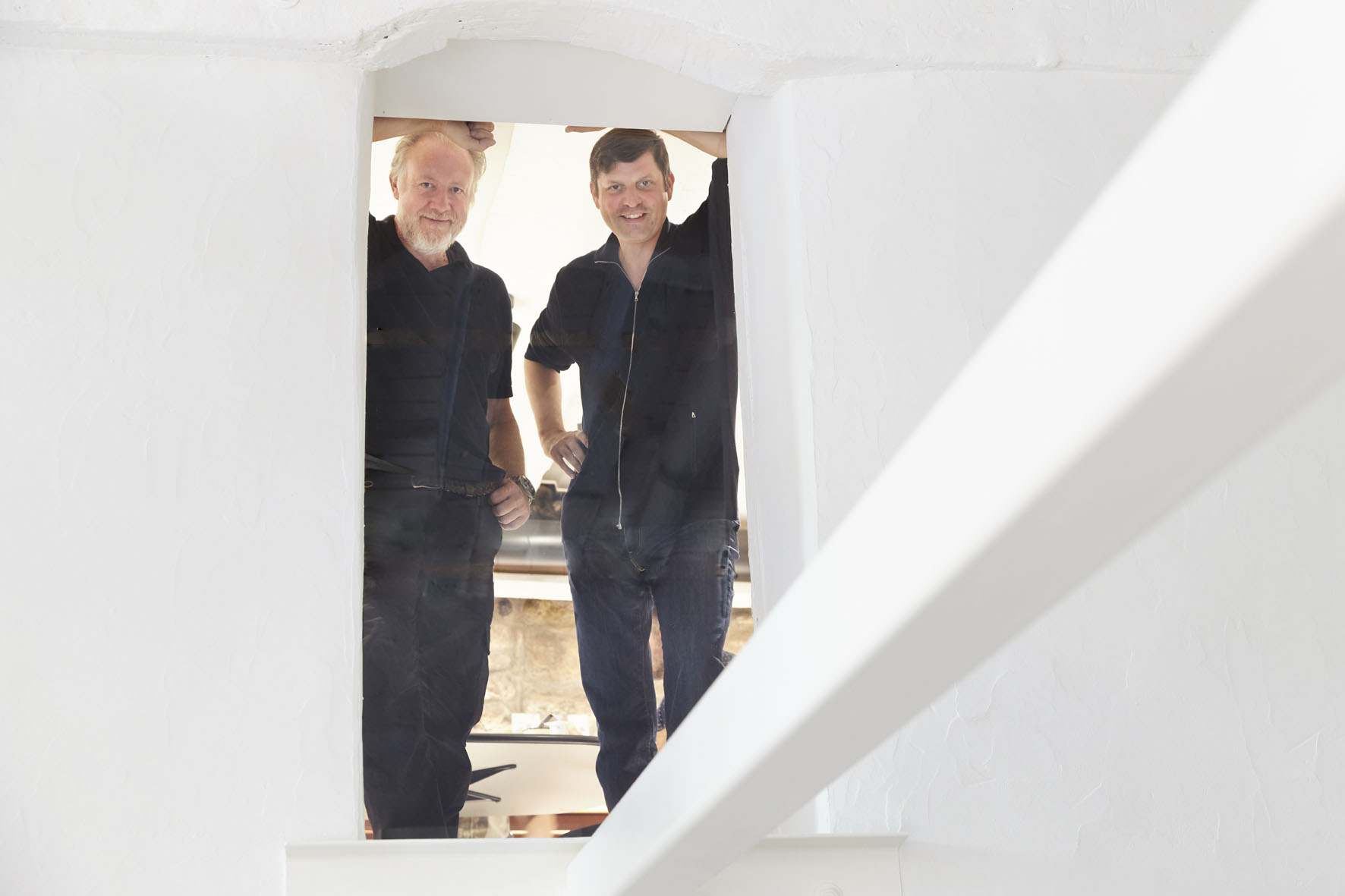
Urwerk was founded two years later, in 1997, with the aim of designing and manufacturing haute horlogerie pieces that fused tradition and futuristic vision. And here we come to Mesopotamia. In their choice of name, Baumgartner and Frei merged the name of the ancient city of Ur – where the Sumerians first observed the conjunction of celestial bodies with the seasons, thus developing the first time measurements – and the German verb ‘werk‘, which means to work, to create, to evolve, to shape, to forge and to arouse emotions.
But in German, Ur is also a prefix meaning ‘ancient’, ‘original’, ‘primitive’. Baumgartner and Frei thus play on the double level of history and linguistics, emphasising how their brand, despite the extreme modernity of mechanics, materials and design, cannot ignore an ancient and primitive conception of time. A historical vision that they translate into avant-garde forms and solutions, creating that bridge that connects past and present, just as it connects Ur and Geneva.
WANDERING HOURS IN URWERK’S DNA
What has distinguished Urwerk since its inception is the complication of the so-called ‘wandering hours‘, an indication of time that takes place not by means of classical hands but through the use of rotating discs bearing the hours, which, with the continuous rotation of the discs on different axes, mark the time by marking a semicircle with the minute scale.
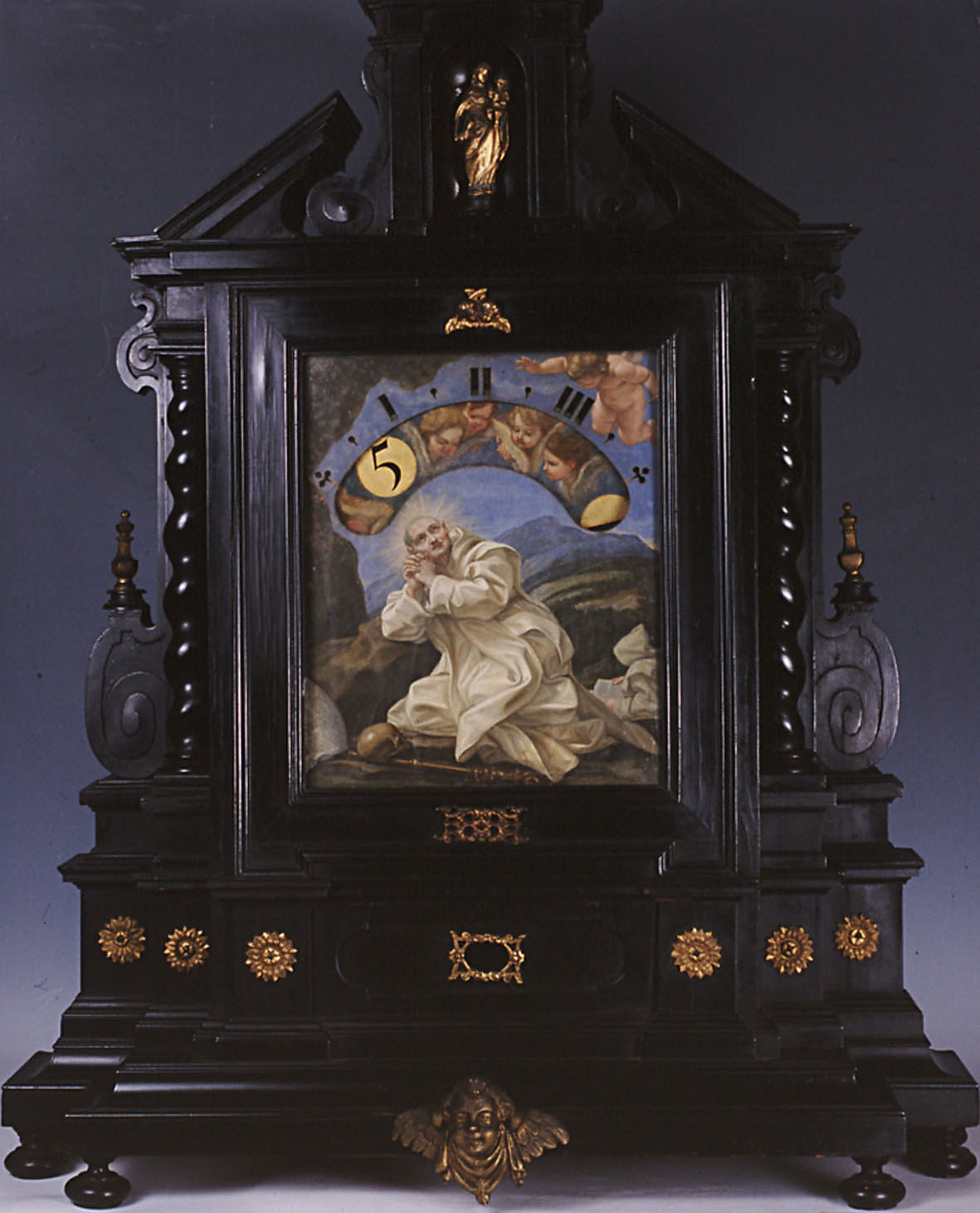
The wandering hours is a complication whose genesis is entirely Italian and dates back to the mid-seventeenth century. At the time, Pope Alexander VII commissioned the Umbrian brothers Matteo, Pier Tommaso and Giuseppe Campani – famous creators of optical instruments – to build a prototype clock with an escapement that was not noisy and allowed the hours to be seen in the dark.
The Campani brothers replaced the hands, whose escapement was anything but silent, with rotating discs indicating the hours by marking a semi-circle with an engraved minute scale, illuminated from behind with an oil lamp. Felix Baumgartner learned watchmaking in his father’s workshop, which restored some of the world’s most important historical clocks, including the Campani brothers’ night clock. It can therefore be said that this complication is truly ingrained in Urwerk’s DNA.
THE UR-SATELLITE COLLECTION
Urwerk’s wandering hours are primarily developed with a patented revolving satellite complication. The hours are in groups of four, presented on rotating arms (or satellites) in a three-pronged carousel. The satellites are truncated pyramids with each side presenting a number and an angle of 85°, so that the time can be seen without rotating the wrist.

In the brand’s UR-Satellite collection, this complication uses satellites with different variations: telescopic hands, retrograde minutes, planetary gears, calendars. There is no lack of other collections with alternative displays to the wandering hours, employing linear indications or indications reminiscent of a car’s odometer, but the display of the time by means of satellites remains Urwerk’s true trademark.


A complication that has evolved over time and in aesthetics, as the watches featured in this article demonstrate: the UR-100V LightSpeed, the UR-120 AKA Spock and the UR-150 Scorpion.
UR-100V LIGHTSPEED
Let us go in numerical order and start withthe UR-100V LightSpeed. A watch that, as its name suggests, combines the function of time indication with rotating satellites with a ‘cosmic’ dimension, at the centre of which lies the dynamics of the speed of light within the solar system. The UR-100V LightSpeed unites time, space and light, in one single place.
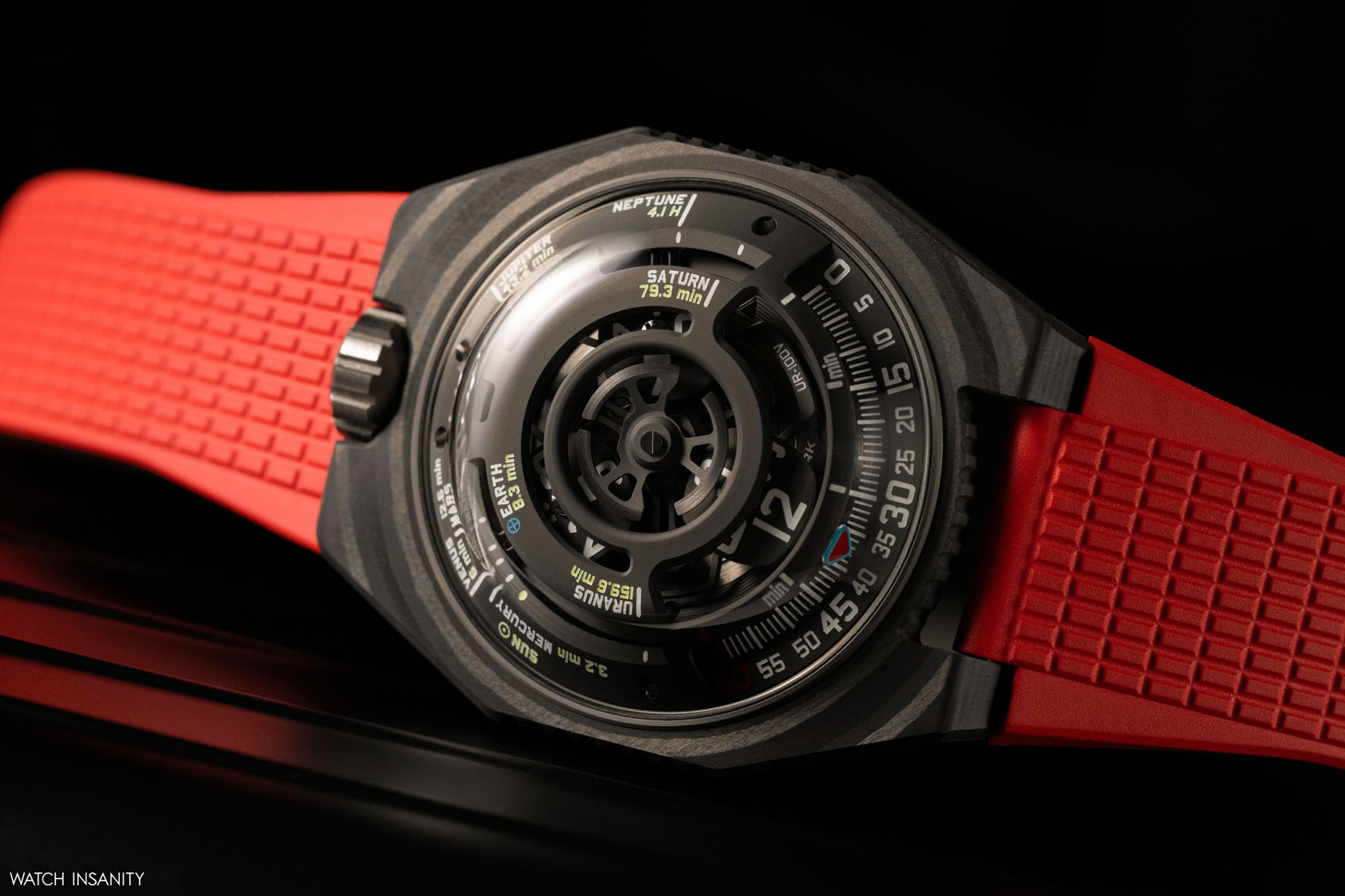
The UR-100V LightSpeed houses a 3D planetarium in its case, showing eight celestial bodies in our solar system, eight landmarks. Starting with the Sun, Baumgartner and Frei calculated and illustrated the time it takes for a ray of light to reach each of the planets from our star: Mercury in 3.2 minutes, Venus in 6, Earth in 8.3, Mars in 12.6, Jupiter in 43.2, Saturn in 79.3, Uranus in 159.6 minutes and Neptune in 4.1 hours.
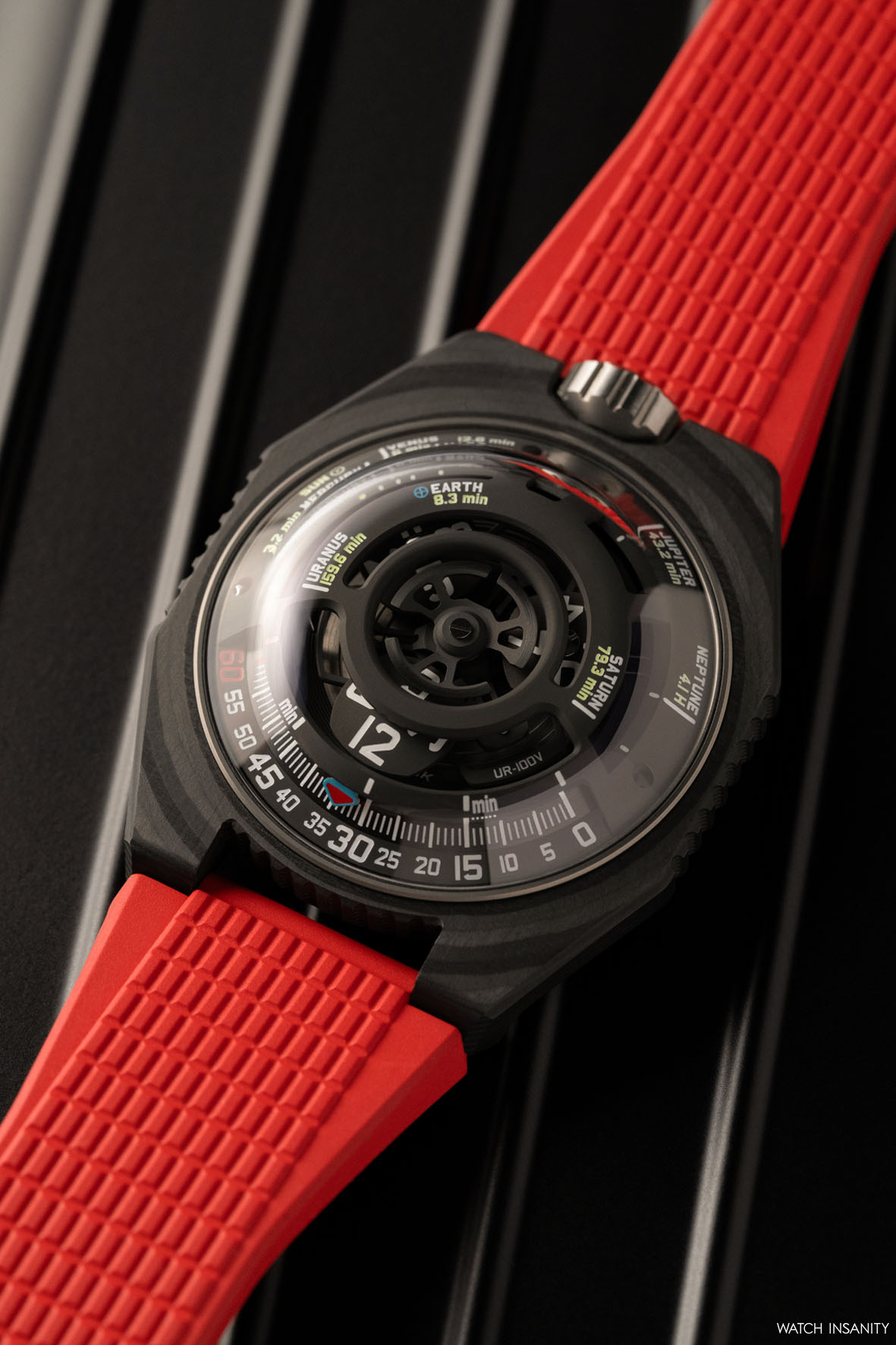
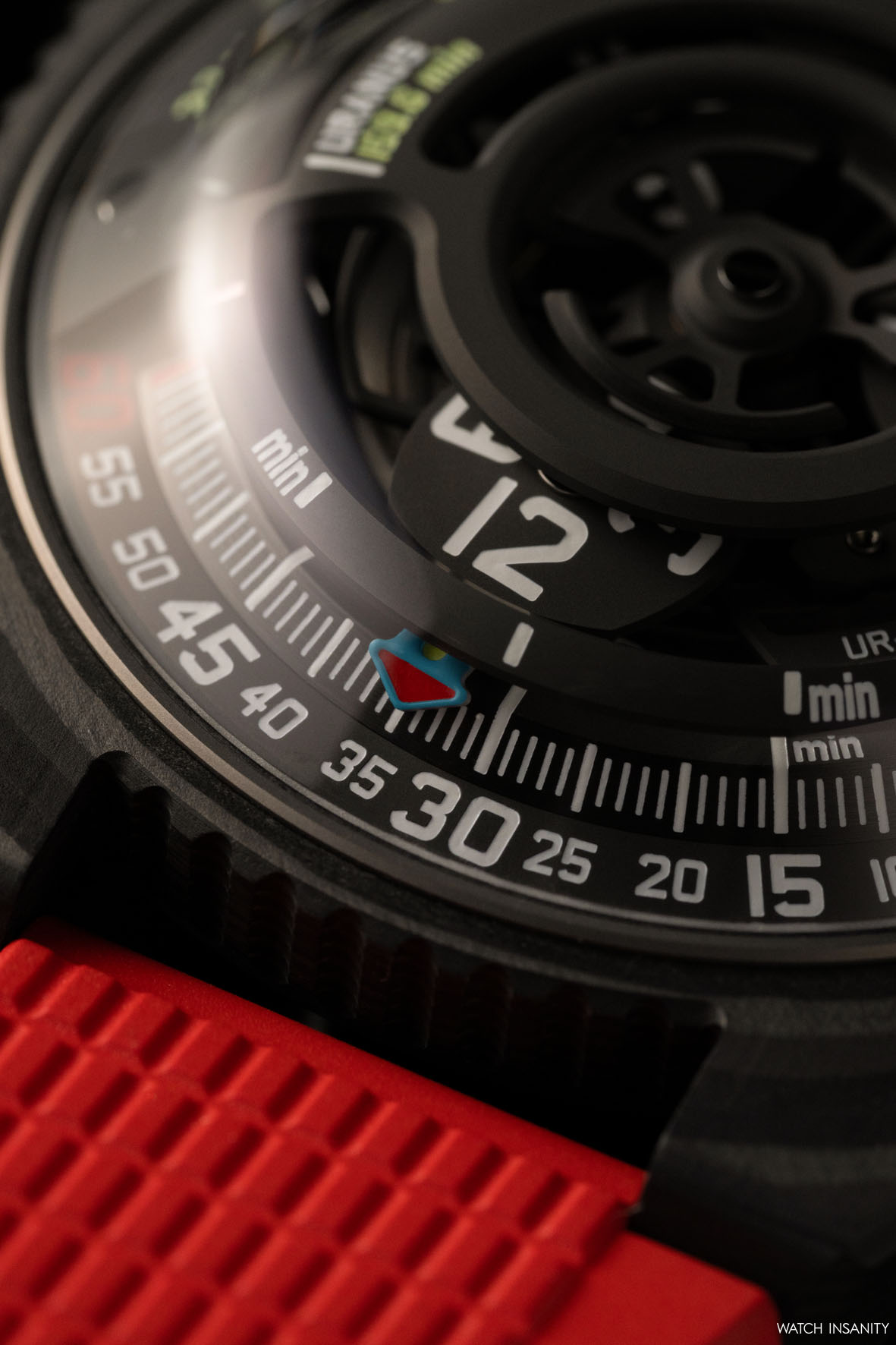
Each of these times is shown, together with the name of the planet, on the planetarium in the quadrant. The starting point, the Sun, is placed at 10 o’clock and the lengths are identified by a yellow and blue indicator, visible through a slit running around the upper part of the dial, where the names of the planets can be seen. At the bottom, the UR-100V LightSpeed takes up the principle of displaying hours and minutes based on the absence of hands. Instead, a rotating satellite indicates the hours and moves along a 120-degree arc, with a scale indicating the minutes identified by a red pointer. When an hour satellite has covered its 60 minutes, the next one, bearing the next hour, appears in front of the minute index, which returns to zero and resumes its course.
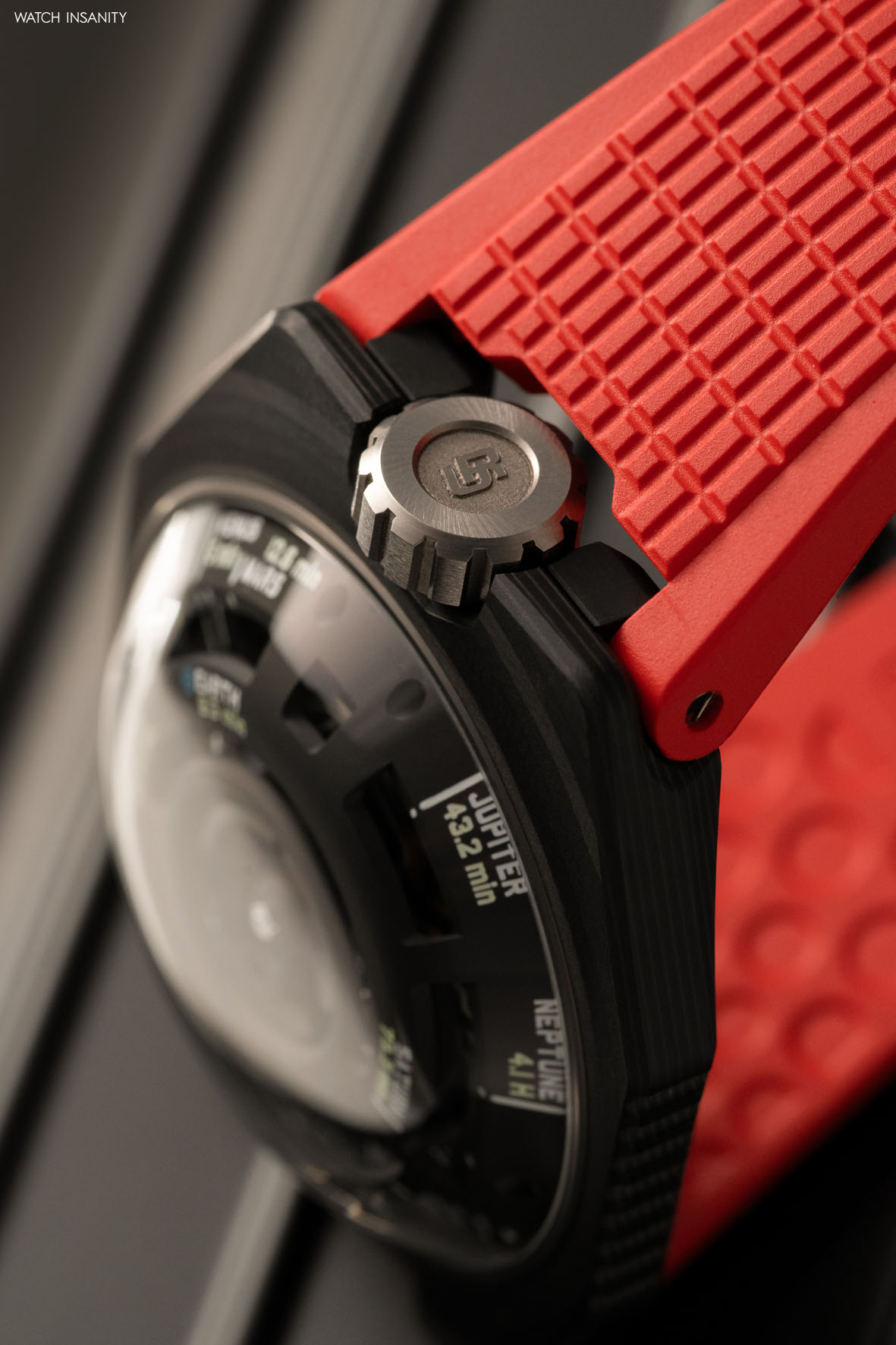
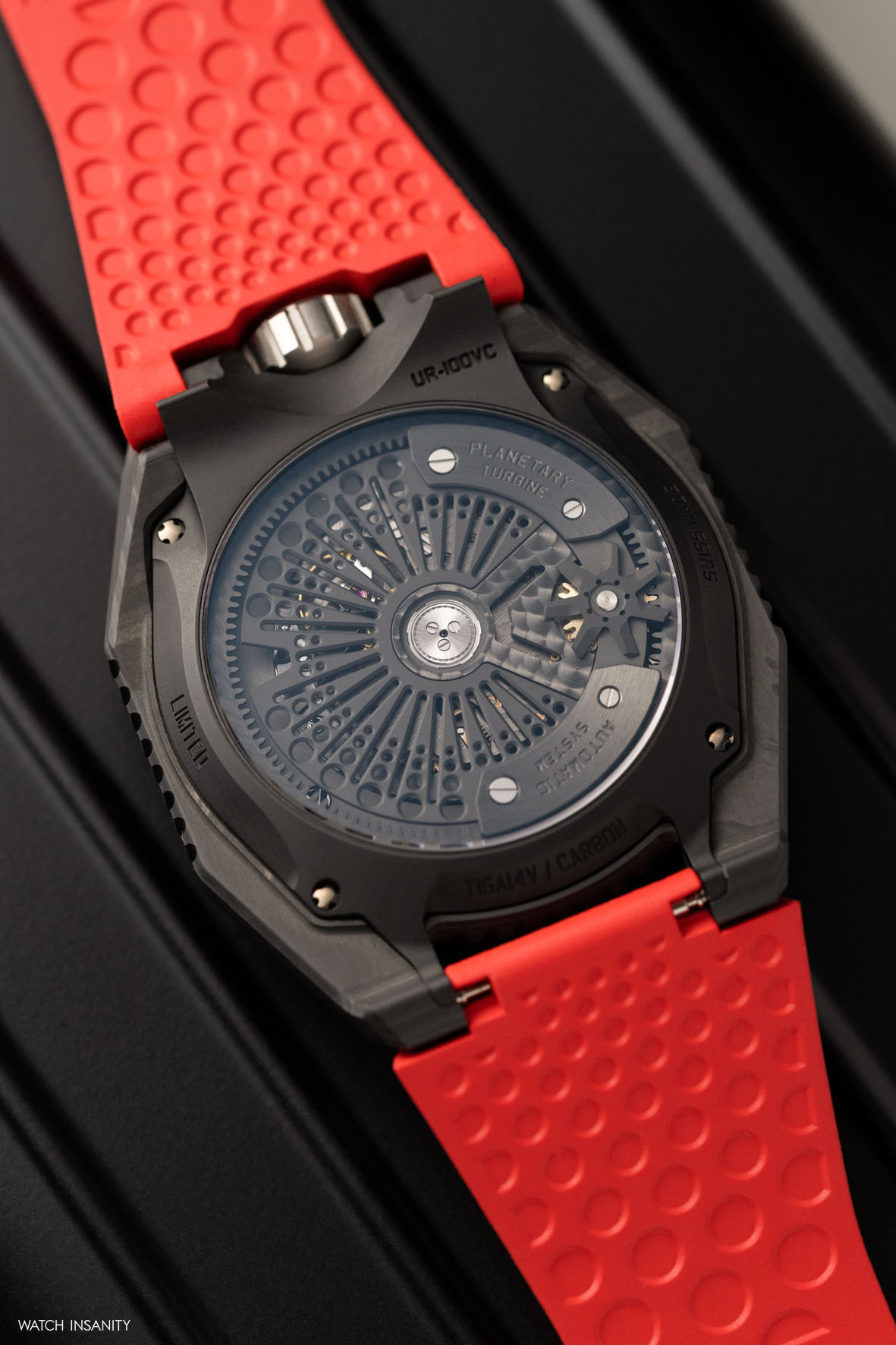
This mechanical machine is animated by the UR 12.02 manufacture automatic movement, with 28,800 vibrations per hour and 48 hours of power reserve. The radiating shape of the aluminium rotor, treated in black PVD and visible through the sapphire crystal caseback, is a reference to the Sun, our galaxy’s engine. The case, water-resistant to 5 bar, is made of 54-layer black ThinPly carbon and is 43 mm wide by 51.73 mm long, with a thickness of 14.55 mm. Attached to the very short lugs is a textured rubber strap with a folding clasp. The screw-down crown is an extra detail that contributes to the water resistance, not at all a given for a watch like this.
UR-120 SPOCK
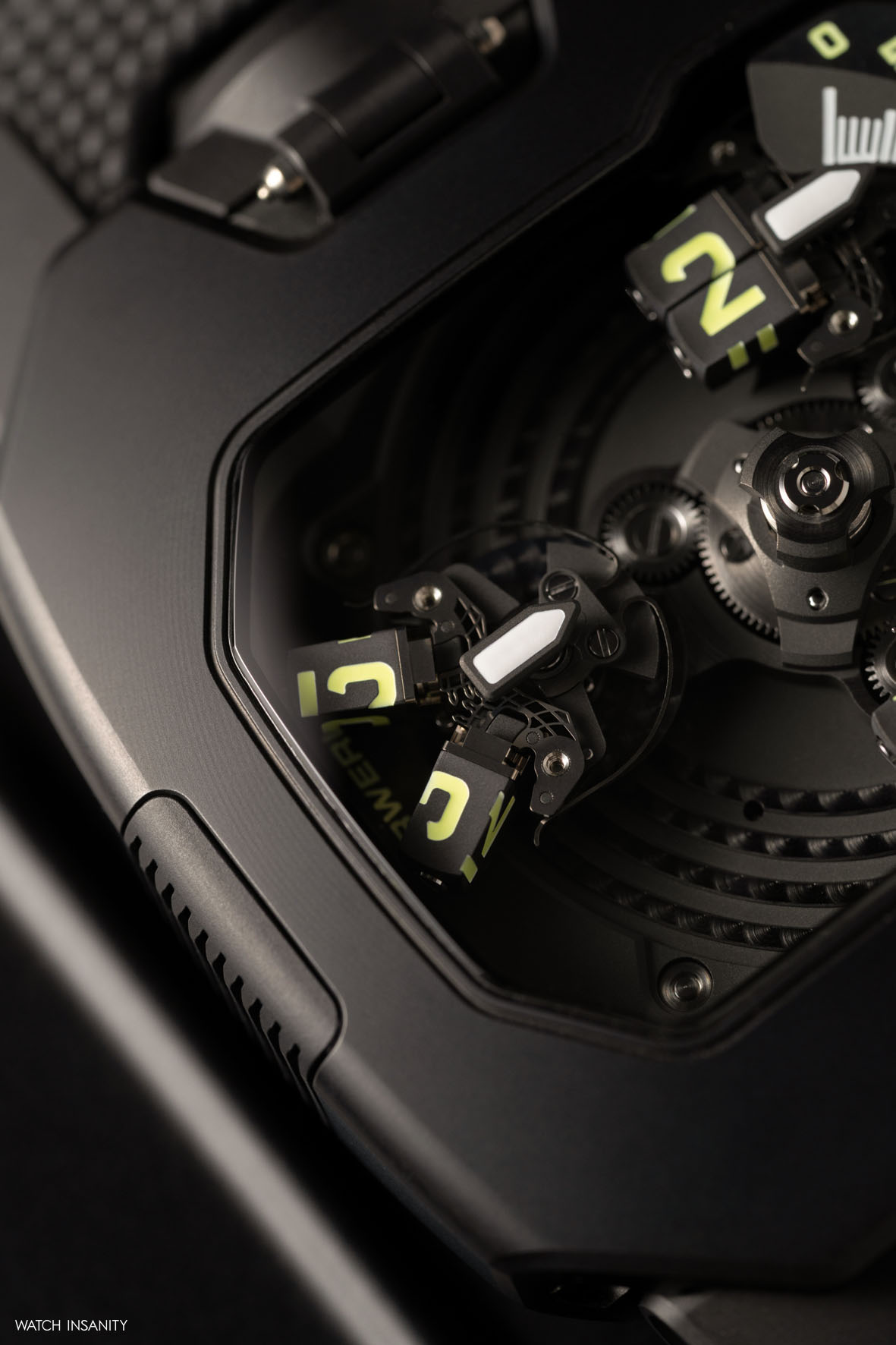
Still more ingenious, if even possible, is Urwerk’s interpretation of wandering hours on the UR-120, named Spock in honour of the famous Star Trek character. A nickname deriving from the spectacular display of the hours through the rotating satellites, each of which shows the hours by reproducing the greeting of theVulcans, the people to whom Dr Spock belongs: little finger and ring finger joined together, separated from the middle finger and index finger joined together as well. The whole forming a V.

A prodigy made possible by the automatic UR-20.01 calibre, which drives the central carrousel with three arms, each bearing a satellite at the end. On all four faces of this satellite is an hour indicator. When it comes out of the minute track – which is on the dial on the right – and reaches the left-hand side, it activates a lever that controls the change of the satellite’s face. It opens, revealing two rectangular studs, which take on a V shape, thus recreating the Vulcan salute. Once separated, both studs rotate on their own axis and join together, to show the new time unit: the number is in fact split in half between the two studs which, joined together, recompose the graphic layout.

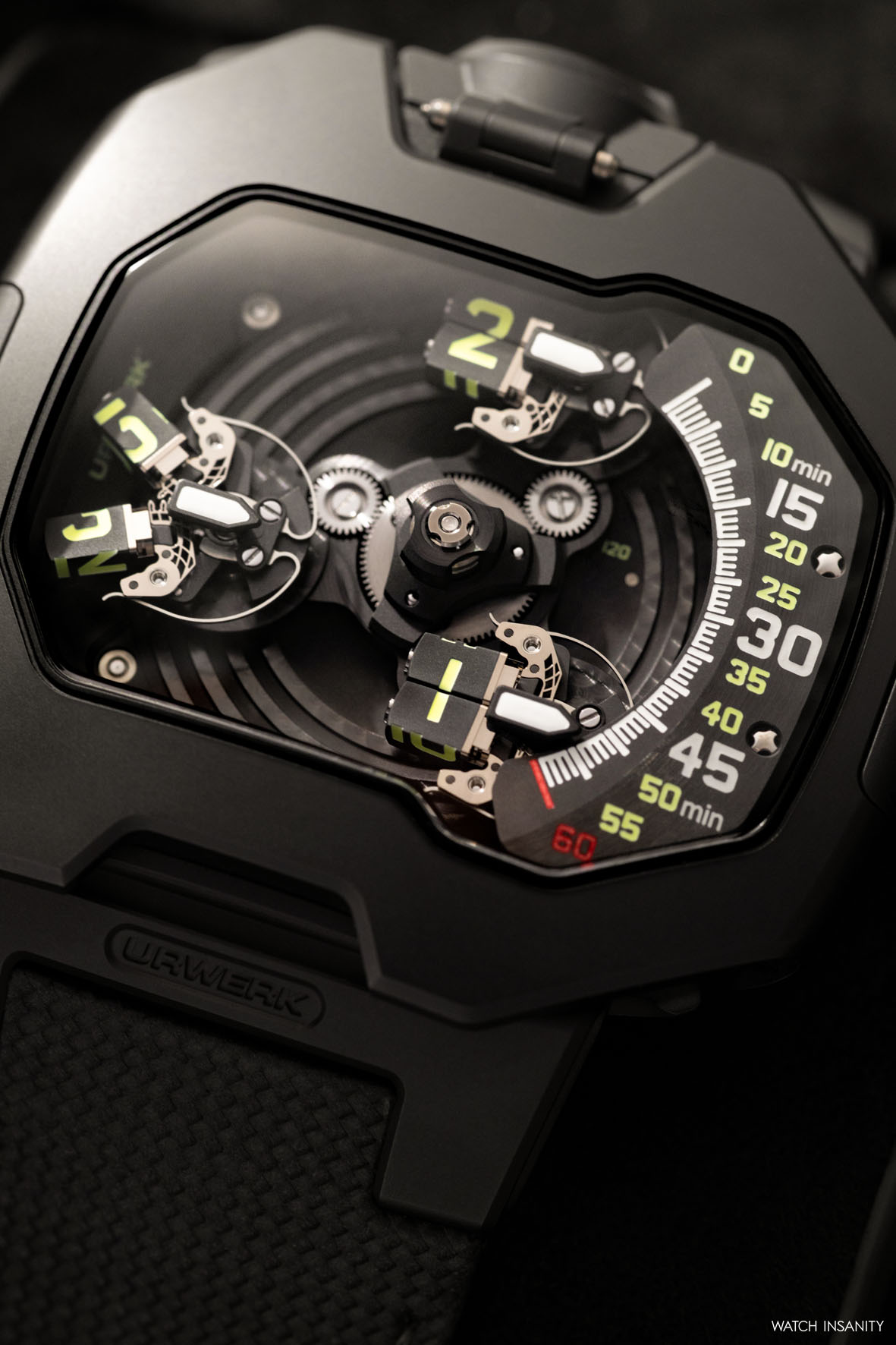
The movement of the UR-120 Spock thus performs a triple revolution: the satellite carousel rotates on a central axis, each satellite counter rotates to remain upright – and thus readable – and each stud rotates on its own axis. The other aspects of the time display remain typical of Urwerk: the carousel of satellites moves along the minute scale, located on the right side of the case; the visible face of the satellite and the paired pointer indicate the hours and minutes, respectively, on that scale.
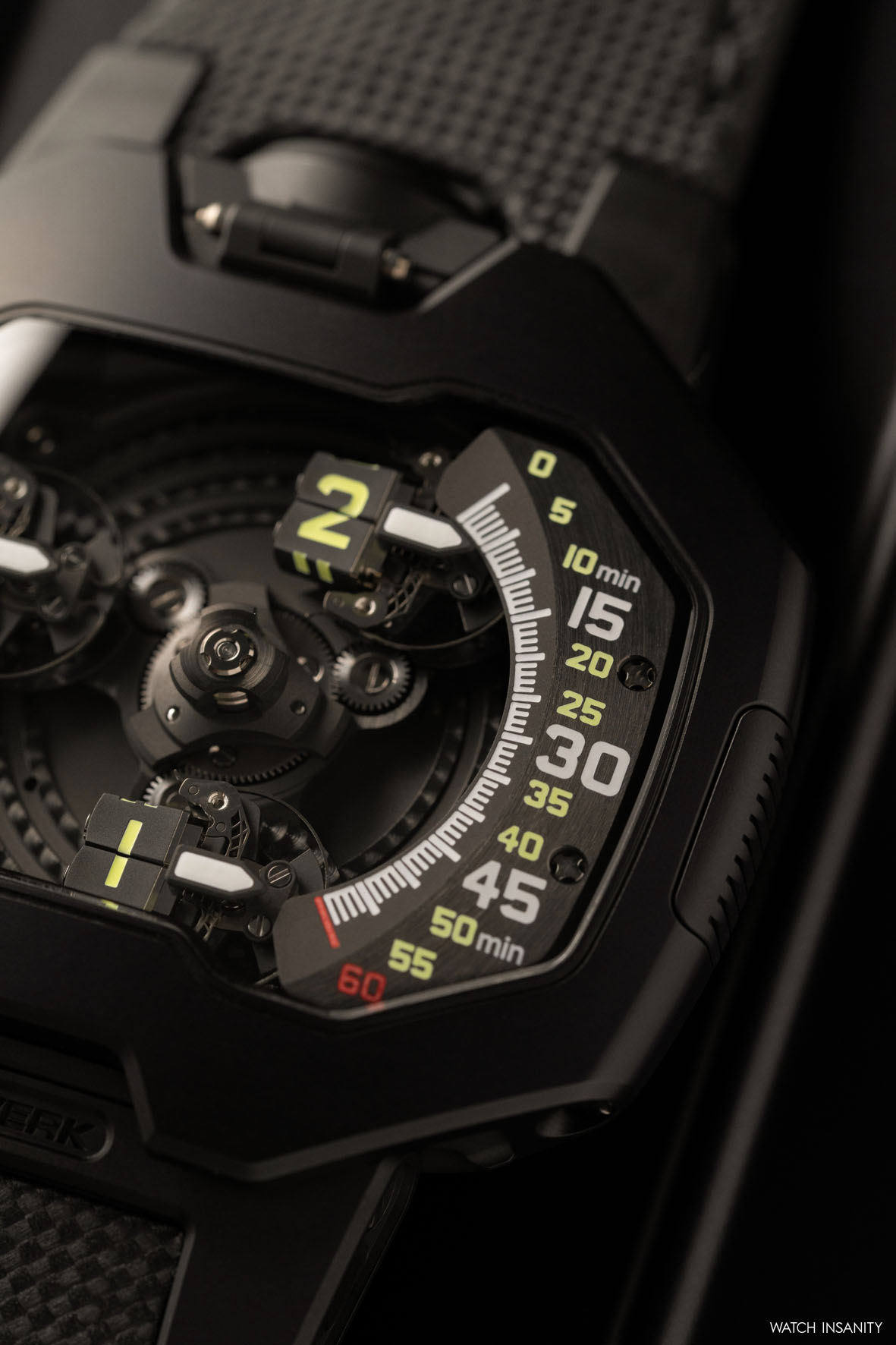
The watch case is made of steel and sandblasted titanium, is asymmetrical and has generous dimensions: 47×44 mm, with a thickness of 15.8 mm. To create it, Martin Frei was inspired by Gerald Genta’s lesson, that is the construction of an interconnected lower and upper part. This is what happens inthe UR-120 Spock, whose parts in question are the bezel (in steel) and the back (in titanium). The design of the latter is interesting: at 3 o’clock there is a small window that allows one to see the pneumatic Windfänger screw, the star-shaped component that regulates the intensity of the automatic winding; at 9 o’clock there is the Urwerk monogram; in between there is an elegant deep-set fluted design.
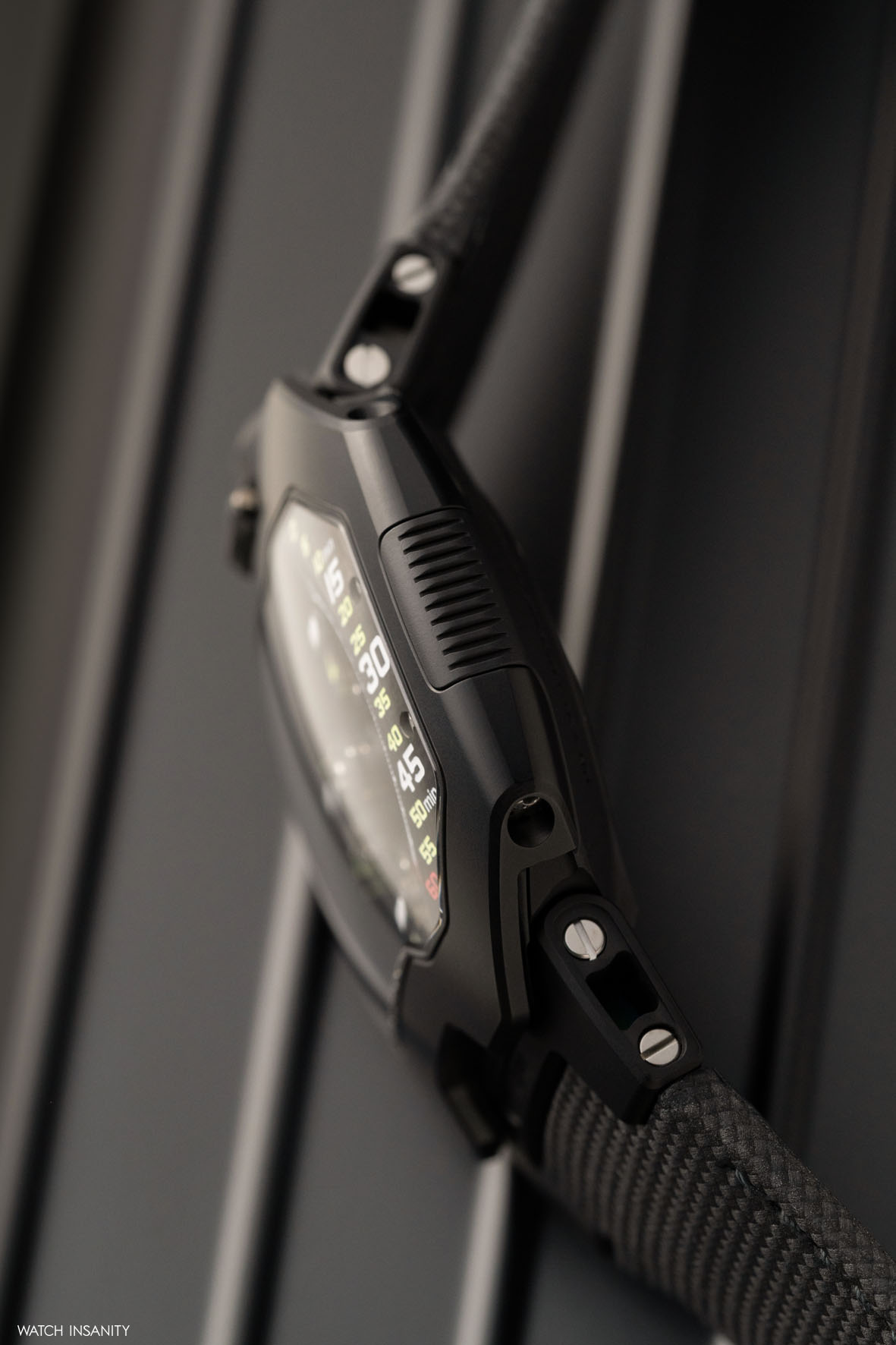
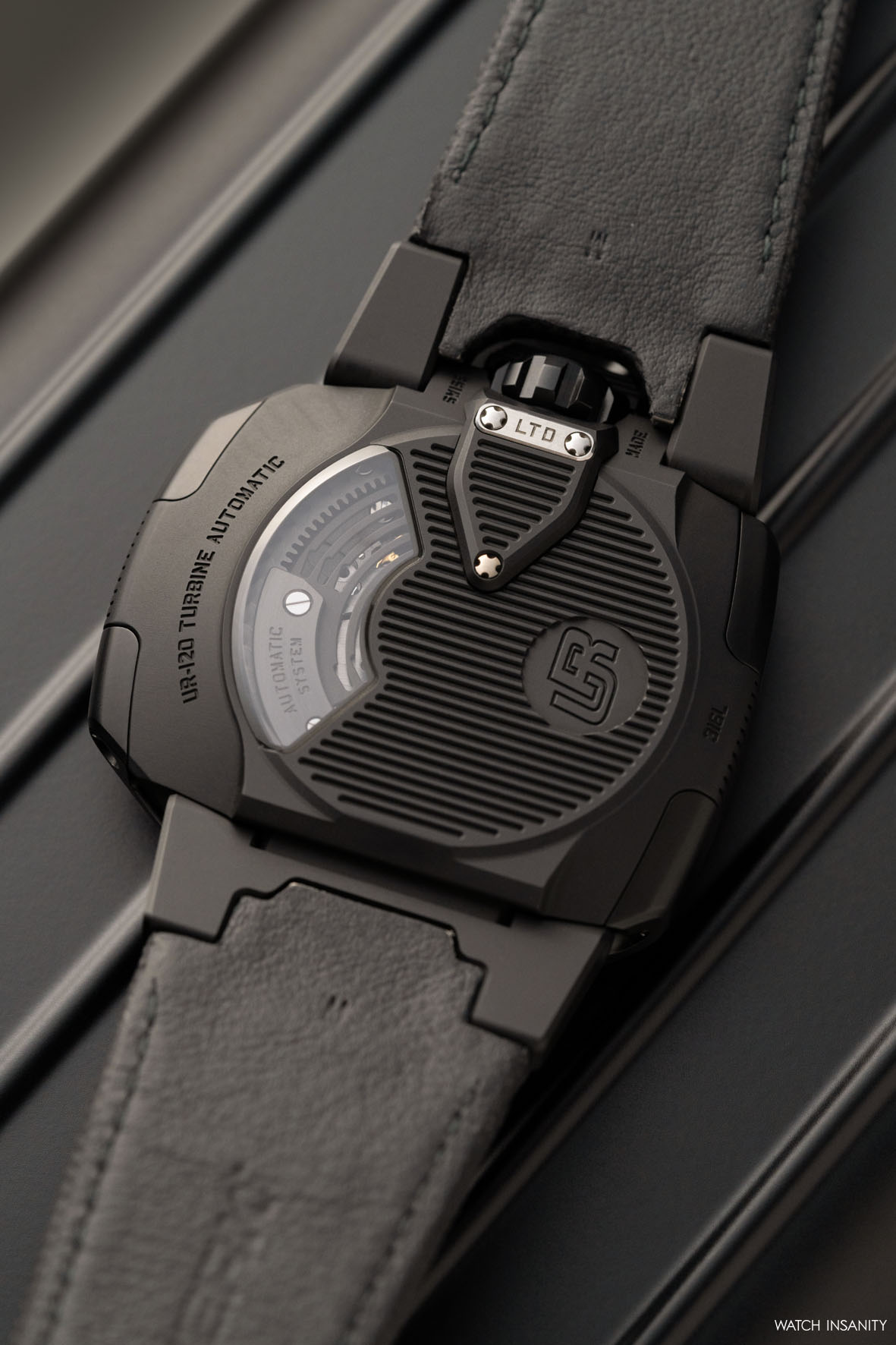
A further element of fluidity is provided by the presence of floating lugs, a rarity in Urwerk creations; inside the one located at 6 o’clock (at 12 o’clock is the crown), there is a spring that facilitates the strap’s fit on the wrist. The material of which it is made is another novelty for Urwerk. Instead of the traditional technical fabric, the manufacturer has chosen calfskin, with an embossed pattern reminiscent of woven nylon, but offering superior comfort and flexibility. The floating lugs make the 120 one of the most comfortable Urwerks on the wrist, despite its size.
UR-150 SCORPION
With the UR-150 Scorpion, wandering hours find further expression. Starting with the large skeleton minute hand that frames the hour, whose tip moves over the 240-degree arc of the retrograde display minute track. At the stroke of 60 minutes, in fact, the hour hand returns to zero thanks to the click of a spring, and the hour satellites each rotate 270 degrees to indicate the new hour: all in just one hundredth of a second.

On this watch, the technical challenge is precisely the arc of the chapter ring, which is not the usual 120-degree arc but a 240-degree arc. Optimising the available energy is essential to maintain a perfect isochronism between the click of the hand and the rotation of the satellites. In fact, the UR-150 Scorpion features Urwerk’s most ambitious retrograde system ever, employing the largest weights ever used by the brand, for more intense speed and inertia. This was achieved thanks to a speed regulator mounted on the UR-150’s flywheel, a mechanism normally used to regulate the chime sequence of a minute repeater. In this way, the return of the retrograde hand is smoother.
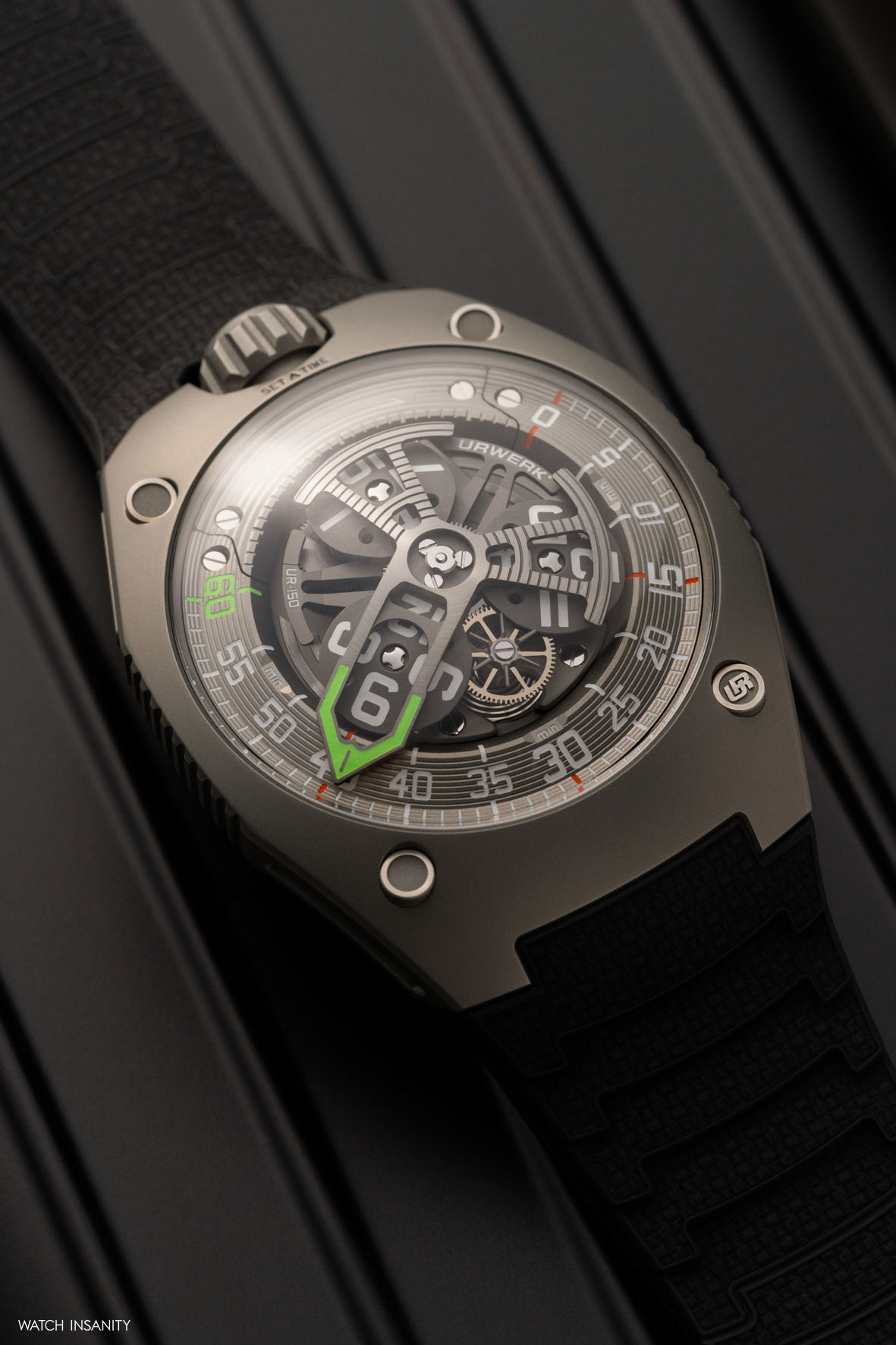
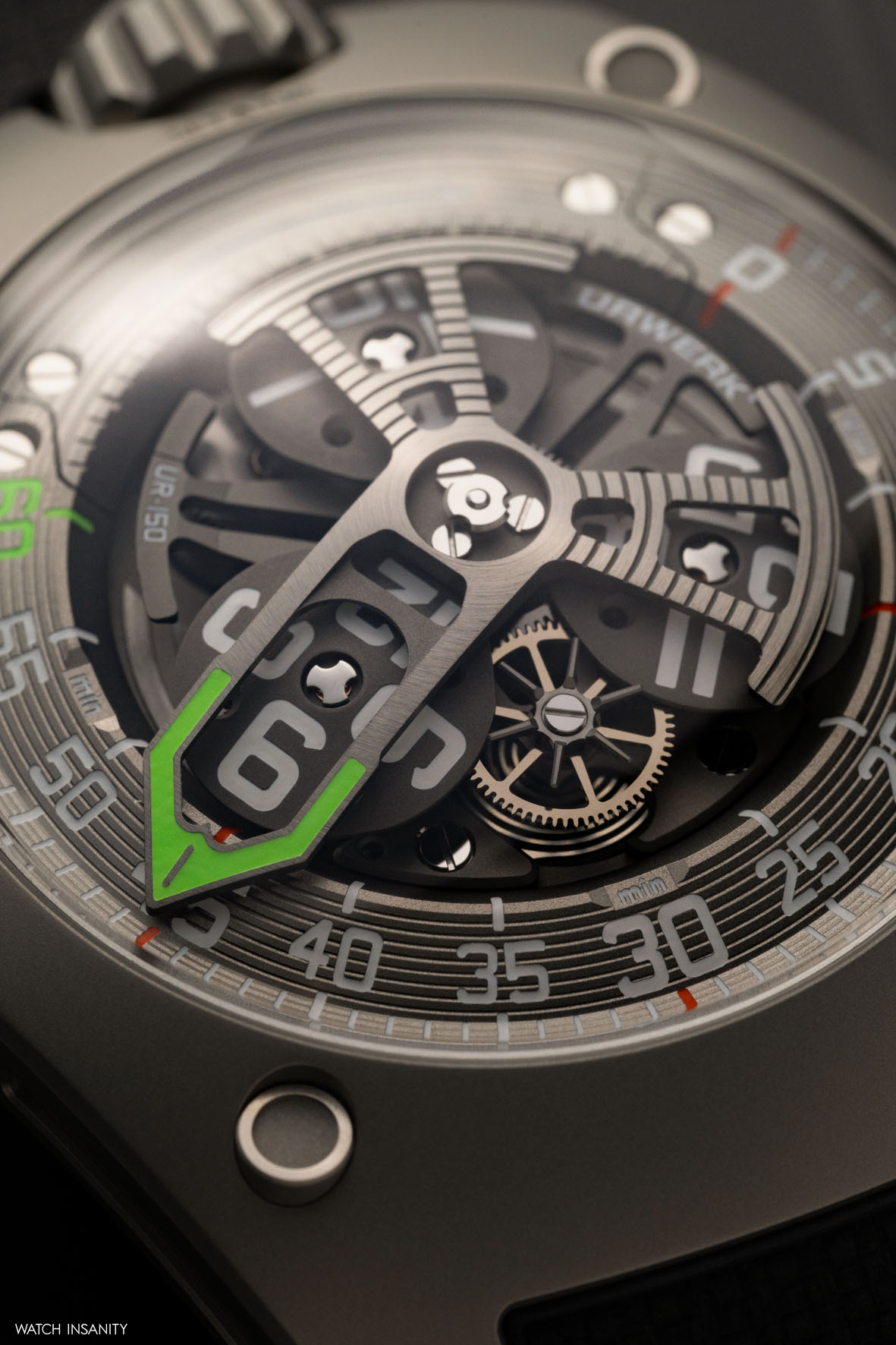
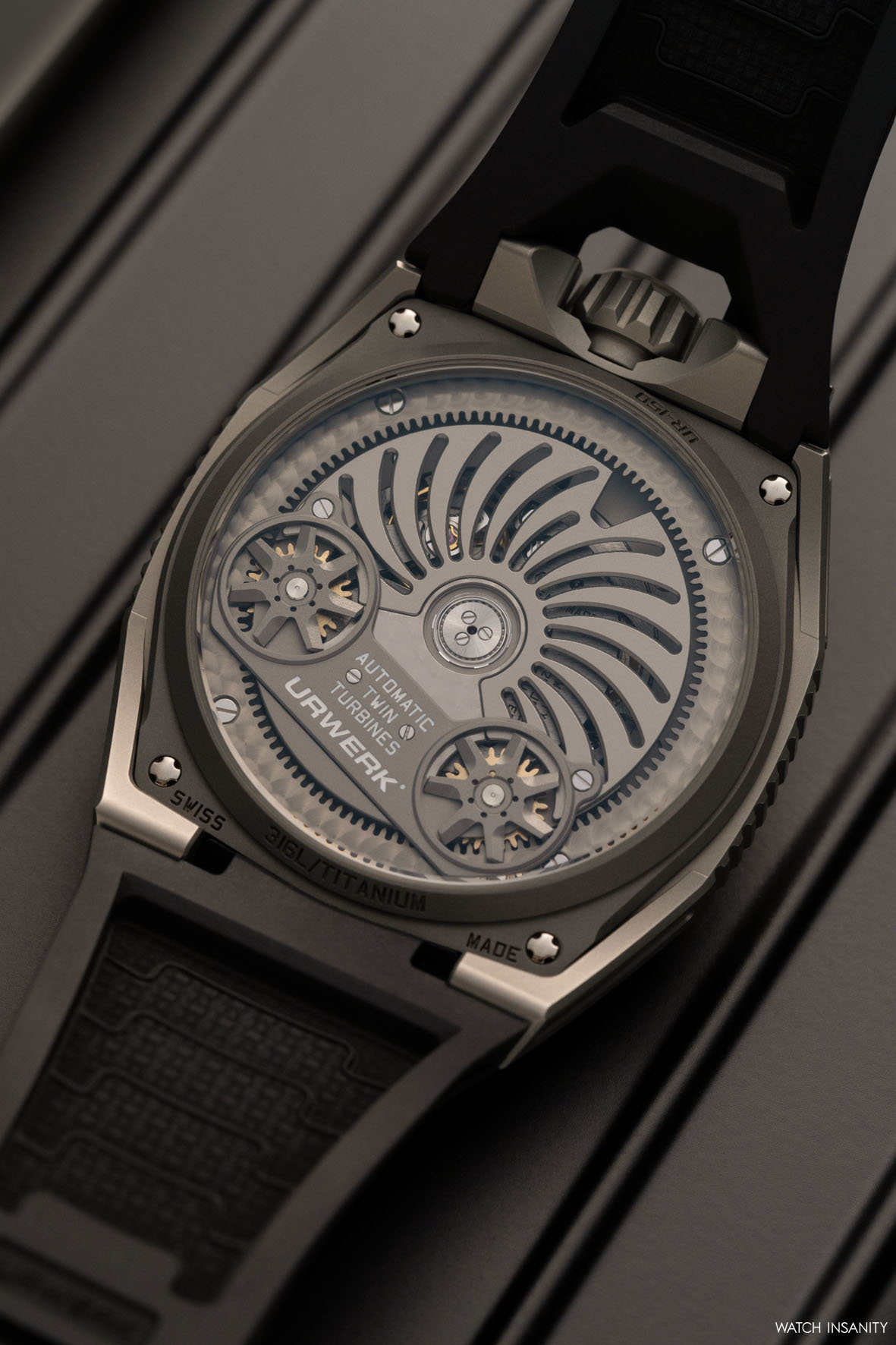
This is thanks to the work done by Baumgartner on the watch movement, the UR-50.01 calibre with 28,800 vibrations per hour and 43 hours of power reserve. A slightly shorter power reserve than the other movements in the collection, despite the fact that the winding system is one of the UR-150 Scorpion’s many innovative features. Equipped with a double series of turbines, it regulates the speed of the rotor and offers unprecedented energy and resistance to shocks, preventing them from affecting the pivot. The great energy required by the retrograde hand on 240 degrees, however, means that the winding range is more limited.
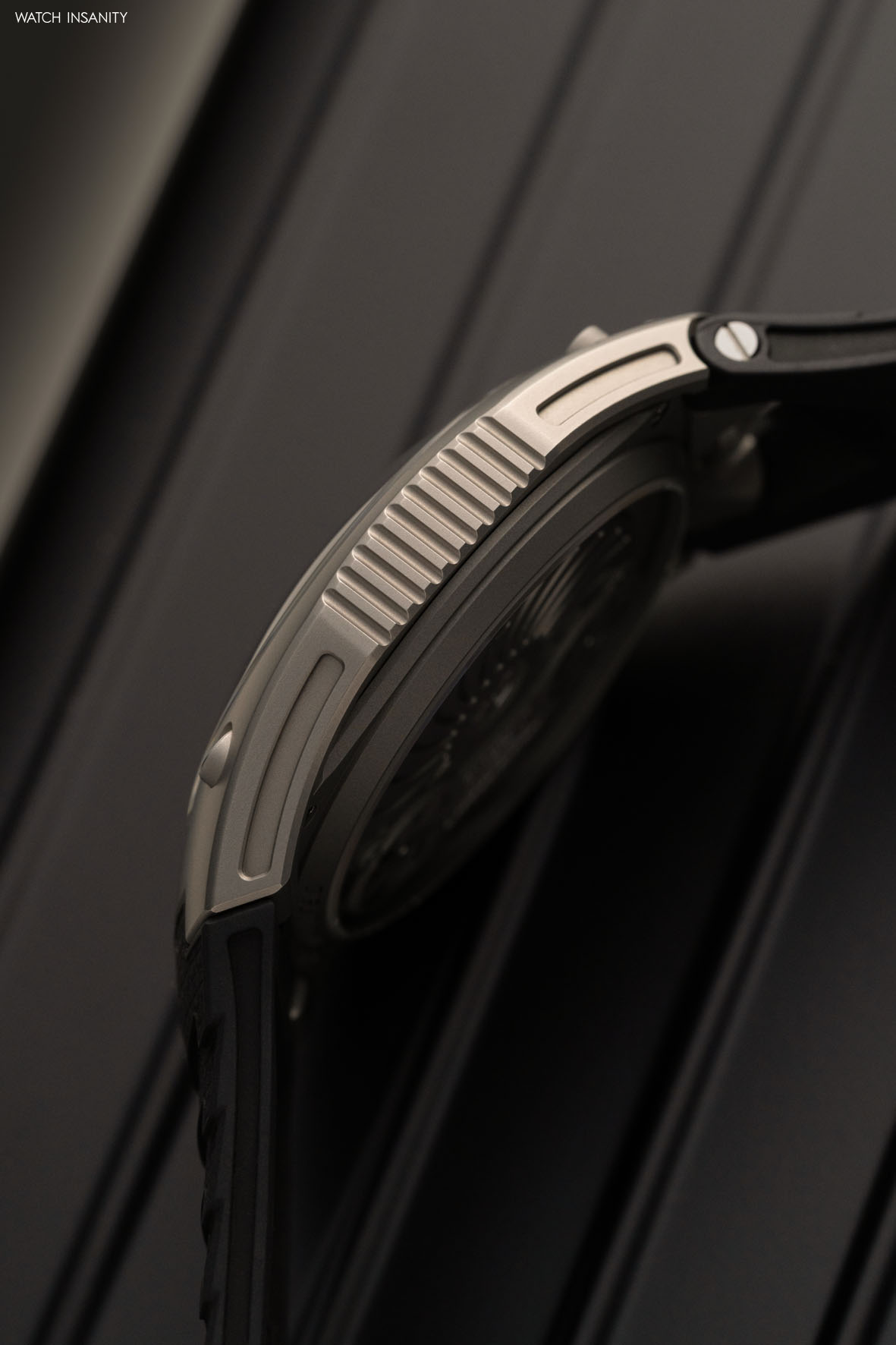
The 42.49×52.31 mm case, 14.79 mm thick, is made of titanium and steel (there is also a titanium-only Dark version), but the artistic touch on the UR-150 Scorpion lies in its ‘sting’: the curved minute hand that follows the profile of the case and sapphire crystal. Seen from the side, the UR-150 has an arched profile, with the case and glass extending from the curve of the bracelet along the same line, ergonomically hugging the shape of the wrist. The curvature extends beyond the case to the movement itself as the satellites and hour hand share the same sloping profile, making it possible to read the time without twisting the wrist. Without lugs, the watch is secured to the wrist by a rubber strap whose shape resembles that of a scorpion’s shell.

The trilogy described here is distinguished not only by its complication, aesthetics and innovation, but also by its price. The UR-100V LightSpeed costs EUR 69,490, the UR-120 EUR 117,600 and the UR-150 Scorpion EUR 94,080, excluding VAT.
By Davide Passoni