

“Independence is a state of mind”. Raymond Weil has chosen as its claim a phrase that precisely defines both its vision of the world of watchmaking and the place it occupies within it. For a manufacturer that will celebrate its half-century anniversary in a year’s time, sitting at the same table as century-old Maisons – often belonging to large financial or industrial groups – and proudly emphasising its independence is not just a façade. It is a declaration of intent.
Raymond Weil was founded in 1976 by the watchmaker of the same name. The year should not be underestimated: it was the height of the so-called “quartz crisis”, when Swiss mechanical watchmaking was in danger of disappearing under the onslaught of electronics, mainly from Japan. In that difficult context, in which many companies adapted to producing cheaper quartz watches, Raymond Weil remained true to its values, choosing to produce luxury mechanical wristwatches at a reasonable price. In 1982, Raymond Weil’s son-in-law joined the company and helped restructure, modernise and expand it into foreign markets. Even then, in promoting the brand, Raymond Weil emphasised the independence of a family-run business.
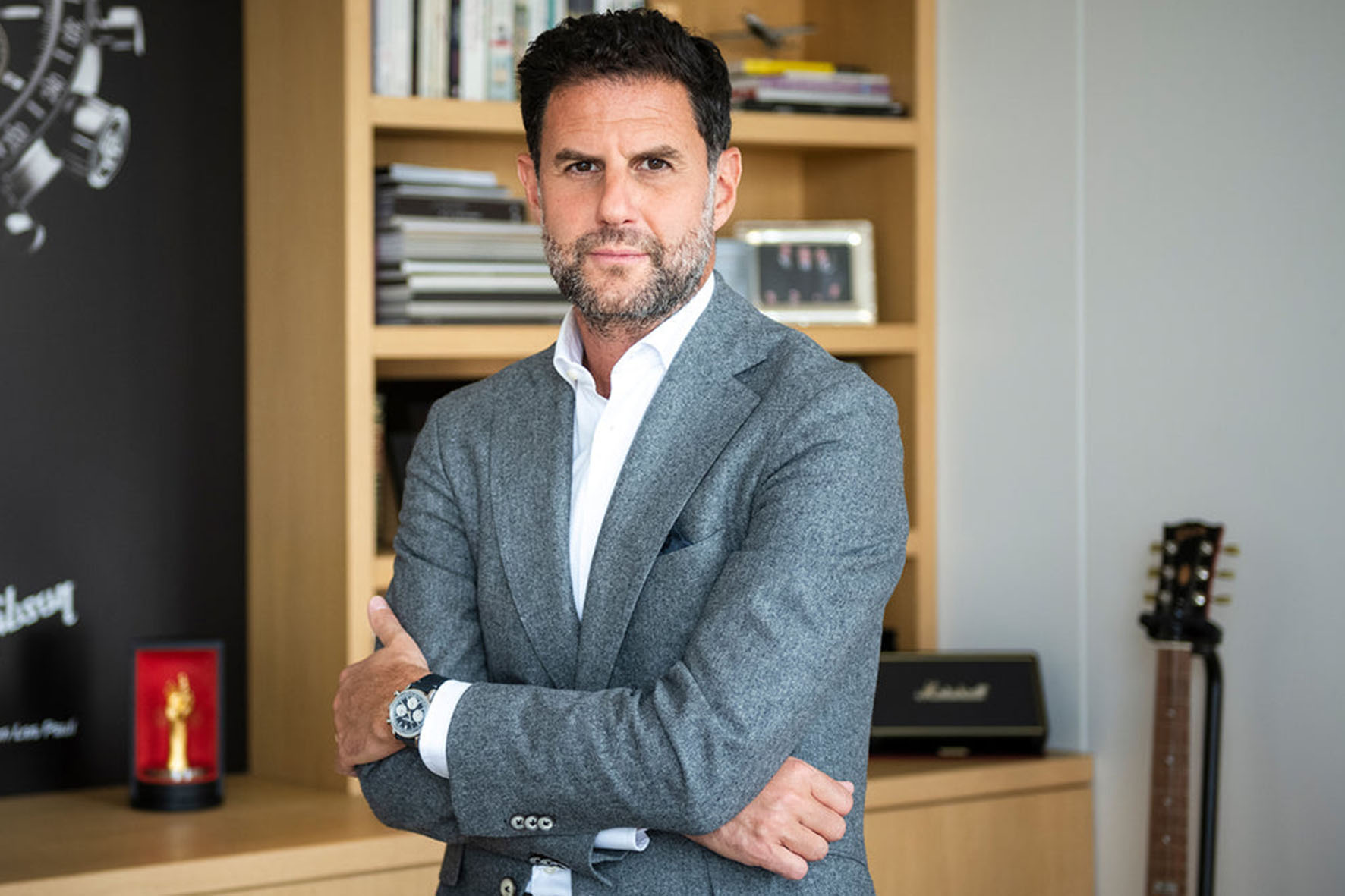
Towards the end of the 1990s, the manufacturer integrated a research and development department into its structure, allowing it to focus on optimising many internal processes. Thanks to this decision, new complications were developed, including the dual time-zone complication. In 2005, the third generation of the family joined the company’s management. Today, Raymond Weil remains one of the very few completely independent, family-owned and family-managed international watch brands. Led by Elie Bernheim, grandson of the founder, the Geneva-based Maison has steadily consolidated its status as one of Switzerland’s leading watchmakers thanks to its four collections: Freelancer, Toccata, Tango and Millesime.
RAYMOND WEIL MILLESIME, A COMPLETE COLLECTION
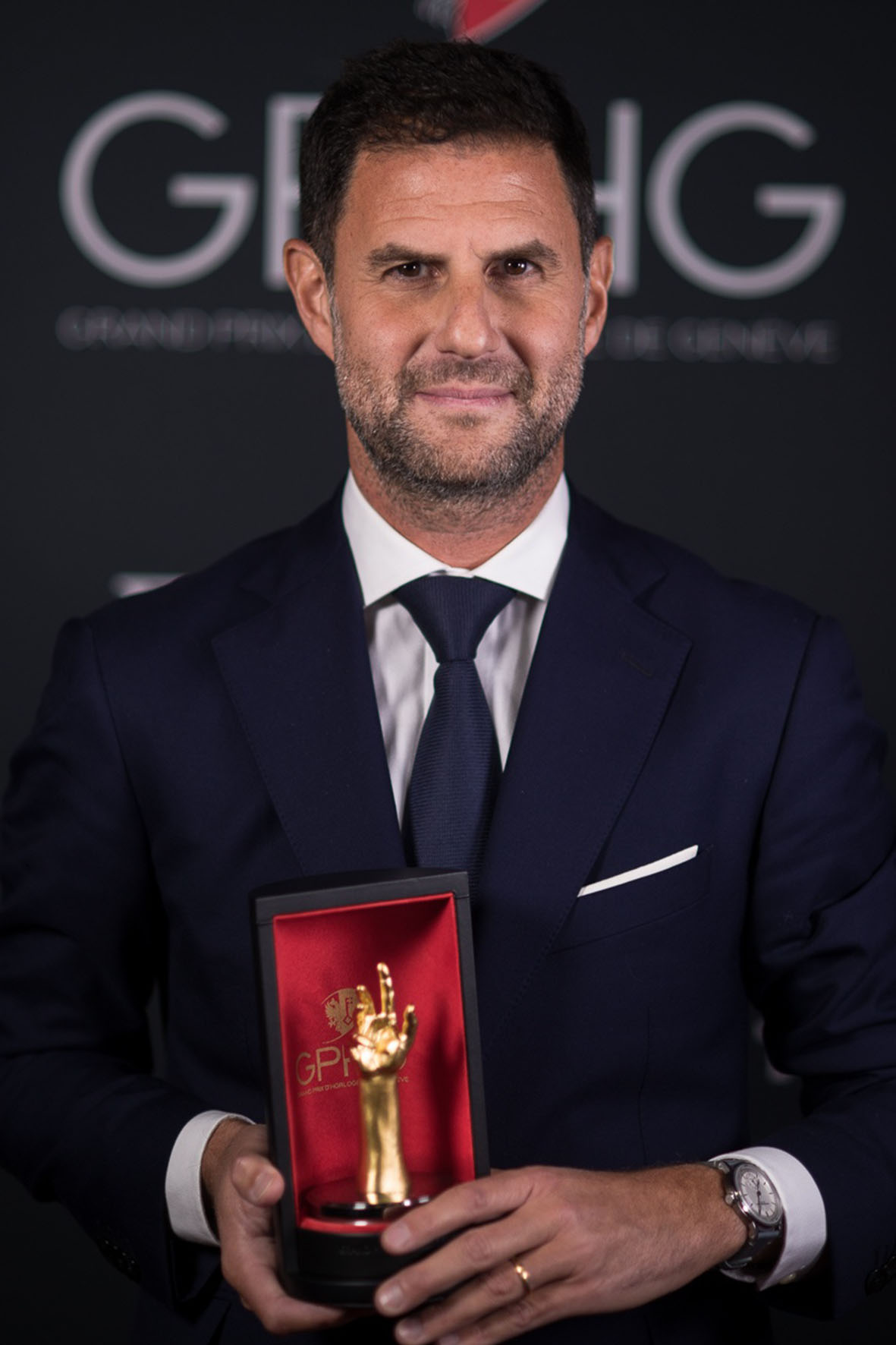
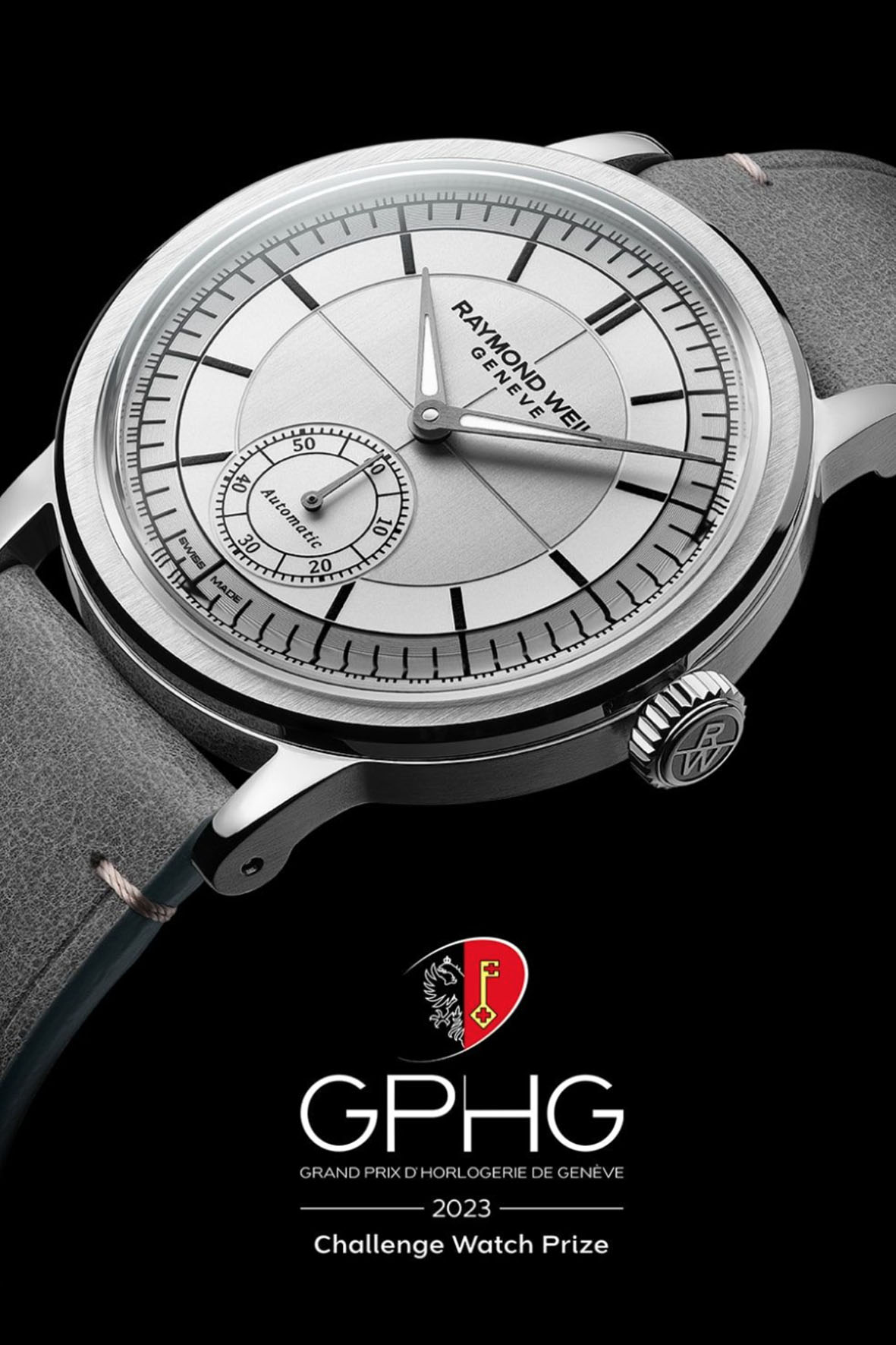
In this article and photo shoot, we focus on Millesime, a collection that is as classic as it is contemporary, with one major strength: its watches are both elegant and casual, effortlessly complementing any look. The Millesime collection is part of a tradition of Swiss watchmaking, crafted with meticulous attention to detail and offering excellent value for money. These characteristics earned the Millesime Automatic Small Seconds first prize in the “Challenge” category at the Grand Prix de l’Horlogerie de Genève in 2023. This is an important achievement, recognising Raymond Weil’s creativity in line with the emerging neo-vintage trend.
In fact, in its quest for innovation, the Manufacture does not limit itself to revisiting watchmaking classics, but actively explores new complications, materials and potential collaborations, showcasing a forward-looking approach that is consistent with its rich heritage. This is the inspiration behind the Millesime collection, which currently comprises four lines, all equipped with automatic calibres: Small Seconds, Central Seconds, Moon Phase and Chronograph.
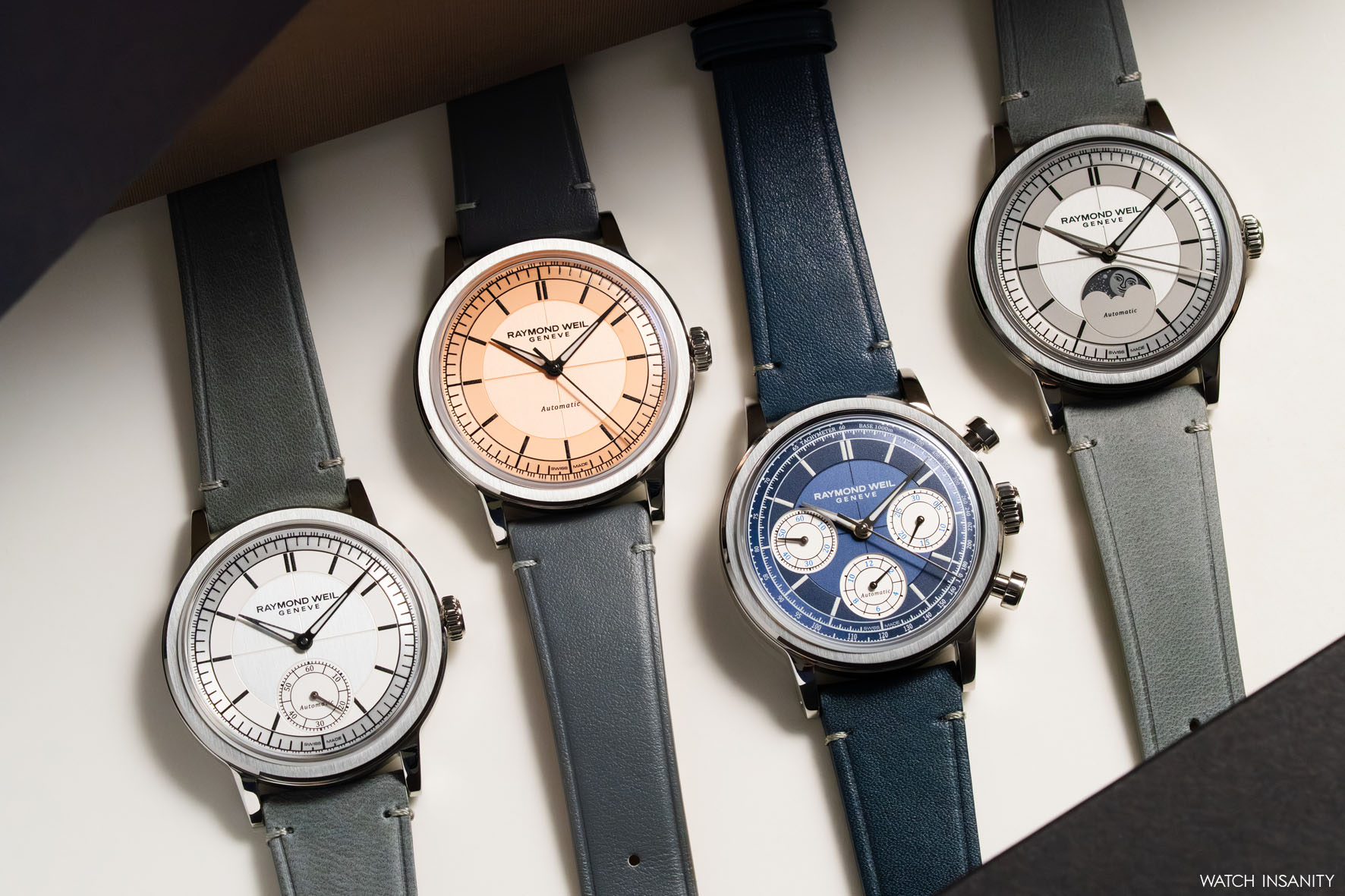
These are the stars of our exclusive shoot, for which we chose the 39 mm case references, as they are the most popular with enthusiasts and collectors and suit almost any wrist size. However, the Small Seconds, Central Seconds and Moon Phase are also available with a 35 mm case.
MILLESIME SMALL SECONDS
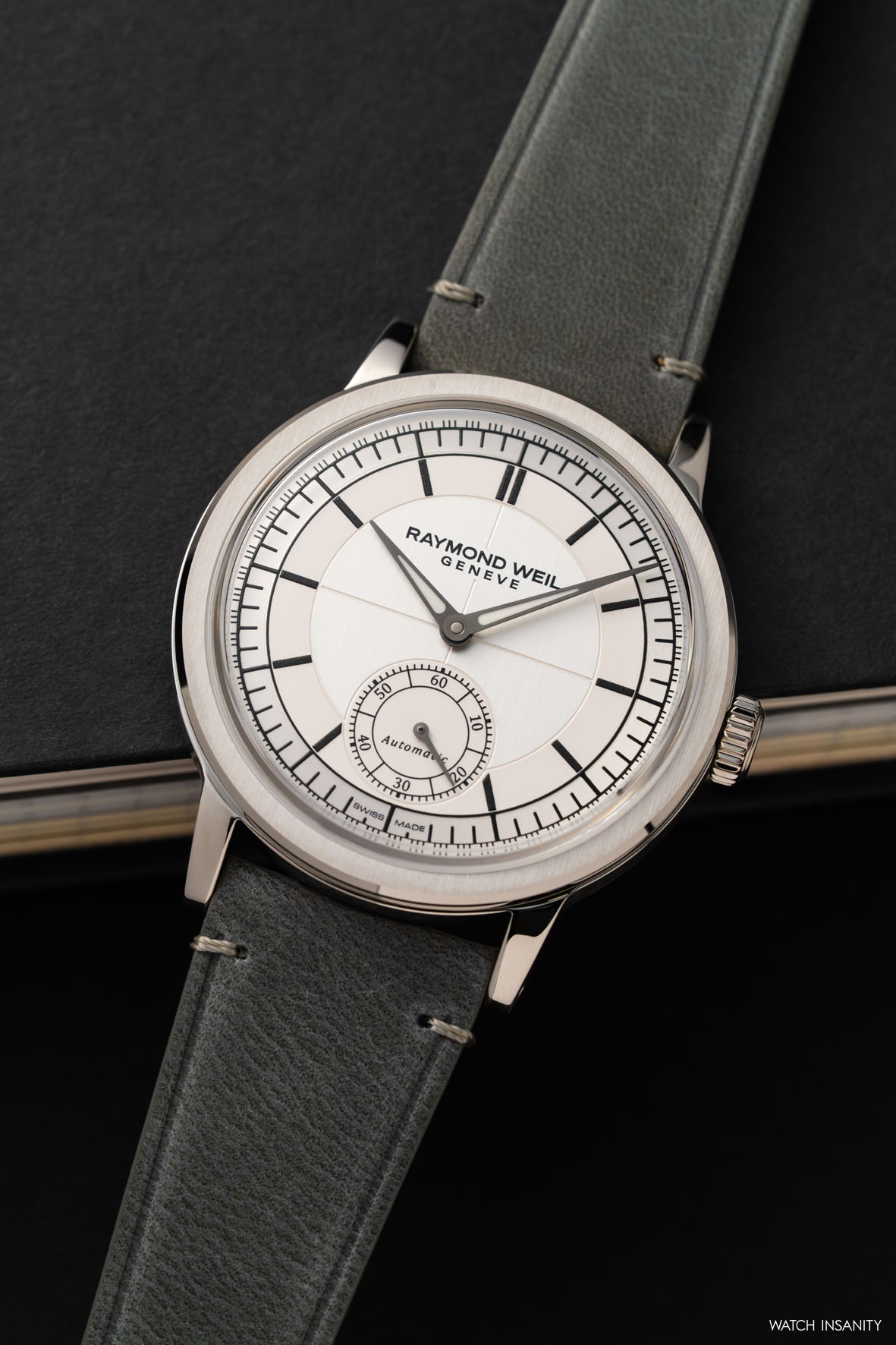
Let’s start with the Millesime Small Seconds with a silver dial, which brought Raymond Weil prestige at the GPHG 2023. What catches the eye is the balance and cleanliness of the shapes. Calling it neo-vintage aesthetics is perhaps an understatement, because in designing the Millesime Small Seconds, Raymond Weil has condensed the present, past and future, especially in the design of the dial and its finishes.
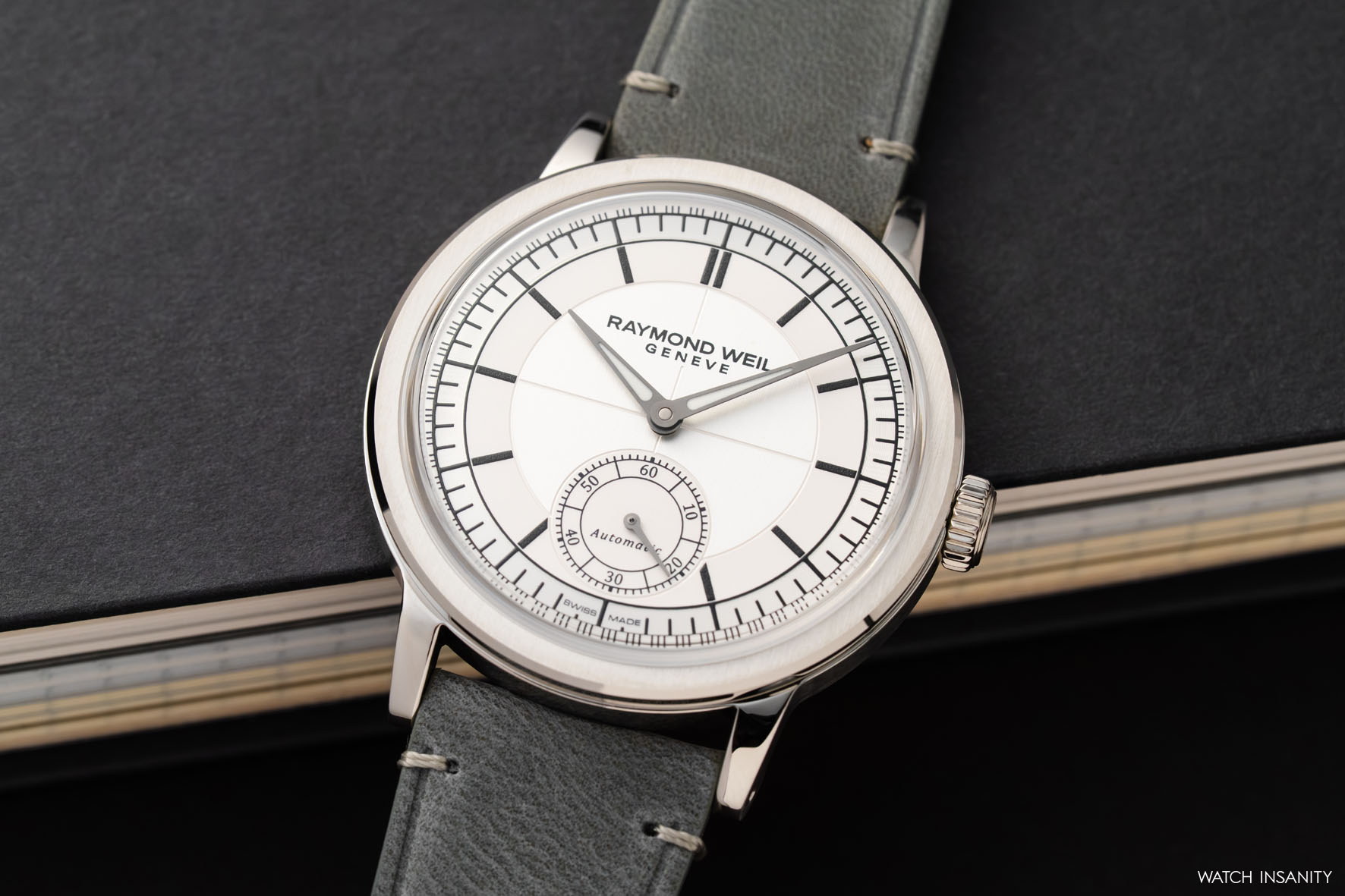
It is divided into three sections, each characterised by a particular type of finish. The central part, with a vertical satin finish, stands out from the smooth opaline small-seconds counter at 6 o’clock, which barely touches the minute track. The hour ring is also smooth, while the minute track, with the precision-seconds scale on the outer edge, has a concentric grooved finish. All this contributes to adding depth to the dial, improving legibility and playing with light.
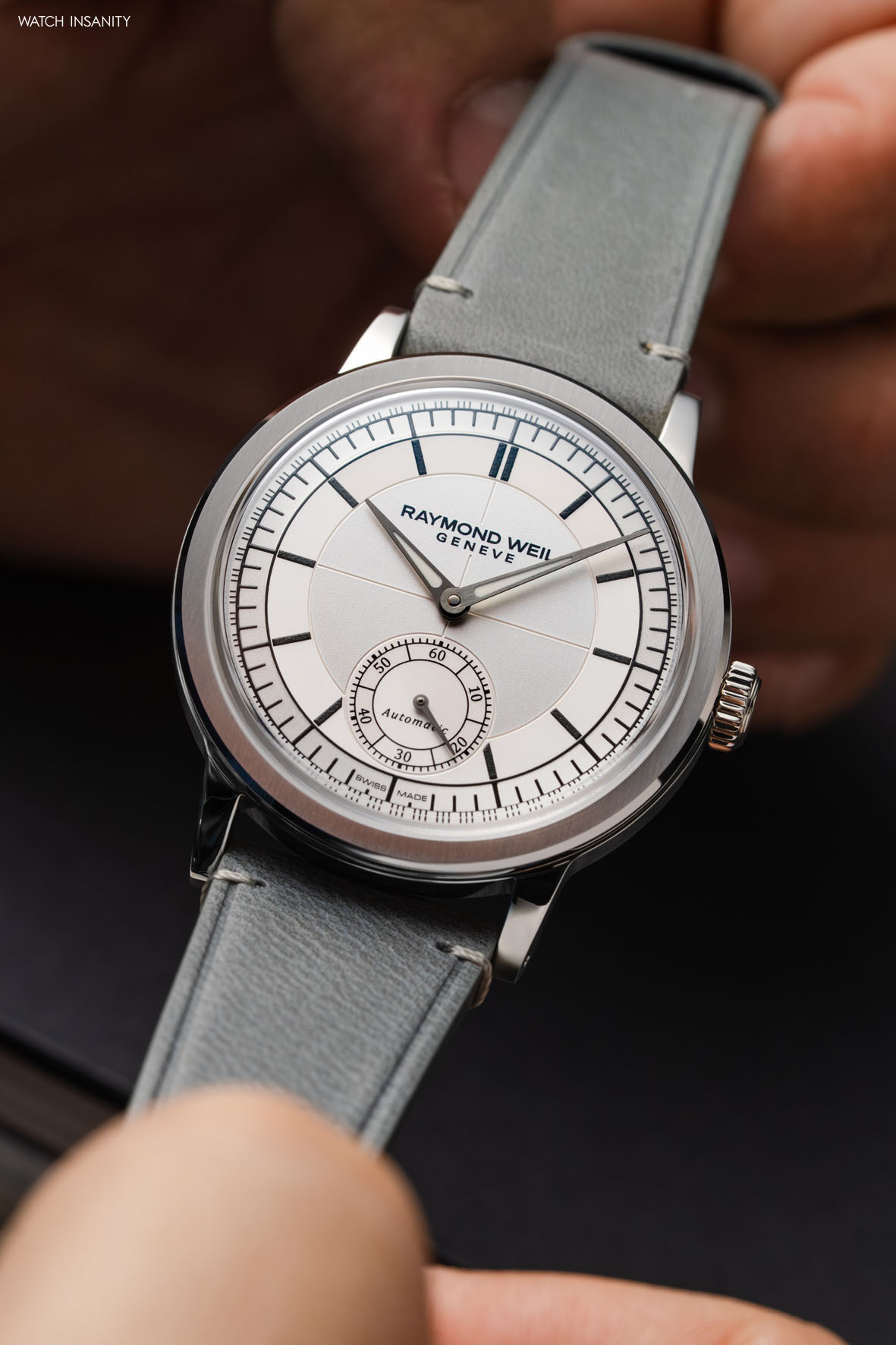
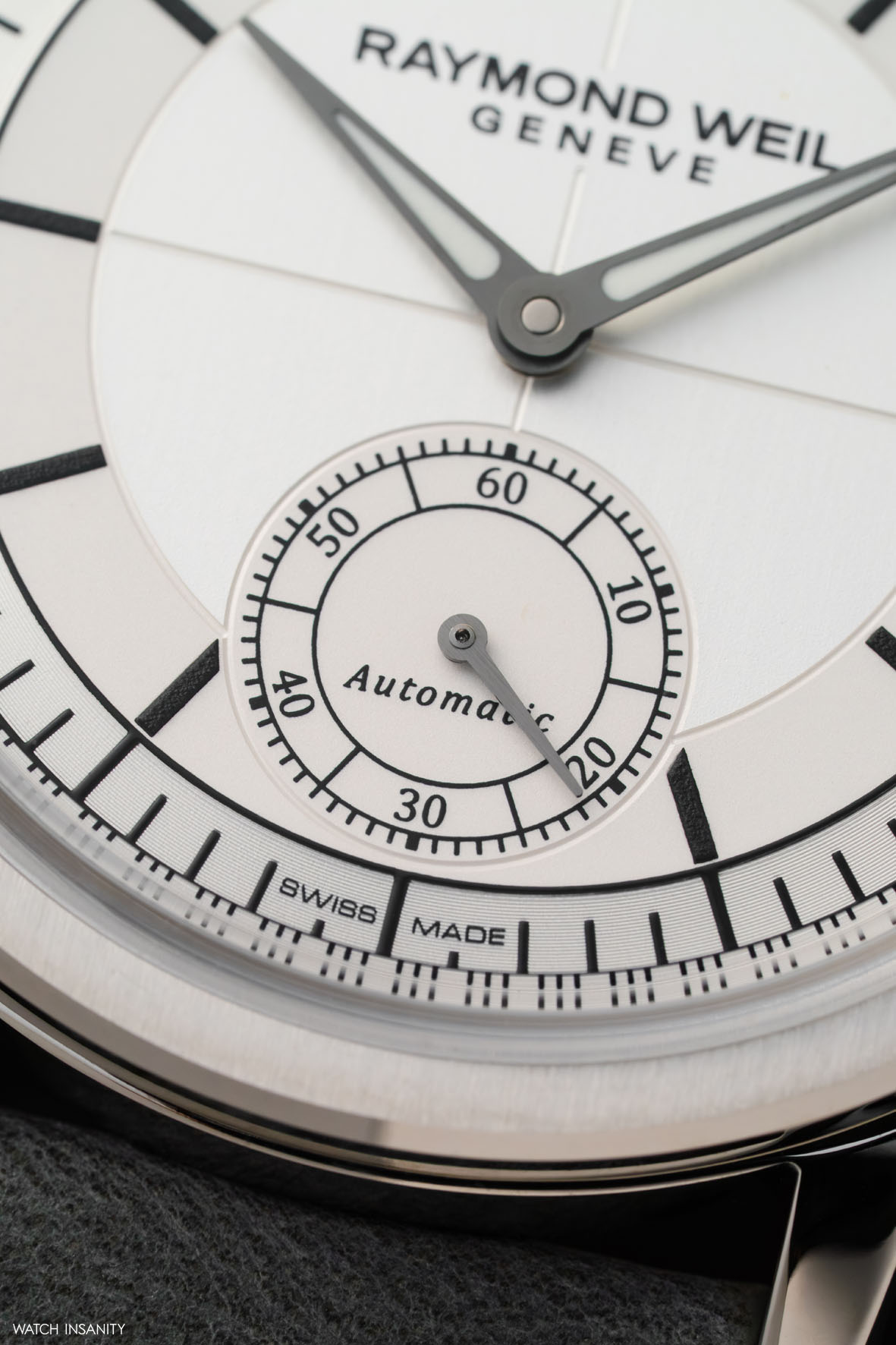
An interesting feature in the centre is the viewfinder. This is often a detail found on vintage watches, and here Raymond Weil has given it a modern twist, engraving it on the dial and working it in a tone-on-tone style rather than printing it in contrast. In addition to silver, the colour range includes champagne, green, blue, anthracite, salmon and an interesting cream shade.
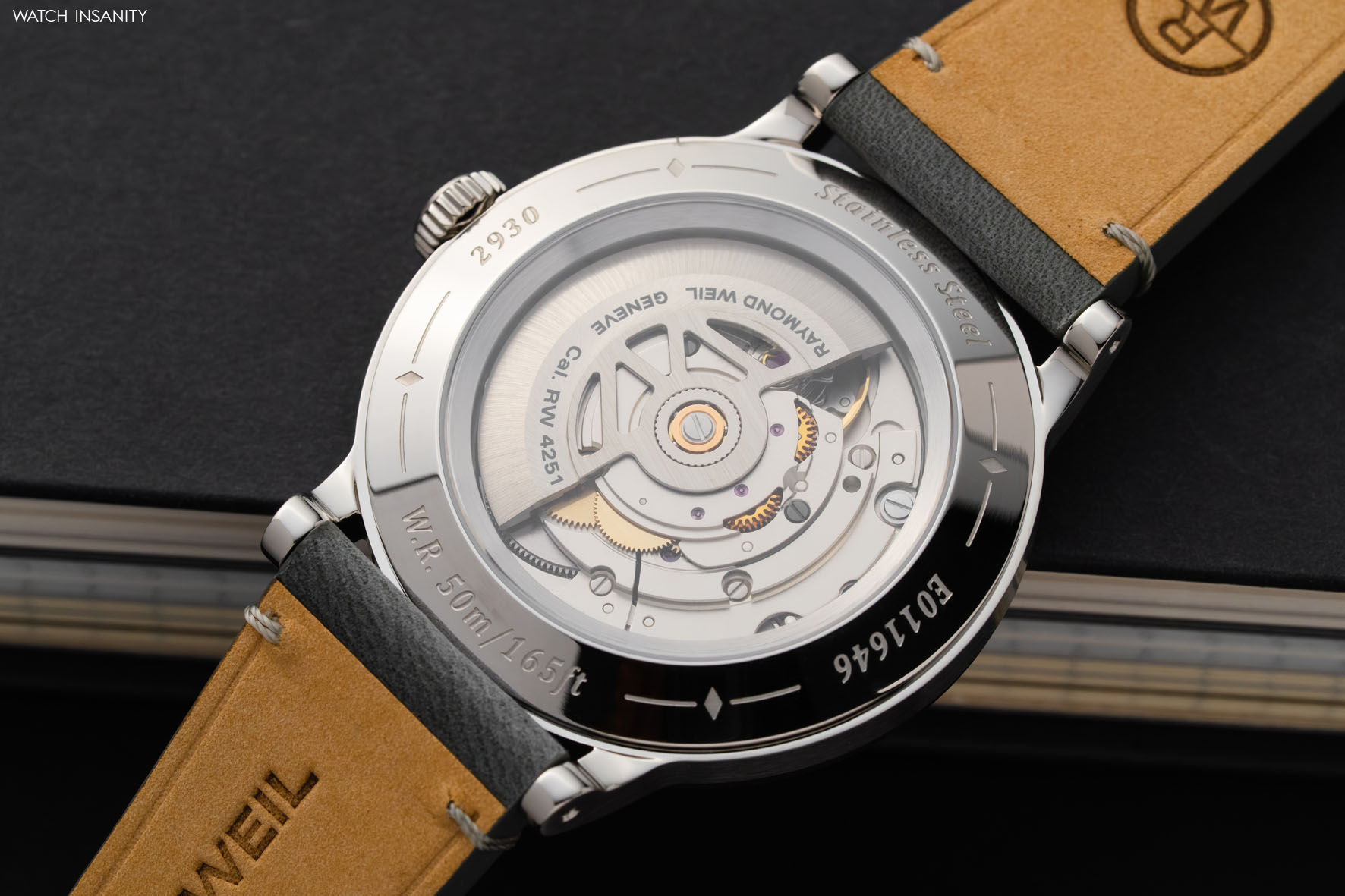
The three-part case, water-resistant to 5 bar, alternates polished and satin-finished surfaces on the middle; it has a flat, thin, vertically satin-finished bezel that crowns a sapphire glassbox crystal with anti-reflective treatment on both sides which, like the rest of the watch, combines modern practicality with retro charm. It is available in steel or steel with rose-gold PVD treatment. It houses the automatic calibre RW4251 (visible through the sapphire crystal case back), developed by Raymond Weil based on the Sellita SW 261, which operates at 28,800 vibrations/hour and has a power reserve of approximately 38–41 hours.
MILLESIME CENTRAL SECONDS
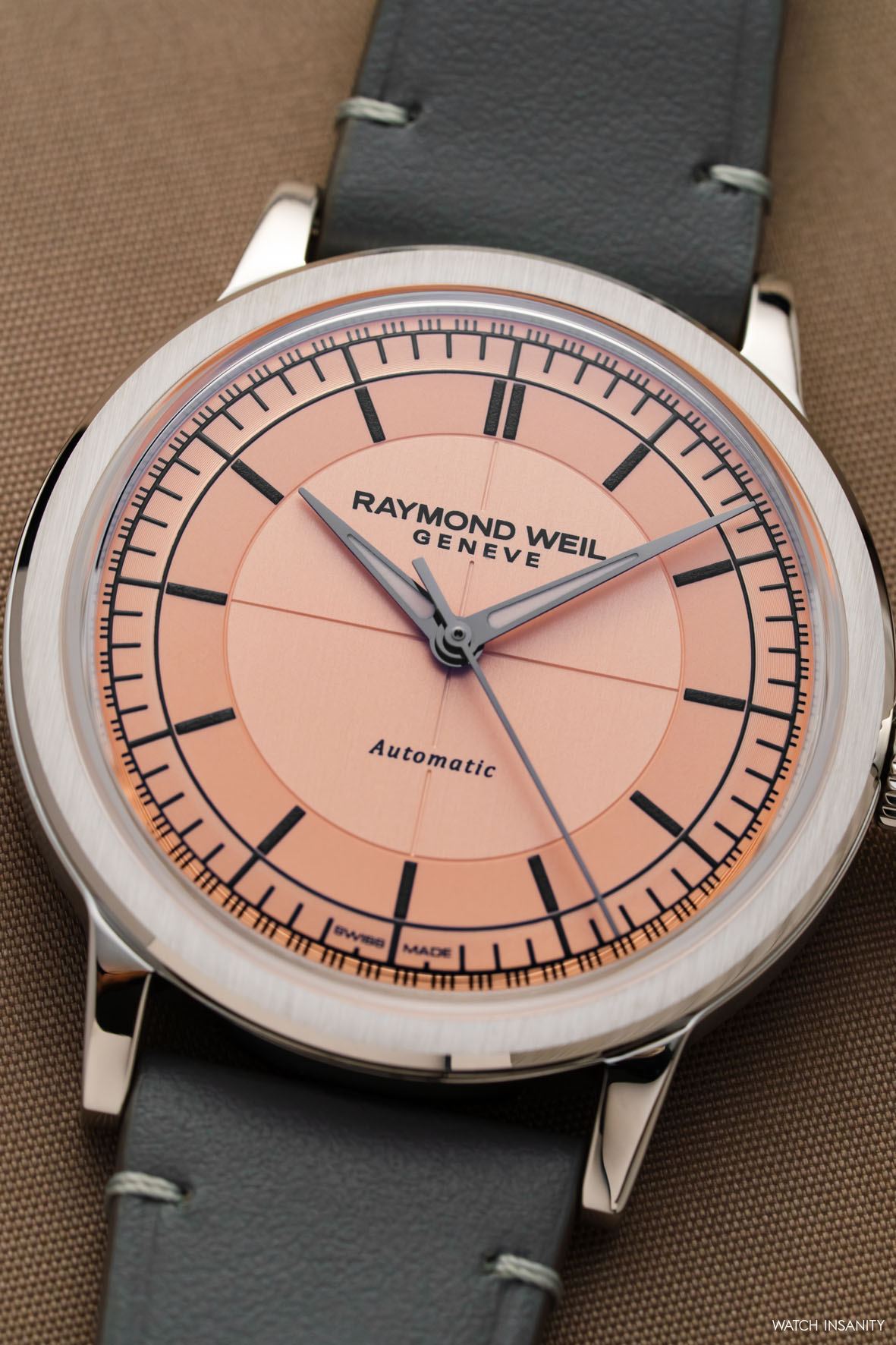
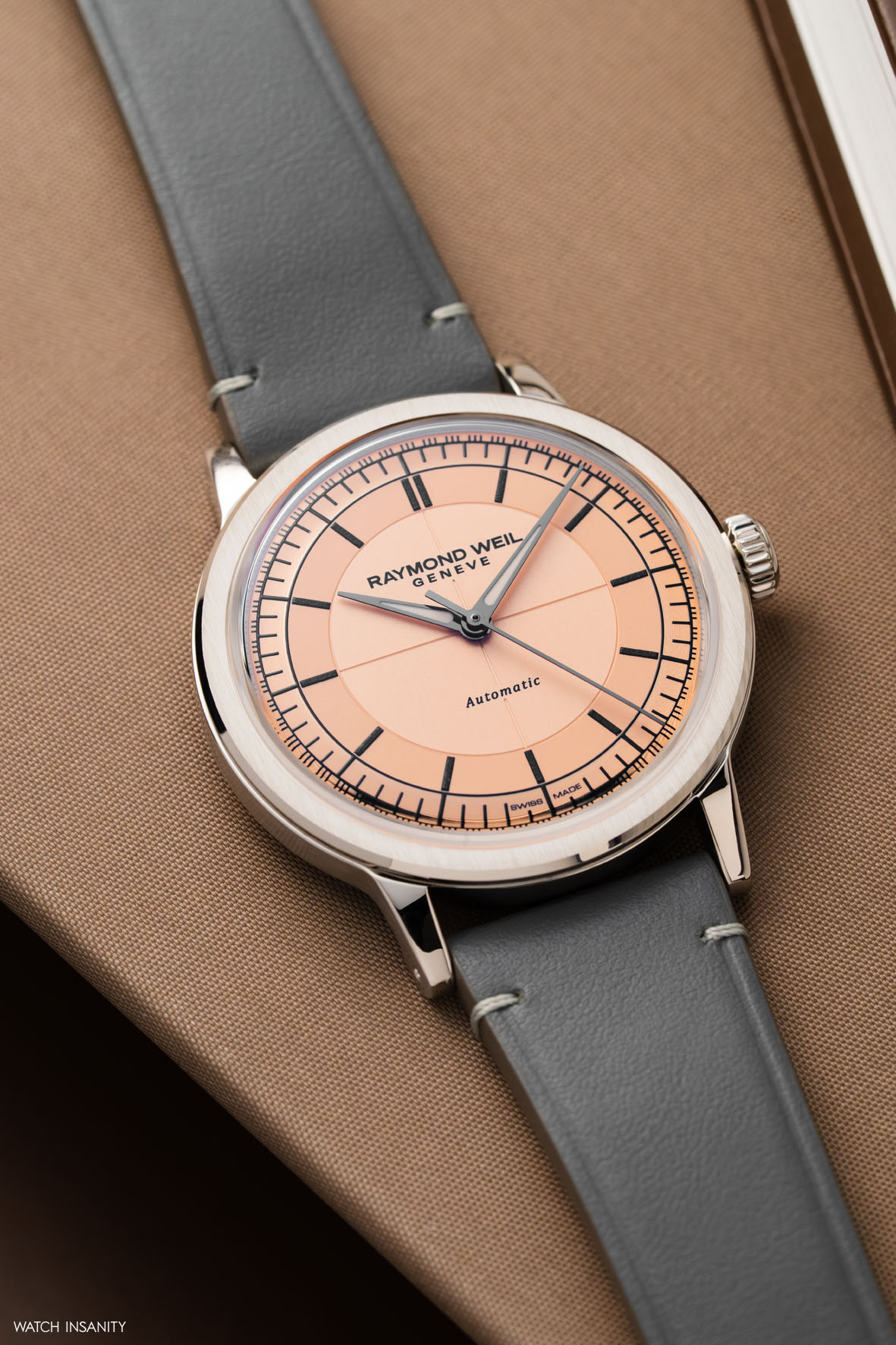
The Millesime Central Seconds shares the same charm as the Small Seconds, with an even more pronounced retro feel, if that is possible. For the shoot, we focused on the model with the extremely elegant salmon-coloured dial. The absence of the small-seconds counter on the dial does not detract from its harmony; on the contrary, it makes it even more balanced. The central seconds hand is even freer to move in a clean space, where the central sight stands out even more for its ability to play with light.
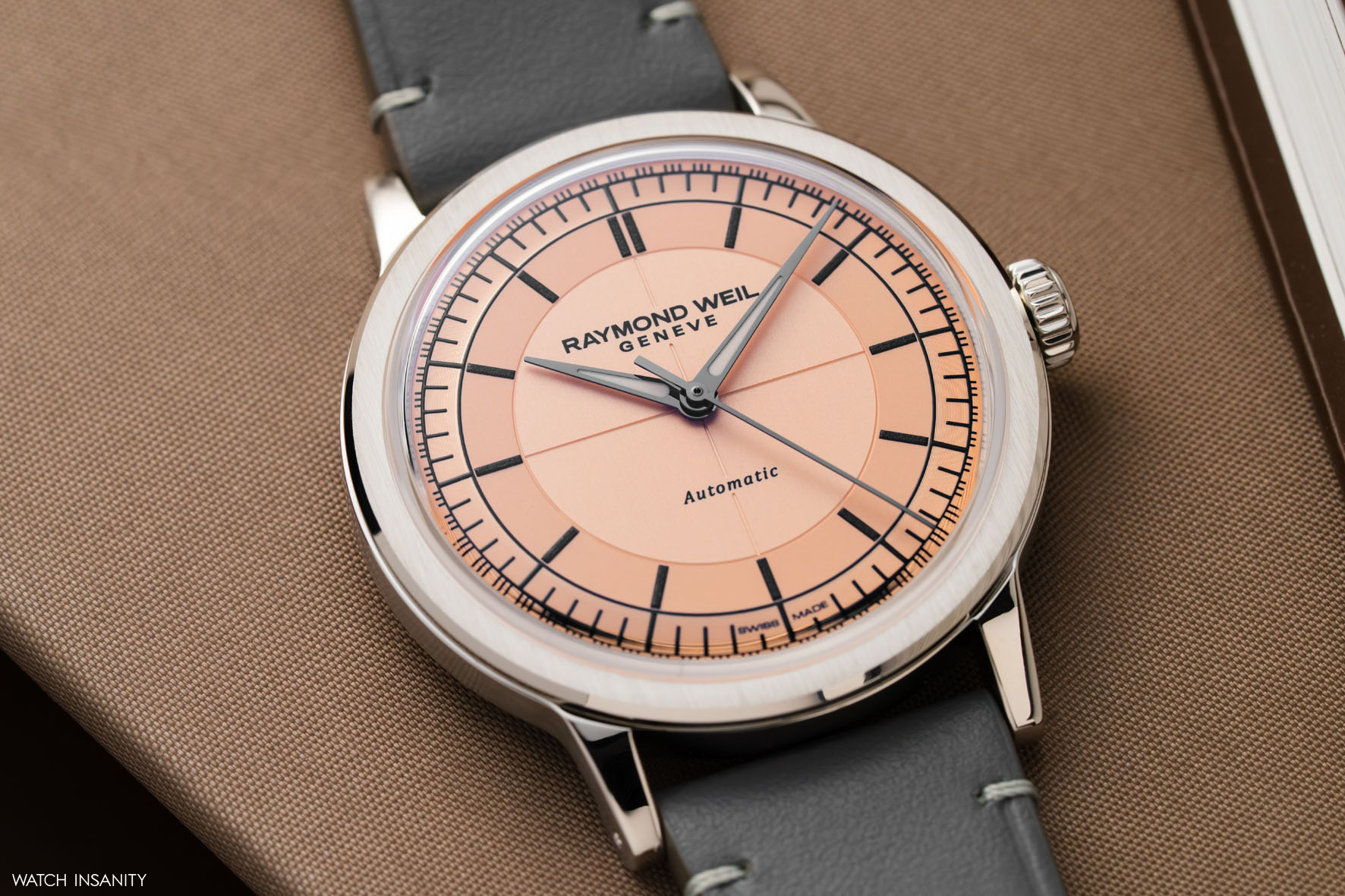
This line also features a three-part dial with matching finishes. In the Central Seconds version, the presence of the precision-seconds scale on the outer edge makes more sense and is more useful than in the Small Seconds; the decision to preserve it in both perhaps follows a logic of aesthetic uniformity, which is entirely understandable and acceptable. In addition to salmon, the Millesime Central Seconds colour palette includes the same shades as the Small Seconds, alongside a beautiful red tending towards burgundy.
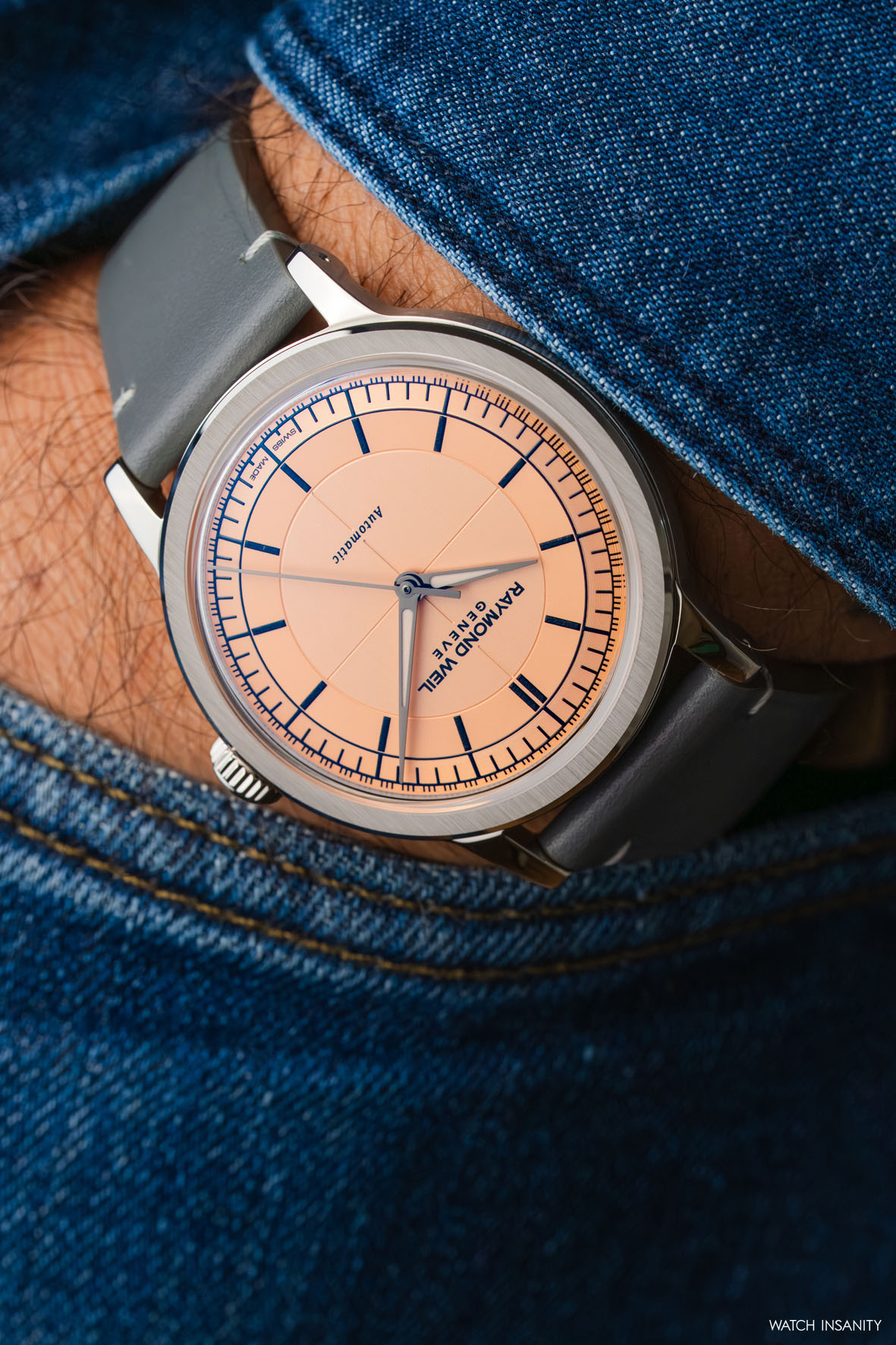
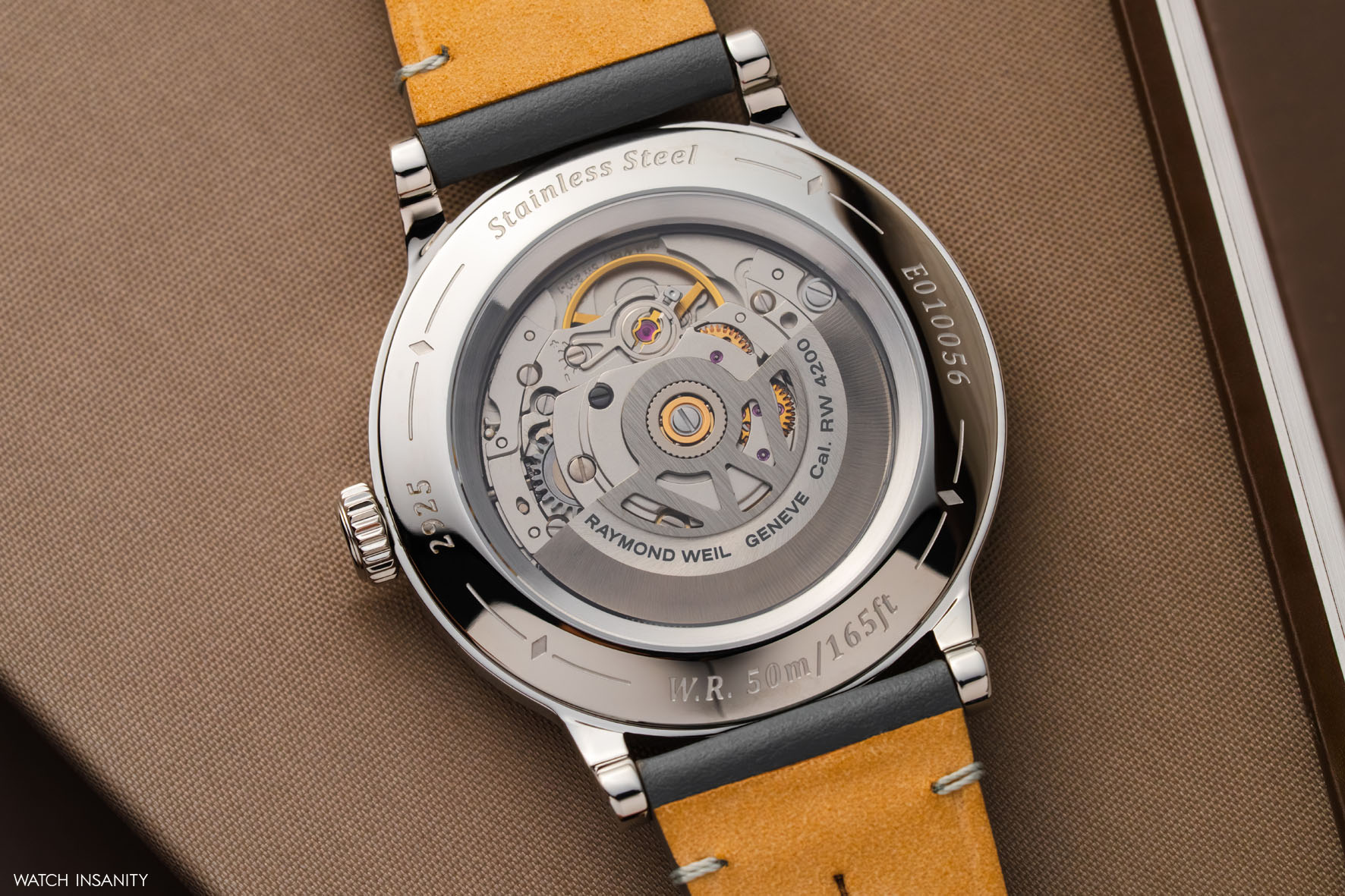
The case structure and finishes remain identical in both 35 and 39 mm sizes. As with the Small Seconds models, the case is made of steel or steel with rose-gold PVD treatment, the latter creating a very elegant effect when combined with the red dial. For the movement of the Millesime Central Seconds, Raymond Weil has essentially customised the rotor of the Sellita SW 200 automatic calibre, inheriting its performance: 28,800 vibrations per hour and a power reserve of approximately 38–41 hours.
MILLESIME MOONPHASE
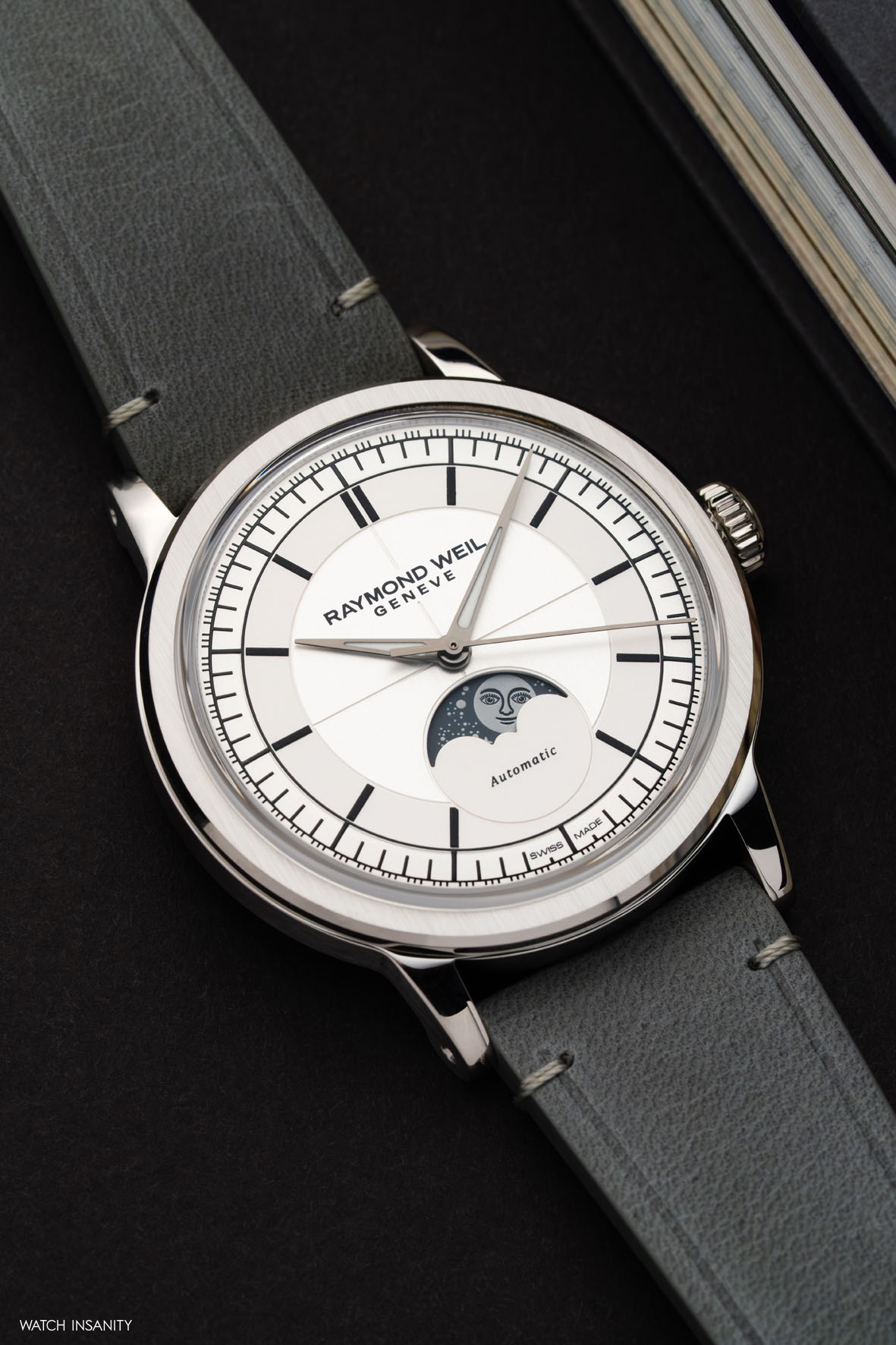
The moonphase complication could not be missing from a retro-style collection such as Millesime. Raymond Weil has therefore enriched it with the Moonphase line, which shares the same clean lines and clarity of information as the others. The moon-phase window is located at 6 o’clock, has the same proportions as the small-seconds dial of the Millesime Small Seconds, and is positioned slightly higher, further away from the minute track.
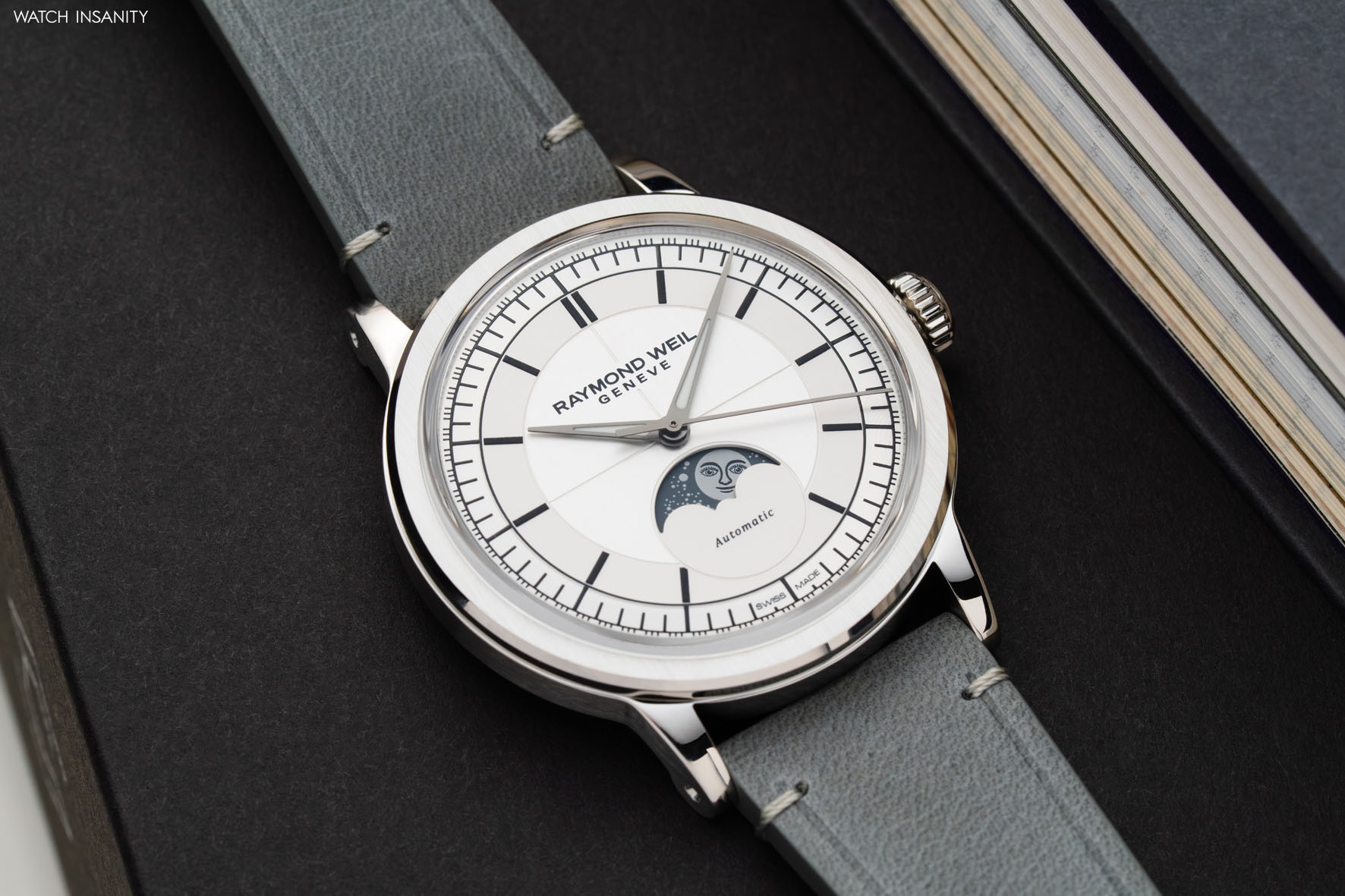
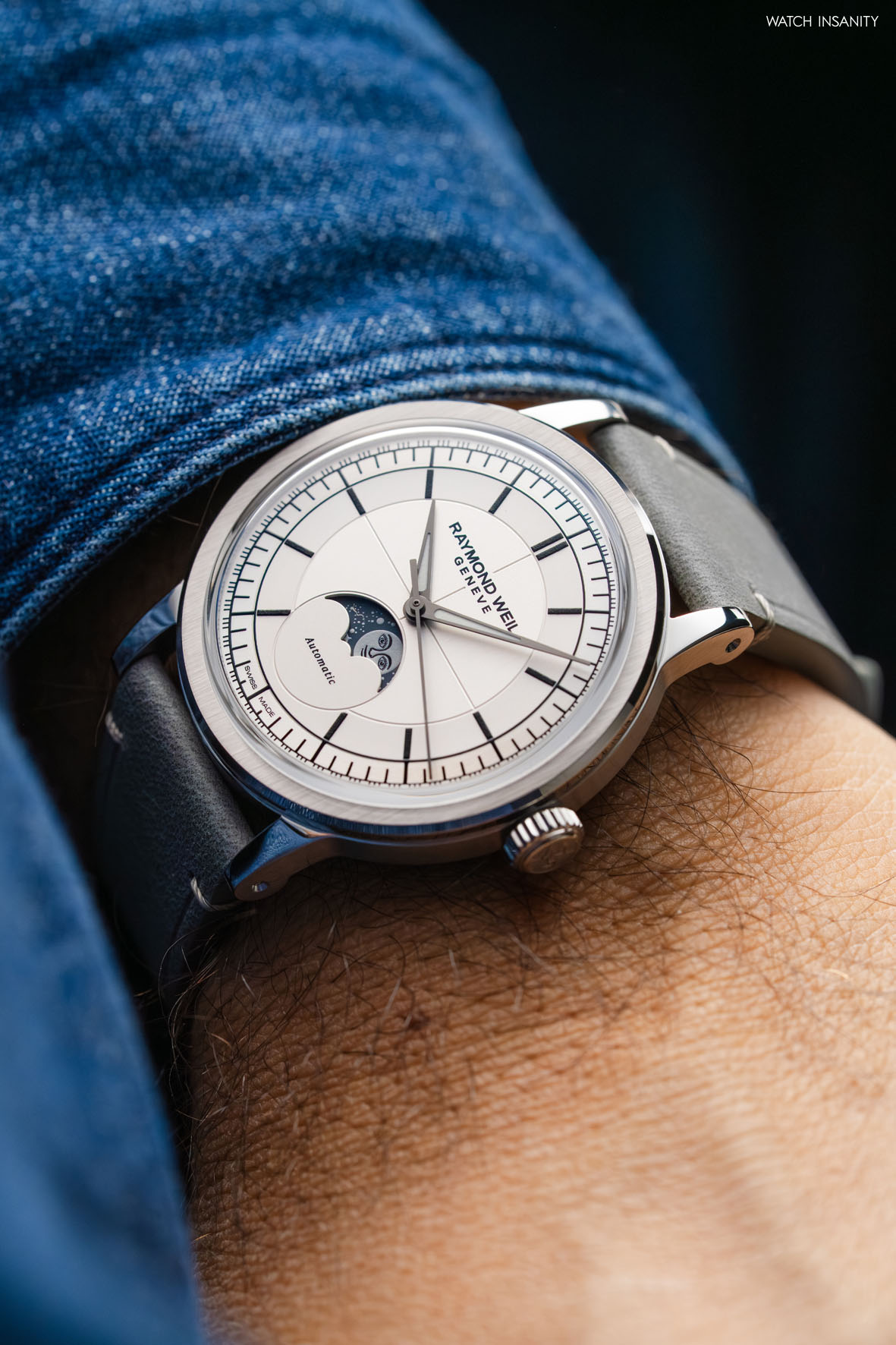
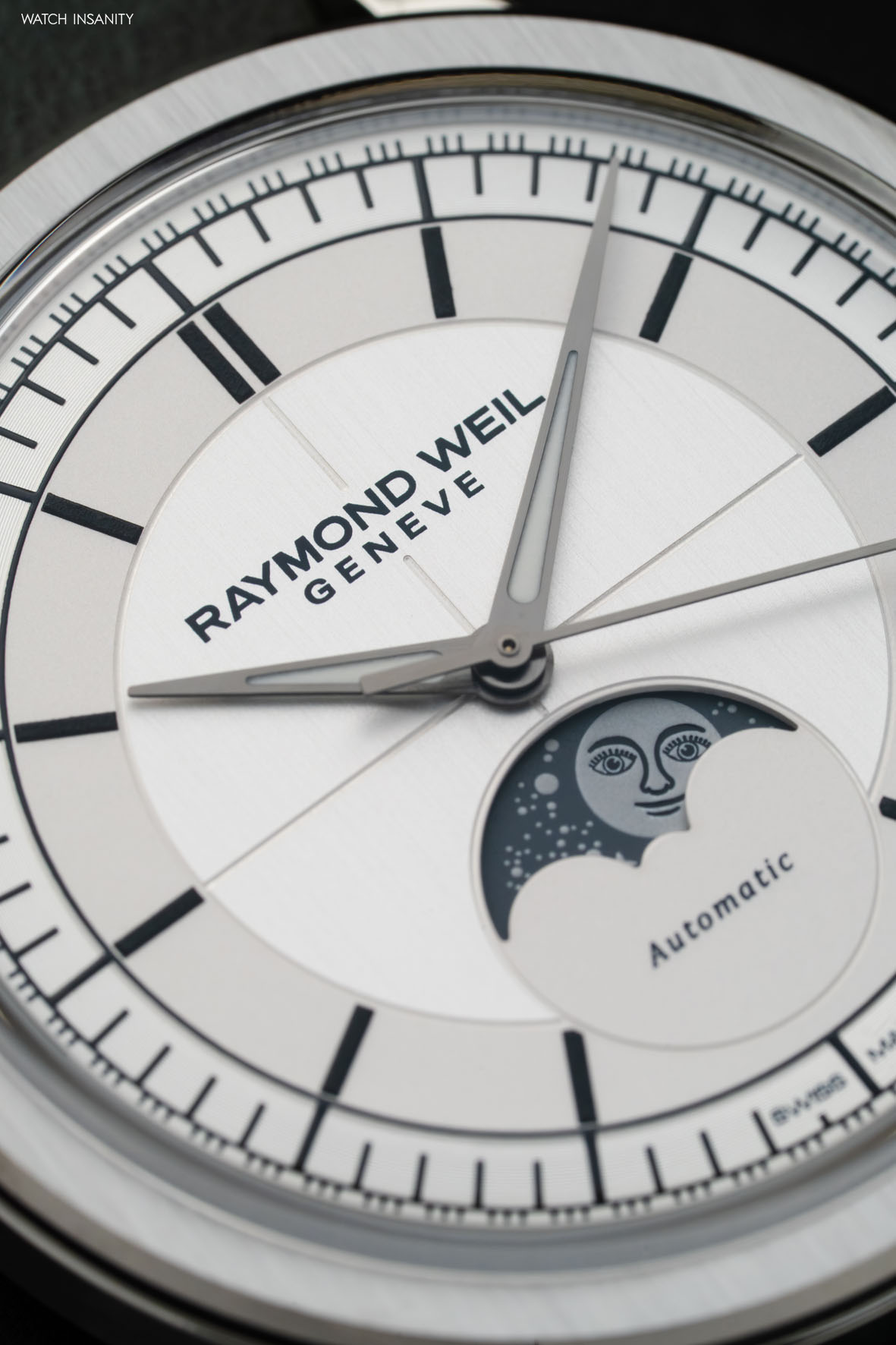
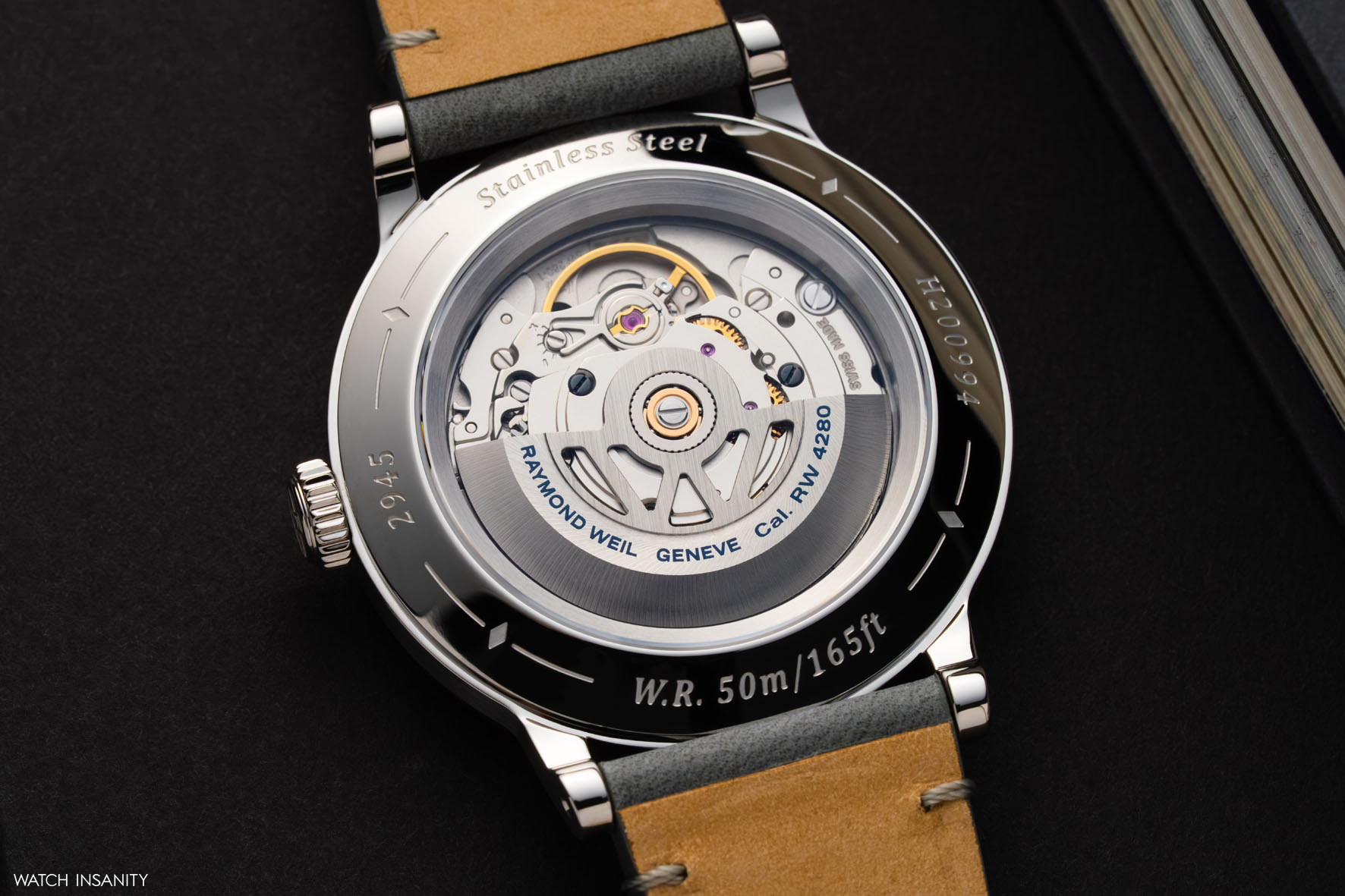
The moon disc depicts the latter with a curious anthropomorphic expression, accompanied by a very simple starry sky on a grey background. The background remains the same regardless of dial colour: the silver you see in our photos, blue, and a very elegant midnight blue combined with a rose-gold PVD-treated case, perhaps the most refined version of the Millesime Moonphase. It should be noted that, unlike the Small and Central Seconds lines, three references with Arabic numerals are available here: two with a blue dial and one with a silver dial and rose-gold PVD treatment. The RW4280 automatic calibre powering these references is an evolution of the Sellita SW280-1, which delivers the same performance as the two movements above.
MILLESIME CHRONOGRAPH
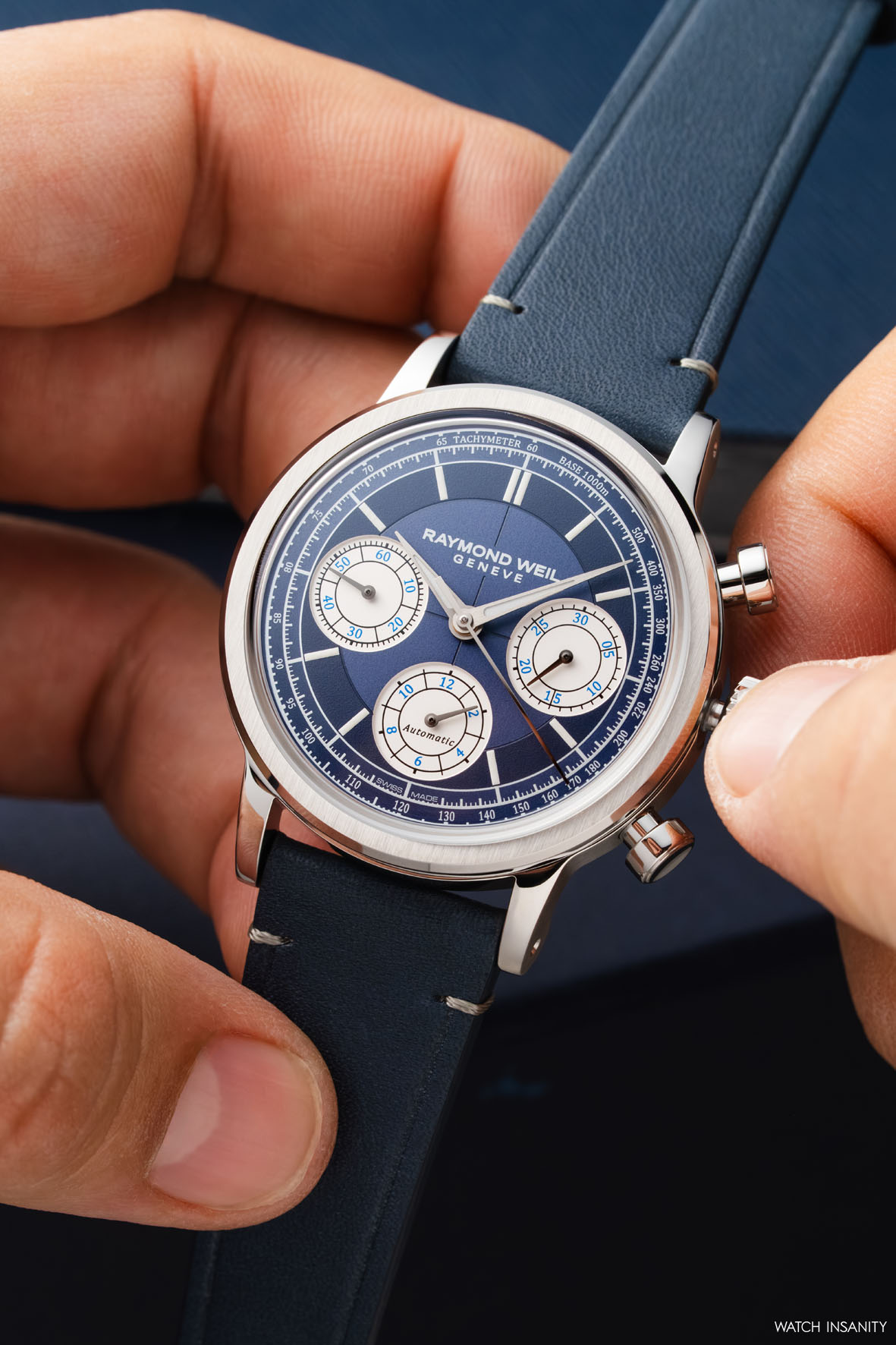
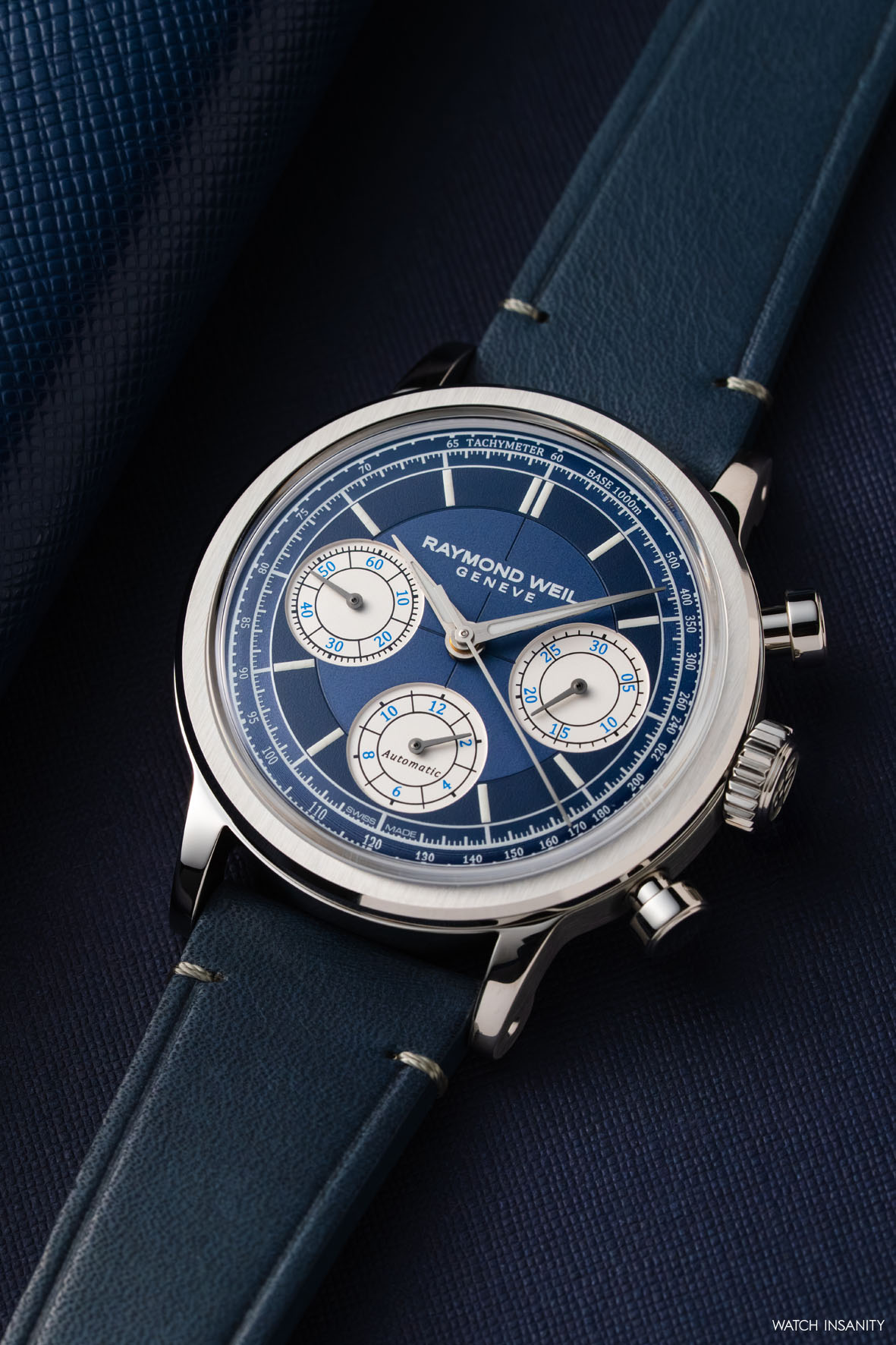
We conclude our presentation of the Millesime collection with the Chronograph, the sportiest of all the lines. Raymond Weil has created eight versions of this chronograph with a strongly vintage aesthetic, and we have chosen to present the one with a blue dial and white counters, which is very sporty. Alongside this, we find the Chronograph with an anthracite dial, a black dial with tone-on-tone counters, a black dial with white counters, and a silver dial with green counters (in a limited edition). The steel case is only 39 mm in diameter and 12.9 mm thick, and in the version with a black dial and white counters, it features rose-gold PVD treatment.
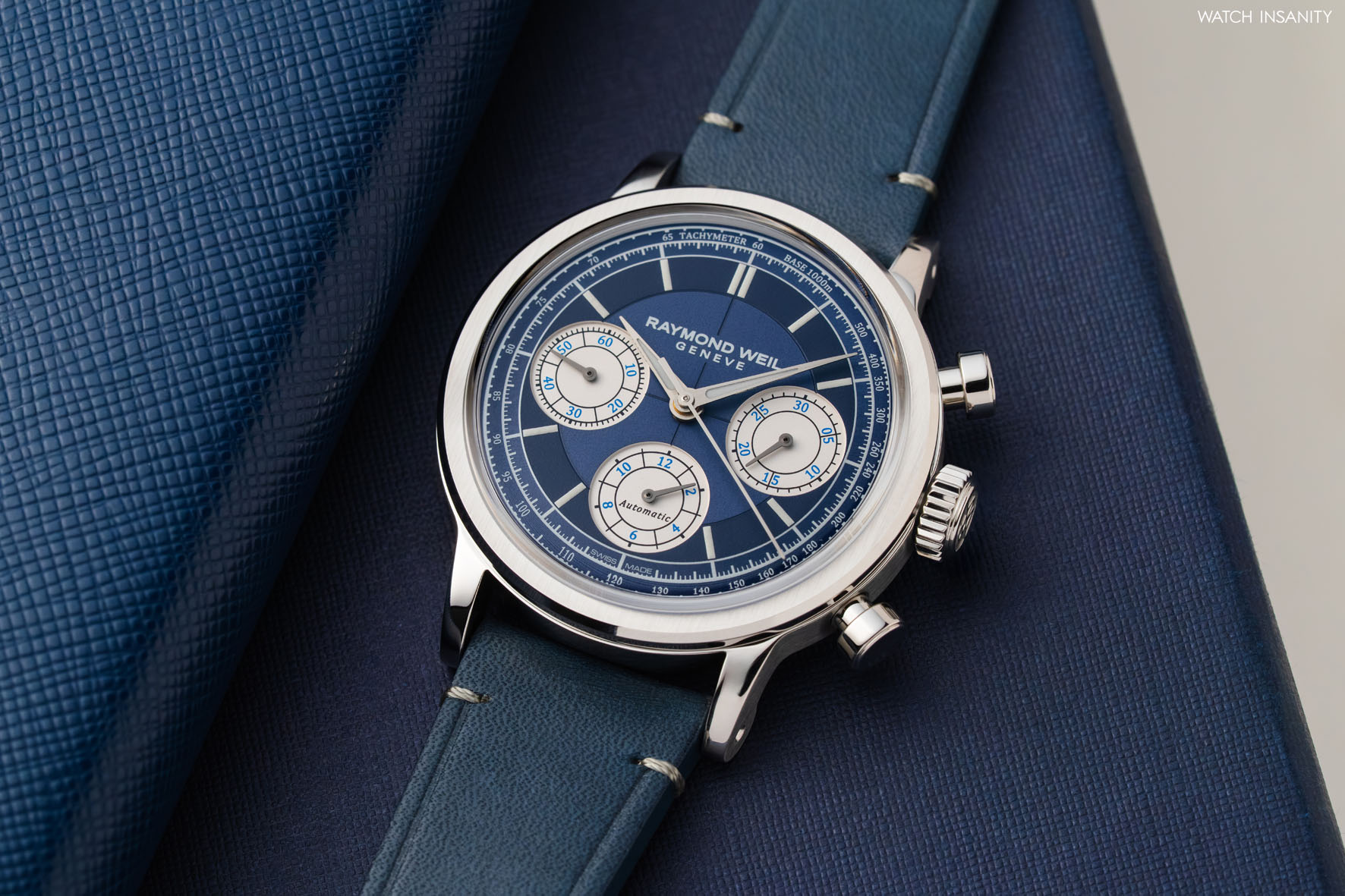
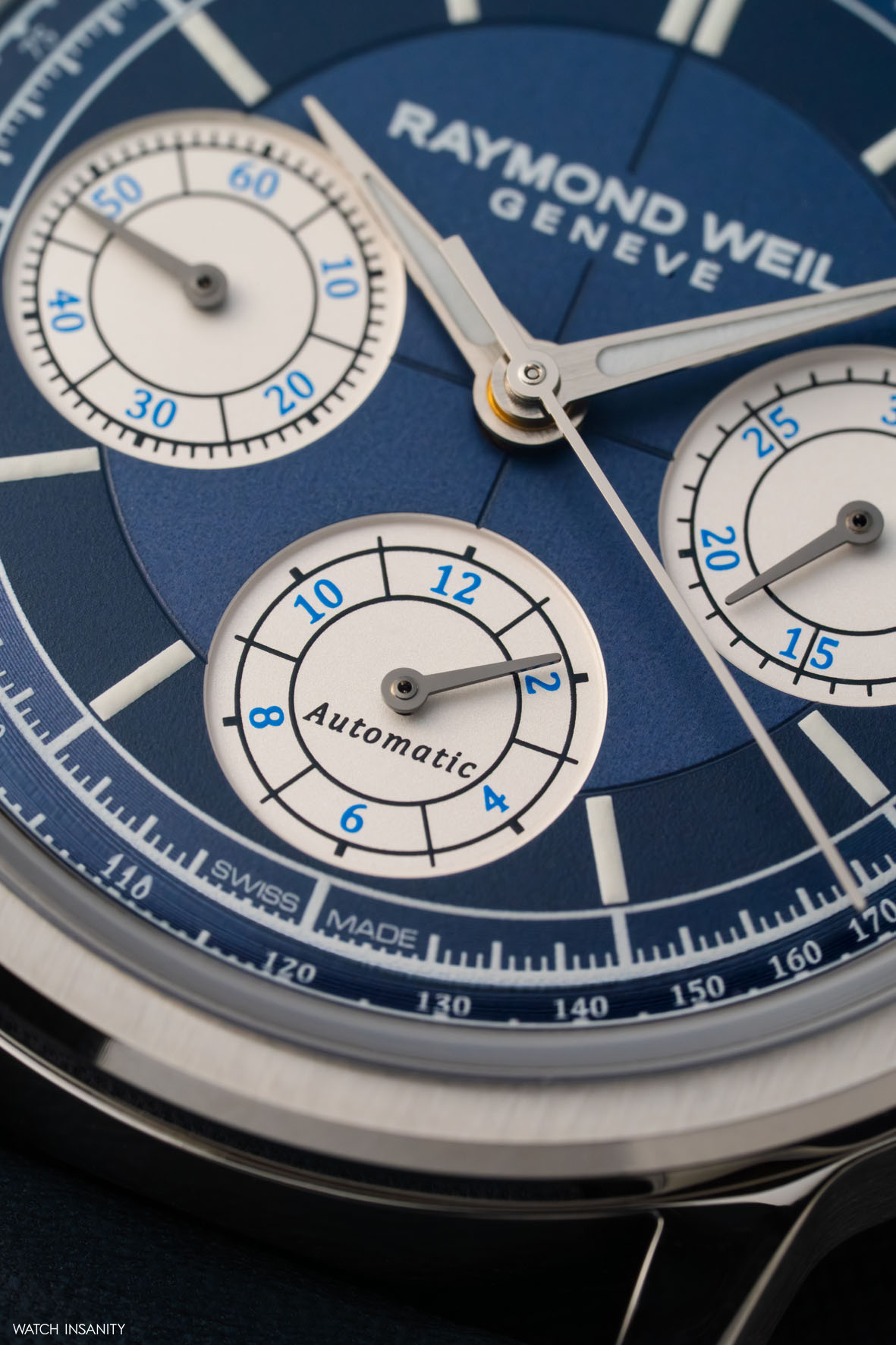
The tripartite structure of the dial seen in previous lines is also found in the Millesime Chronograph, with the difference that the tachymeter scale is positioned on the outer portion, preceded by the precision-seconds scale. The 30-minute, 12-hour and 60-second counters have a matte finish; their indices vary in colour depending on the dial tone. Similarly, the hour and minute hands and hour indices may or may not feature rose-gold PVD treatment depending on the chronograph version.
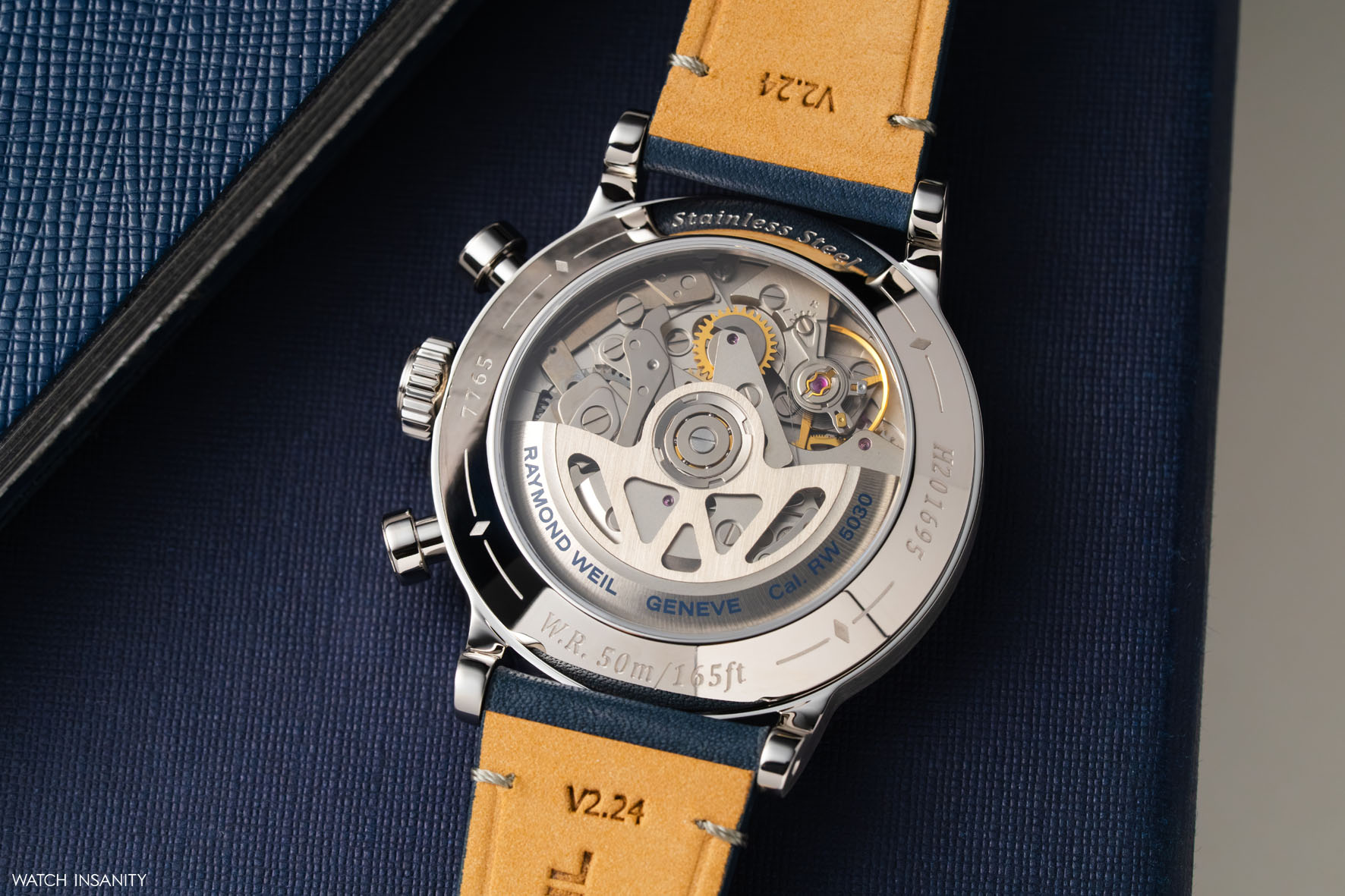
The calibre powering the Millesime Chronograph is the RW5030, developed by Raymond Weil based on the Sellita SW510. It is a robust and reliable automatic calibre, visible through the case back, operating at 28,800 vibrations/hour with a very respectable power reserve of 62 hours. The chronograph functions are activated by retro-style pushers, which give the watch a pleasing balance in terms of proportions.
RAYMOND WEIL’S LESSON IN STYLE
All the watches in the Millesime collection share certain common features. They are available with either leather straps or five-row steel bracelets, with or without PVD treatment. The straps have a pin buckle, while the bracelets have a butterfly clasp. The lugs have holes to facilitate strap changes and easily customise the watch’s look. The crown is beautifully and uniquely engraved with the RW logo, a detail that further enhances the perceived quality of the Millesime watches.
Prices vary depending on the line, but remain faithful to the principle of affordable quality and luxury that the manufacturer has set for itself. The Millesime Small Seconds ranges from €. 1,850 to €. 1,950 depending on the strap or bracelet, with the cream-dial versions reaching €. 2,375 and €. 2,750. The Central Seconds ranges from €. 1,695 to €. 2,195, and the Moon Phase from €. 2,295 to €. 2,750. The Chronograph is more expensive, ranging from €. 3,725 to €. 3,850. The Millesime Central Seconds, Moon Phase and Chronograph also have limited editions that are now sold out.
Essentially, therefore, Raymond Weil’s Millesime is a classic example of a watch with a vintage design that incorporates modern features, a formula that has proved highly effective over the last 10–15 years and continues to be successful. The main difference compared to the work done by other brands is that, in the case of the Millesime, there was no reference watch from the past to draw on. Raymond Weil designed it from scratch to have an attractive, retro look from the very first glance: mission accomplished, not least because the design team was not bound by the constraints of an existing watch and was therefore freer to create without deviating from its mission. This is a result that is far from obvious in today’s watchmaking world.
By Davide Passoni