

2025 will be remembered as an exceptionally rich year in watchmaking anniversaries. Numerous manufacturers have celebrated extraordinary birthdays, and many watches that have made history have celebrated remarkable anniversaries. Among them, Girard-Perregaux’s Laureato holds particular significance, having reached the milestone of its 50th year with a special reference, the Laureato FIFTY. A limited edition of 200 pieces, just released on the market, is already the object of desire for collectors and the vast community of enthusiasts, both of the La Chaux-de-Fonds brand and of the Laureato in particular.
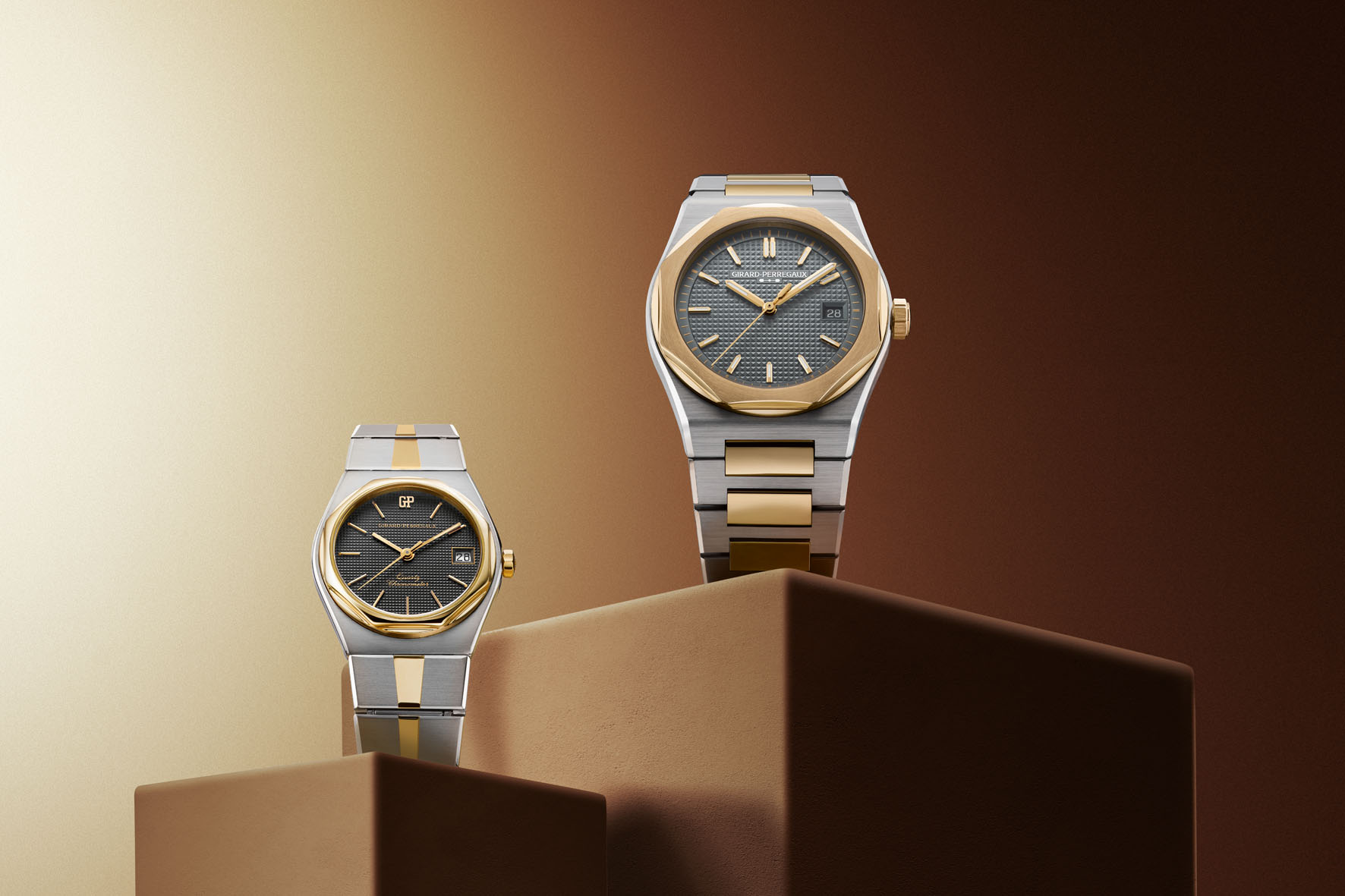
LAUREATO FIFTY: SHAPE AND MATERIALS
Because the new Laureato FIFTY has everything it takes to become a must-have. If we think about the original watch of 1975 while we put the newly released model on our wrist, one thing appears clearly: its soul and essence have not changed, quite the contrary. They have evolved, adapted to the times and tastes, and done so with the sole aim of remaining true to what they represent, in terms of both aesthetics and mechanics. Although it’s worth remembering that the first Laureato was powered by a quartz calibre, typical of its time, but finished with great care with Côtes de Genève and perlage decorations – a level of refinement uncommon among many brands. But we will come back to that later.
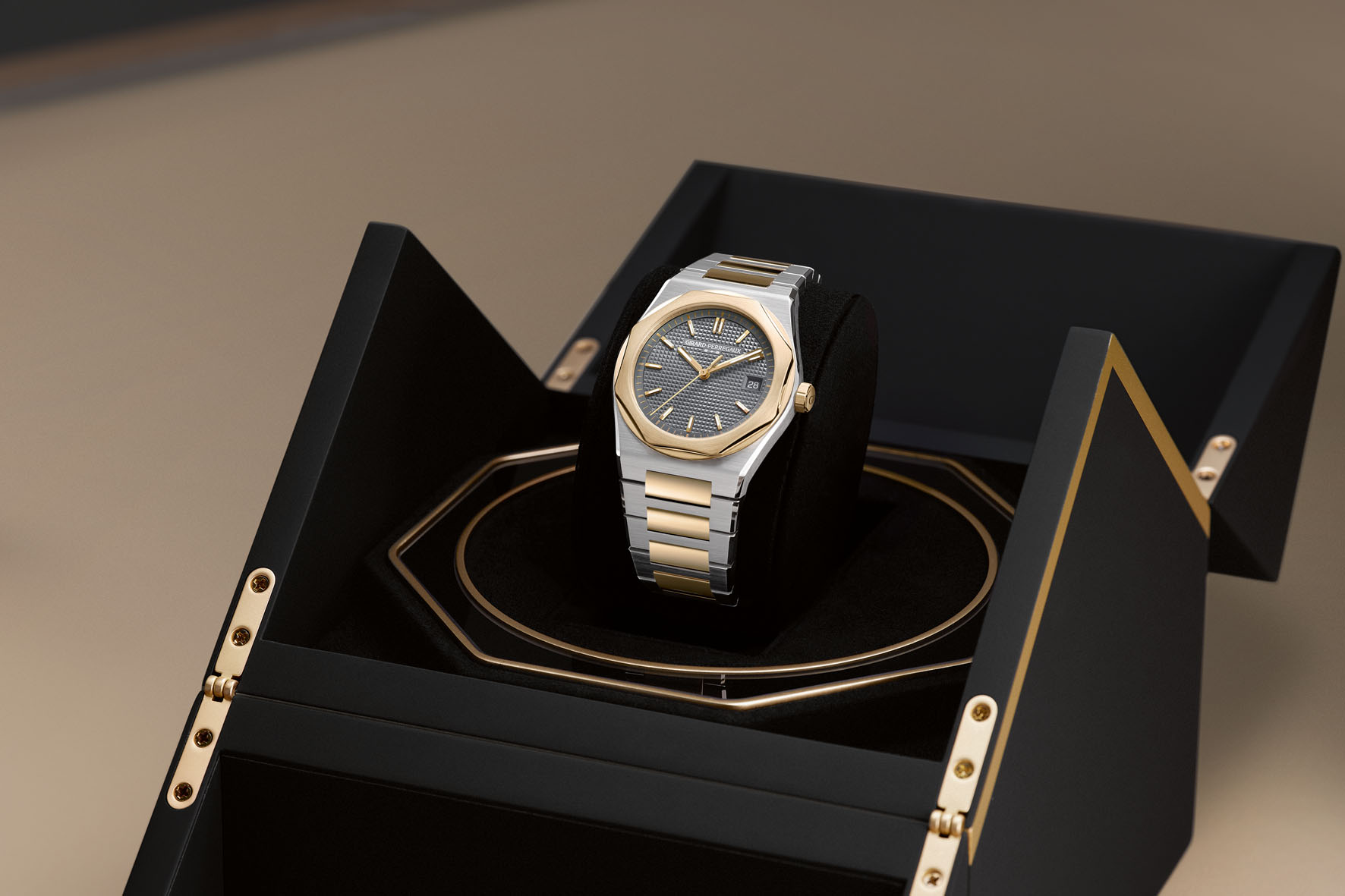
Let’s get straight to the heart of the new Laureato FIFTY, which features the aesthetic traits that all enthusiasts appreciate, and that make it recognisable at first glance. We are talking about the octagonal bezel resting on a base defined by a circular ring, the slightly tonneau-shaped case and the integrated, tapered bracelet. Girard-Perregaux has incorporated the style and design codes of the original Laureato into the new reference, paying particular attention to details.
A couple of these details, if we can call them that, immediately catch the eye: the size of the case and the combination of materials. The diameter of the Laureato FIFTY is smaller than we are used to, as it measures 39 mm. An ideal size for wearability, which in this reference is further enhanced by the thickness, kept by Girard-Perregaux below 10 mm at just 9.8 mm.
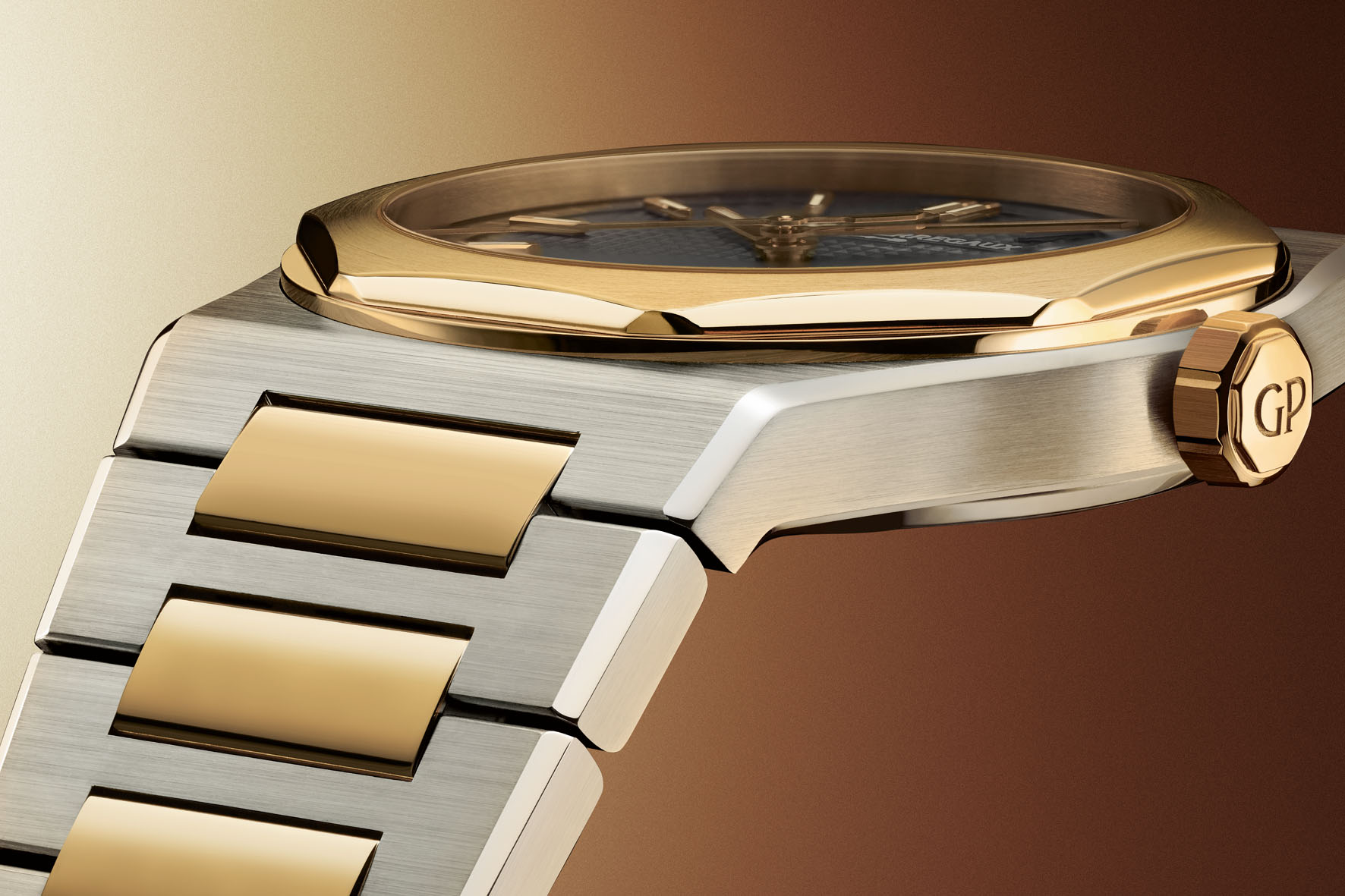
The choice of materials, besides serving an aesthetic purpose, is also based on a philological reasoning. The Laureato FIFTY is made of steel and 3N yellow gold, a combination that recalls that of the very first Laureato from 1975. The difference lies only in the updated aesthetics, more contemporary, and in the modernity of the materials – still steel and gold, but more durable and stable than those employed fifty years ago.
STEEL, GOLD AND A DISTINCTIVE DESIGN
Steel and gold, thus. Those who love fine watchmaking know that this is a combination that does not tolerate half measures. Steel and gold are either loved or hated; they rarely leave one indifferent. It is a style that enjoyed great success in the 1970s and 1980s, before becoming a niche product; however, it always had admirers who kept its charm alive, and never disappeared. The Laureato FIFTY is here to remind us of just that: it is not a watch for the nostalgic, but a piece that honours a timeless history and style.
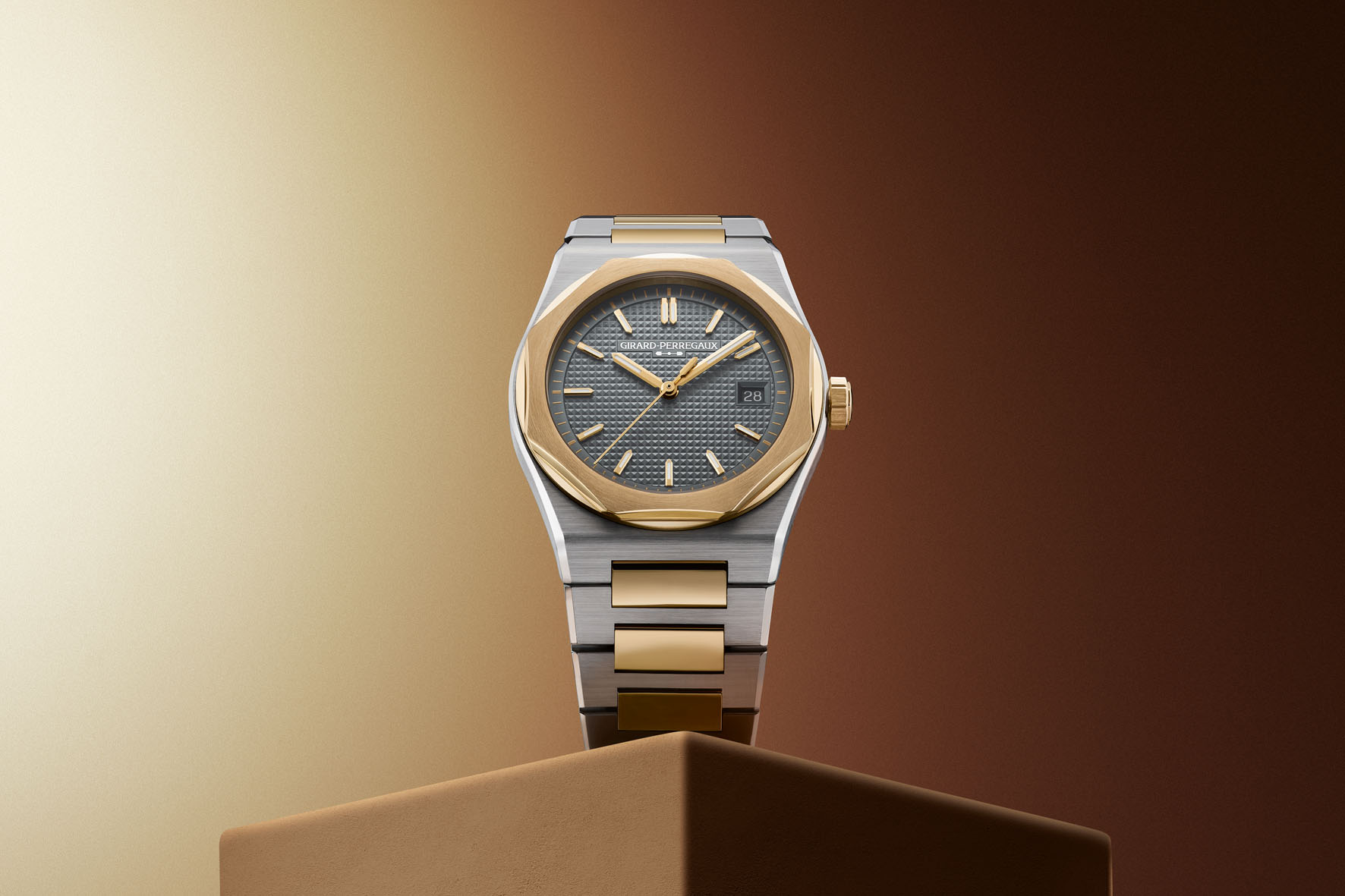
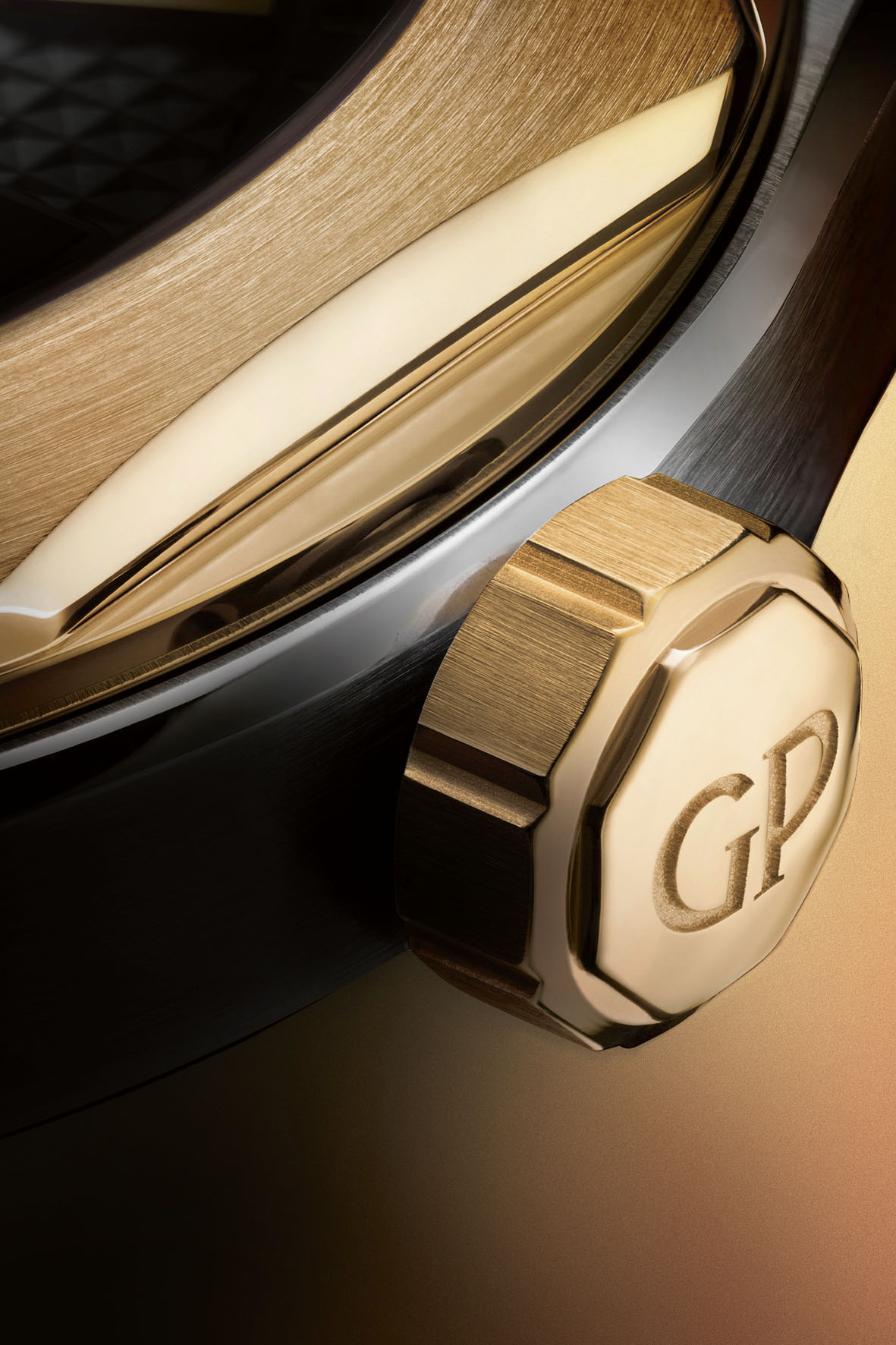
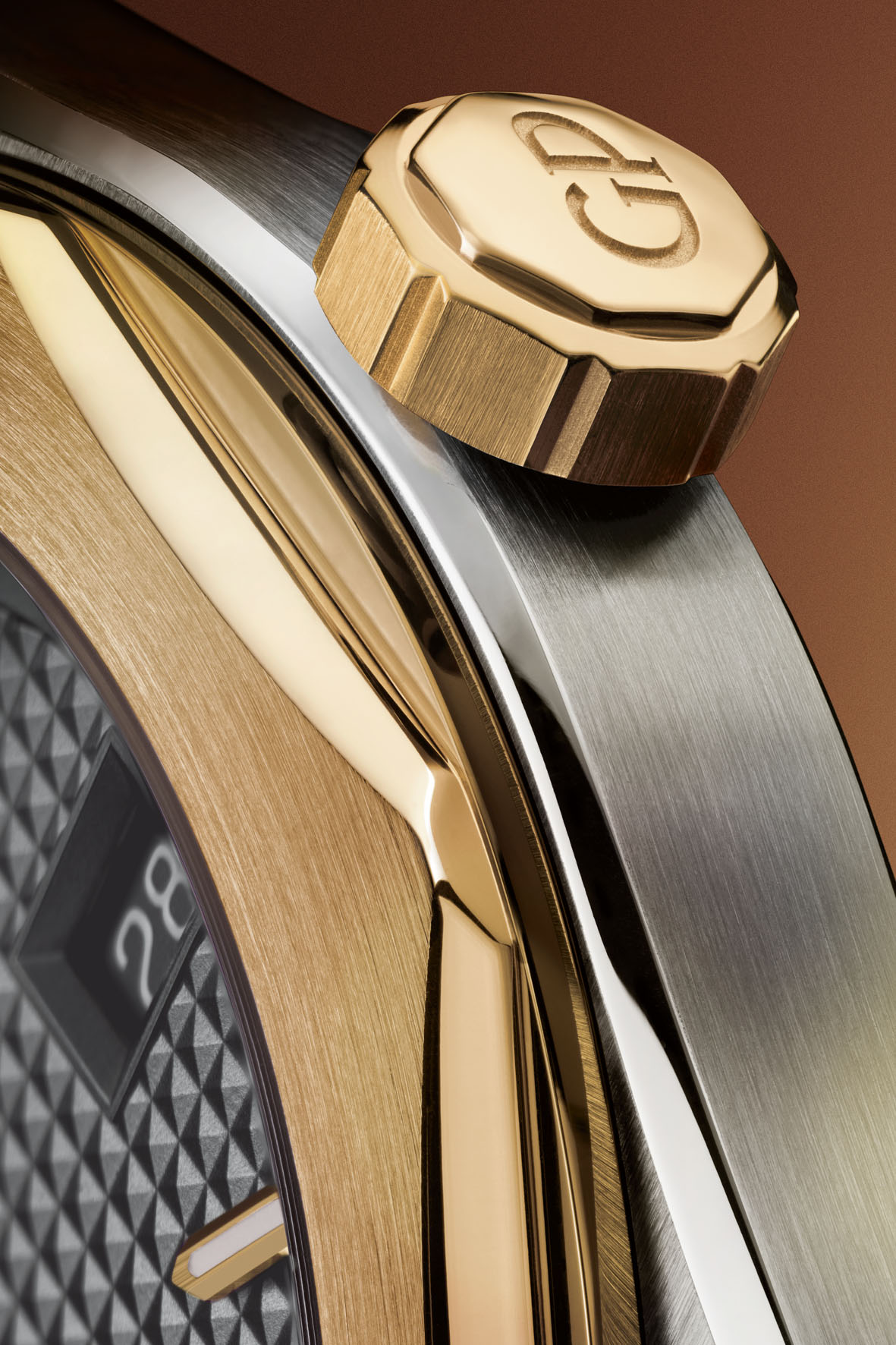
The Laureato FIFTY features 3N yellow gold in the bezel, the central links of the integrated bracelet and the winding crown. The case and H-shaped links of the bracelet are made of steel. Girard-Perregaux has done an excellent finishing job on both metals. Let’s start with the gold. The octagonal yellow gold bezel has a new, more slanted bevel, and the circular polish is only present on the surface of the bezel itself – contrasting elegantly with the polish that characterises the ring below. The latter, in fact, seems to illuminate the bezel from behind, giving it an exceptional presence on the wrist.
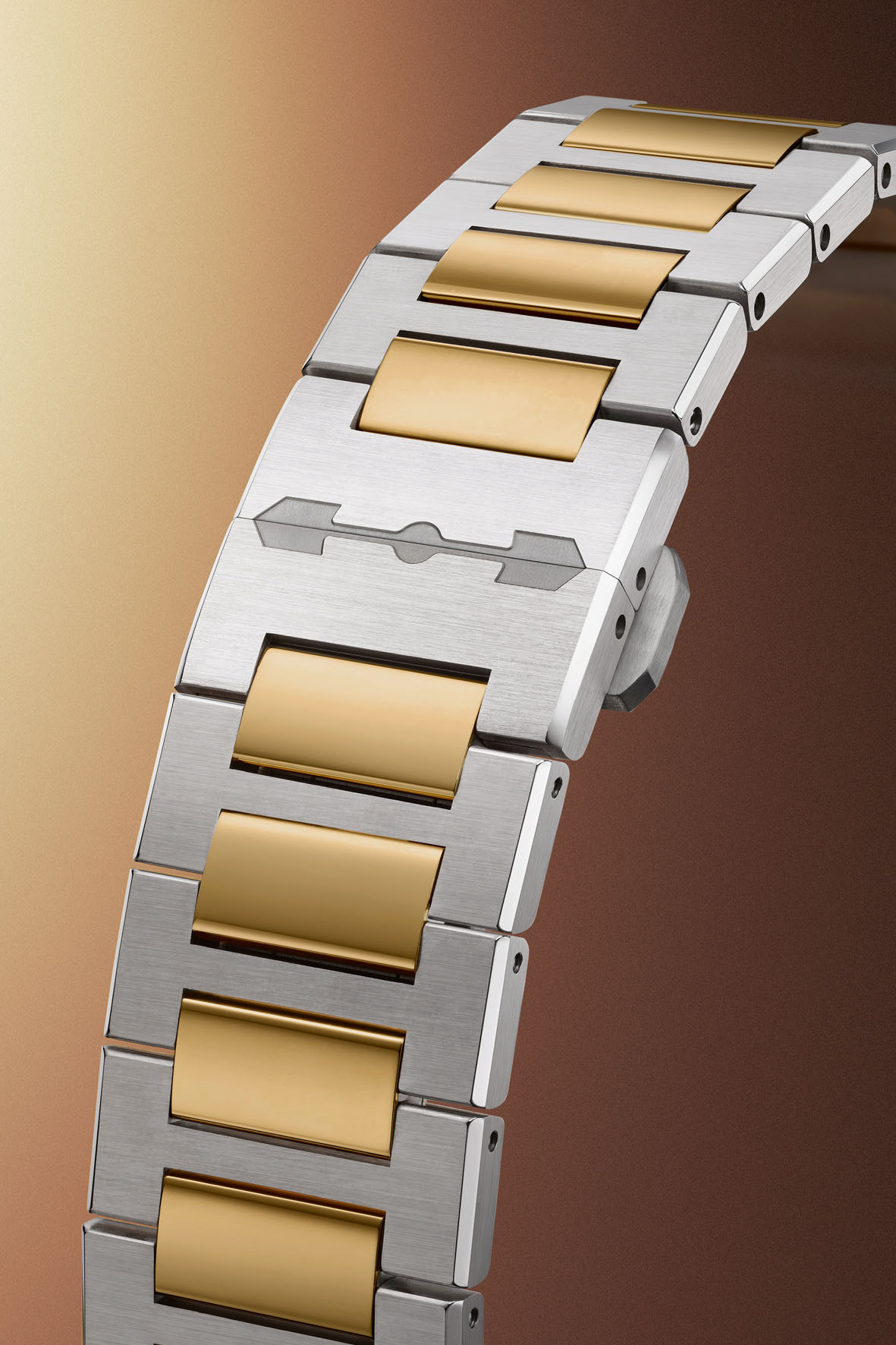
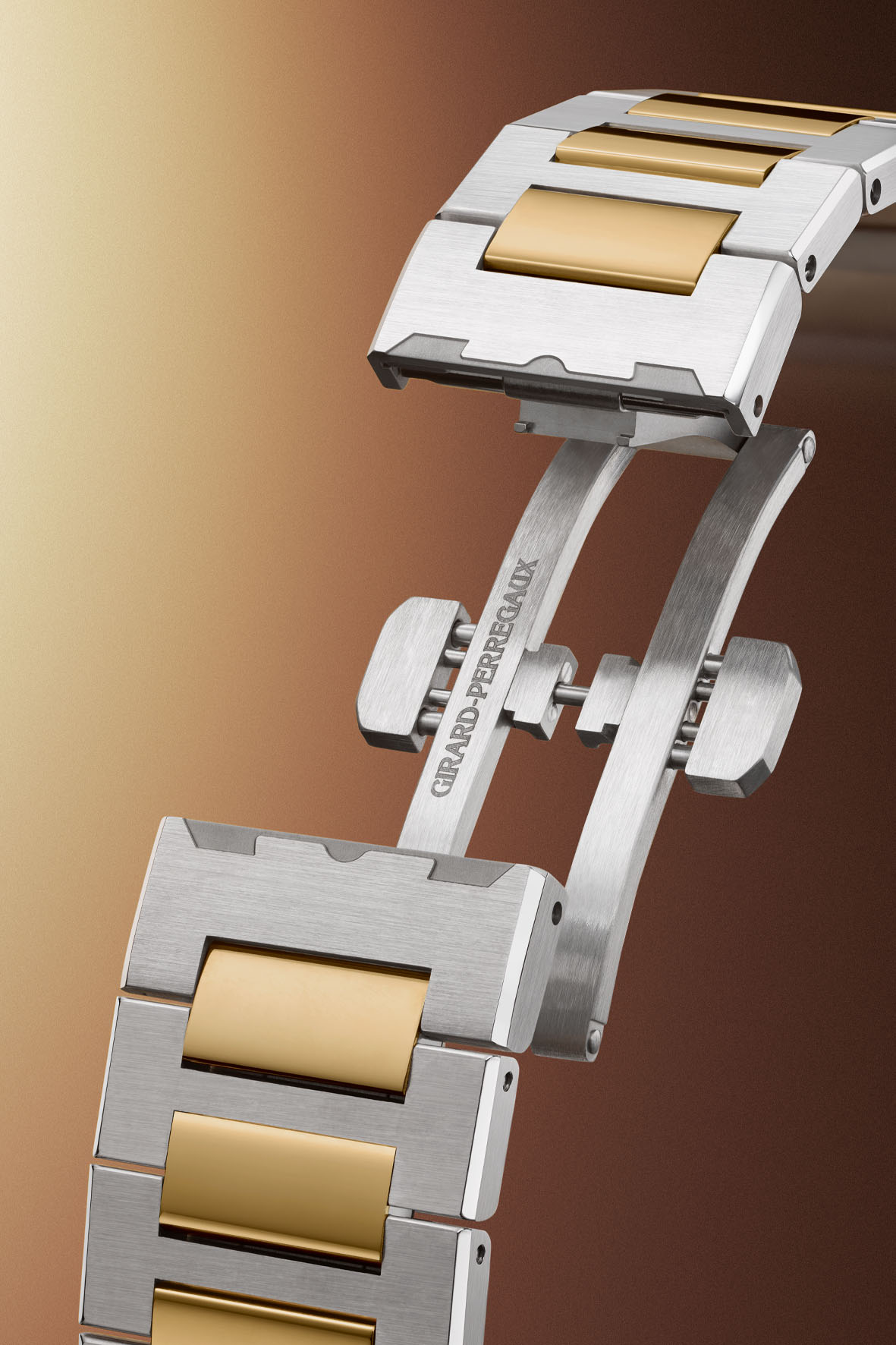
The gold links of the bracelet – slightly more rounded than the others – are also polished and contrast with the H-shaped steel links, which have a clear horizontal satin finish in keeping with that of the case. This way, even visually, the integrated bracelet fully fulfils its practical and aesthetic function. The profiles of the case and bracelet are satin-finished, emphasising the non-trivial research that Girard-Perregaux has carried out in the creation of the Laureato FIFTY.
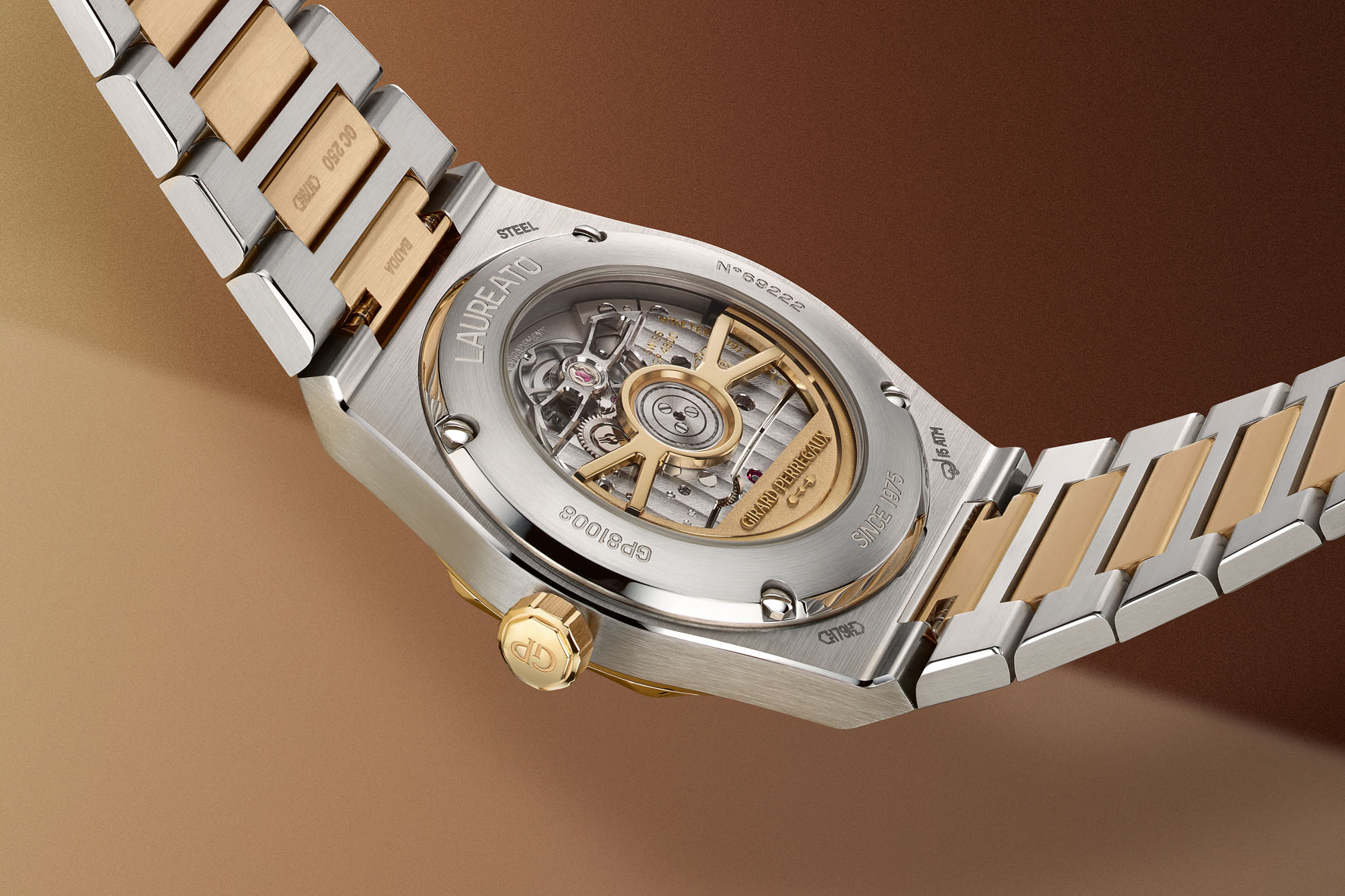
As proof that this bracelet is not only functional but also has a strong aesthetic value, it is worth noting the buttons that open the folding clasp with the GP logo. They are octagonal, like the bezel, and constitute a design element that gives uniformity to the entire watch. In terms of functionality, the clasp incorporates a system that allows for a 4 mm adjustment to better fit the bracelet to the wrist.
THE DIAL OF THE LAUREATO FIFTY
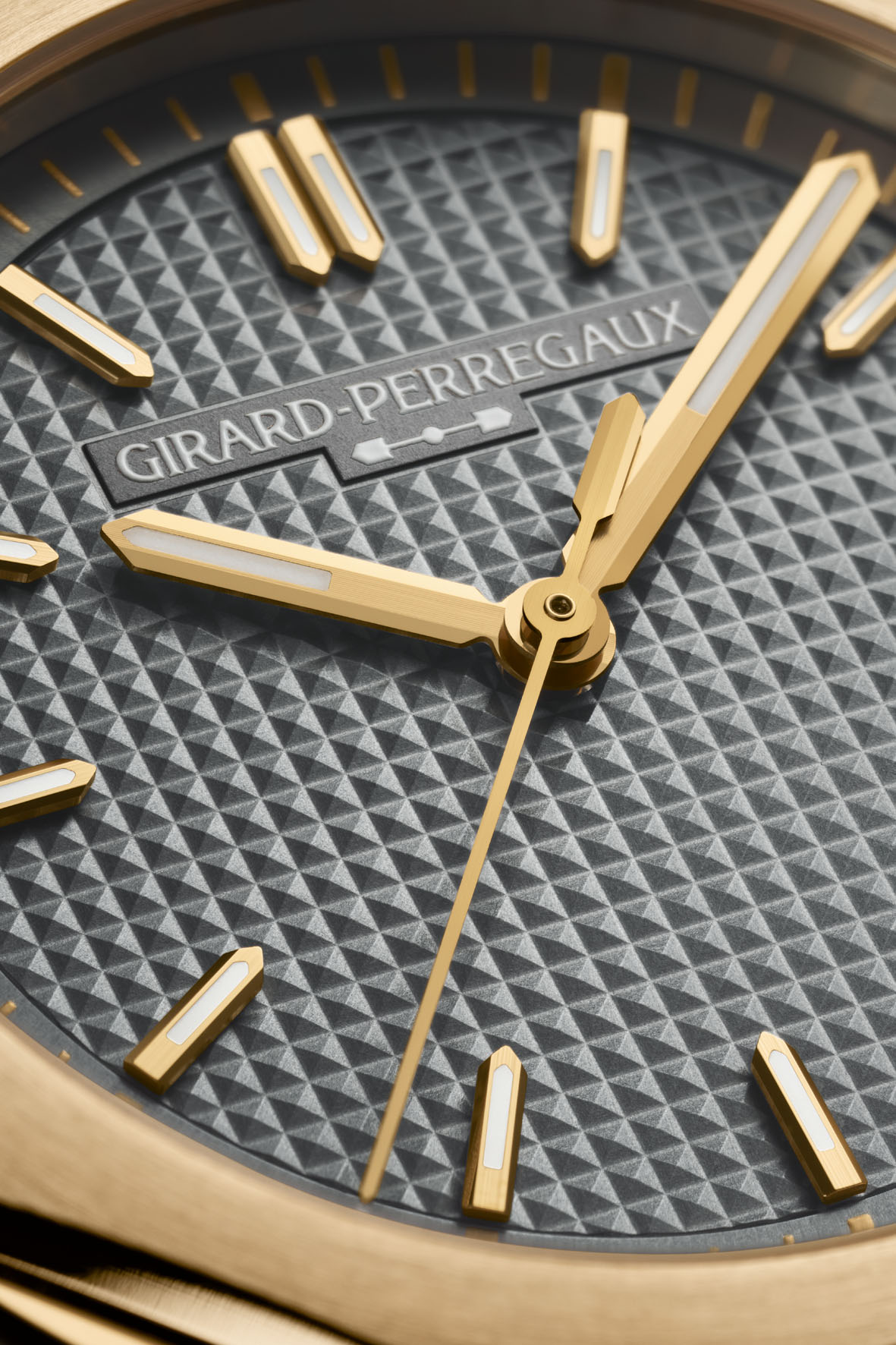
The dial of the Laureato FIFTY is an exercise in watchmaking elegance, closely connected to the collection’s heritage. It is grey in colour, a shade that contrasts with the bright tones of the case and bezel. However, rather than fading into the background, it is illuminated by a sharp contrast with the rest of the timepiece and, above all, by the grey Clous de Paris soleil pattern – slightly larger than before for greater visual impact. The minute track is a uniform grey.
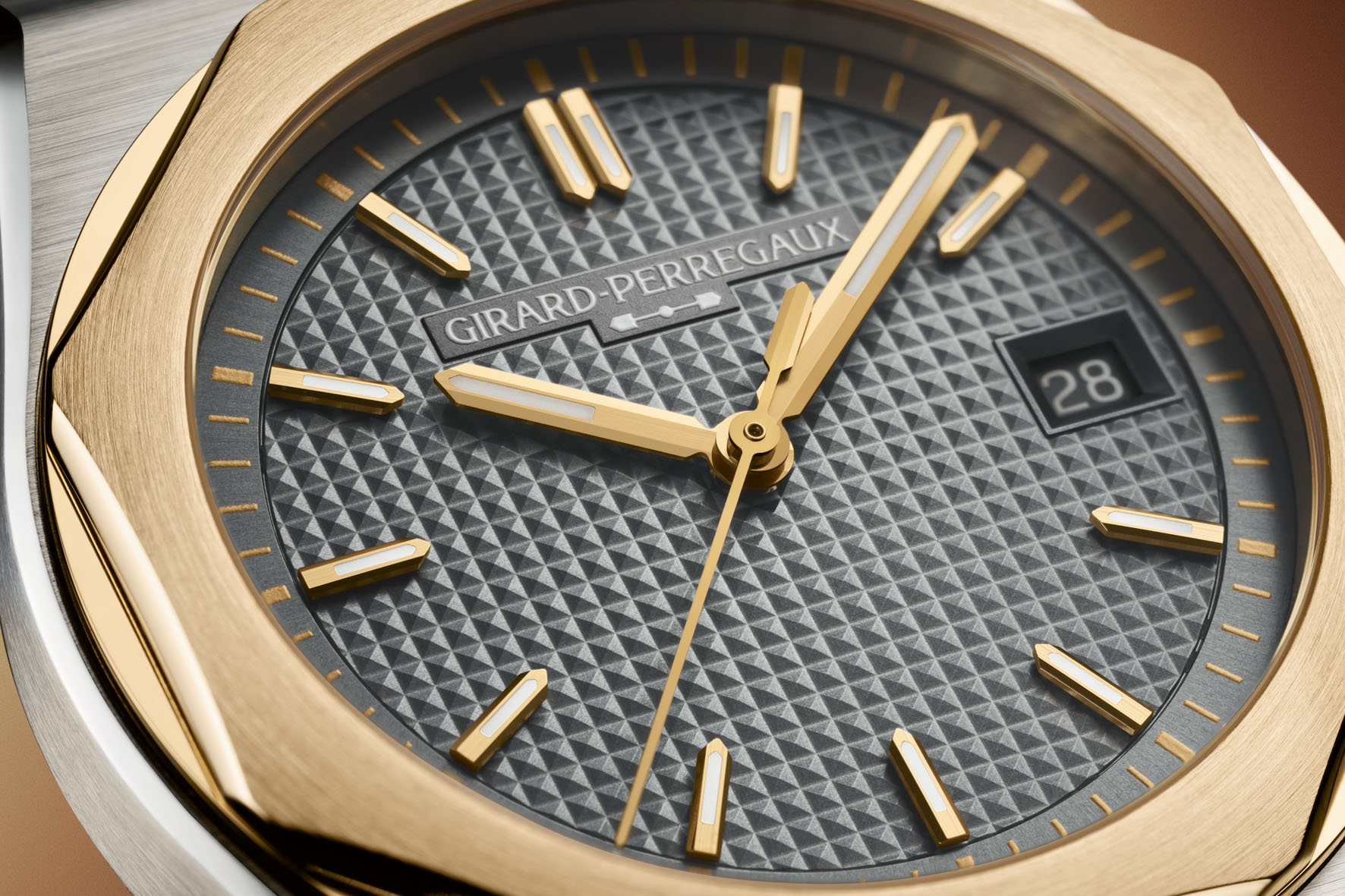
The beauty of the dial is completed by the hour markers and hands. The former are applied and elongated, thinner than in the past, in rose gold with 3N gold plating and the inner part covered with luminescent material. The double hour marker at 12 o’clock is a beautiful detail. The hands are the classic Laureato baton hands, and the hour and minute hands have the same finish as the hour markers – rose gold with 3N gold plating and luminescent material – while the central seconds hand is plated in 3N gold. The counterweight is arrow-shaped, paying homage to the famous three-bridge shape that has become the symbol of Girard-Perregaux.
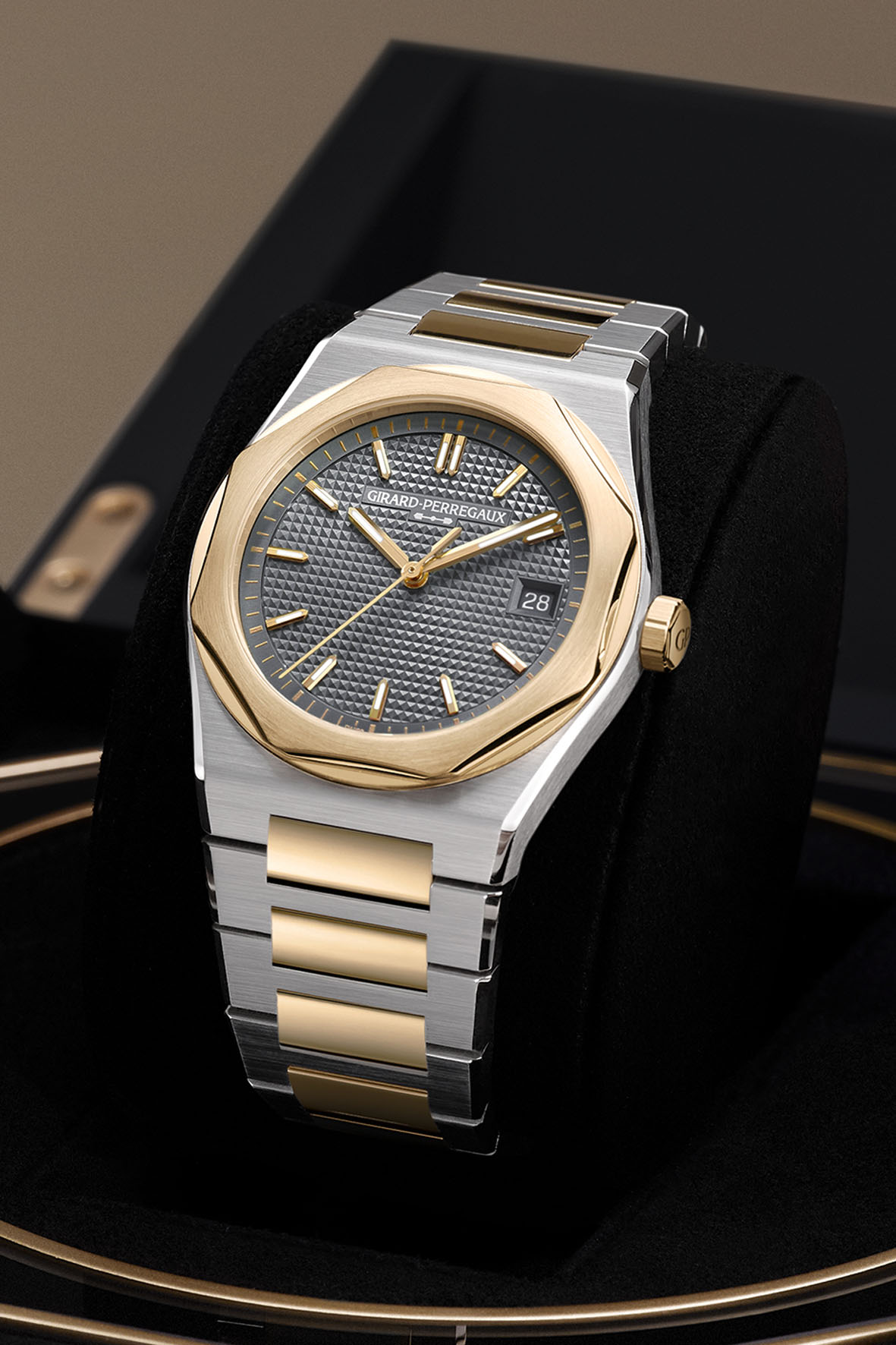
Girard-Perregaux has added a special touch to the date window at 3 o’clock. In addition to being enhanced by an elegant flared frame, it has a date disc in the same grey colour as the dial. This tone-on-tone treatment is much appreciated because it does not break the aesthetic unity of the watch but instead enhances it. It may sound trivial, but not all manufacturers devote this amount of attention to a complication as common as it is not always loved. Such care, however, helps to appreciate it more.
GIRARD-PERREGAUX AND THE GP4800 CALIBRE
Just as the quartz movement was a product of its time, today we live in an era in which mechanical savoir-faire is rightly celebrated. This is why Girard Perregaux has chosen to preserve the aesthetic references to the 1975 model in the Laureato FIFTY, while equipping it with a brand-new mechanical movement: the GP4800automatic calibre, developed entirely in-house in La Chaux-de-Fonds, a manufacture with over 30 calibres, 80 patents and a team of master watchmakers.
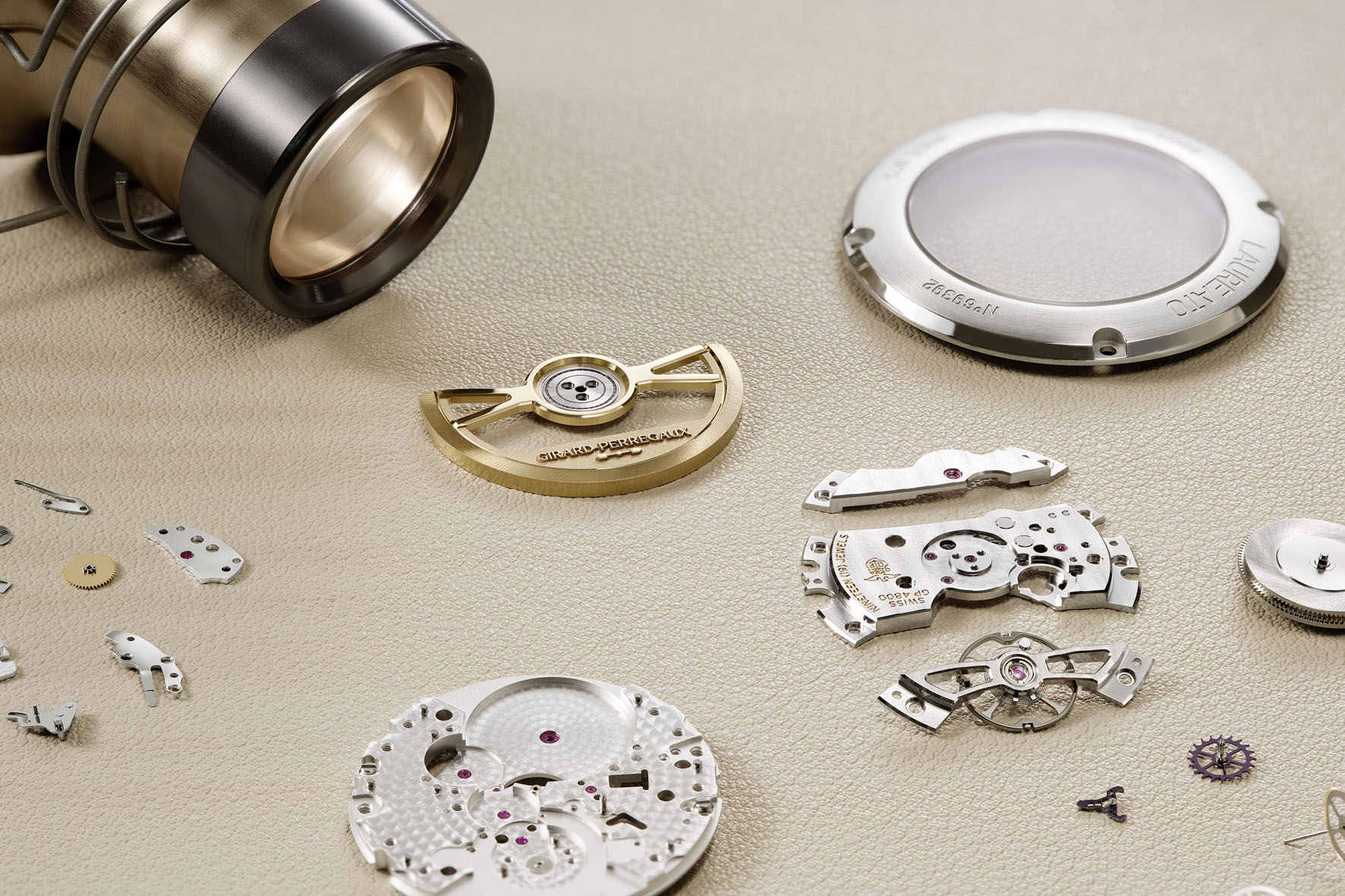
The GP4800 calibre is appreciated for its compactness, thanks to a diameter of 25.60 mm and a thickness of 4.28 mm. It is also versatile, as it has been designed so that additional complications can be added to the movement in the future, thanks to a specially designed layout. Versatility is now a requirement for every calibre, and it is something that an integrated manufacturer such as Girard-Perregaux is able to guarantee without too much difficulty.
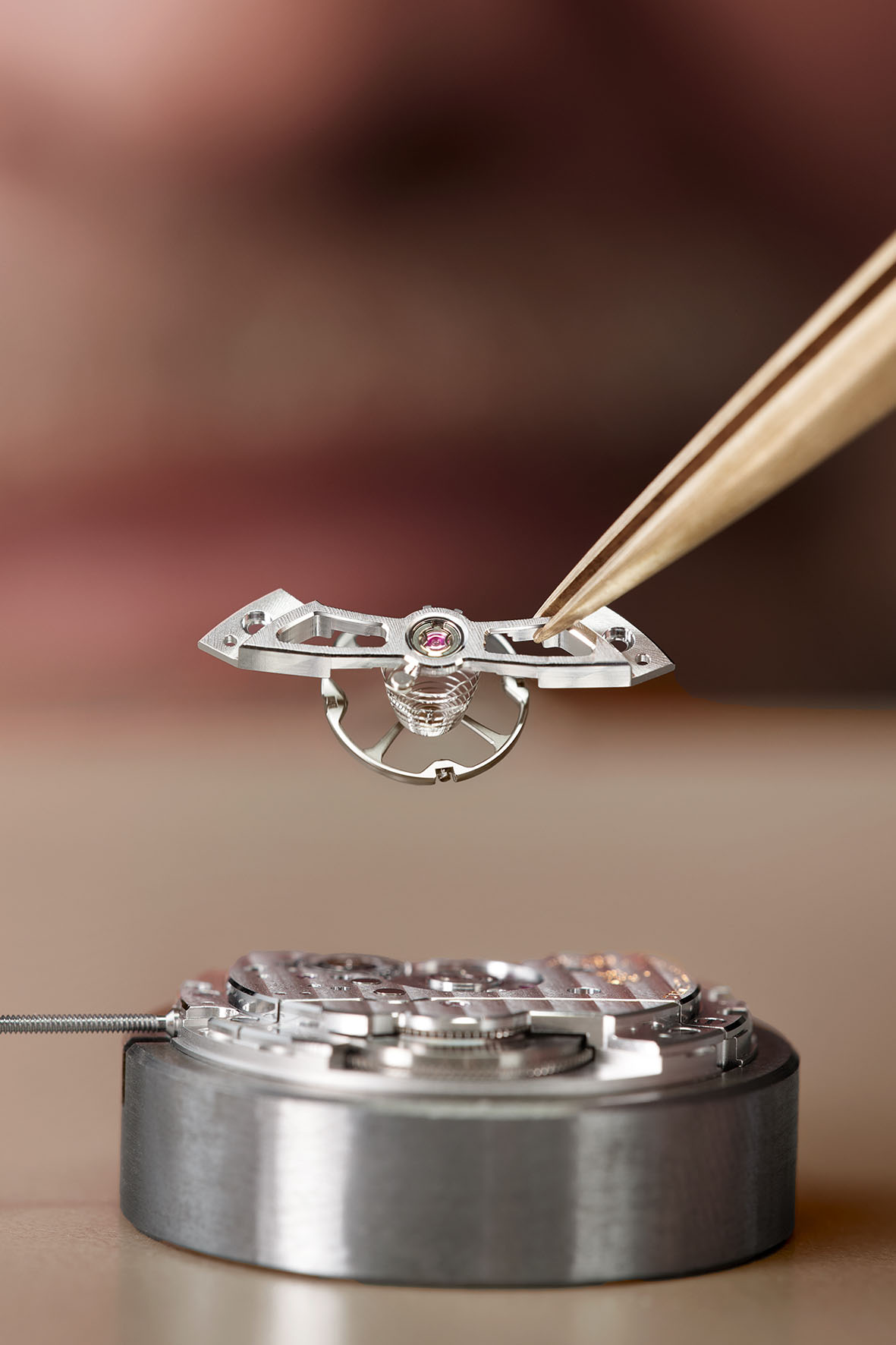
In addition to having a silicon escapement – now the standard for high-quality anti-magnetic movements – the calibre is equipped with a seconds stop function for precise time setting and, above all, a variable inertia balance wheel. As enthusiasts are well aware, this device significantly improves the watch’s running accuracy. In the variable inertia balance wheel, the length of the balance spring is fixed, and the rate is adjusted by means of four white gold screws mounted on the edge of the balance wheel itself. This system allows for finer and more precise adjustments.
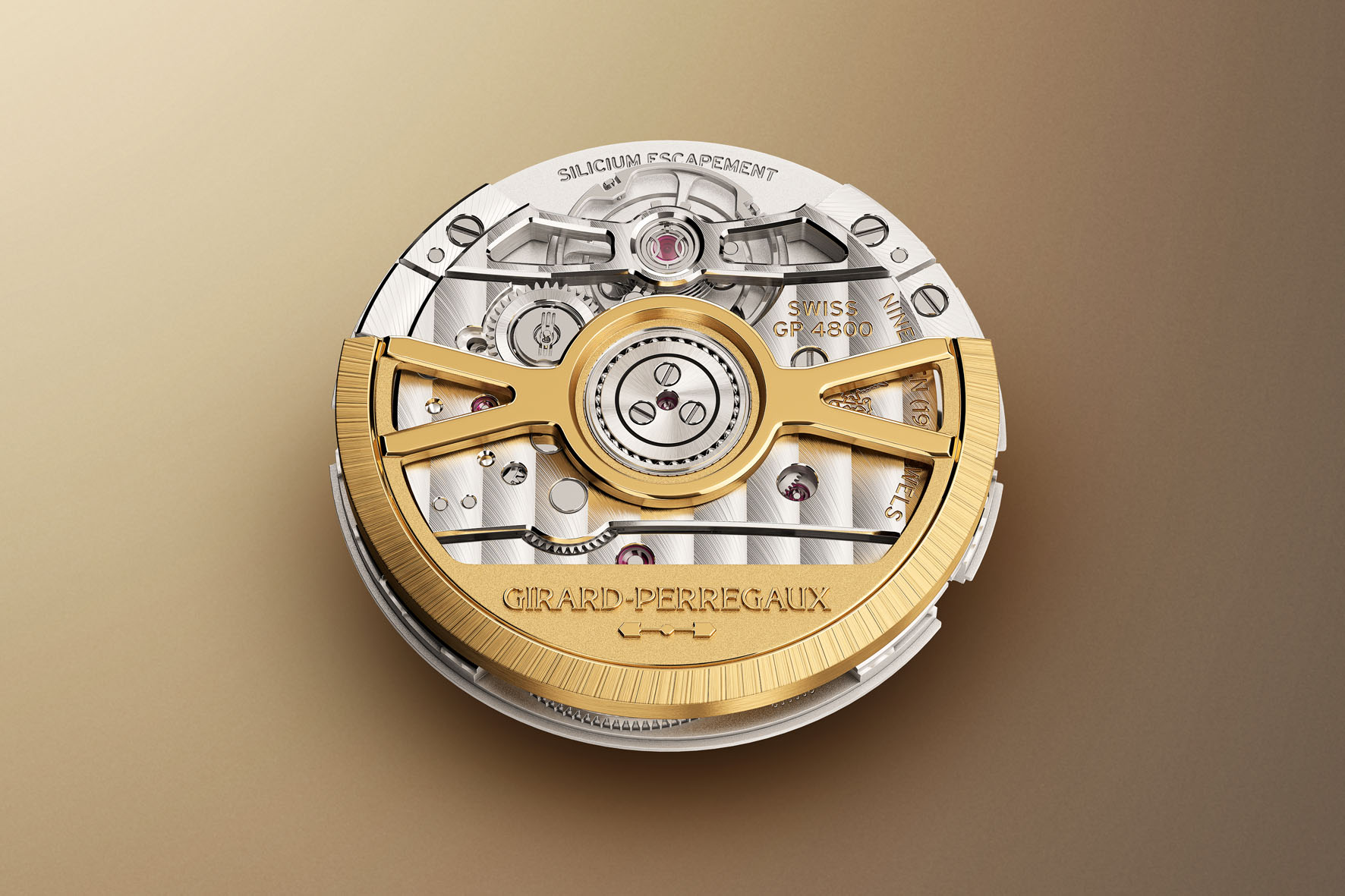
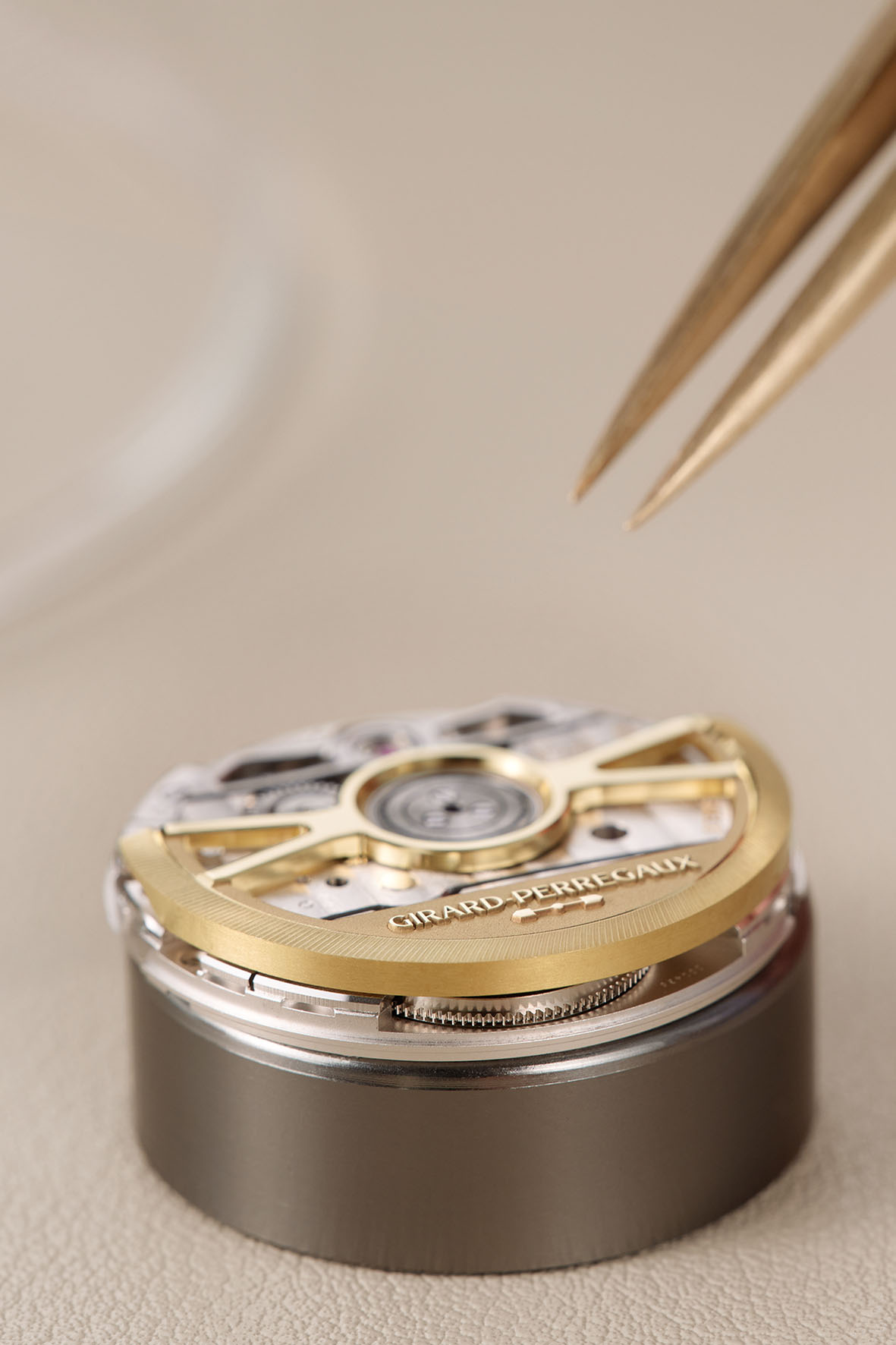
The mainspring generates significant torque, as the balance wheel has an inertia of 8 mg per centimetre. High torque is synonymous with greater precision: this precision also contributes to the power reserve, which is credited with a minimum of 55 hours in the GP4800 calibre. The improvement in performance also extends to the winding system, in which the oscillating weight is mounted on a ceramic ball bearing with a damping system that reduces winding noise and counteracts shocks.
REFINED FINISHES
In addition to these technical refinements, Girard-Perregaux’s commitment to the calibre is also evident in the very high level of its finishes. The rhodium-plated bridges feature gold engravings and are adorned with straight Côtes de Genève, diamond-cut edges and mirror-polished screw heads, which contrast with the visible parts of the sandblasted mainplate. Although hidden, the underside of the mainplate is decorated with a perlage finish; the oscillating weight features polished arrow-shaped motifs and its sides are worked with a combination of sandblasting, snail decoration and traits tirés. Completing the picture are the ball bearing clutch with a soleil finish, the barrel drum decorated with a snail pattern, and the wheels with circular satin finishing, with no fewer than ten different types of finishing present on the calibre.
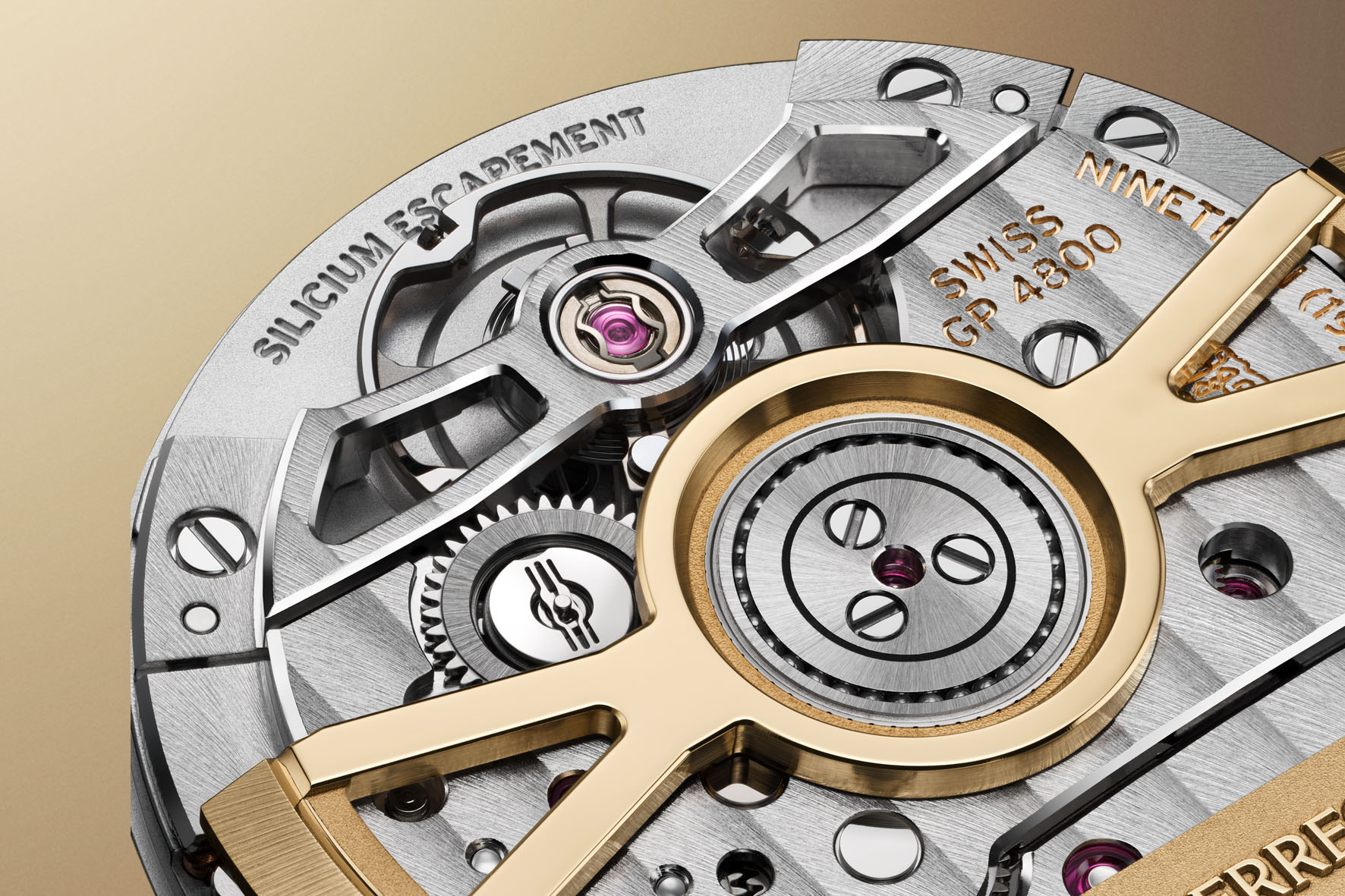
As a testament to Girard-Perregaux’s tradition, beneath the Laureato FIFTY’s oscillating weight – skeletonised and made of 18-carat gold – are three bridges, inspired by the 1867 pocket watch, a distinctive feature of the brand. The balance bridge is fixed at two points for greater stability and is skeletonised, as is the design of the oscillating weight. This is why the latter is visible through the sapphire crystal case back. This does not affect the water resistance of the case, which is 15 bar.
THE ORIGINS OF THE GIRARD-PERREGAUX LAUREATO AND THE EXCELLENCE OF QUARTZ
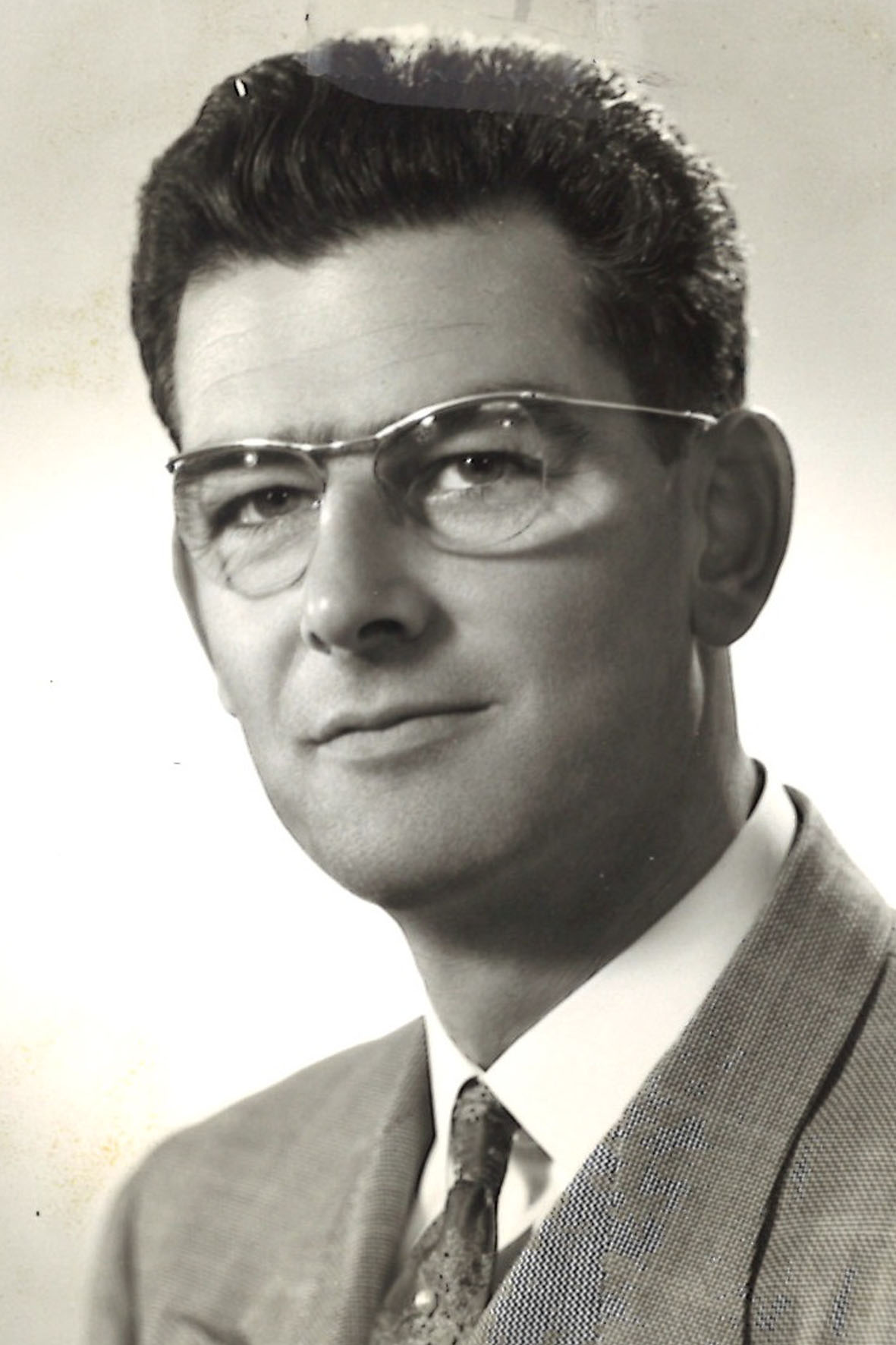
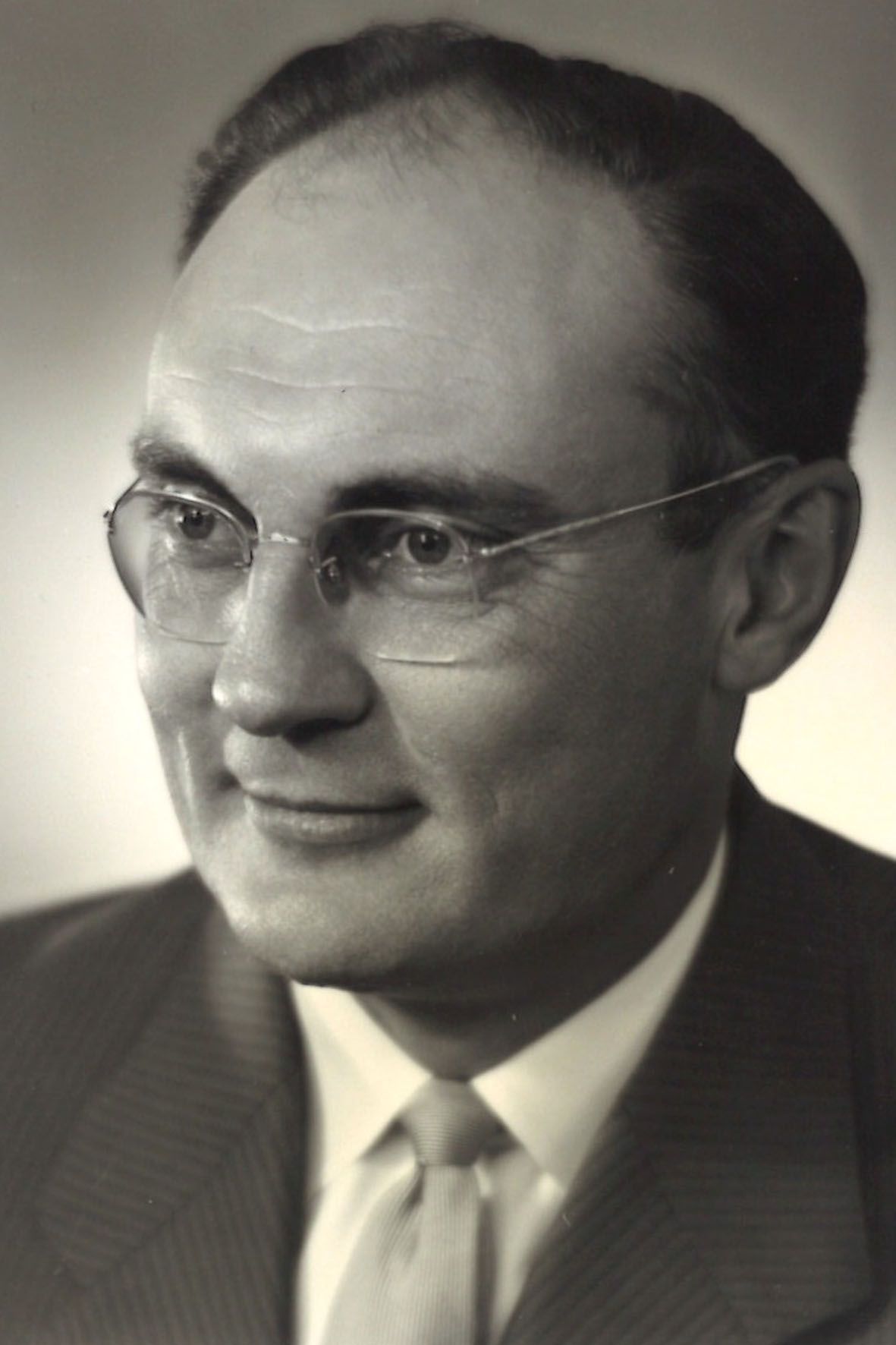
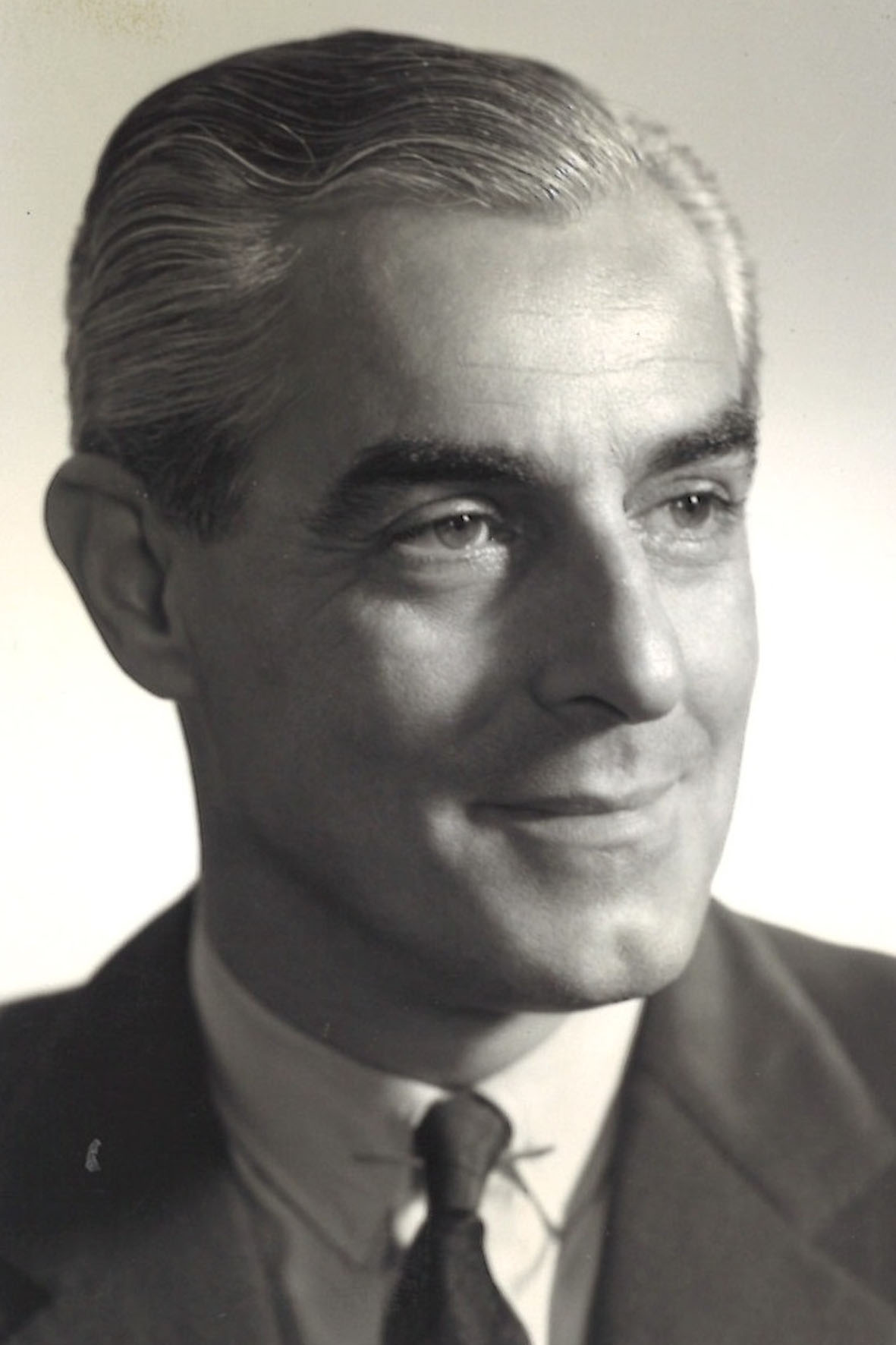
The Laureato FIFTY is truly the worthy heir to a timepiece that, over 50 years, has marked an era and set a style. In a historical context, that of the 1970s, in which watches had to combine precision, elegance and modernity, and under the direction of Jean-Pierre Graef, Charles-Edouard Virchaux and Jean-Edouard Friedrich, Girard-Perregaux strongly believed in the technological advances to be made within the brand in order to perpetuate its growth. They were not satisfied with simply creating a watch, but wanted to create a strong signature with a clear vision: to combine traditional watchmaking savoir-faire with cutting-edge technical and aesthetic innovations. The birth of the Laureato, in 1975, represented the synthesis of all this.
Since its creation, the Laureato has been entirely designed, developed and produced within the walls of the manufacture. Unlike its competitors at the time, which used mechanical movements, the Laureato collection was equipped with an ultra-thin quartz calibre developed in-house by Girard-Perregaux, a choice that demonstrated the brand’s desire to become a technological leader. Thanks to its investments in research and development, in 1971 the brand established the universal frequency for quartz at 32,768 Hz – a standard still used today by the entire watchmaking industry. In 1977, 83% of the patents granted by the COSC andrelated to this technology were held by Girard-Perregaux.
A DESIGN THAT MADE HISTORY
But innovation went beyond quartz. The Laureato’s design was modern, thanks to its tonneau case topped with an octagonal bezel. The bold shapes of the case middle, with octagonal patterns (tetragons and others on different models), were already present before the Laureato: the Deep Diver being a perfect example of this. Launched in 30 mm and then evolving into other sizes, it stood out for its avant-garde shapes that combined form and function and echoed the codes of the sporty-chic watches so popular in the first half of the 1970s. Among these, the integrated steel bracelet. Designed for functionality and comfort, it combined two finishes – satin and polished – creating an elegant contrast and a unique play of light.
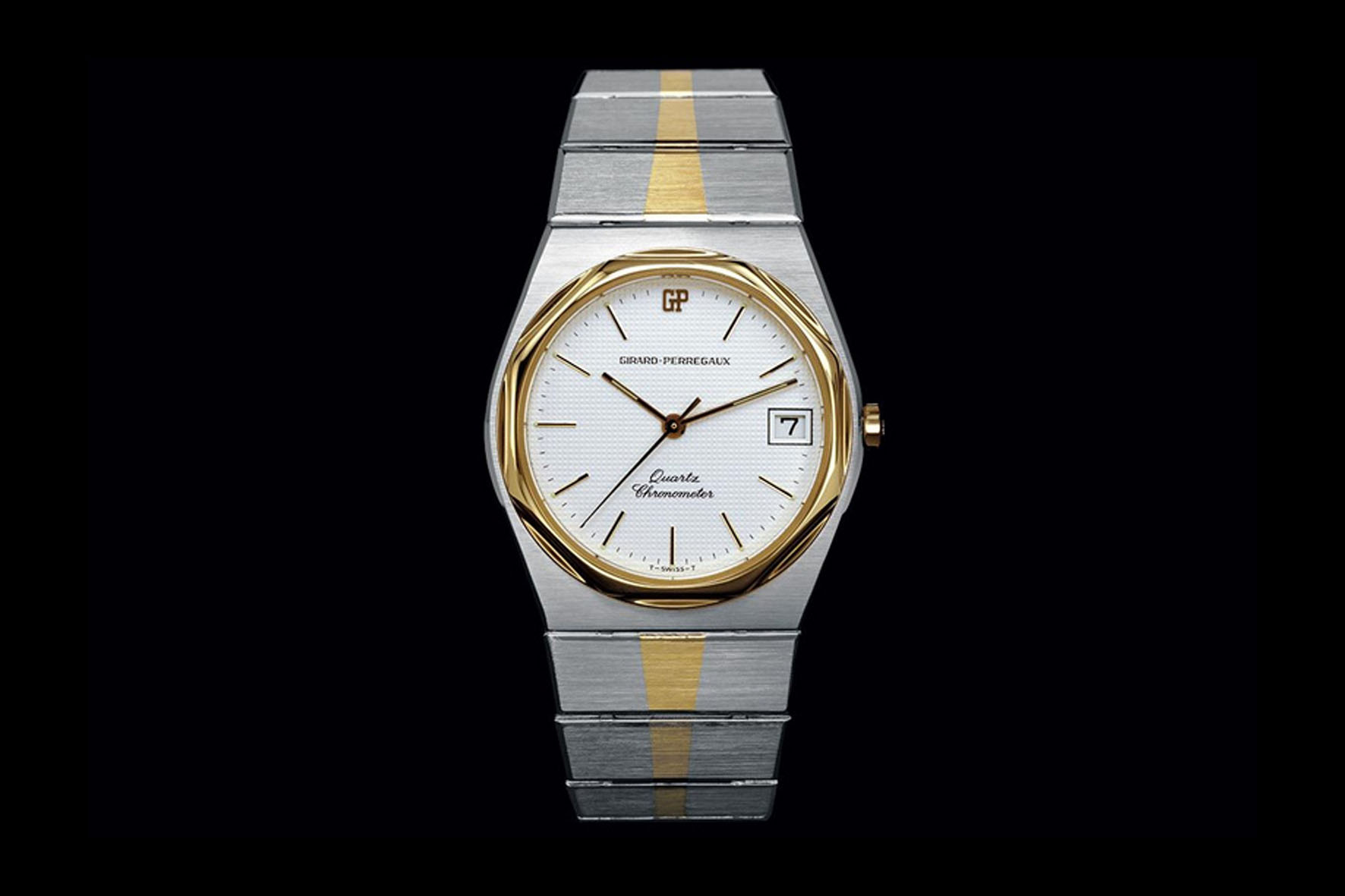
Let’s take a look at the octagonal bezel. Recognisable at first glance, it represented much more than an aesthetic detail; rather, it was a key element of identity, a graphic signature that, like the Three Bridges, was deeply rooted in the brand’s DNA. The desire to break with the conventional roundness of traditional watch design, inaugurated by the Deep Diver, continued with the Laureato – whose bezel was so perfectly adapted to the tonneau case that forgetting its presence was easy.
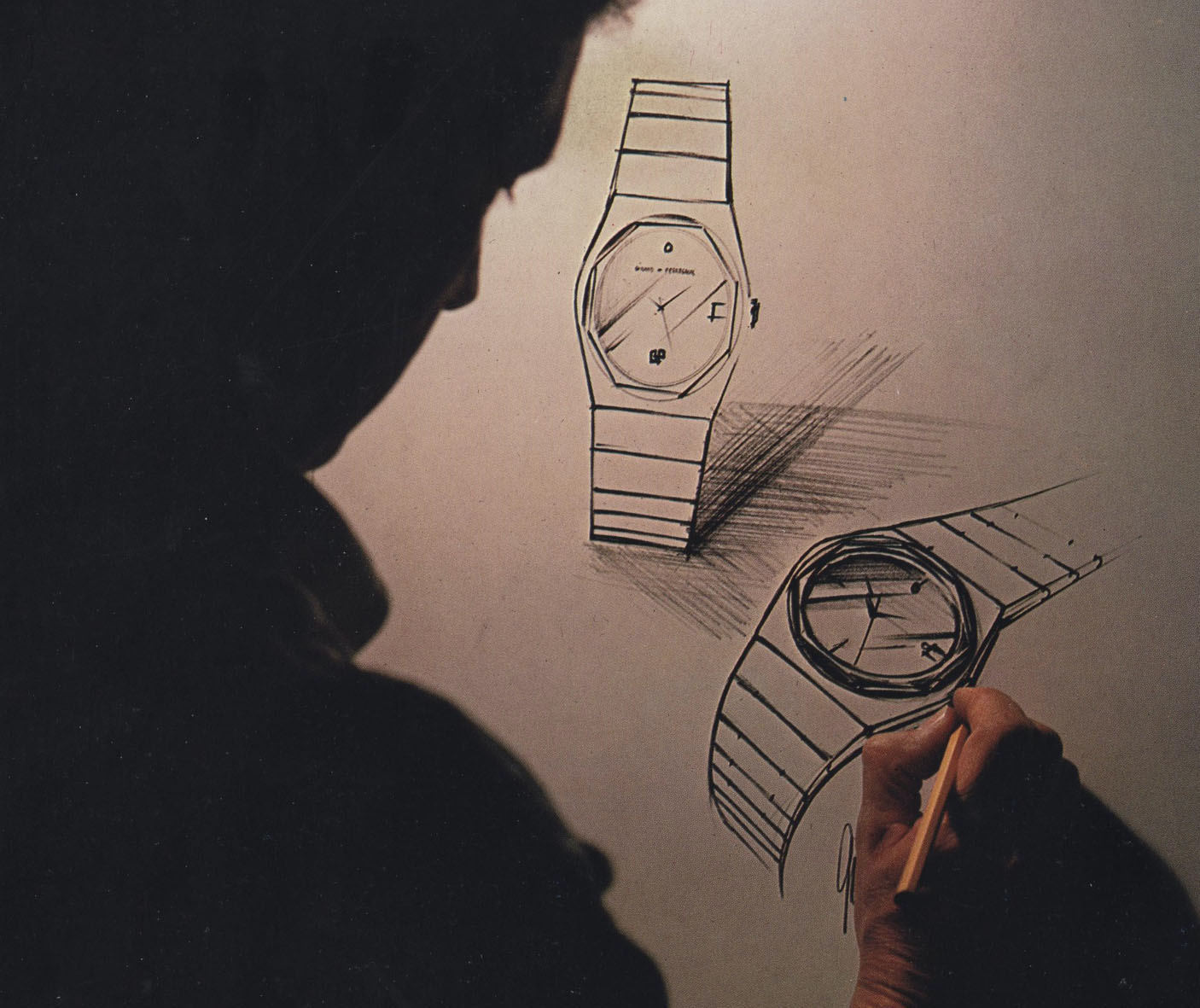
Far from the screws and sharp angles of the Royal Oak, the Laureato’s bezel exuded a more delicate and subtle refinement. Set in a circle, its upper surface was slightly domed, reminiscent of the rounded polish applied to the tourbillon bridge. This visual contrast between angles and controlled curves gave the watch a balanced and harmonious, timeless appearance. Each facet of the watch captured the light differently, accentuating its sophisticated nature. It expressed a vision of design and graphic elegance faithful to the avant-garde spirit of Girard-Perregaux.
LAUREATO: EVOLVING WHILE REMAINING TRUE TO ONESELF
Finally, with regard to the finishes of the case and movement, it is worth remembering that they represented the very essence of fine watchmaking. From this point of view, the Laureato met the highest standards, both then and now. The steel is treated uncompromisingly as a precious metal, combining polished, brushed and satin-finished surfaces: a demanding approach that made it particularly difficult to work with, as it is much harder than gold. That is why it is said that the first prototypes were made in white gold to facilitate the work of the development teams. And that is why the result was a steel watch that was more expensive than some of its gold competitors.
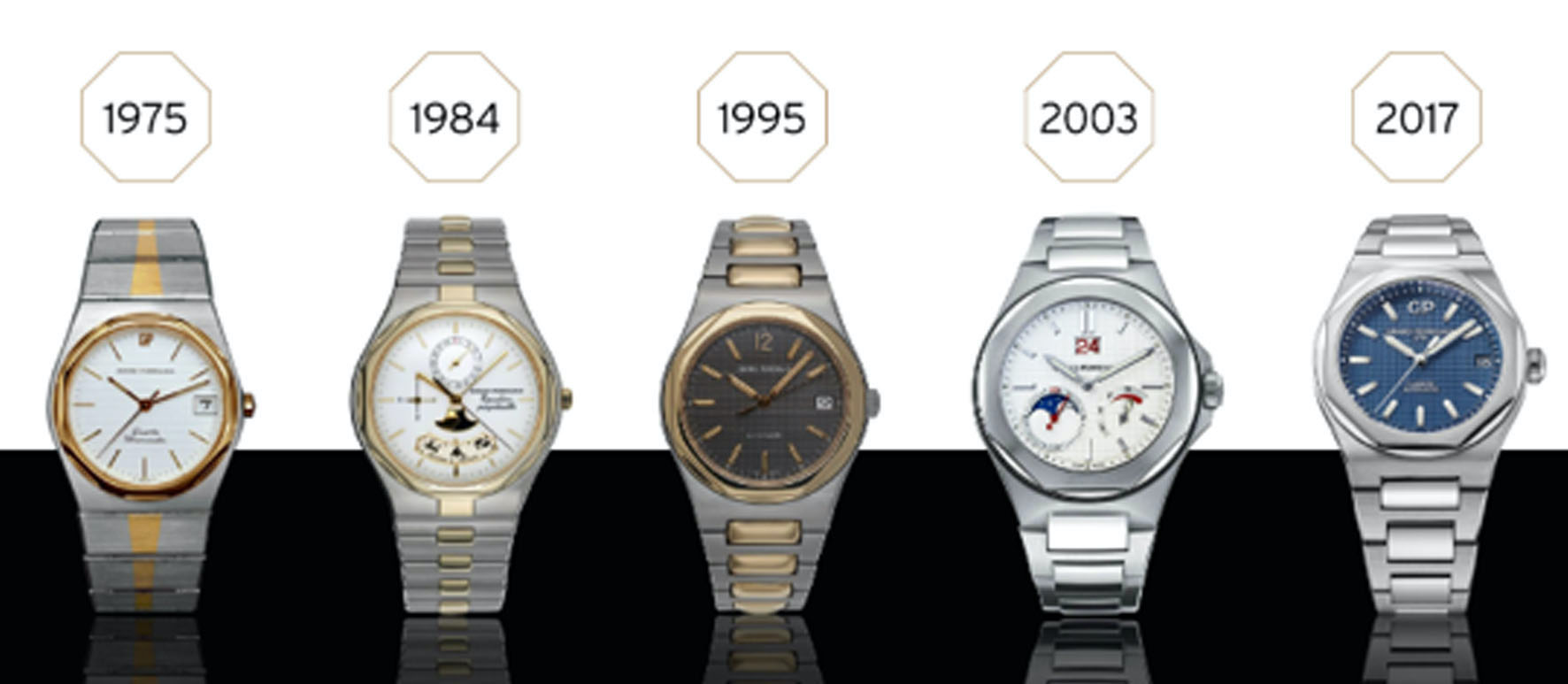
Over the years, the Laureato continued to evolve while remaining true to its strong identity. In the 1980s, the collection was enriched with complications such as the equation of time, further increasing the complexity and appeal of this model. The arrival of the 3100 automatic movement in 1995, and the evolution of the design towards a more sporty character in 2003, testify to the watch’s ability to adapt to the passing of time without ever losing its essence. The Laureato has stood the test of time, and today stands as one of the great names among wristwatches released in the 1970s.
By Davide Passoni